

1, 2, 3, Kick (Second Chorus)
L.F. Randolph
Questions abound about the "care and feeding" of modern four-stroke engines. This article won't answer everything, but it will help bridge the gap from the two-stroke for the first-time four-stroke engine owner.
Introduction
Most typical modelers are not deeply concerned with the exact inner workings of their engines. Instead, they are more interested in a good installation and the necessary maintenance procedures that will provide trouble-free operation. The ideal engine is one that performs like the family car: you start it, and it runs.
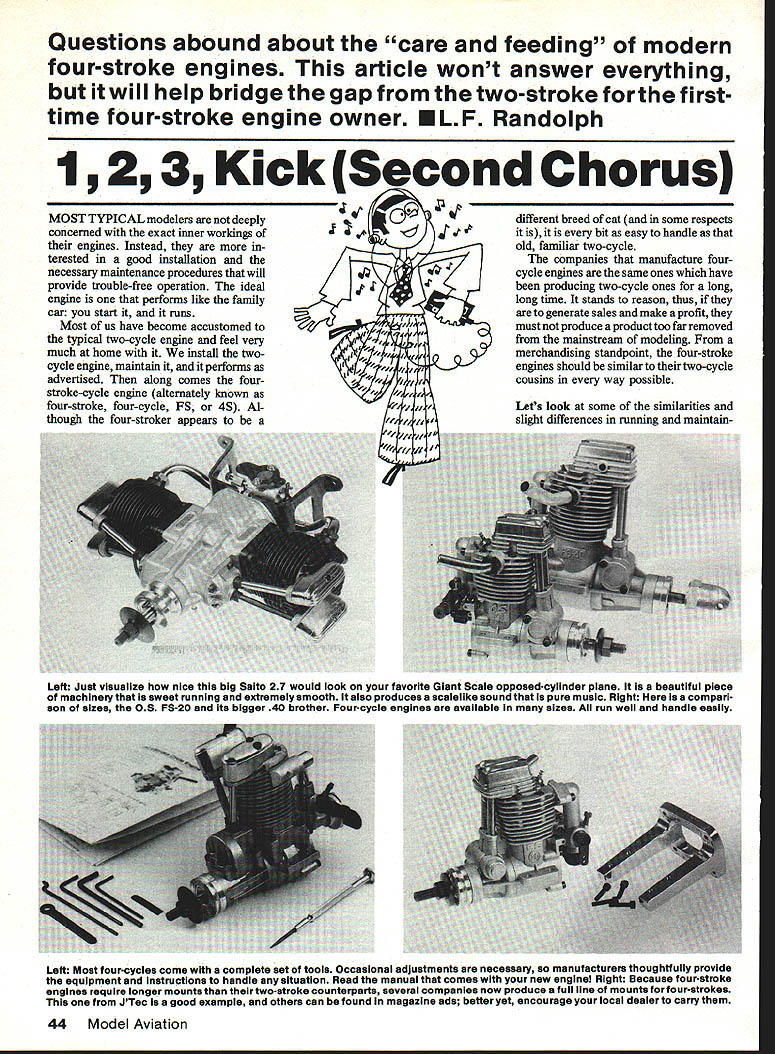
Most of us have become accustomed to the typical two-cycle engine and feel very much at home with it. We install the two-cycle engine, maintain it, and it performs as advertised. Then along comes the four-stroke-cycle engine (alternately known as four-stroke, four-cycle, FS, or 4S). Although the four-stroker appears to be a different breed of cat (and in some respects it is), it is every bit as easy to handle as that old, familiar two-cycle.
The companies that manufacture four-cycle engines are the same ones which have been producing two-cycle ones for a long, long time. It stands to reason, thus, if they are to generate sales and make a profit, they must not produce a product too far removed from the mainstream of modeling. From a merchandising standpoint, the four-stroke engines should be similar to their two-cycle cousins in every way possible.
Let's look at some of the similarities and slight differences in running and maintaining.
Fuel tank, muffler and general cleanup
- The fuel tank location for both types is the same — center of the tank in line with the center of the carburetor.
- Muffler pressure to the tank can be used with the four-cycle engine, if desired, just as it can with two-cycles.
- After flying sessions, the four-stroke engine should be wiped clean and lubricated with a good-quality oil (automatic transmission fluid is one of the best). This is a good practice with any model engine.
Mounting and physical differences
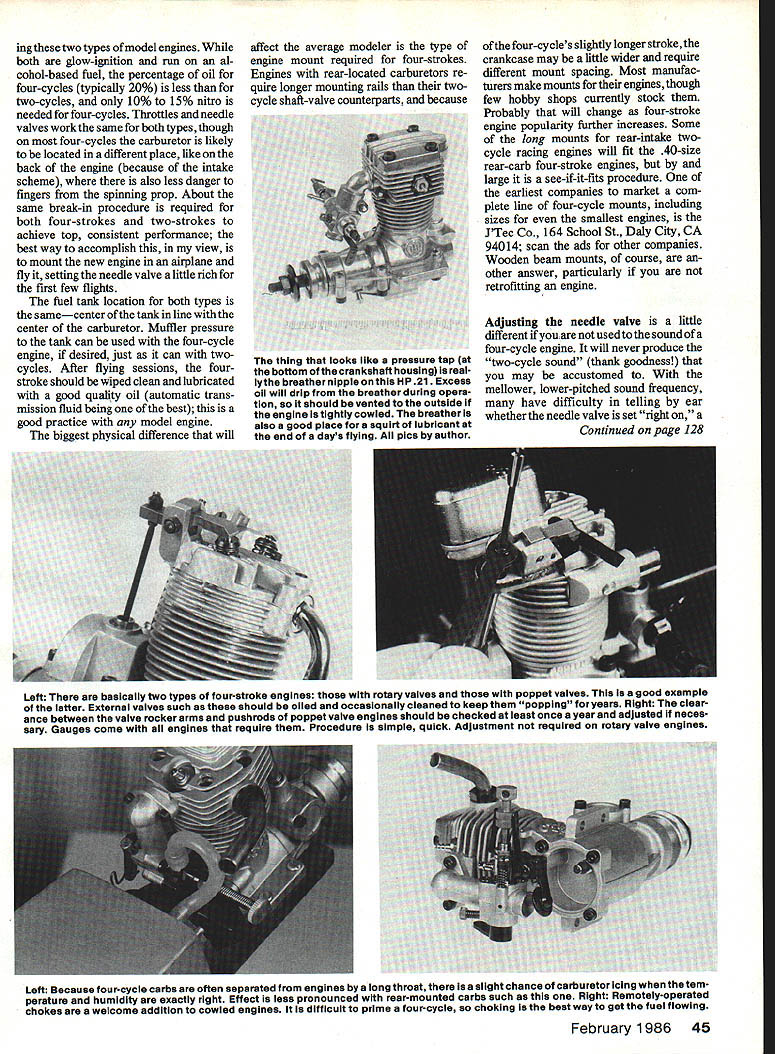
The biggest physical difference that will affect the average modeler is the type of engine mount required for four-strokes. Engines with rear-located carburetors require longer mounting rails than their two-cycle shaft-valve counterparts, and because of the four-cycle's slightly longer stroke, the crankcase may be a little wider and require different mount spacing.
Most manufacturers make mounts for their engines, though few hobby shops currently stock them. Probably that will change as four-stroke engine popularity increases. Some of the long mounts for rear-intake two-cycle racing engines will fit the .40-size rear-carb four-stroke engines, but by and large it is a see-if-it-fits procedure.
One of the earliest companies to market a complete line of four-cycle mounts, including sizes for even the smallest engines, is the J'Tec Co., 164 School St., Daly City, CA 94014; see the ads for other companies.
Wooden beam mounts, of course, are another answer, particularly if you are not retrofitting an engine.
Needle-valve adjustment and running
Adjusting the needle valve is a little different if you are not used to the sound of a four-cycle engine. It will never produce the "two-cycle sound" (thank goodness!) that you may be accustomed to. With the mellower, lower-pitched sound frequency, many have difficulty in telling by ear whether the needle valve is set right — a bit lean, or a bit rich. Most seem to arrive at a too-lean setting by ear, and that isn't good.
Actually, the exhaust provides the best clue to a proper setting the first few times. Set the needle valve so there will be a small amount of visible smoke, and the setting will be very close to correct. To get exact, consistent, peak rpm from a four-stroke engine, many set the needle valve with the aid of a tachometer.
Do not run four-stroke engines lean or with less than 20% oil in the fuel.
Starting
On the subject of running four-strokers, it is interesting to note that one manufacturer suggests flipping the prop backwards against the compression for starting. In their case, it works. In fact, my very first four-stroke engine was started by flipping the prop backwards. Following instructions, it started on the very first flip.
Traditional starting by hand-flipping is no problem with four-cycle engines. However, the same starters used on two-cycle engines are just as effective for four-strokers. Although I have heard of backfires kicking props loose on the larger engines (usually the result of having the needle valve set too lean), I have never experienced the problem. An extra quarter-turn of the prop nut seems to be good insurance.
Propellers
Manufacturers usually suggest a range of propellers for each engine, but the ideal prop for you to use is the one that is best for each airplane/engine combination. Maximum power of a four-stroke engine is produced at a lower rpm than for a two-stroker, and this and other factors translate to needing a bigger prop and/or one with more pitch than for a comparably sized two-stroker. The amount of prop thrust put out by the low-revving engine may amaze you.
The performance figures given by engine reviewers in some magazines—those showing peak power output with a specific prop at a specific rpm—if developed from bench running, don't tell the whole story for practical usage. Bench running doesn't show the effects of the prop's unloading while in flight. The best thing is to try flying with different props until the one best suited to the airplane is found. A key thing to remember is that the thrust of the propeller gives the airplane the "go" to fly; the engine simply turns the propeller.
Crankcase breather and cleanup
The last item of difference is the four-stroke engine's crankcase breather. This is not a pressure tap. Since the crankcase is not part of the carburetion system, it must be vented to relieve internal air pressure as the piston goes up and down. A bit of oil drains from the breather, so it is a good idea to vent it to the outside of the airplane if the engine is cowled.
The breather vent is also a good place for a shot of oil after each flying session to give the bearings a little more protection. The breather should be part of your clean-up procedure.
Conclusion
Four-cycle engines are here to stay. No doubt they will become as commonplace as two-cycle engines in the future. If you don't have one, get one. You'll love it.
Transcribed from original scans by AI. Minor OCR errors may remain.

