
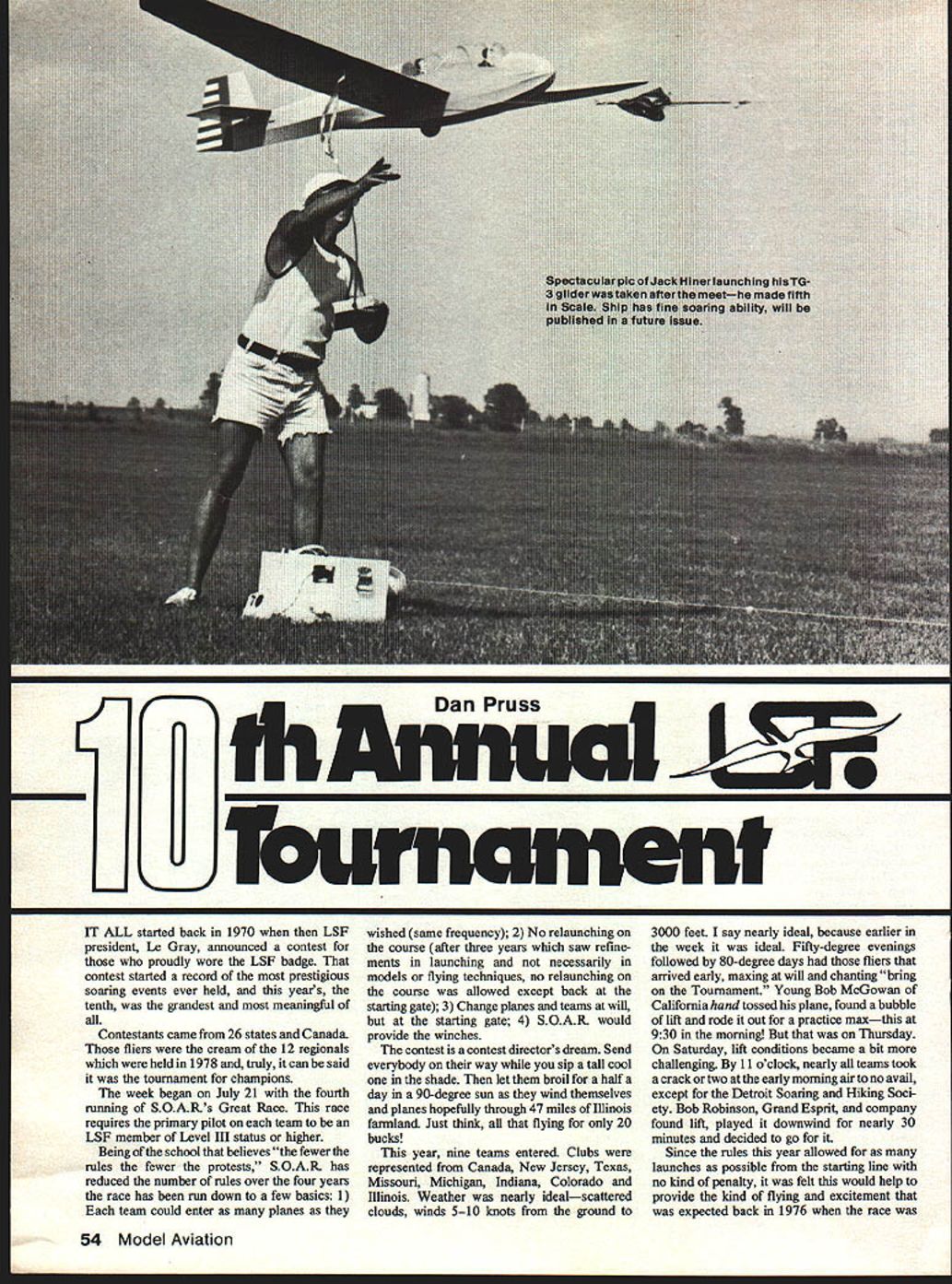
10th Annual LSF Tournament
Dan Pruss
Background
It all started back in 1970 when then-LSF president Le Gray announced a contest for those who proudly wore the LSF badge. That contest began a record of the most prestigious soaring events ever held, and this year's tenth was the grandest and most meaningful of all.
Contestants came from 26 states and Canada. Those fliers were the cream of the 12 regionals held in 1978 — truly, the tournament for champions. The week began on July 21 with the fourth running of S.O.A.R.'s Great Race.
S.O.A.R.'s Great Race
The Great Race requires the primary pilot on each team to be an LSF member of Level III status or higher. S.O.A.R., believing that "the fewer the rules the fewer the protests," reduced the number of rules over four years down to a few basics:
- Each team could enter as many planes as they wished (same frequency).
- No relaunching on the course (relaunching was allowed only back at the starting gate).
- Change planes and teams at will, but at the starting gate.
- S.O.A.R. would provide the winches.
The contest is a director's dream — send everybody on their way while you relax in the shade, then let them work for hours in the sun through miles of farmland. This year nine teams entered, representing clubs from Canada, New Jersey, Texas, Missouri, Michigan, Indiana, Colorado, and Illinois. Weather was nearly ideal: scattered clouds and winds 5–10 knots from the ground to 3,000 feet.
Early in the week conditions were excellent; pilots arrived early, maxing at will. On Saturday lift became more challenging. By 11:00 a.m., nearly all teams had tried the early air with little success, except for the Greater Detroit Soaring & Hiking Society. Bob Robinson, Grand Esprit, and company found lift, played it downwind for nearly 30 minutes and decided to go for it.
Because the rules allowed unlimited launches from the starting line, teams could repeatedly relaunch and hunt for lift to get onto the course. What developed was super-efficient teamwork in the art of relaunching rather than the envisioned gaggle-of-sailplanes-in-lift sprint.
After Robinson became a speck in the sky, winches were kept busy. Robinson was long gone and eight other planes tried to find lift for about the next hour; all found it at one time or another. Some tried the course only to end up barely on the first leg, while others found a patch and went on.
At one point all nine teams were in the air. Detroit relaunched with Pat Flinn flying their Astro Maggie. S.O.A.R. had Stan Watson flying his original design, Pegasus, a 14-foot ship that eats lift. By 12:20 Detroit was again on its way; S.O.A.R. followed, then Fort Wayne with Bob Steele and Scott Prindle. Five birds were strung out on the course with less than a quarter-mile separating them. After 37 miles and 34 minutes, the Fort Wayne club (L.O.F.T.) landed. S.O.A.R. and Detroit worked in each other's lift and overtook each other several times.
Several teams had only short official flights: Gerry Bower and John McMillan of Ontario made several attempts but only one official flight; Tom Williams and Doyle Modesto of Texas logged 1.25 miles for their only official flight; Jerry Epps of Chicago's S.A.C. Club went 2.0 miles; Skip Miller and the Renaud family made three attempts for a best of 1.8 miles. The St. Louis Eagles (Ken and Helen Olson) played the lift all day but often ran out of it as they approached the starting gate.
At the seven-mile mark, G.D.S. & H.S. (Detroit) appeared to be in trouble as Pat Flinn had his Astro Maggie at telephone-pole height while S.O.A.R.'s Pegasus was high. After six sessions of working lift from the treetops, the Pegasus finally lost it. Detroit then took over the course and continued on. Eventually Detroit went past the 21-mile mark as receiver batteries gave out despite being a long-range pack. The Greater Detroit Soaring & Hiking Society won with a distance of 21.2 miles. S.O.A.R.'s 14 miles were good for second place, and the Millstone Valley Silent Flyers went 8.7 miles for third.
Sunday — Last-Chance Qualifiers
Sunday, July 22, hosted a contest for last-chance qualifiers. The same qualifying tasks as the previous year were used for those who wanted another opportunity to qualify.
The fuel crunch that year affected the contest circuit; many modelers cancelled, leaving several spots open. LSF president Gordon Pearson announced the Last Chance contest would still be a full contest. Because of many no-shows for the tournament, all Last Chance fliers could fly in the main tournament if they could adjust to the slots open by frequency. This generated cheers from those who had feared being spectators on the main days.
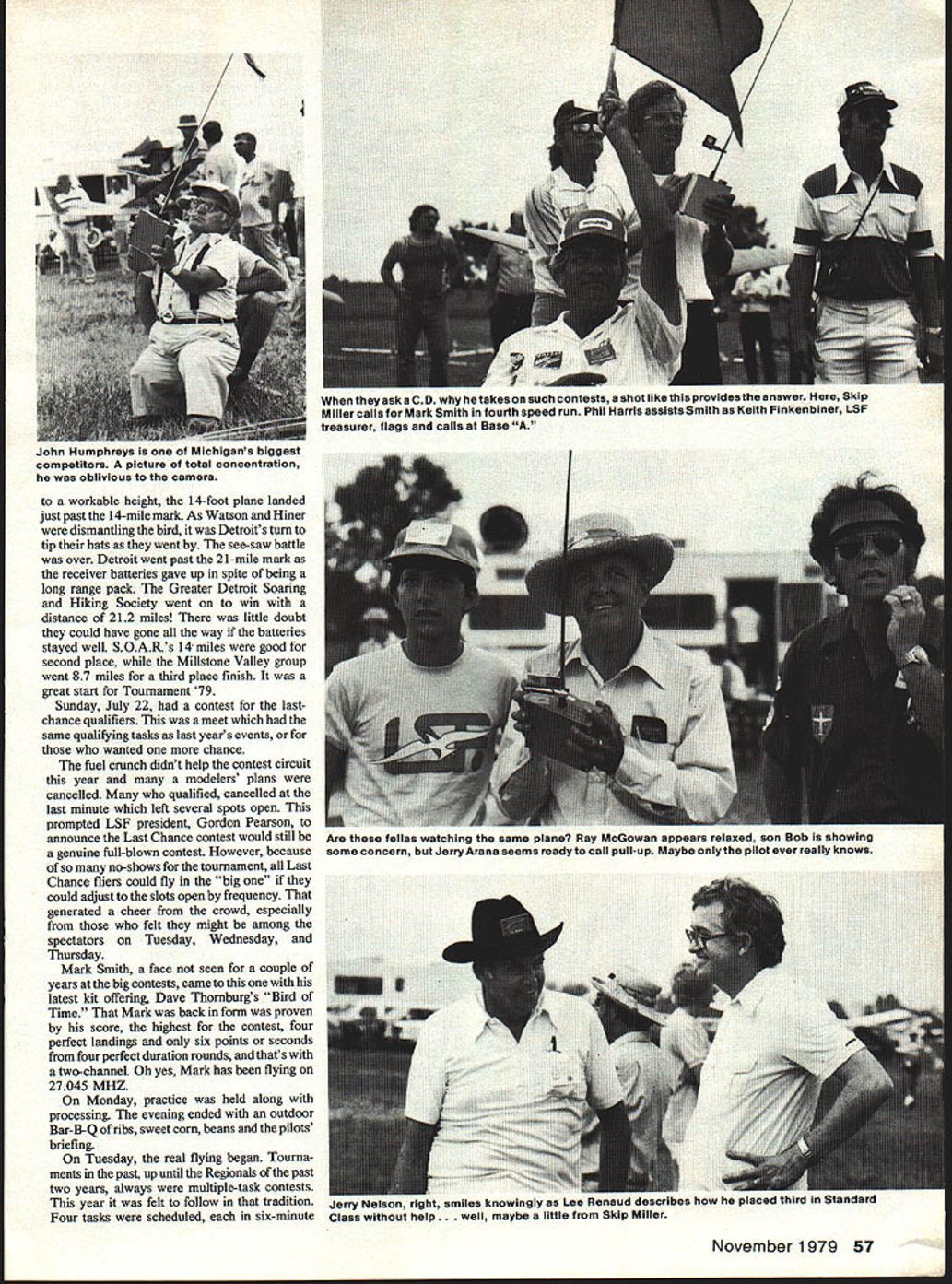
Mark Smith, returning to the big contests with Dave Thornburg's "Bird of Time" kit, scored highest in the Last Chance contest: four perfect landings and only six points (seconds) from four perfect duration rounds, flown on a two-channel model at 27.045 MHz.
Practice and Opening
Monday was practice and processing day. The evening ended with an outdoor barbecue of ribs, sweet corn, beans, and the pilots' briefing.
Tournament Tasks and Scoring
On Tuesday the main flying began. Following tradition, four tasks were scheduled, each in six-minute rounds:
- Duration rounds.
- Four-lap speed-distance runs (four 150-meter laps).
- Scoring was done by computer, thanks to Ken and Helen Olson.
The speed-distance task was flown first each morning. Chris Adams (California) turned 34 seconds for the four 150-meter laps; Warren Tiahrt matched that time. Only seven others went under 40 seconds.
The next rounds were duration. Dwight Holley recorded a perfect 6:00 and a 47-point landing (48 being perfect). His son Hoyt also had a perfect max and a 30-point landing. Skip Miller had a six-minute max but his perfect landing resulted in zero because his plane flipped.
At the end of the first day Dwight Holley led Unlimited, Hoyt Holley led Standard. Rex Powell (Alabama) topped Two Meter and was fifth overall. Tim Renaud (California) led Jr./Sr. and was 19th overall.
Wednesday and Mid-Tournament
On Wednesday the wind shifted, moving the speed/distance course and changing the challenge. Ray Hayes (Indiana) turned the two best speed times that day: 36.5 and 35.0, giving him the overall lead in speed ahead of Miller and Adams.
Round six duration was won by Noal Rossow (Michigan) with 5:59/47, putting him on top in Two Meter. Overall leader remained Dwight Holley, 12 points ahead of Skip Miller, who had worked up from 12th place on the first day. First in Standard remained Hoyt Holley, ahead of Jerry Arana and Ray Hayes.
Ray Hayes continued to dominate speed, turning the fastest time of the meet in round seven with 32.6 seconds (four 150-meter laps). Miller was the only other competitor under 40 seconds that morning with 37.2 seconds. Holley, needing a respectable run, recorded 40.5 seconds, leaving him 72 points behind Miller in that task.
Round eight offered surprises for the final standings. Jeff Mrlik won the round with 6:00/45. Holley outscored Miller in that round, 6:01/41 to 5:56/42. Fifteen of the top 20 competitors maxed that round.
Final Results and Awards
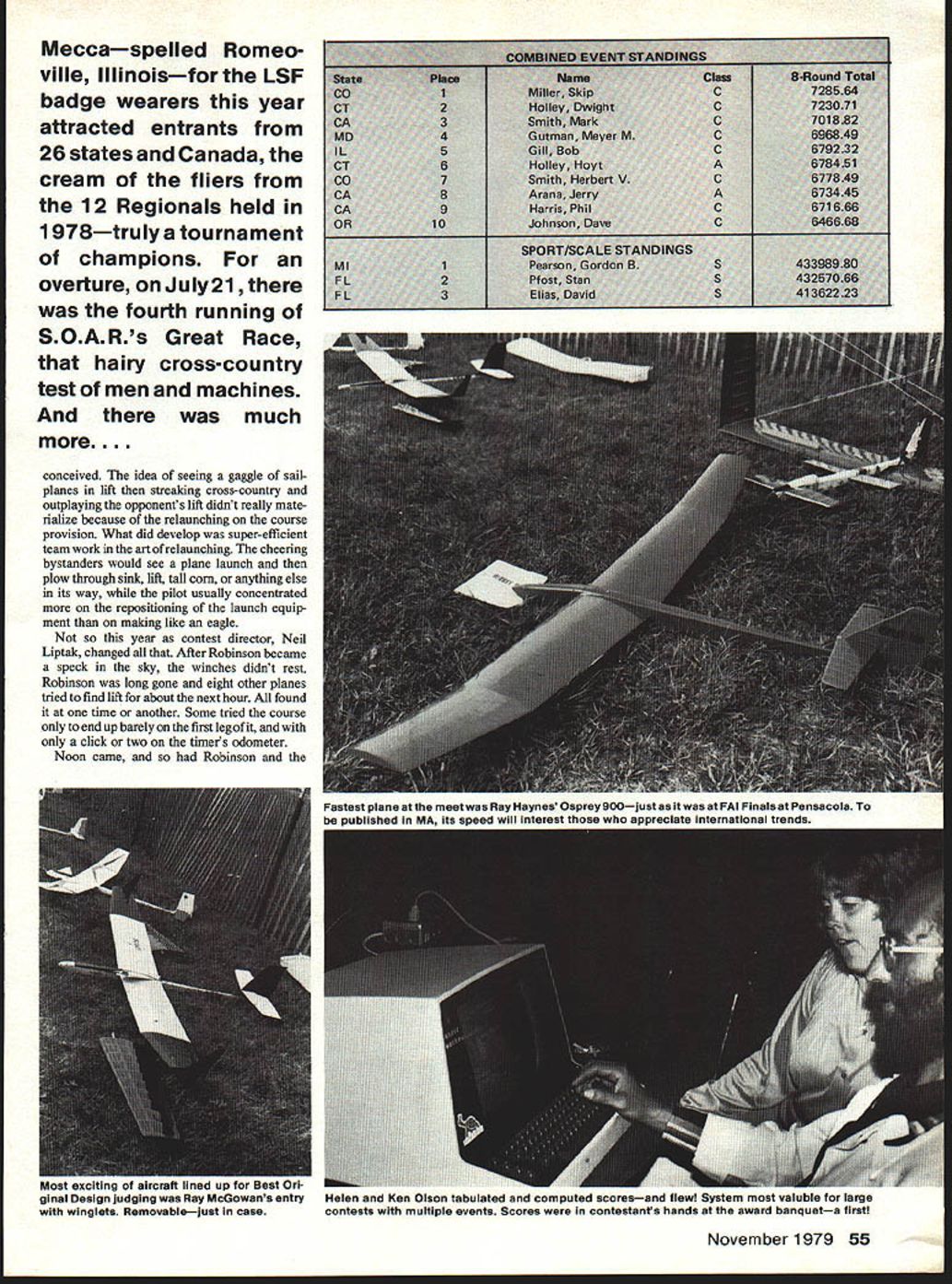
LSF Tournament '79 concluded about 2:00 p.m. Skip Miller, who had won the AMA Nationals and the World Championships in 1977, added another prestigious victory: Grand Champion of the 1979 LSF Tournament.
Other notable results:
- Hoyt Holley — Standard class winner and sixth overall.
- Tim Renaud — 14th overall and first in Jr./Sr.
- Paul Weedeking — edged out Noal Rossow in Two Meter.
- Gordon Pearson (LSF president) — Scale event winner.
The banquet was a white-table-cloth affair. Awards presentation was almost outdone by $3,000 worth of prizes. The Renaud family won two radios and a kit (items not listed in Cox Hobbies catalogs). To avoid embarrassment, Lee Renaud raffled off the radios for a dollar a chance, raising $450 for the LSF treasury.
Tournament Shortlines
- At least 35 different models (not counting scale) were flown.
- Four fliers flew on 27 MHz with no interference.
- Meyer Gutmann's quarter-scale Jantar drew attention and stopped activity every time it flew.
- Michigan had 22 contestants; California had 16.
- Scale had 14 pre-registrations; ten flew.
- Class breakdown: Standard — 26; Unlimited — 64; Two Meter — 10.
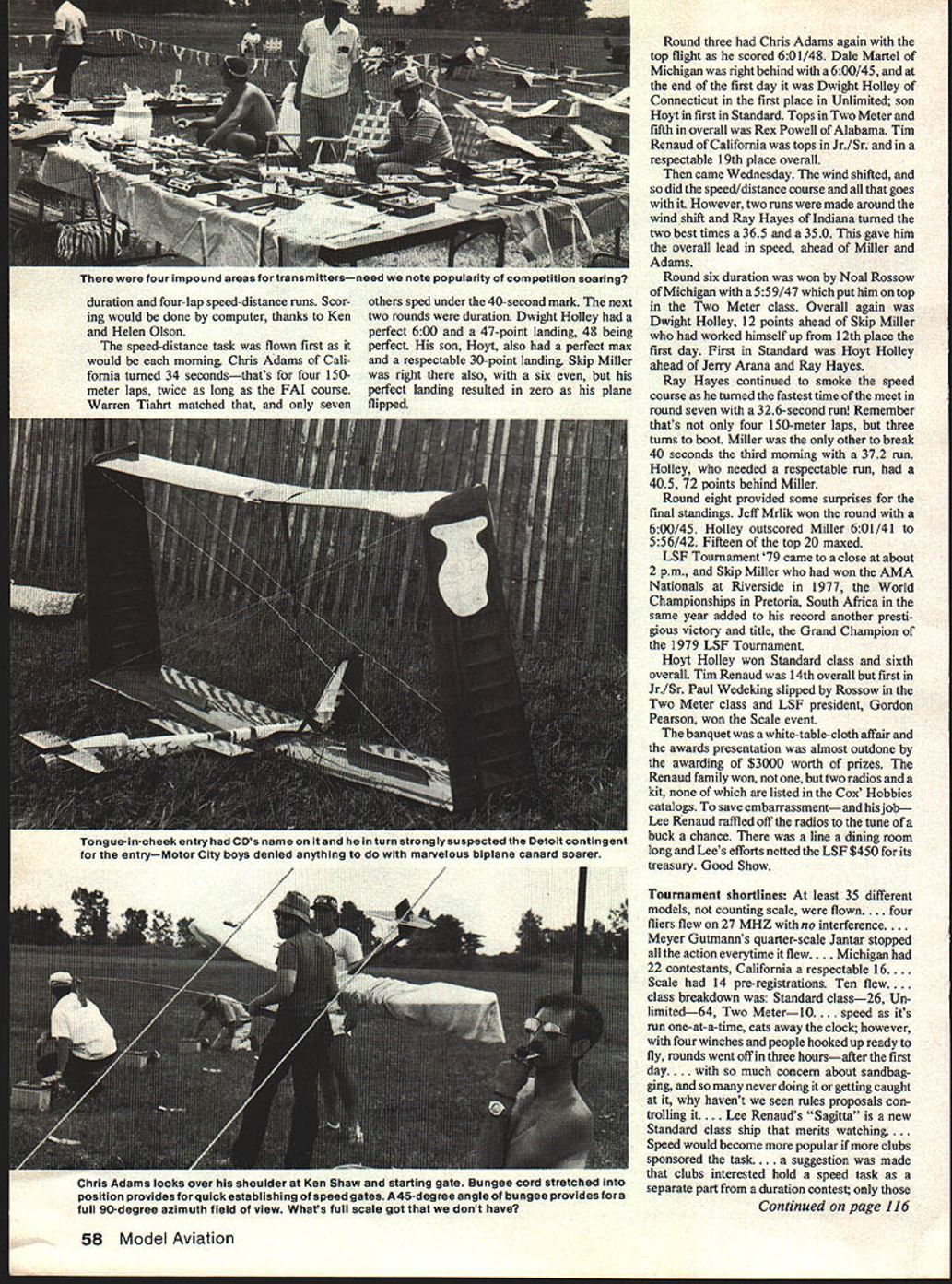
- Speed (run one-at-a-time) required multiple winches and ready teams; rounds typically ran three hours after the first day.
- With concern about sandbagging, some suggested rules to control it, but none were adopted at the event.
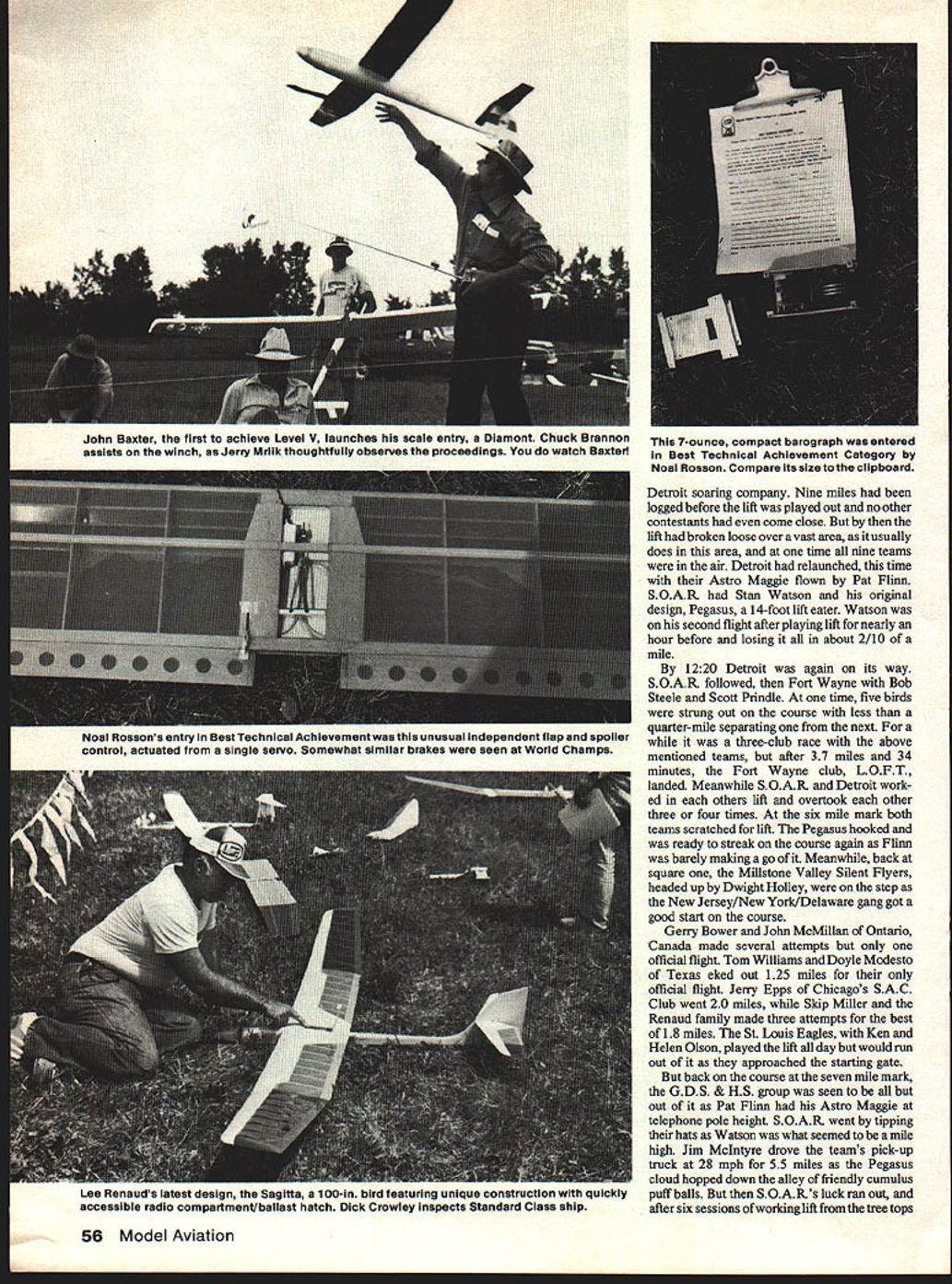
- Lee Renaud's "Sagitta" is a new Standard-class ship worth watching.
- Speed might become more popular if more clubs sponsored the task. A suggestion was made to hold speed as a separate event from duration so only interested fliers would participate and scoring could be separate.
Competitors and Team Awards
Competitors by level:
- I — 12
- II — 16
- III — 30
- IV — 46
- V — 4
Best team effort was awarded to the Rocky Mountain Soaring Association: Skip Miller, Herb Smith, and Dick Crowley.
Smith's Invader won best original design (see Model Aviation, August 1979 issue).
Transcribed from original scans by AI. Minor OCR errors may remain.

