
10th Electric Championships
Larry Jolly
With all the articles and magazine coverage electric-powered flight has received recently, one would assume that it is something new. Only recently has the average sport flier discovered the benefits of electric power, but for close to 11 years there have been dedicated modelers in Southern California experimenting and perfecting the various applications of electric motors for flight.
February 4 and 5, 1984 marked the tenth anniversary of the Electric Championships. Not only has this electric competition run consecutively for 10 years — no small achievement in itself — but it has grown to the point of being the premiere gathering for electric enthusiasts. Nowhere else in the world does any group assemble to compete in 13 separate events in three different categories. The contest runs annually in January or February and draws people from all over the United States. In years past, entrants have even traveled from Europe to compete.
This year's competition drew 79 competitors, some traveling from as far away as Alaska. Because of the number of entrants and the number of events, the Electric Championships is like an Electric Nationals—or at least the closest thing to it.
Weather and growth
This year's competition had outstanding weather; temperatures rose into the low 80s on both days, with a gentle sea breeze in the afternoon. With the weather cooperating, it was much easier to run the contest and finish on schedule—and it was very enjoyable for the contestants.
The 1984 running of this annual event in Southern California was blessed with lovely weather and 79 contestants for events in Free Flight and Control Line—as well as Radio Control. The capabilities of the equipment, and the abilities of modelers to make good use of it, has grown by leaps and bounds in the span of only a few years.
Organization and directors
Because of the number of events and categories, it is customary to have one overall Contest Director and several category directors. This year Bob Boucher served as overall Contest Director, with Bill Stroman running Free Flight, Tony Naccarato running Control Line, and Larry Jolly running the Radio Control events.
The Electric Championships was staged on two days at two different locations. Saturday's events were held at Magnolia High School in Anaheim, and Sunday's events were held at Mile Square in Fountain Valley. Both sites are well known to modelers in the Southern California area.
The 13 events in three categories were as follows:
- Radio Control: seven-cell Old-Timer, seven-cell Sailplane, Modified F3E, Open Old-Timer, seven-cell Pylon, Aerobatics, and Scale.
- Free Flight: Junior Duration, 020 Replica, Scale, and Open Duration.
- Control Line: Scale and seven-cell Speed.
It may be of interest to note that the organizers have decided the logical method to govern power is to limit the number of battery cells that are used. Instead of outlawing different makes of motors, the directors of the Electric Championships have deemed it more important to equalize power—such as in the glider events—by limiting the number of battery cells a competitor may use. It's also much simpler for the Contest Director to check if a competitor is conforming to the rules by counting the cells.
Saturday — Radio Control events
On Saturday morning the seven-cell Old-Timers were up first. The Old-Timer event is probably the most fun of the Radio Control events; the attraction is not so much to win as to see those neat old airplanes floating in the sky. We flew 7-minute maxes with 90-second motor runs, followed by landing in a 25-ft. circle. The models flown typically were near 70 in. wingspan and utilized gear reductions so that a large propeller could be used. The most-chosen combination was a Challenger .05 equipped with a 2-to-1 gear reduction on seven 800 mAh cells and a Rev-up 11‑7/8 propeller. If you show up with this combination at the 1985 Champs, you are not likely to be outclassed in the power department.
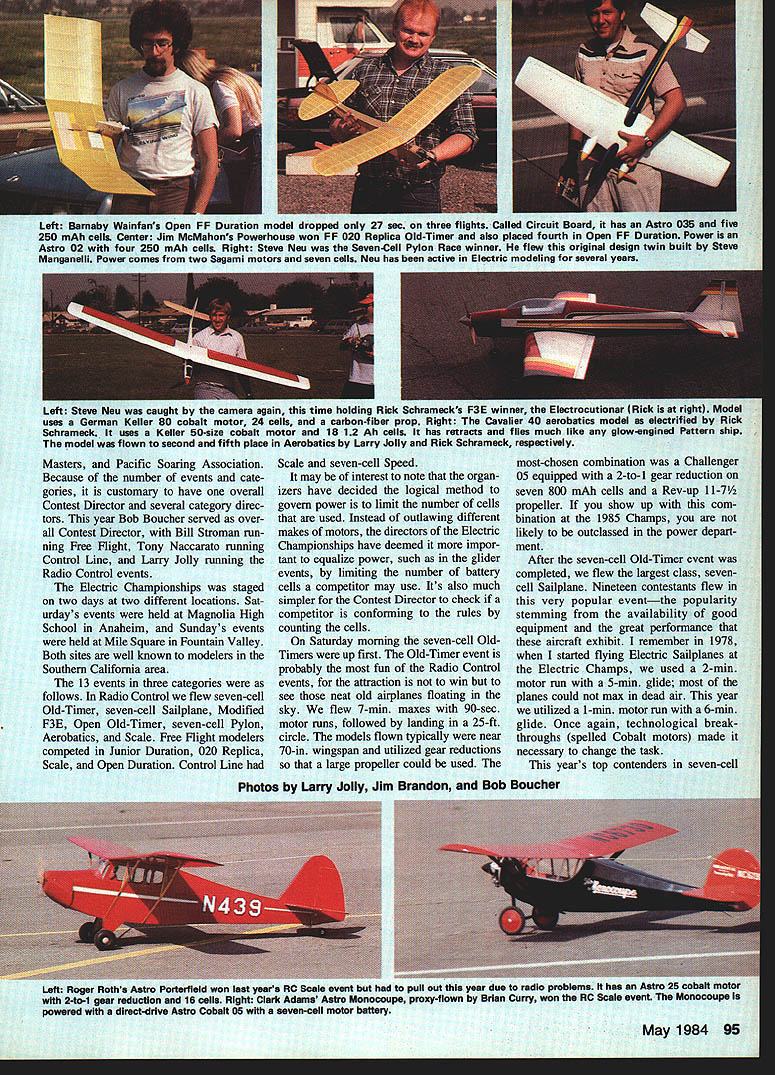
After the seven-cell Old-Timer event was completed, we flew the largest class, seven-cell Sailplane. Nineteen contestants flew in this very popular event—the popularity stemming from the availability of good equipment and the great performance that these aircraft exhibit. I remember in 1978, when I started flying Electric Sailplanes at the Electric Champs, we used a 2-minute motor run with a 5-minute glide; most of the planes could not max in dead calm air. This year we utilized a 2-minute motor run with a 6-minute glide. Once again, technological breakthroughs (spelled Cobalt motors) made it necessary to change the task.
The most popular combination was a Cobalt motor—either Astro or Keller—with seven 800 mAh cells swinging a 7‑4 Rev-up prop in an Electrocus; 12 out of the 19 competitors flew this combination. Anyone reading this report and thinking of getting into Electrics should consider this class. Seven-cell Sailplane is the perfect place to jump in. You are virtually assured success. Everything works, and these are great sport ships. Most of the Electric competitors keep a seven-cell Sailplane around for Sunday outings to the flying field.
The next class flown was Modified F3E (international class Electro-Sailplanes). To our knowledge, the Pacific Soaring Association has more experience with running F3E than any other club in the United States. Because of past work with F3E, and in an effort to make the event more equitable, the tasks were slightly modified to include fixed motor runs and normalized scoring.
For those not familiar with F3E, the task calls for a model to be launched and climbed to altitude. After turning off the motor, the model completes as many 150-meter laps as possible in a 180-second time frame. The model is then flown through a gate—two poles 60 ft. apart—and starts a 5-minute duration flight. The motor can be turned on and off as many times as necessary to complete the task.
The problem arises because normally one model, or at most two, is flown on the course at a time. Because most of the top models have comparable performance, the single biggest determinant of a competitor's score is what kind of weather he encounters on the course. If a competitor experiences large quantities of up-air on the course, he is much more likely to win than if he encounters sink.
Because of these inequities we used 30-second fixed motor runs, normalized the scores, and flew three models on the course at a time. The models are typically small (100-in. wingspan or less), use between 16 and 24 1.2 Ah cells, and have over 15 oz./sq. ft. wing loading.
The key to winning F3E is to have a quick-climbing model (one with a good thrust-to-weight ratio) and a high wing loading. These models have climb rates in excess of 2,000 ft. per minute and weigh 5 lb. or more. The event was won in fine style by Rick Schrameck using his Electrocutionar design and a Keller 80.
After F3E was over, we flew Open Old-Timers. Actually, there were no true Open Old-Timers in attendance; all the models that competed were 7-cell models. The task chosen was a 2-minute motor run and last-man-down wins—one mass flyoff.
Saturday night several of the competitors got together with Dist. X AMA Associate Vice President Betty Stream to find out the ins and outs of setting up a national organization. After the night was over, the Southern California Electric Aeromodeling Association (EAA) was formed. By the time the contest was over, the first 50 people had signed up. The EAA's goals are to cater to the competition electric flier and promote technological advancement as it pertains to electric-powered aeromodeling.
Sunday — Free Flight and Control Line
Sunday morning found us at Mile Square. Bill Stroman and Tony Naccarato already had the Free Flight and Control Line fliers organized by the time I arrived. It was really something to look across to the Free Flight side and see the beautiful Scale ships fly by on silent wings. I was too busy running the RC events to get across for a close view of the models.
From what I could gather, most of the models in the Electric Free Flight events were original designs or built from plans, with the only kit models showing up in 020 Old-Timer Replica. The majority of the models flown used either the Astro 035 or 020 and either four or five cells. The most popular propeller was the Top Flite 5¼‑3 white nylon. The duration events used 25-second motor runs with 2-minute maxes. Apparently the only contestant to score three maxes was 14-year-old Cynde Waddell in the Junior Duration event.
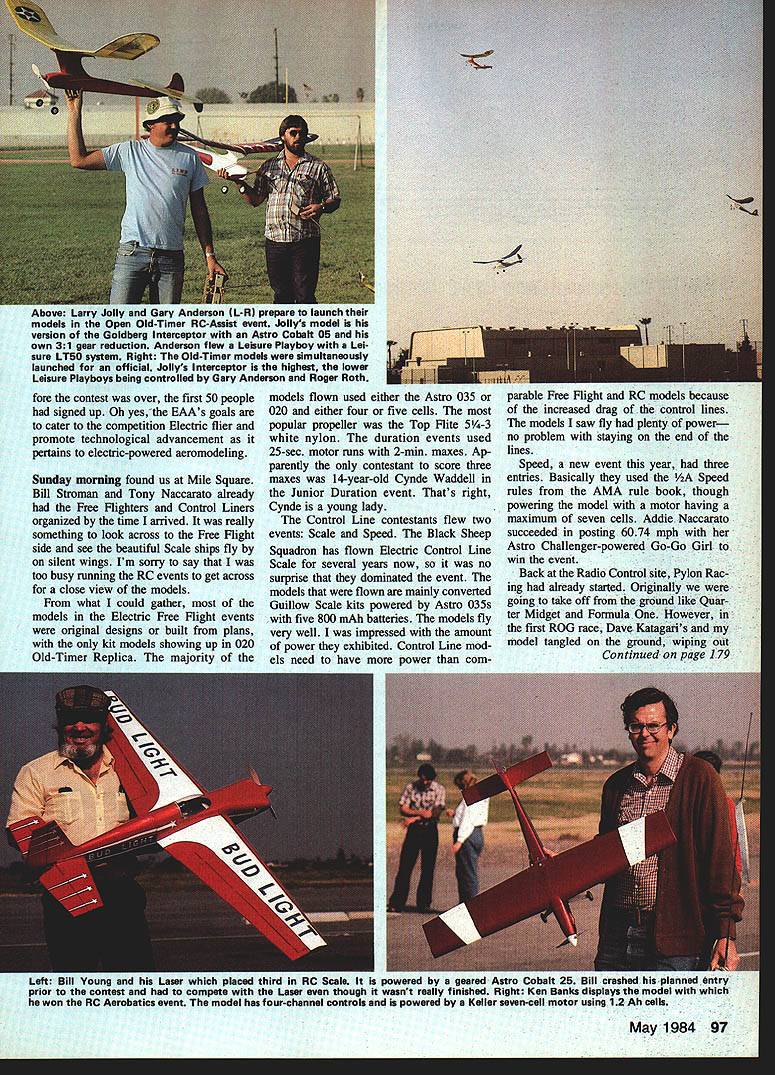
The Control Line contestants flew two events: Scale and Speed. The Black Sheep Squadron has flown Electric Control Line Scale for several years now, so it was no surprise that they dominated the event. The models that were flown are mainly converted Guillows Scale kits powered by Astro 035s with five 800 mAh batteries. The models fly very well. Control Line models need to have more power than comparable Free Flight and RC models because of the increased drag of the control lines. The models I saw fly had plenty of power—no problem staying on the end of the lines.
Speed, a new event this year, had three entries. Basically they used the N2A Speed rules from the AMA rule book, though powering the model with a motor having a maximum of seven cells. Addie Mae Naccarato succeeded in posting 60.74 mph with her Astro Challenger-powered Go-Go Girl to win the event.
Pylon, Pattern, and other RC events
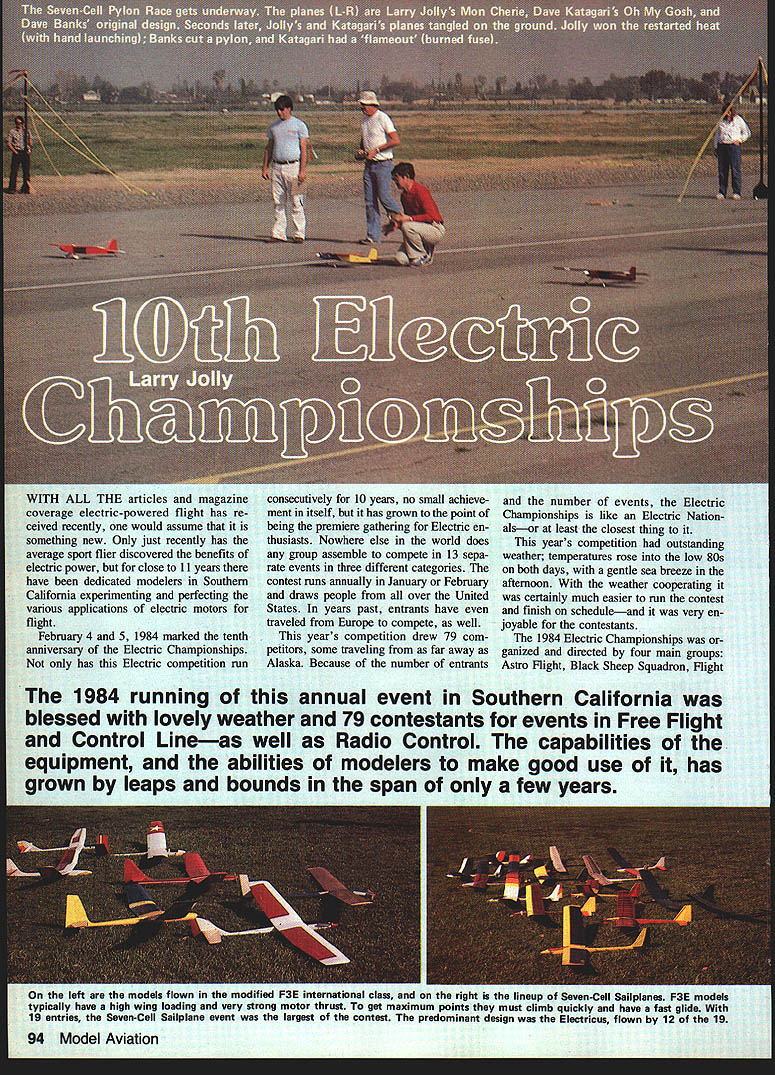
Back at the Radio Control site, Pylon Racing had already started. Originally we planned to take off from the ground like Quarter Midget and Formula One. However, in the first ROG race, Dave Katagiri's and my model tangled on the ground, wiping out both of us. That wasn't too bad, except three of the remaining five fliers were on red and white. We had no choice but to fly two-two-two and hope we could survive. Since we had not crashed, we alternated taking off each lap—stall turns and underpowered tugs being the order of the day. The result was that the five laps were bunched and there were some close finishes.
At the Electric Champs we flew the Open Sportsman RC Pattern as shown in the rule book. For the first time we had a .40-size Pattern ship, complete with retracts. However, an .05-size model won Pattern (the big Pattern model came in second, just short by two points). All that it will take for Electrics to gain a strong foothold in regular Aerobatics flying is a reliable and readily available throttle. Switching the motor on and off makes maneuvers not smooth.
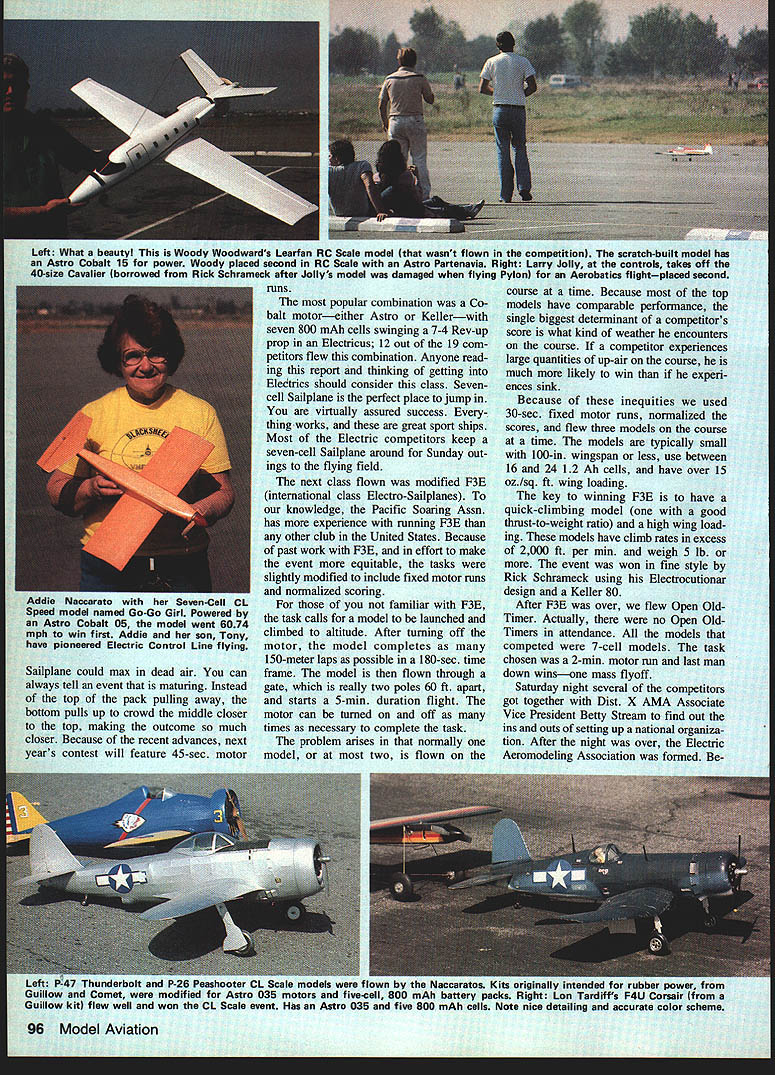
Of all the events flown at the Electric Champs, I think Scale had the most crowd appeal. With the power available today, Scale is the one segment that is wide open for development. There is so much more potential for these models than there was even three years ago. This year a Monocoupe, from a kit by Astro Flight, won the competition. Powered by a Cobalt .05, that little Monocoupe stole everyone's heart as it silently flew through its paces.
We've already started planning for next year's contest, and we have plenty of space for you. If you're freezing on the East Coast next February, why don't you grab your favorite Electric model and join us? Also, if you'd like information on joining the EAA, please send your address to me and I'll see that it gets to the right folks: Larry Jolly, 5501 W. Como, Santa Ana, CA 92703.
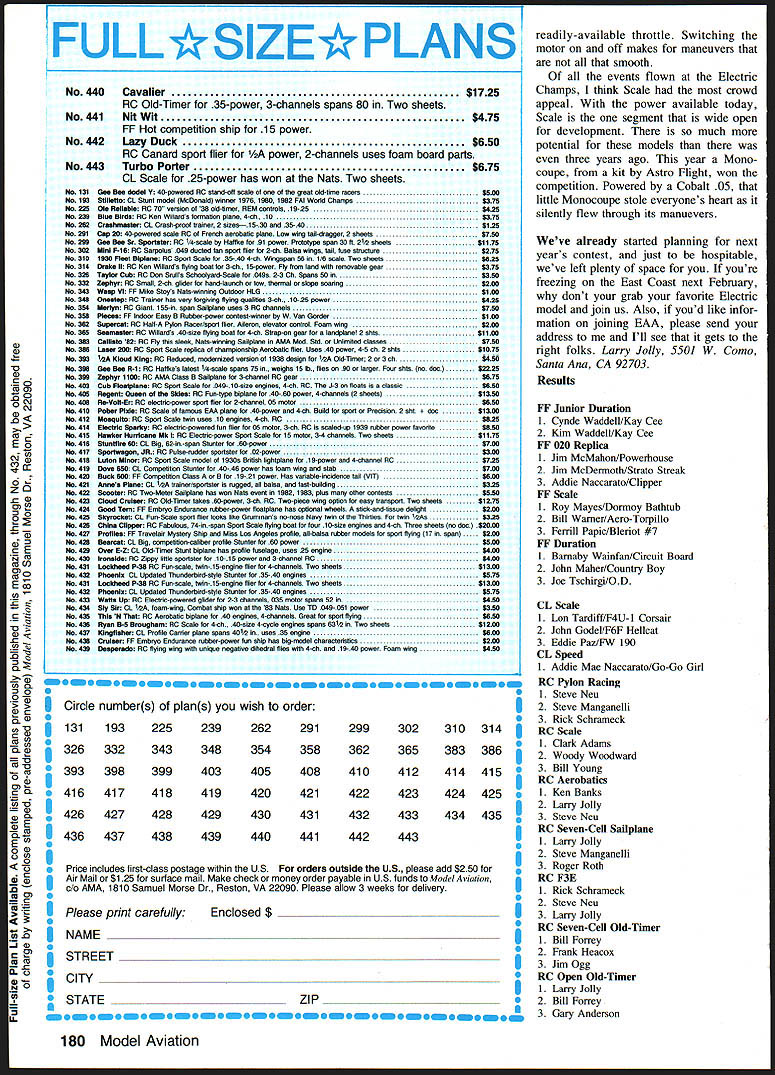
Results
FF Junior Duration
- Cynde Waddell / Kay Cee
- Kim Waddell / Kay Cee
FF 020 Replica
- Jim McMahon / Powerhouse
- Jim McDermott / Retro Streak
- Eddie Naccarato / Clipper
FF Scale
- Roy Mayers / Dormoy Bathtub
- Bill Warner / Aero-Torpillo
- Ermil Papic / Bleriot #7
FF Duration
- Barnaby Wainfans / Circuit Board
- John Maher / Country Boy
- Joe Tschirgi / Old Timer
CL Scale
- Lon Tardiff / F4U-1 Corsair
- John Godel / F6F Hellcat
- Eddie Paz / FW 190
CL Speed
- Addie Mae Naccarato / Go-Go Girl
RC Pylon Racing
- Steve Neu
- Steve Manganelli
- Rick Schrameck
RC Scale
- Clark Adams
- Woody Woodward
- Bill Young
RC Aerobatics
- Ken Banks
- Larry Jolly
- Steve Neu
RC Seven-Cell Sailplane
- Larry Jolly
- Steve Manganelli
- Roger Roth
RC F3E
- Rick Schrameck
- Steve Neu
- Larry Jolly
RC Seven-Cell Old-Timer
- Bill Forrey
- Frank Heacox
- Jim Ogg
RC Open Old-Timer
- Larry Jolly
- Bill Forrey
- Gary Anderson
Transcribed from original scans by AI. Minor OCR errors may remain.

