
10th Flying Aces Nats
Bill Warner
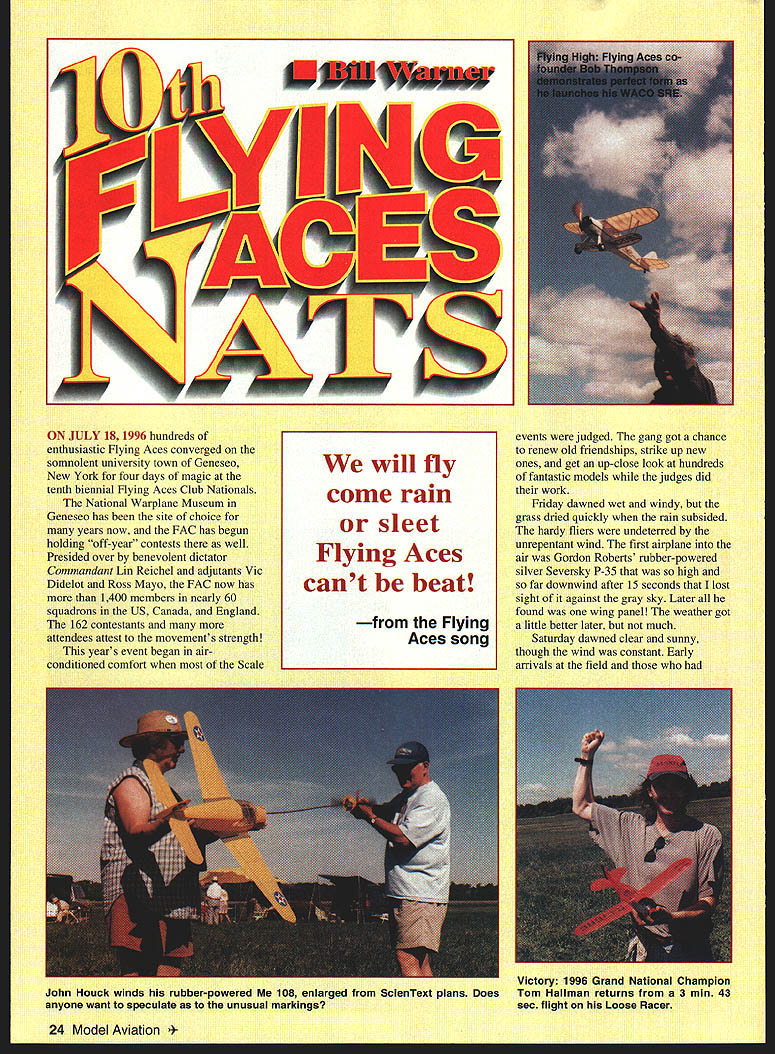
ON JULY 18, 1996 hundreds of enthusiastic Flying Aces converged on the somnolent university town of Geneseo, New York for four days of magic at the tenth biennial Flying Aces Club Nationals. The National Warplane Museum in Geneseo has been the site of choice for many years now, and the FAC has begun holding "off-year" contests there as well. Presided over by benevolent dictator Commandant Lin Reichel and adjutants Vic Didelot and Ross Mayo, the FAC now has more than 1,400 members in nearly 60 squadrons in the US, Canada, and England. The 162 contestants and many more attendees attest to the movement's strength!
This year's event began in air-conditioned comfort when most of the Scale events were judged. The gang got the chance to renew old friendships, strike up new ones, and get an up-close look at hundreds of fantastic models while the judges did their work.
Friday dawned wet and windy, but the grass dried quickly when the rain subsided. The hardy fliers were undeterred by the persistent wind. The first airplane into the air was Gordon Roberts' rubber-powered silver Seversky P-35 that was so high and so far downwind after 15 seconds that I lost sight of it against the gray sky. Later all he found was one wing panel. The weather improved a little later, but not much.
Saturday dawned clear and sunny, though the wind was constant. Early arrivals at the field and those who had camped overnight were treated to the roar of the museum's huge Antonov, Colt biplane, B-17 and Navy C-47 taking off to take part in the airshow. Fortunately Sunday turned out rather nice — sunny skies, lighter winds, and the sky constantly filled with dozens of airplanes being flown in competition just for fun. Models were often retrieved via automobile about a mile downwind; guys using walkie-talkies seemed to have somewhat of an advantage. As always, plenty of lost models showed up. The GHQ tent claimed models and reunited them with owners. In addition, the FAC Nats' ambulance was a grim reminder that participants have reached an age when chasing miles on foot to retrieve models can be a threat to health. Fortunately the ambulance wasn't needed.
Some Neat Ideas Seen on the Field
One of the great things about being around creative Flying Aces is that there is a never-ending stream of ideas to adapt to one's own modeling. Some of the best seen at this year's FAC Nats included:
- Jack McGillivray's wing dethermalizer that made it easier to retrieve his winning rubber-powered Cessna CR-3 between rounds in the Thompson Trophy mass launch. The wings pivot 45° to change the flight path on an aluminum-tube main spar released by a Tomy toy clockwork timer housed in the cowl.
- Bob Bojanowski's giant-scale Rearwin Speedster — the great-flying model was scaled up to 73 inches from Peerless plans.
- Marie and Dave Rees (of HiLine Motors) and their Convair B-36 — six electric HiLine Mini-4 motors power the model.
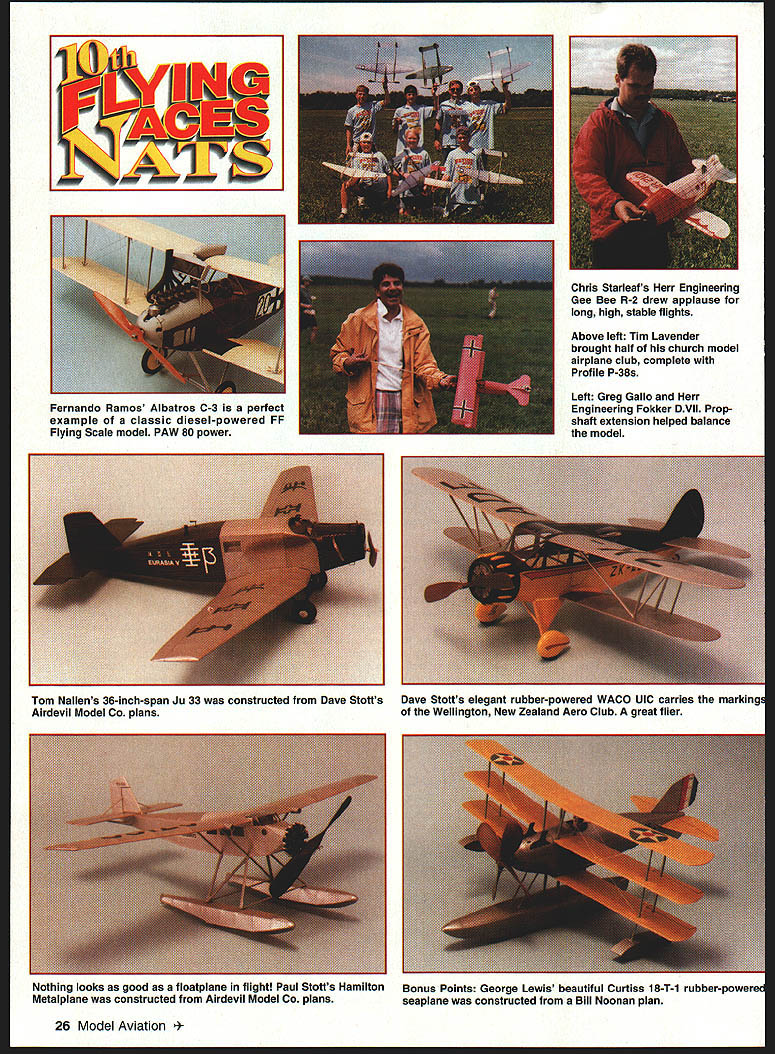
- Tom Nallen's 36-inch-span Ju 52 constructed from Dave Stott's Airdevil Model Co. plans.
- Paul Stott's Hamilton Metalplane floatplane constructed from Airdevil Model Co. plans — nothing looks as good as a floatplane in flight.
- Dave Stott's elegant rubber-powered WACO UIC carrying the markings of the Wellington New Zealand Aero Club — a great flier.
- Bonus points: George Lewis' beautiful Curtiss 18-T-1 rubber-powered seaplane constructed from the Bill Noonan plan in Model Aviation, and Ramos' Albatros C-3 — a perfect example of a classic diesel-powered free-flight scale model, PAW 80 power.
- Chris Starleaf's Herr Engineering Gee Bee R-2 drew applause for long, high, stable flights.
- Larson's method for making corrugated covering on the Hamilton Metalplane: sandwich thin aluminum foil between sheets of model-railroad basswood corrugated roofing, then squeeze — the results were quite realistic.
- Dave Stott's WACO UIC featured great-looking wheel pants made from 4-lb/cu ft foam, rubbed with Red Devil spackle, sanded, given a coat of Daconite lacquer-based wood sealer, and finished with acrylic paint.
- George Nason's tiny P-47D does one minute indoors and two minutes outdoors. It is made from blue foam with thin bamboo leading edges on the wings and tail surfaces. A music-wire prop-hanger assembly allows quick propeller changes to alter thrust. George uses 70% prop-diameter antenna wire made by twisting multiple strands of stripped stretch yarn.
- Jack Moses' RWD-5 has the wing attached to the top of the fuselage with three pairs of little rare-earth magnets from Radio Shack. The wing stays well stuck in flight, but on a hard landing the wing will turn or pop completely off.
- Greg Gallo extended the prop shaft of his H1 Engineering Fokker D.VII out in front of the model and added lead to it to balance the model — a lot less lead than he'd put inside the nose.
- Joe Barish used stretchable nylon pantyhose to cover the nose of his impeccable six-engine Me 323 Gigant. Bulletproof!
- Ken Bassett's Sig Tiger is covered with yellow plastic Reynolds Wrap, attached with Balsaloc and carefully heat-shrunk. Trim is Formula U polyurethane paint applied on the inside.
Some outstanding aircraft and notable highlights:
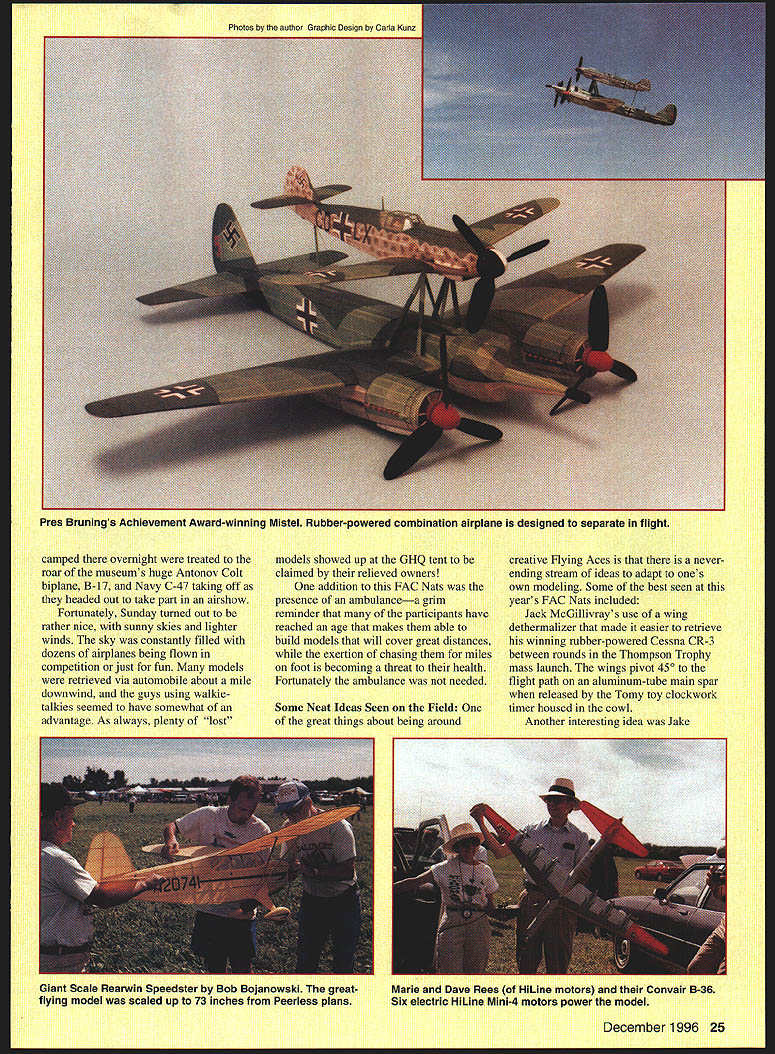
- Pres Bruning created quite a stir with his amazing rubber-powered Mistel. The full-scale Mistel consisted of an Me 109 perched atop a Ju 88 that had been converted into a flying bomb, complete with a shaped charge in the nose. Pres designed his models so that both would continue flying after separation. The ensemble flew well, but the separation latch stuck and they landed together. Some "fix-at-home" damage prevented further testing. He was awarded the club's 1996 Achievement Award for this superb model.
- Dave Rees' B-36, powered by six Hi-Line Mini-4 electric motors, drew a crowd each time it was flown. One feature of the model is its free-floating rudder — an old free-flight scale trick for effectively reducing a too-large vertical stabilizer's area to achieve better spiral stability.
- Bob Bojanowski's 73-inch-span Rearwin Speedster (based on a 24-inch-span Peerless plan) weighs only 1-1/2 pounds including rubber. The model was a real crowd pleaser. The flawless workmanship and impeccable flight performance earned it a permanent place in the "Legends of the FAC Nats" category. This beauty is powered by 16 strands of 55-inch-long braided 1/4-inch rubber; it flies on 1,100 to 1,200 turns twisting its 23-inch carved balsa prop.
- Gene Smith's Peanut Dick Howard Tigercat used rubber motors four to five times longer than the model's nacelles, and it outflew many simpler Peanut models with ease.
A three-ring circus? The FAC Nats is truly "The greatest show on earth," giving one many more choices than just which of the three rings to watch. With the line of modelers stretching for nearly a quarter of a mile, it is unlikely that anyone would see even half of the hundreds of models that are pulled out of vans, trailers, and trunks and flown. As soon as you walk down to the end of the flightline, someone pulls a truly astounding airplane out and flies it at the opposite end. It's no small wonder that each person attending the event will see it differently!
How the Events Are Flown
For most of the events, when a modeler feels like flying, he or she gets a timer and walks out to the spot of his or her preference on the field and launches. Three flights per event are usual, with the best flight (or in some events the total of all three flights) used to determine places. For some larger events that draw many contestants, rounds are flown as time permits under the control of contest officials to keep things moving.
In Scale events, the points awarded for fidelity to scale, workmanship, and difficulty are added to the flight duration points. Non-Scale events, like Old-Time Rubber, are flown on time alone.
The ten mass-launch events, with categories ranging from WW I Dogfight to the Greve Trophy, consist of a series of rounds where the first couple of airplanes to drop are eliminated each time until only the first, second, and third places are left. There's always a crowd for these dramatic episodes with their heartbreaks and cliff-hangers.
Magic Moments
- Talking with the legendary Earl Stahl, and finding him pretty well recovered from his recent illness.
- Listening to the applause for Chris Starleaf's Herr Engineering Gee Bee R-2 rubber model after an amazingly long, high, and stable flight.
- Watching open-mouthed as Stu Wexler's Indoor Scale Ken Johnson WACO SRE Peanut on floats did its "homesick angel" climb and flew on for an eternity.
- Hearing a true story about a now-divorced Canadian doctor whose then-wife piled 15 of his models on the driveway and ran back and forth over them a few times.
- Seeing the irrepressible Ed Coleman (editor of the popular WW II model planbook sold by Model Builder) again. Ed has had seven strokes now, but refuses to let his partial paralysis get him down. No walker for him — he toured the flightline on a Massey Ferguson tractor.
- Cheering for Terry Pittman's gorgeous Farman Jabiru four-engine electric model as it struggled valiantly to gain altitude on test flights.
- Witnessing the Glastonbury, Connecticut contingent whooping it up for their hero, John Rood, in the WW II mass launch. They were even considerate enough to let him put his model down before tossing him into the air to show their appreciation.
- Consoling Fernando (Lucky) Ramos: he paid a $50 surcharge to bring the model box from California, lost his Miss Canada Old-Timer rubber model on his first flight, and never got a flight on his fantastic Albatros C-3 diesel-powered model due to fuel-draw problems.
- Appreciating the efforts Tim Lavender put in on behalf of his 14-member church model club in Smyrna, Tennessee — seven of whom made the FAC Nats, replete with matching T-shirts and huge profile P-38 rubber models. The club started out a few months ago building Stringless Wonders and advanced through Baxter Pussycats and Prairie Birds. Nikki Spradling, one of this fine group's members, succinctly expressed their experience: "Cool!"
All Flying Aces Are Winners
There were many trophies and awards at Sunday night's banquet — from the new Grand National Champion, Tom Hallman, to the new inductees into the FAC Hall of Fame.
The speaker at this year's banquet was genial Lindsey Smith, who recounted his career with the Royal Air Force with slides and his characteristic wit. Jokes were told, hands were shaken, songs were sung, and even the food was well done.
The Texas contingent started their 28-hour drive home right after the banquet, while others made plans to visit the Curtiss Museum on their way east. Promises were made among friends to send plans, drawings, etc., "as soon as I get home."
The tenth Flying Aces Nats went into the history books as the best yet. As the lines in the Flying Aces song go: "We will fly come rain or sleet / Flying Aces can't be beat!" Believe it.
Postscript
You can join this extended family of enthusiasts and get their bang-up newsletter with lots of plans, data, hints, and fun; dues are only $10 per year in the US and Canada, and $15 overseas. Send to FAC G.H.Q., 3301 Cindy Lane, Erie, PA 16506.
Transcribed from original scans by AI. Minor OCR errors may remain.

