
1/2A Texaco Scale
By James E. Horner
Introduction
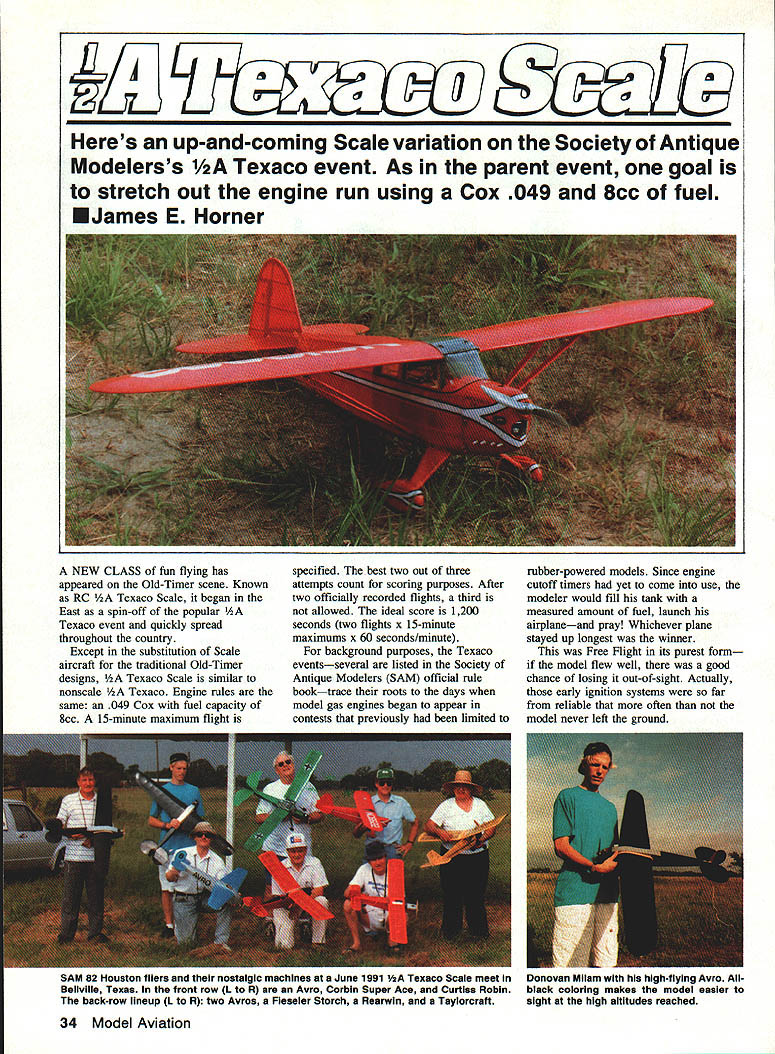
Here's an up-and-coming Scale variation on the Society of Antique Modelers' (SAM) 1/2A Texaco event. As in the parent event, one goal is to stretch out the engine run using a Cox .049 and 8 cc of fuel.
A new class of fun flying has appeared on the Old-Timer scene. Known as RC 1/2A Texaco Scale, it began in the East as a spin-off of the popular 1/2A Texaco event and quickly spread throughout the country. Except for the substitution of scale aircraft for the traditional Old-Timer designs, 1/2A Texaco Scale is similar to nonscale 1/2A Texaco.
Rules
- Engine: Cox .049 only.
- Fuel capacity: 8 cc.
- Maximum flight: 15 minutes per attempt.
- Attempts: Best two out of three count for scoring purposes. After two officially recorded flights, a third is not allowed.
- Ideal score: 1,200 seconds (two flights × 15 minutes × 60 seconds).
No modifications to the engine are permitted by the rules, and the propeller diameter is limited to 8 inches.
Background
For context, the Texaco events listed in the SAM official rule book trace their roots to the days when model gas engines began appearing in contests that previously had been limited to rubber-powered models. Before engine cutoff timers were common, modelers filled a measured tank with fuel, launched the airplane, and hoped the engine ran as long as possible. Whichever plane stayed up longest was the winner.
This was Free Flight in its purest form, often meaning the model could be lost if it flew out of sight. Early ignition systems were unreliable; more often than not the model never left the ground.
The introduction of radio control in Model Aviation allowed pilots to control and return the airplane to the launch point, which renewed interest in old-time Texaco events.
Why 1/2A Texaco Scale Is Popular
Several factors have driven the popularity of 1/2A Texaco Scale:
- Models are relatively small, typically around 300 square inches of wing area, making them easy to transport compared with the 8–10 foot wingspan models flown in standard Texaco.
- The small Cox .049 engines normally operate with the maximum allowable 8-inch propeller, resulting in relatively slow turning speeds and a docile powered portion of the flight.
- The modest cost of the model engine and the ease of entry for anyone who already owns radio gear keeps the barrier to entry low.
The goal in 1/2A Texaco is to achieve a long engine run on the 8 cc fuel allotment. With the 8-inch propeller, engines turn at roughly 4,750 rpm (actual rpm depends on prop pitch). No engine modifications are permitted, though many fliers insert extra head gaskets to smooth and lengthen the run. Opinions on optimal nitro content vary widely: some use high-nitro Cox fuel, others prefer lower-nitro RC sport fuel. There are reports—arguably illegal and hard to detect—that a small amount of gasoline has been mixed into fuel. One contestant reportedly ran 11 minutes on the 8 cc supply.
The fuel allotment and slow-turning engines virtually guarantee a maximum flight of 15 minutes. Often the engine stops before the fuel is exhausted. In wind, slow-turning engines may lack power and the model may refuse to climb.
Engine Operation and Flying Experience
Engine operation is a fascinating and essential part of the event. Scale models of early airplanes fly realistically on modest power, evoking aviation's early days. The high-pitched 8-inch prop and the slowly turning engine produce a distinctive sound; when an unfamiliar plane is heard overhead, people come outdoors to watch its birdlike grace as it progresses slowly across the sky.
With a typical engine run of about five minutes, these small models can reach considerable altitudes, especially when thermals are present. Watching a model circle lazily overhead, rising on a thermal after the engine has stopped, is pure joy. Small trim adjustments can widen the circle or induce a gentle stall without losing altitude. Often a model will leave one thermal, head back toward the field, catch another, and loft up again—an endlessly satisfying cycle for thermal fliers.
Events and Examples
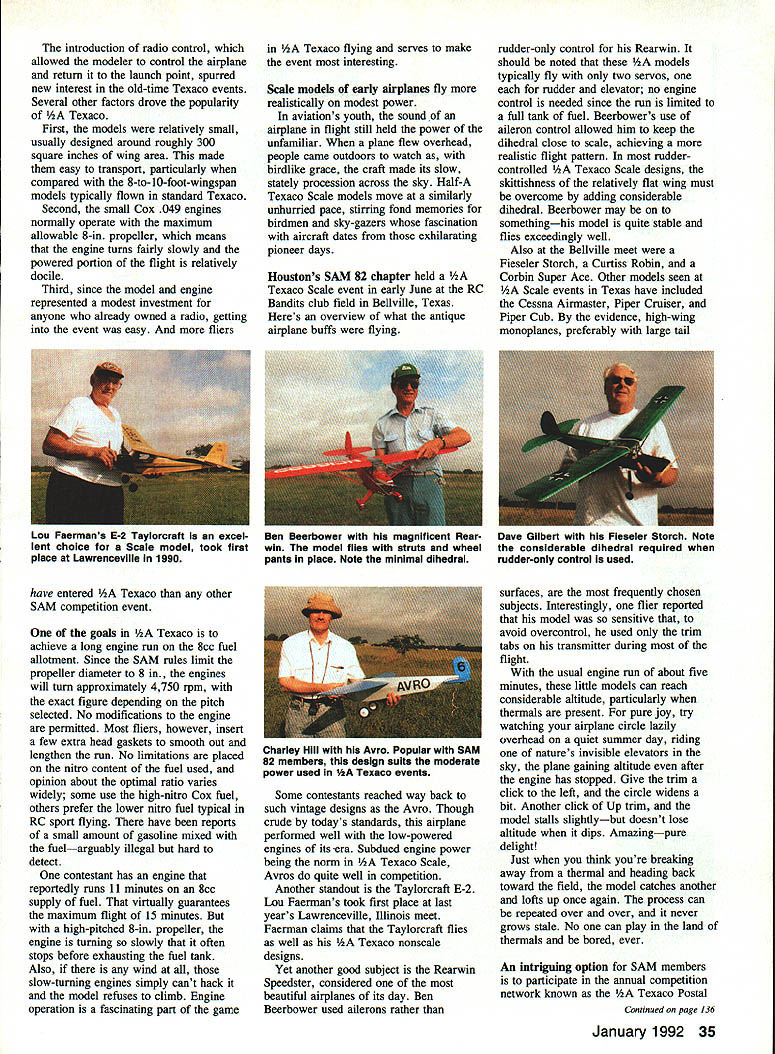
Houston's SAM 82 chapter held a 1/2A Texaco Scale event in early June at the RC Bandits club field in Bellville, Texas. Models flown included:
- Fieseler Storch
- Curtiss Robin
- Corbin Super Ace
- Cessna Airmaster (reported at other Texas events)
- Piper Cruiser (reported at other Texas events)
- Piper Cub (reported at other Texas events)
By observation, high-wing monoplanes with large tail surfaces are frequently chosen subjects. One flier reported that his model was so sensitive he used only the transmitter trim tabs during most of the flight to avoid overcontrol.
1/2A Texaco Postal Meet
An intriguing option for SAM members is to participate in the annual competition network known as the 1/2A Texaco Postal Meet. SAM chapters worldwide fly their 1/2A Texaco models on the same weekend at their respective club fields. Because these are duration events, each club is on its honor to accurately record the times (in seconds) of its five best fliers. The scores are sent to the administering club (the winning club administers the next year's postal meet) and are arranged in descending order; the club with the highest total score is declared the winner.
- There are no entry fees.
- Clubs may fly on either Saturday or Sunday for flexibility in case of foul weather.
- Recently, a club member was allowed to fly on his own, report his time to his club, and attest to its accuracy.
While weather conditions influence scores and some clubs may experience poor flying conditions on the chosen weekend, more clubs have joined each year. Competing across the miles from the local flying field appeals to many modelers who are otherwise tied to home base.
The success of the 1/2A Texaco Postal Meet suggests a similar program could emerge for 1/2A Texaco Scale. Currently, 1/2A Texaco Scale models have not reached the popularity of the nonscale variety—few SAM chapters could rally five Scale fliers to compete—so the sibling event could start small with the top three fliers' scores and phase in the top five as participation grows.
SAM 82 Houston's first 1/2A Texaco Scale Postal Meet took place on September 28–29, 1991.
Getting Involved
If your club is interested in participating in future meets, contact:
Jim Horner 15746 Walkwood Drive Houston, Texas 77079
We'd be happy to have you join us in the fun of 1/2A Texaco Scale flying.
Transcribed from original scans by AI. Minor OCR errors may remain.

