
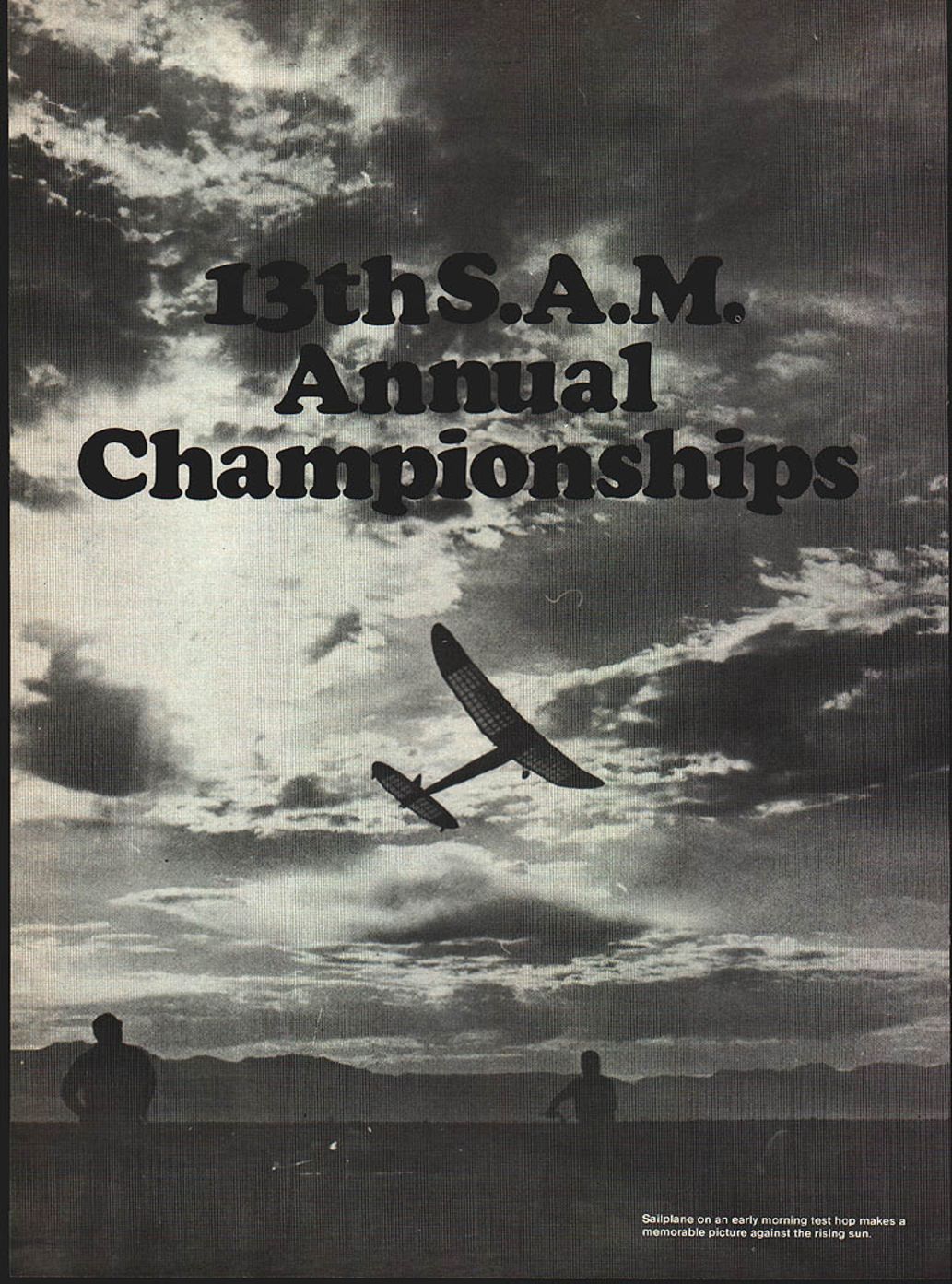
13th S.A.M. Annual Championships
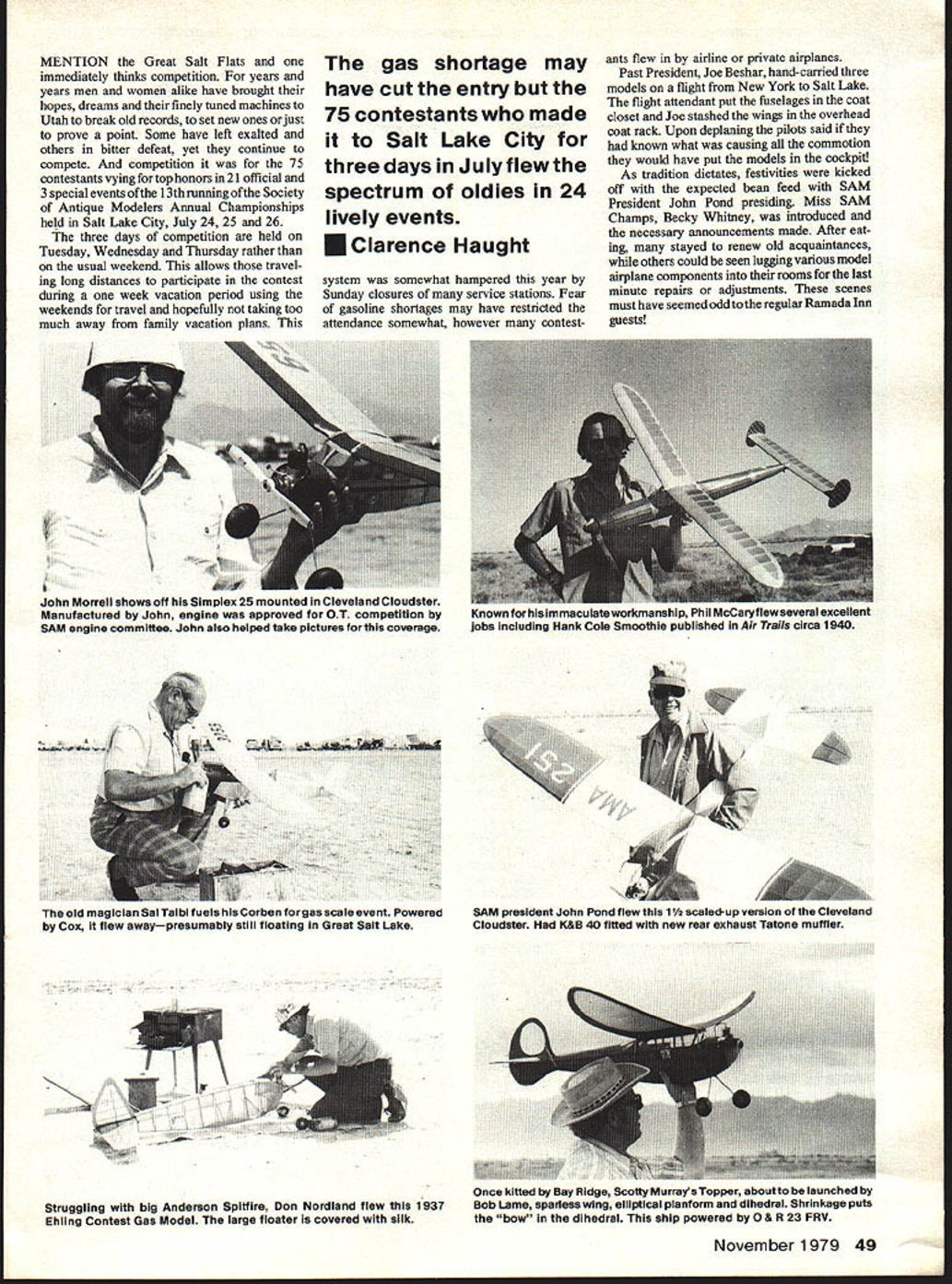
Mention the Great Salt Flats and one immediately thinks competition. For years men and women have brought their hopes, dreams and finely tuned machines to Utah to break old records, set new ones, or just to prove a point. Some have left exalted and others in bitter defeat, yet they continue to compete. Competition it was for the 75 contestants vying for top honors in 21 official and 3 special events at the 13th running of the Society of Antique Modelers Annual Championships held in Salt Lake City, July 24–26.
Schedule and travel
The three days of competition were held on Tuesday, Wednesday, and Thursday rather than the usual weekend. This schedule allows those traveling long distances to participate during a one-week vacation period, using the weekends for travel and hopefully not taking too much away from family vacation plans.
The gas shortage may have cut entries, but the 75 contestants who made it to Salt Lake City flew the spectrum of oldies in 24 lively events. Many contestants flew in by airline or private airplane. Past President Joe Beshar hand-carried three models on a flight from New York to Salt Lake; the flight attendant put the fuselages in the coat closet and Joe stashed the wings in the overhead rack. Upon deplaning the pilots joked that if they had known what caused the commotion they would have put the models in the cockpit.
Opening festivities
As tradition dictates, festivities were kicked off with the expected bean feed with SAM President John Pond presiding. Miss SAM Champs, Becky Whitney, was introduced and the necessary announcements were made. After eating, many stayed to renew old acquaintances while others could be seen lugging model components into their rooms for last-minute repairs or adjustments. These scenes must have seemed odd to the regular Ramada Inn guests.
Site and weather
The weather prior to contest days had been rather wet, unusual for this time of year. Although conditions were great on opening day, contestants suffered from the aftermath of the wet weekend. While many areas around Salt Lake are referred to as salt flats, the contest area was not part of the true Utah Salt Flats.
The Saltair model field is approximately 13 miles from downtown Salt Lake, beyond the airport and about 1½ miles south of the Great Salt Lake. The soil is a mixture of sand, salt, and dirt and is a large barren dry-lake type area surrounded by sagebrush. This soil becomes very sticky when wet and was still quite damp from the rains. When walking across the surface one tends to become an inch taller with each step until you are either (a) too tall to continue or (b) your feet are too heavy to lift. Negotiating this on a chase bike was virtually impossible, making foot-chasing the order of the day. Fortunately, winds were minimal and most chases were within a half mile. During a three-hour period on Thursday flying was voluntarily suspended until conditions improved.
Winds blew toward the lake each morning with a typical 180° shift in mid-morning. Low wind velocity tempted several modelers to fly in the early mornings, resulting in some models going for a swim in the lake. Most were recovered, but a few were still in the water at awards-banquet time. Due to the heavy salt content of the lake, objects tend to float well but corrosion is fierce if proper clean-up is not done immediately after recovery.
Temperatures for the three days ranged 85°–95°F. Although quite warm, it was not unpleasant. Lift was generally good but sparse, and times were low as a result with only a few max-outs.
Free Flight events
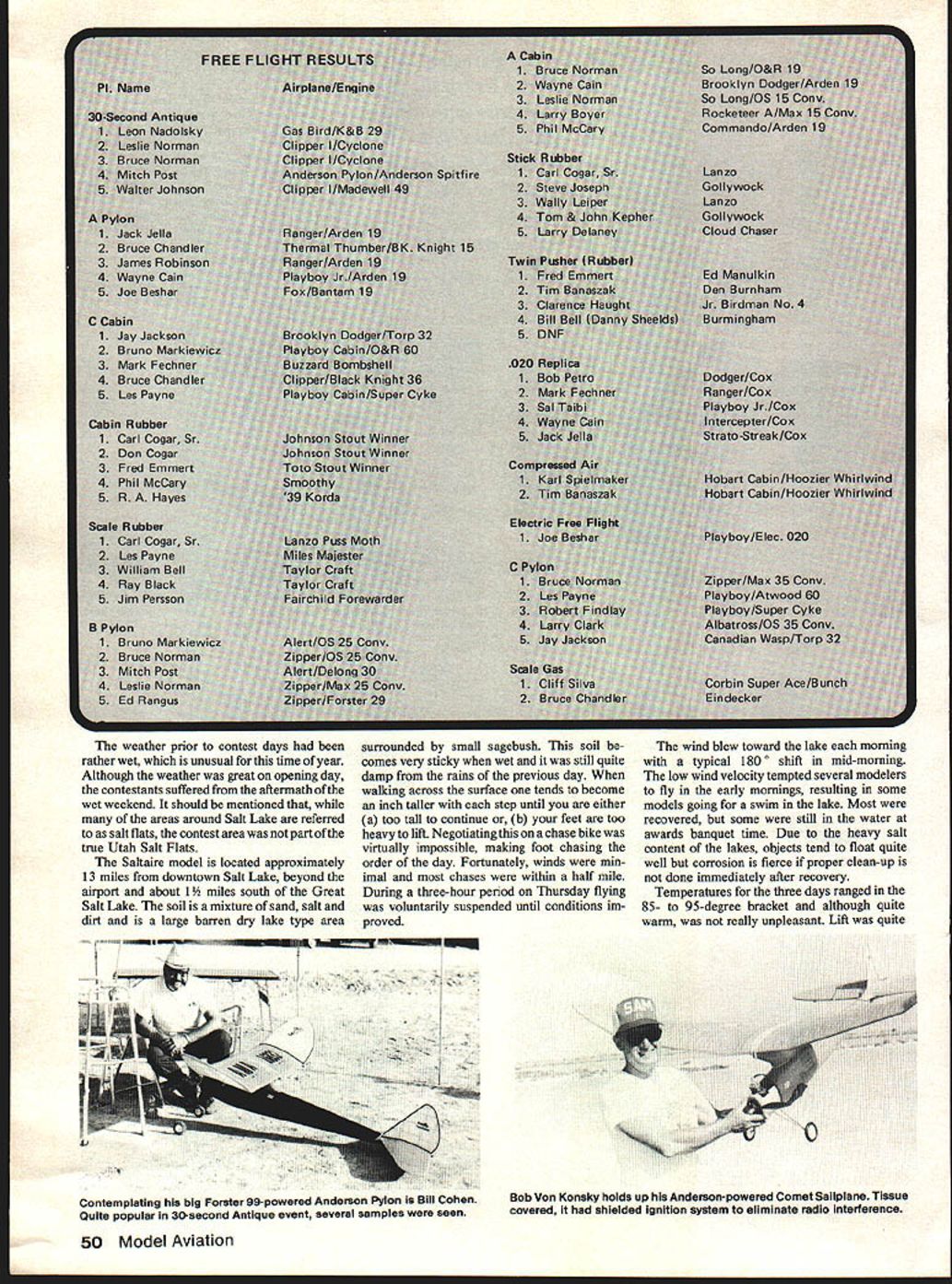
Free Flight Fuel Allotment Antique was scheduled for 6:00 a.m. on Thursday in hopes of calm flying conditions. The calm did not materialize and the event was flown later in the day. Mitch Post won it with 13:58 flying an Anderson Pylon — low for this event. Cliff Silva, a strong contender in Fuel Allotment, lost his famous 1937 Roll in the hills south of the field. Cliff also put his "Gas Bird" in the lake but it was retrieved. Several others lost models as well.
Class-C Pylon was the most hotly contested event of the champs. Excluding Bruce Norman's winning time of 18:10, the other four places were within a 24-second envelope.
Both rubber and power scale events were held, and a good variety of models were entered. Workmanship was quite good and most models seemed well trimmed prior to contest flying.
A personal note on Old Timer (OT) scale: as flown at these champs, OT scale is strictly a duration event with no static points awarded and no maximum flying time. The modeler with the largest fuel tank often wins, and many models are foolishly lost in the Gas event. Rubber scale is a little more reasonable in that a motor run over a minute is uncommon, but ultra-light, low-detailed models still tend to beat heavier, more detailed ones. OT scale needs a large field if this system is to continue. Perhaps the Mooney system for scale judging would fit better.
Special events
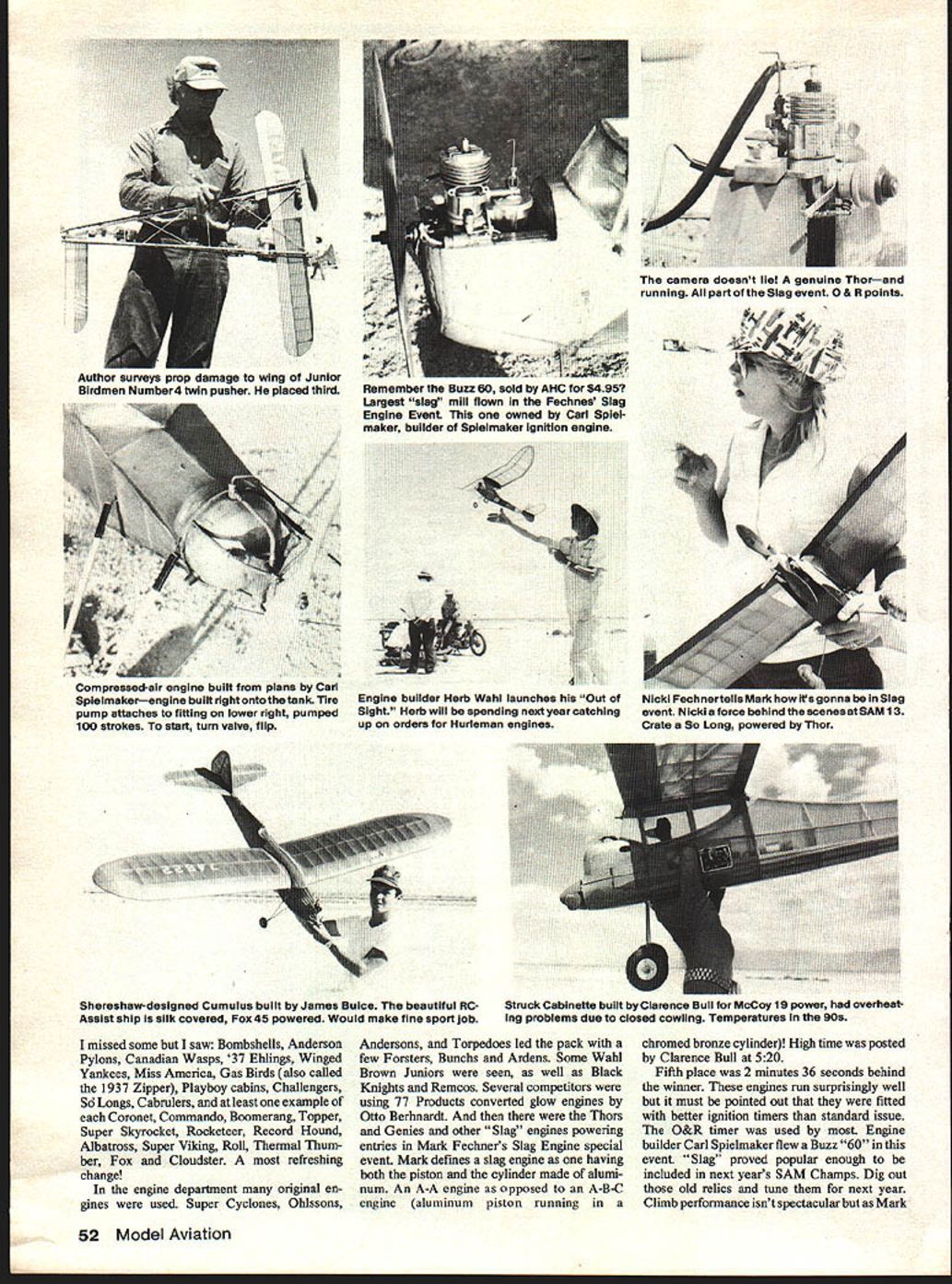
Mark Fechner's Slag Engine special event drew interest. Mark defines a slag engine as one having both the piston and the cylinder made of aluminum — an A-A engine — as opposed to an A-B-C engine (an aluminum piston running in a chromed bronze cylinder). High time was posted by Clarence Bull at 5:20. These engines run surprisingly well but were fitted with better ignition timers than standard; most used the O & R timer. Engine builder Carl Spielmaker flew a Buzz "60" in this event. "Slag" proved popular enough to be included in next year’s SAM Champs.
Other special events included:
- Tim Banaszak Compressed Air Event: three entrants (Tim Banaszak, Carl Spielmaker, and Bert Pond). These models are like giant indoor models flown outdoors; engines are home-built and often multi-cylinder radials. They can be built with simple hand tools and plans are available.
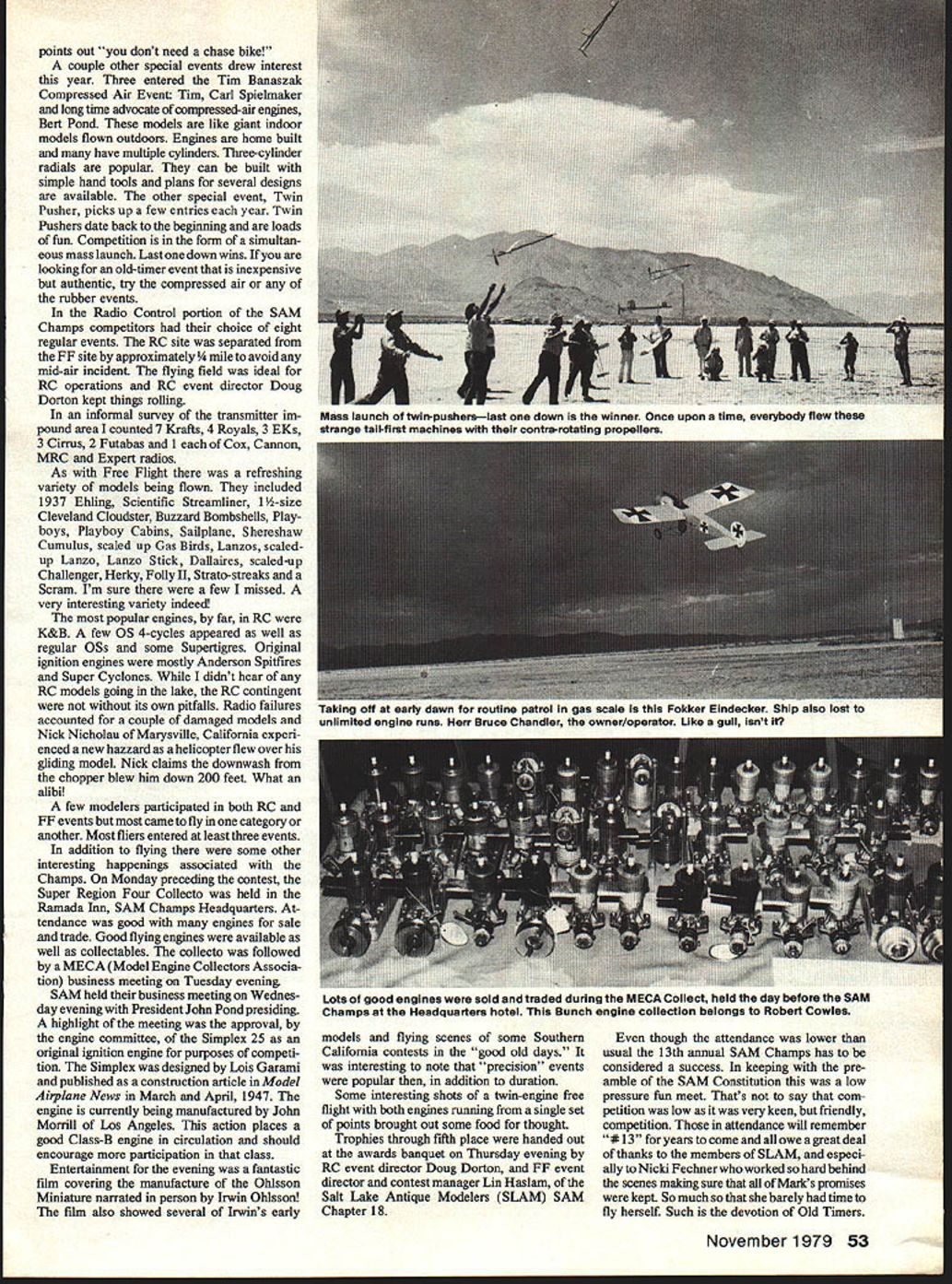
- Twin Pusher: a fun event dating back to the early days. Competition is a simultaneous mass launch; last one down wins.
If you’re looking for an authentic, inexpensive old-timer event, try the compressed-air or any of the rubber events.
Models and designs
One of the most encouraging aspects of the SAM Champs was the great variety of designs present on the field and in the winners circle. In addition to the usual Playboys, Sailplanes, Zippers, Rangers, Alerts, Clippers, and Dodgers, the field included:
- Bombshells
- Anderson Pylons
- Canadian Wasps
- ’37 Ehlings
- Winged Yankees
- Miss America
- Gas Birds (also called the 1937 Zipper)
- Playboy cabins
- Challengers
- So Longs
- Cabrulers
- Coronet
- Commando
- Boomerang
- Topper
- Super Skyrocket
- Rocketeer
- Record Hound
- Albatross
- Super Viking
- Roll
- Thermal Thunderer
- Fox
- Cloudster
A most refreshing change!
Engines
Many original engines were used. Leading the pack were Super Cyclones, Ohlssons, Andersons, and Torpedoes, with a few Forsters, Bunches, and Ardens. Some Wahl Brown Juniors, Black Knights, and Remcos were seen. Several competitors used 77 Products converted glow engines by Otto Bernhardt. Thors, Genies, and other "slag" engines powered entries in the slag special event.
Radio Control (RC)
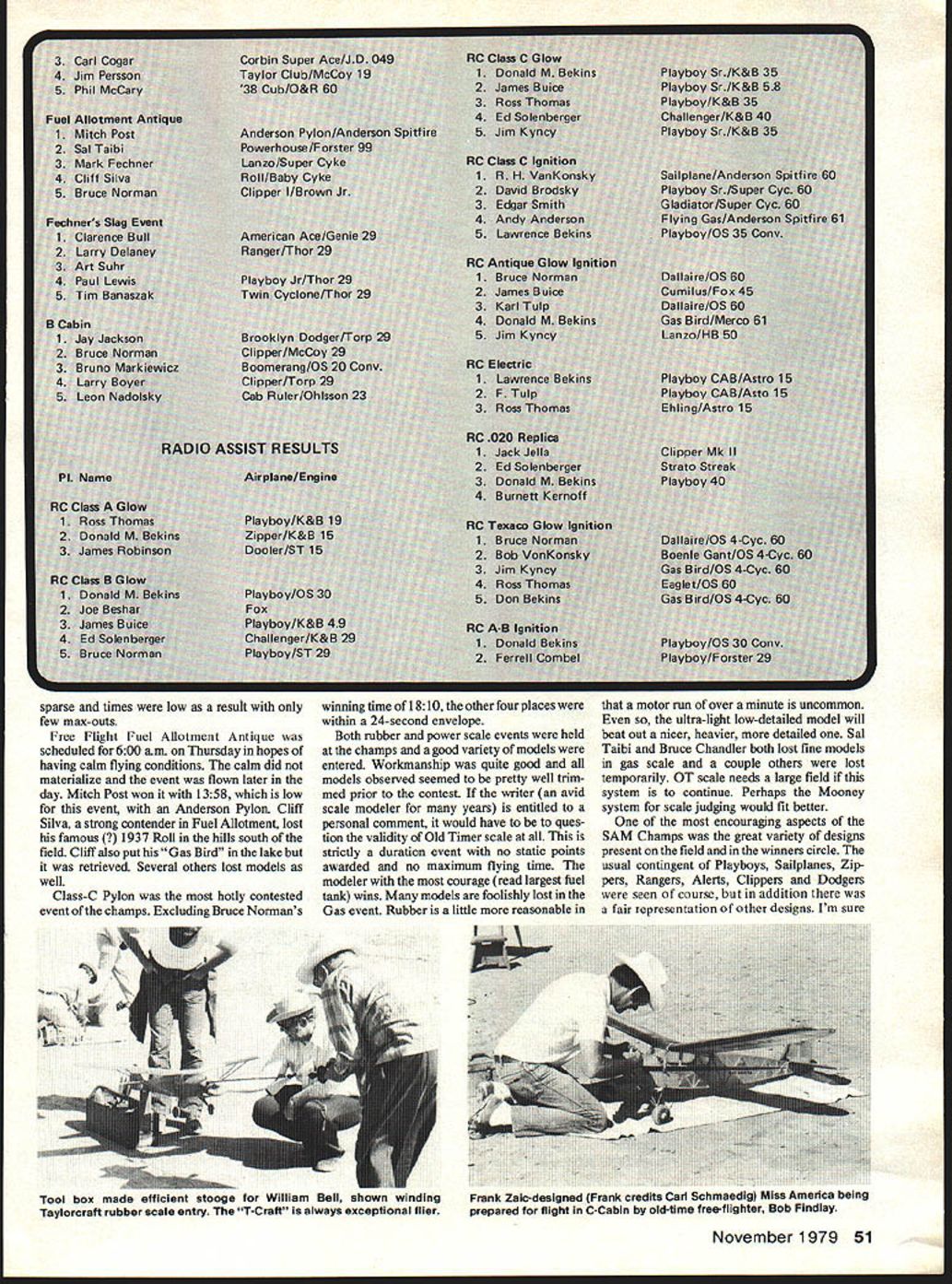
In the RC portion competitors had a choice of eight regular events. The RC site was separated from the FF site by about 1/4 mile to avoid mid-air incidents. The flying field was ideal for RC operations and RC event director Doug Dorton kept things rolling.
An informal survey of the transmitter impound area counted:
- 7 Krafts
- 4 Royals
- 3 EKs
- 3 Cirrus
- 2 Futabas
- 1 Cox
- 1 Cannon
- 1 MRC
- 1 Expert
As with Free Flight, there was a refreshing variety of models flown in RC, including 1937 Ehling, Scientific Streamliner, 1½-size Cleveland Cloudster, Buzzard Bombshells, Playboys, Playboy Cabins, Sailplanes, Shereshaw Cumulus, scaled-up Gas Birds, Lanzos, Lanzo Stick, Dallaires, scaled-up Challengers, Herky, Folly II, Strato-streaks, and a Scram.
K&B engines were the most popular in RC, with a few OS four-strokes, regular OSs, and some Super Tigres. Original ignition engines in RC were mostly Anderson Spitfires and Super Cyclones. Radio failures accounted for a couple of damaged models, and Nick Nicholau of Marysville, California reported that helicopter downwash allegedly blew his gliding model down 200 feet — a memorable alibi.
A few modelers participated in both RC and FF events, but most came to fly in one category. Most fliers entered at least three events.
Meetings, collecto, and awards
On Monday preceding the contest, the Super Region Four Collecto was held in the Ramada Inn, SAM Champs headquarters. Attendance was good with many engines for sale and trade. The collecto was followed by a MECA (Model Engine Collectors Association) business meeting on Tuesday evening.
SAM held their business meeting on Wednesday evening with President John Pond presiding. A highlight was the engine committee’s approval of the Simplex 25 as an original ignition engine for competition. The Simplex was designed by Lois Garami and published as a construction article in Model Airplane News in March and April 1947. The engine is currently being manufactured by John Morrill of Los Angeles. This action places a good Class-B engine in circulation and should encourage more participation in that class.
Entertainment for the evening was a fantastic film covering the manufacture of the Ohlsson miniature, narrated in person by Irwin Ohlsson. The film also showed several of Irwin’s early models and flying scenes of some Southern California contests in the "good old days." It was interesting to note that precision events were popular then in addition to duration. Some interesting shots of a twin-engine free flight with both engines running from a single set of points provided food for thought.
Trophies through fifth place were handed out at the awards banquet on Thursday evening by RC event director Doug Dorton and FF event director and contest manager Lin Haslam of the Salt Lake Antique Modelers (SLAM), SAM Chapter 18.
Conclusion
Even though attendance was lower than usual, the 13th annual SAM Champs was a success. In keeping with the preamble of the SAM constitution, this was a low-pressure fun meet. Competition was keen but friendly. Those in attendance will remember "13" for years to come and owe a great deal of thanks to the members of SLAM — especially Nicki Fechner, who worked tirelessly behind the scenes to make sure Mark’s promises were kept, leaving her little time to fly. Such is the devotion of Old Timers.
Transcribed from original scans by AI. Minor OCR errors may remain.

