
15th Annual QSAA Giant Scale Fly-In
Giants invaded the Nevada desert — some virtually exploding vertically into the air, others eerily quiet as they flew arrow-straight twenty feet above the ground. The craftsmanship was incredible and the performances often beyond belief. — John A. de Vries
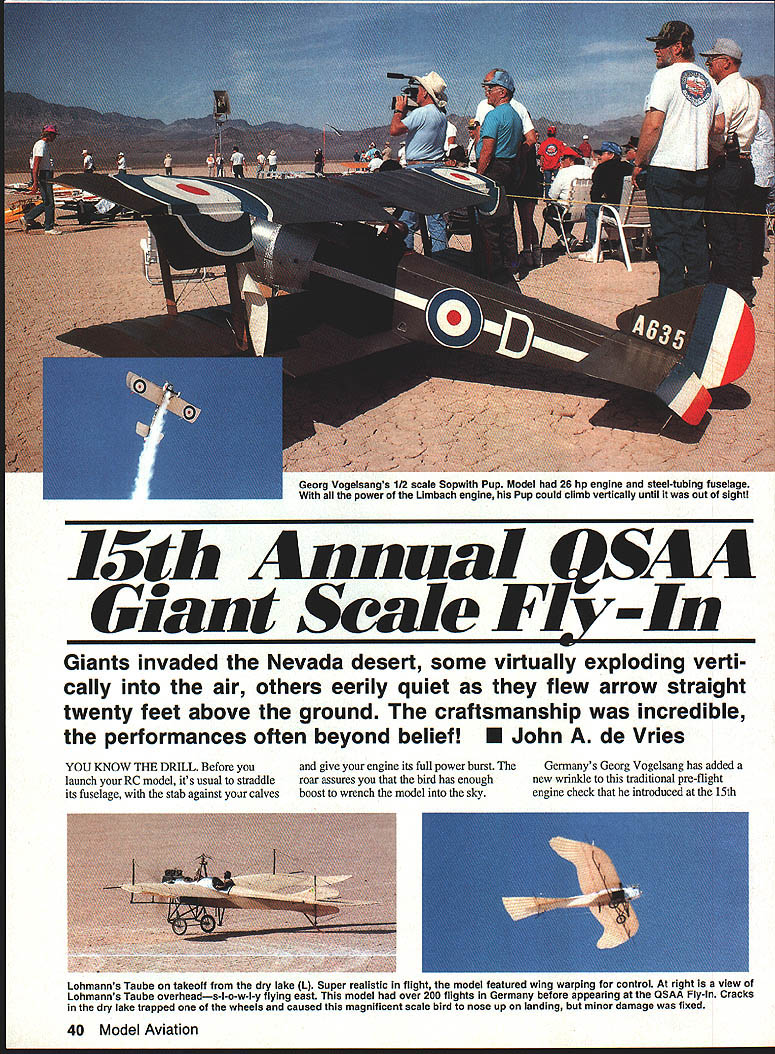
Georg Vogelsang's Sopwith Pup
You know the drill. Before you launch your RC model, it's usual to straddle its fuselage with the stab against your calves and give your engine a full-power burst. The roar assures you that the bird has enough boost to wrench the model into the sky.
Germany's Georg Vogelsang added a new wrinkle to this traditional preflight engine check at the 15th Annual QSAA (Quarter-Scale Airplane Association) Fly-In the last weekend in October, 1991. Georg brought a half-scale Sopwith Pup to the desert dry lake powered by a 26 hp Limbach 280 cc engine. The powerplant, designed for snowmobiles and full-size ultralight aircraft, was converted for model use and equipped with a 38-inch-diameter, ten-inch prop. It had power to spare.
To perform the run-up, one of Georg's young assistants straddled the fuselage in the traditional fashion, grasped the cockpit coaming with both hands and hung on for dear life. Before Georg gave the Limbach full bore, the assistant grasped the belt of a second helper — it took two sturdy people to hold the Sopwith back.
Expecting a long takeoff run, I trained my Minolta along the runway. The model ran three feet or so and exploded into the air — the takeoff was truly vertical. Spectators fifty yards away swore the 70-lb. model had been hand launched.
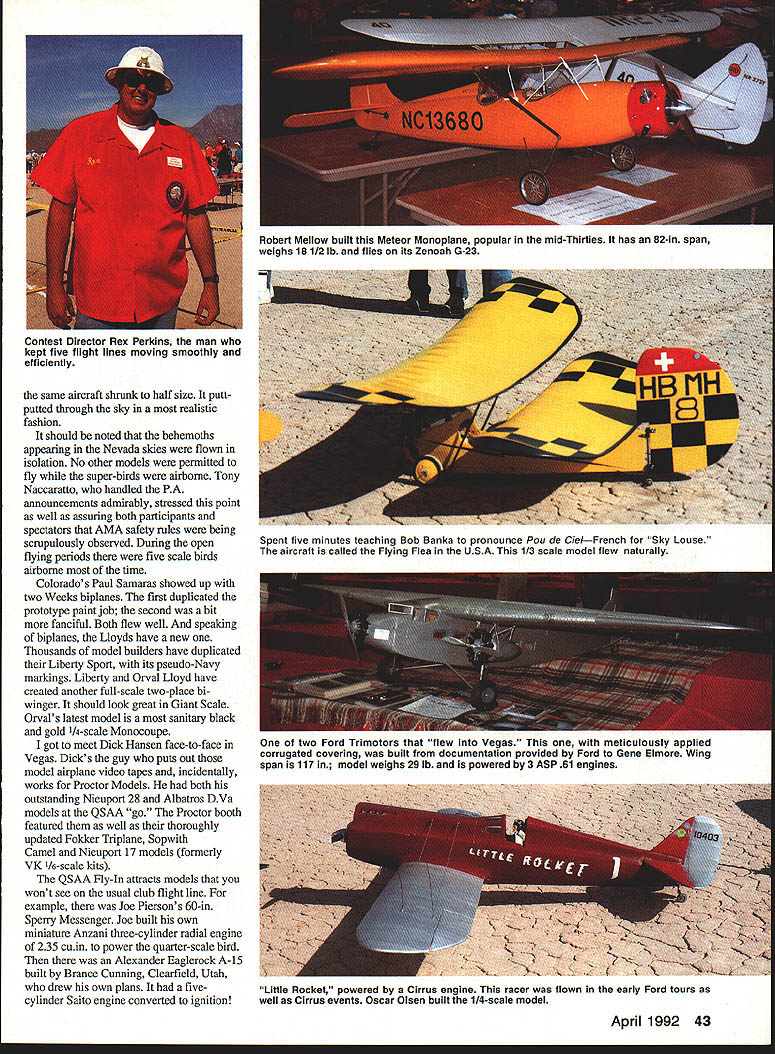
Georg proceeded to put on a show like none I have seen. Stressed to 20 Gs, the model made loops with less than a 30-foot radius and rolls so tight it looked as if the wingtips would meet. The Pup was equipped with a smoke system that created great billows of white and added to the thunder of the Limbach as Georg maneuvered less than 100 yards away for most of the performance. The swell of applause when the model lightly touched down was tribute to a masterful display of RC flying. The Sopwith was nearly perfect in construction: the fuselage of welded steel tubing, fabric covering duplicating the prototype, and attention to detail such as coreless motor servos whose gaps revealed RAF bull's-eye insignia colors as the ailerons drooped with the radio off. Herr Vogelsang's radio was on 35 MHz, so interference at the dry lake was unlikely.
Other standout performances
- Dennis Crooks — ducted-fan Lockheed SR-71 (kitted by Yellow Aircraft). The black beauty was eerily quiet and flew arrow-straight about 20 feet above the ground; Dennis demonstrated loops and rolls with precision.
- German contingent — a huge North American OV-10 that flew convincingly; one spectator quipped, "It flies just like the ones we had in 'Nam."
- Paul Samaras (Colorado) — two Weeks biplanes, both flying well (one with prototype paint, the other more fanciful).
- Lloyds — a new Liberty Sport biplane; Orval Lloyd's latest model is a black-and-gold 1/4-scale Monocoupe.
- Notable individual entries included:
- The Naccaratos, Tony and his mom Addie — an electric-powered quarter-scale version of the tailless Hill Pterodactyl.
- Claude McCullough — Waco S3HBA Cuban Fighter.
- Noel Hess (Utah) — Giant Vought SBU-1 based on Paul Matt drawings; both spectacular in looks and flight.
- Walt Moucha — Pazmany PS-2, a 108-incher that flew beautifully; kit availability was expected soon.
- Two Ford Trimotors on display — one reproduced from Ford-provided data with corrugated metal-appearing covering, powered by three ASP 60s.
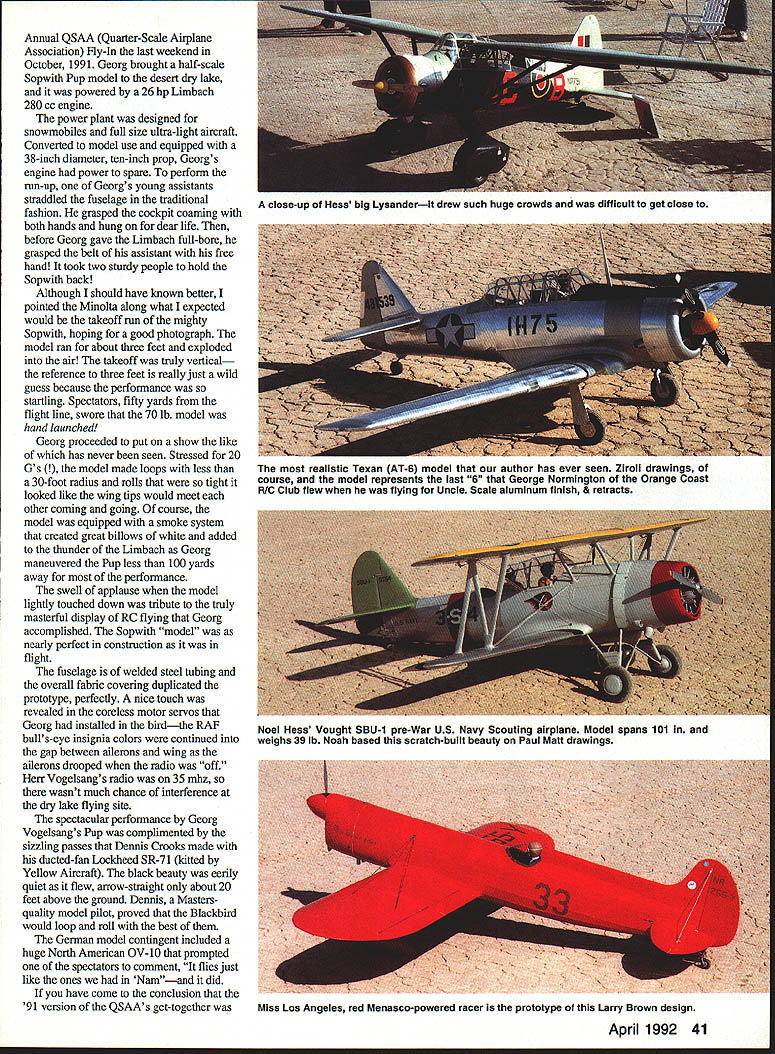
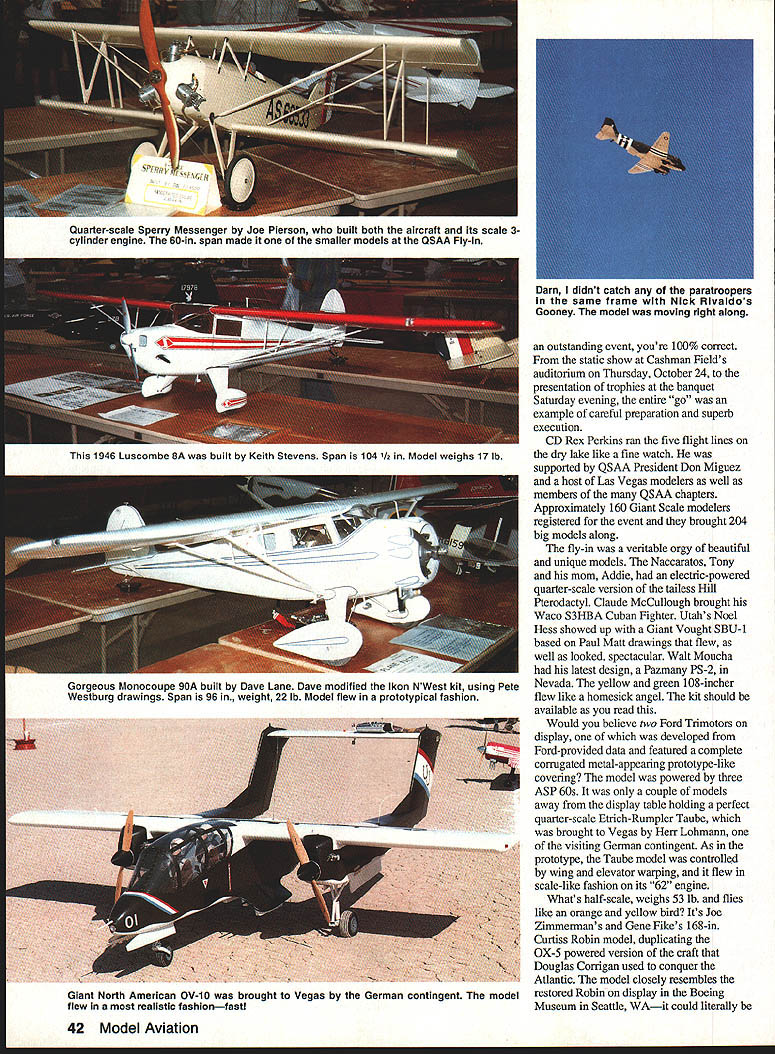
- Herr Lohmann (German contingent) — a perfect quarter-scale Etrich-Rumpler Taube, controlled by wing and elevator warping and flown on a .62 engine.
- Joe Zimmerman and Gene Fiske — a 1/6-scale Curtiss Robin (OX-5 powered) weighing 53 lb., modeled closely on the restored Robin at the Boeing Museum in Seattle.
- Joe Pierson — 60-in. Sperry Messenger with a self-built miniature Anzani three-cylinder 2.35 cu. in. radial engine.
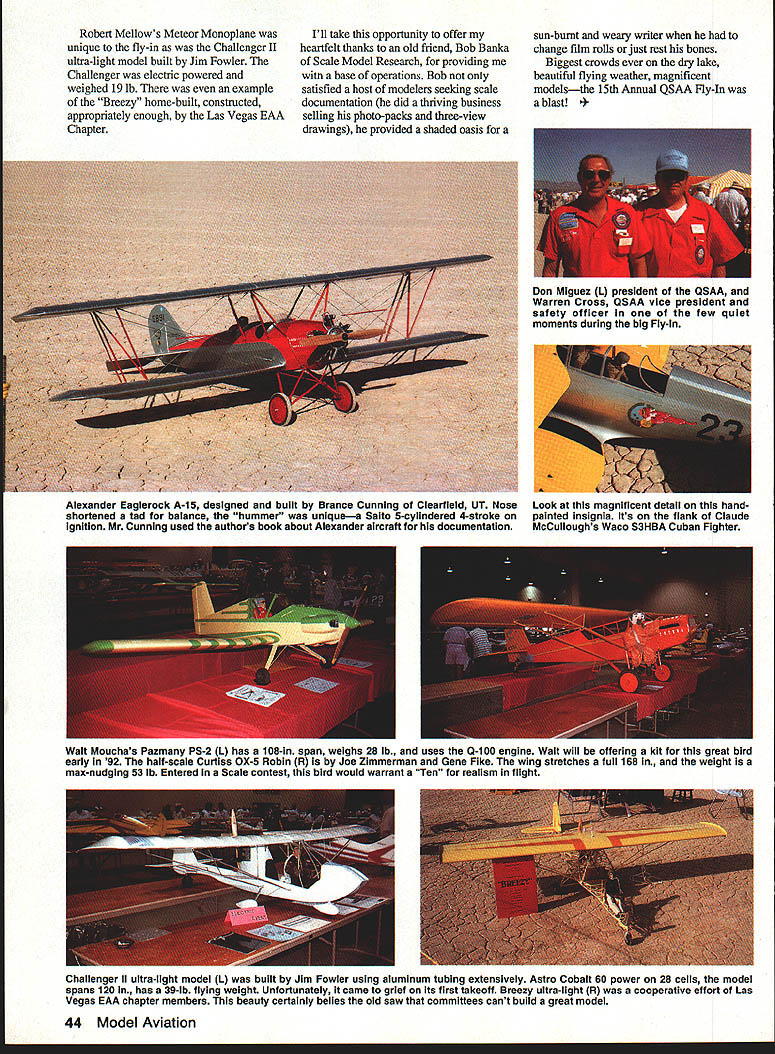
- Brance Cunning (Clearfield, Utah) — Alexander Eaglerock A-15, plans drawn by builder, with a five-cylinder Saito engine converted to electronic ignition.
- Robert Mellow — Meteor Monoplane (unique to the fly-in).
- Jim Fowler — Challenger II ultralight model, electric powered and weighing 19 lb.
- Las Vegas EAA Chapter — an example of the "Breezy" homebuilt.
- Dick Hansen (Proctor Models) — Nieuport 28 and Albatros D.Va models; Proctor featured updated Fokker Triplane, Sopwith Camel and Nieuport 17 kits.
The fly-in was a veritable orgy of beautiful and unique models. Approximately 160 Giant Scale modelers registered and brought 204 big models. During open-flying periods there were often five scale birds airborne at once.
Organization, safety and logistics
- CD Rex Perkins ran the five flight lines on the dry lake like a fine watch, supported by QSAA President Don Miguez, many Las Vegas modelers, and members of the QSAA chapters.
- Safety: The behemoths were flown in isolation — no other models were permitted to fly while the super-birds were airborne. Tony Naccarato, who handled the P.A. announcements, stressed strict observance of AMA safety rules to participants and spectators.
Acknowledgements
My heartfelt thanks to Bob Banka of Scale Model Research for providing a base of operations. Bob supplied scale documentation, photo-packs and three-view drawings, and offered a shaded oasis for a sun-burnt and weary writer needing to change film or rest.
Biggest crowds ever on the dry lake, beautiful flying weather, magnificent models — the 15th Annual QSAA Fly-In was a blast!
Transcribed from original scans by AI. Minor OCR errors may remain.

