
16 hours and 43 minutes
By Jack Finn
WHAT DOES IT TAKE to set a World Duration Record? At the very least, it takes a dedicated individual who has a dream and is willing to spend the necessary hours carrying that dream forward. Plenny Bates is the individual who had the dream and the persistence to make it come true. Credit must also be given to Maynard Hill for his technical advice and encouragement throughout the program. Don Lindley of Standard Oil deserves thanks for his technical advice on fuel and oil and for a supply of L-50 oil.
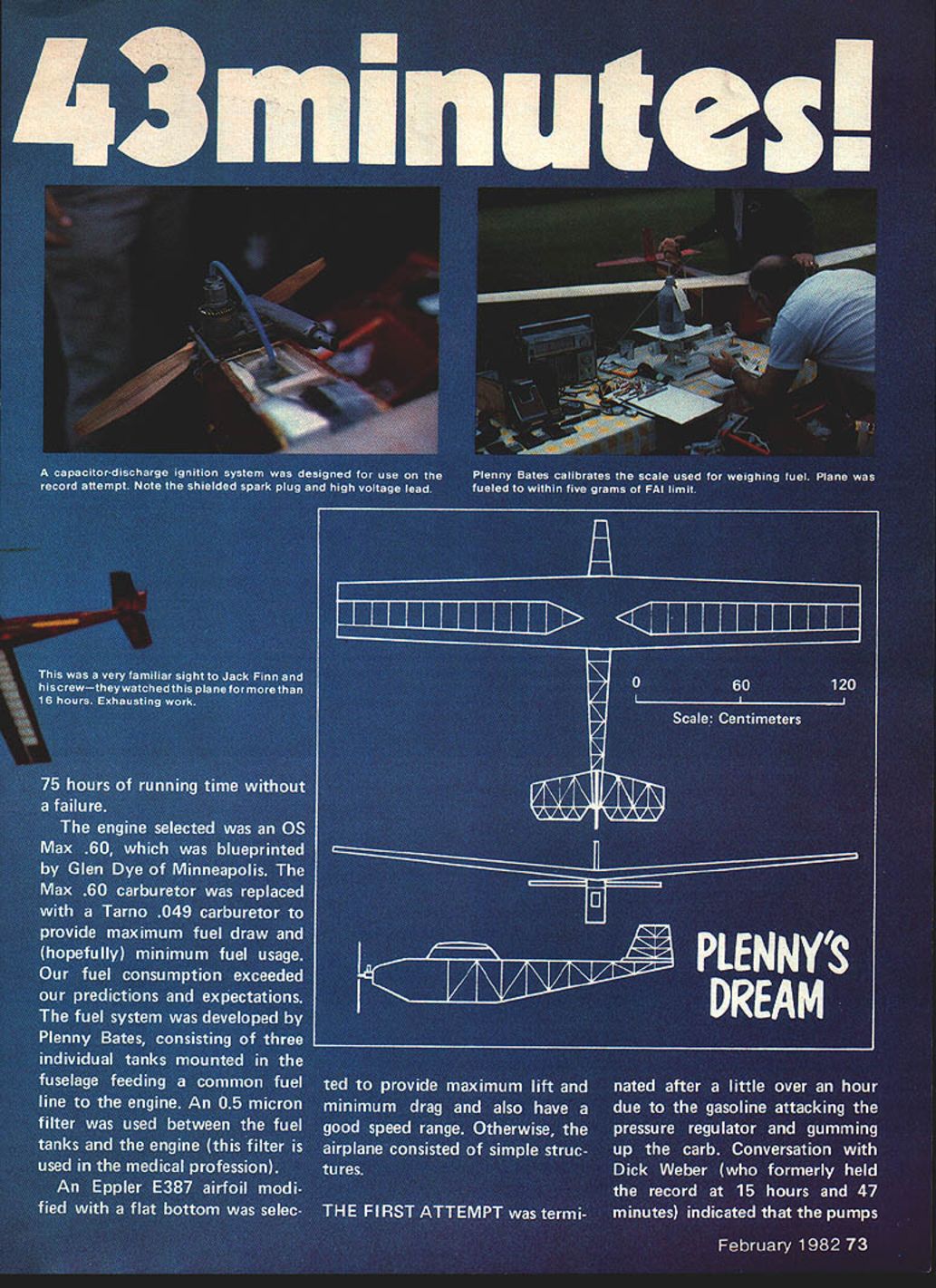
The most critical item in setting a Duration World Record is fuel consumption. A modern ball-bearing glow engine converted to ignition was selected for reliability reasons. Instead of using the conventional model ignition system of a coil and mechanical points, Emil Svercl was enlisted to develop a capacitive discharge ignition system using a magnetic pickup instead of mechanical points. The development of this system is a story in itself (Editor: a future article is planned). A battery-powered ignition engine running 40 hours would not have been possible 10 years ago. The reliability of the system we used has been demonstrated by approximately 75 hours of running time without a failure.
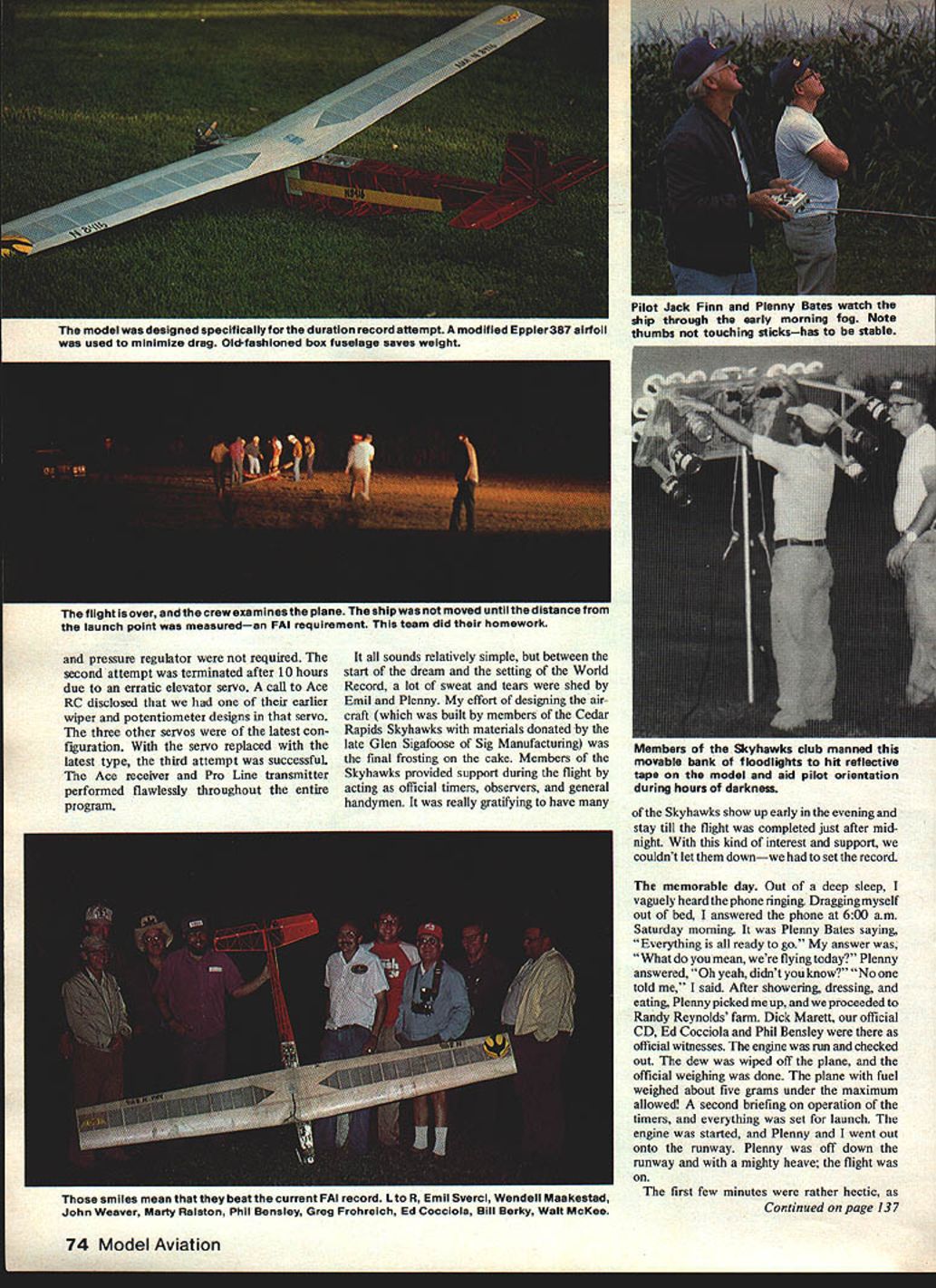
The engine selected was an OS Max .60, blueprinted by Glen Dye of Minneapolis. The Max .60 carburetor was replaced with a Tarno .049 carburetor to provide maximum fuel draw and (hopefully) minimum fuel usage. Our fuel consumption exceeded our predictions and expectations. The fuel system was developed by Plenny Bates, consisting of three individual tanks mounted in the fuselage feeding a common fuel line to the engine. A 0.5-micron filter was used between the fuel tanks and the engine (this filter is used in the medical profession).
An Eppler E387 airfoil modified with a flat bottom was selected to provide maximum lift and minimum drag and to give a good speed range. Otherwise, the airplane consisted of simple structures.
The team and equipment
- Pilot and project leader: Plenny Bates
- Technical advisor (ignition): Emil Svercl
- Technical advice and encouragement: Maynard Hill
- Fuel and oil advisor: Don Lindley (Standard Oil)
- Engine blueprinter: Glen Dye (Minneapolis)
- Airplane builder and supporters: Members of the Cedar Rapids Skyhawks; materials donated by the late Glen Sigafoose of Sig Manufacturing
- Radio gear: Ace receiver and Pro Line transmitter (performed flawlessly)
- Servos: Initial problems with an early wiper and potentiometer design; later replaced with latest-configuration servos
Attempts and problems
The first attempt was terminated after a little over an hour due to the gasoline attacking the pressure regulator and gumming up the carburetor. Conversation with Dick Weber (who formerly held the record at 15 hours and 47 minutes) indicated that the pumps and pressure regulator were not required.
The second attempt was terminated after 10 hours because of an erratic elevator servo. A call to Ace RC disclosed that we had one of their earlier wiper-and-potentiometer designs in that servo; the three other servos were of the latest configuration. With the problematic servo replaced by the latest type, the third attempt was successful.
The Ace receiver and Pro Line transmitter performed flawlessly throughout the entire program.
The memorable day
Out of a deep sleep, I vaguely heard the phone ringing. Dragging myself out of bed, I answered the phone at 6:00 a.m. Saturday morning. It was Plenny Bates saying, "Everything is all ready to go." "What do you mean, we're flying today?" I answered. "Oh yeah, didn't you know?" Plenny answered. "No one told me," I said.
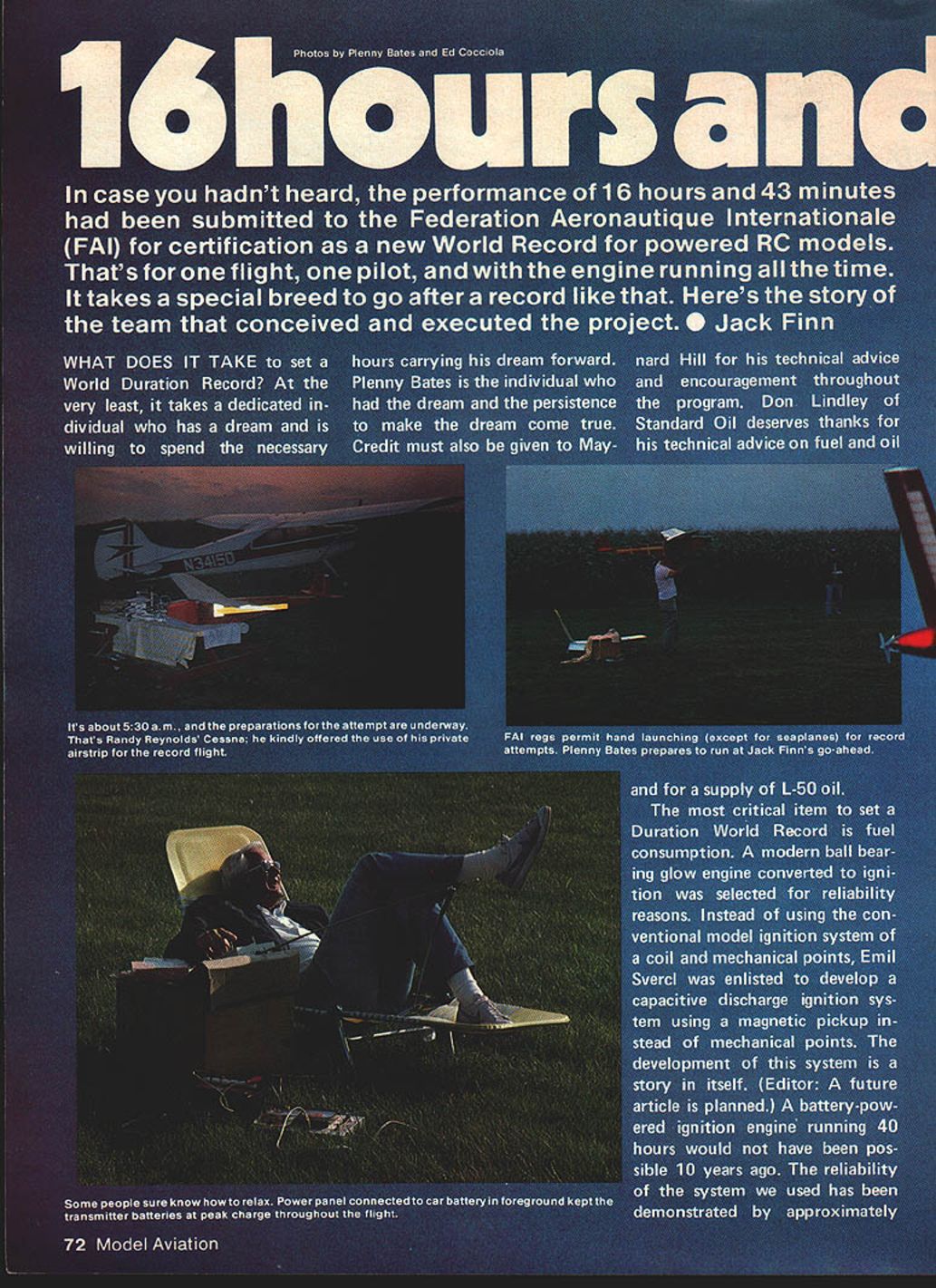
After showering, dressing, and eating, Plenny picked me up and we proceeded to Randy Reynolds' farm. Dick Marett, our official CD; Ed Cocciola; and Phil Bensley were there as official witnesses. The engine was run and checked out, the dew was wiped off the plane, and the official weighing was done. The plane with fuel weighed about five grams under the maximum allowed. A second briefing on operation of the timers was held, and everything was set for launch. The engine was started, and Plenny went out onto the runway. Plenny was off down the runway with a mighty heave; the flight was on.
The first few minutes were rather hectic, as Plenny had increased the wing incidence since the last flight and the elevator trim needed some up adjustment. The plane wanted to climb excessively, almost to a stall, and it caught me off guard. I soon got the plane trimmed out and climbed for altitude.
For the next 20 minutes everything was going smoothly, and then fog started to move through the area. I brought the plane in close. With the help of the ground crew, we kept the plane in sight until the fog cleared, about 30 minutes later. We then put the plane back out for another altitude climb. For the next hour the periodic fog would come in and then clear; each time I would bring the plane in close until I had good visual.
I lost engine operation once during this period and Plenny had to restart it from the ground.
After the fog cleared, I climbed to 400–500 feet upwind (from the west at 5 to 7 mph) and flew in wide circles. The next worry was rain. We could see real dark areas to the north and south where it obviously was raining. Dark clouds passed over us, but we didn't get any rain. This period lasted from about 9:00 to 11:00.
During the afternoon hours, large areas of lift and thermals passed through. At times I had full down trim in the elevator in order to keep the plane from climbing out of sight. The wind was so light that I would fly the plane upwind a quarter mile or so and just let it ride the lift and thermals. The thermals, as any free-flight flier knows, put the plane into a circling flight path. I would let it drift around until it got close to me, then fly it upwind and repeat the process. Lift and thermals are always followed by down air, so I would let the plane come down to 200–300 feet before applying full power and again climbing to 500–600 feet. This sequence continued for the rest of the afternoon.
Night flying and landing
The next critical period was at dusk. My glasses are "photo grey," which become quite dark during the day. At dusk I was still looking skyward, so my glasses stayed dark when it was still fairly light. With the help of Wendell Maakenstad as my second pair of eyes, we transitioned into the night hours.
To see the plane at night, reflective tape had been placed on the fuselage sides, the bottom of the wingtips, and the bottom of one side of the elevator. In addition, a strobe light was mounted inside the fuselage, which could be turned on or off. A bank of spotlights was mounted on a stand that could be manually swivelled to follow the plane. Greg volunteered to operate the lights, and he did a great job. I moved up to just behind the light stand — with a blanket between me and the lights to eliminate the back glare.
Since I had never flown an RC model at night, this was a new experience. One mistake we made was not placing reflective tape on the leading edge of the wing. I was flying the plane in circles, and when the plane was heading straight at the lights it almost disappeared. This was scary, so I tried to minimize the head-on time by flying larger circles and varying the headings left and right.
Another unexpected situation came up from about 9:00 to 11:00 — night thermals and downdrafts. Being a free-flighter as well as an RC flier, I was aware that thermals exist at night, but I never expected them to be so strong. I had to use full down trim and hold additional down elevator to keep the plane low enough for the spotlights. Several times, when the plane was at about 100 feet altitude, it hit strong updrafts at the intersection of a bean and corn field. It took full down elevator to keep the plane from stalling.
We had a scare during this time: the engine almost died. Quickly going to full throttle cleared the problem, but it really put a scare into the crew. The last hour was great. The air became stable, and full darkness had set in. I could then circle at about 100 feet altitude, and the light operator could track the aircraft much easier.
Once the new record had been set, a decision was needed about how long to continue. I asked what time it was, then decided to fly to midnight, which meant the flight started on Saturday morning and ended on Sunday. Once we passed midnight, I set up for landing.
We had two cars down the runway with their headlights on facing away from my position. I moved our car in front of the lights, planning to set the plane down 50 to 100 feet in front of the light stand. Wendell Maakenstad was with me. The first pass was too high and fast, so Wendell said to go around. We were flying off a friend's private airstrip (60 feet wide) with tall Iowa corn on both sides. On the go-around, I cleared the corn by about 10 feet until the final approach. On the turn to final, I was about two feet above the corn. With the engine at full idle, I lined up on the runway with the plane heading toward me. The car lights and the tracking lights provided enough light to see it at low altitude. The plane still had flying speed and required some down elevator. When it was about 75 feet out, Wendell said to set it down, so the flight ended with a touch of down elevator.
There was only one period when I was really worried (aside from when the engine almost quit). That was between 10:00 and 11:00 p.m. when I became tired. My normal bedtime is around 10:00, and the body was saying, "Why are we still up?" It was during this period when Wendell's help really saved the day. He was not aware that I had completely lost sight of the plane several times and that I occasionally saw six reflective tapes instead of three. Each time he told me what the plane was doing and what control input to use. After 11:00 p.m., I got my second wind and was wide awake for the rest of the flight.
All in all, this has been a great experience — one I will never forget.
Editor’s Note
Before we could get this article into print, we were informed that Maynard Hill has recorded an even better performance for RC powered duration models which will also be submitted to the FAI for certification as a new World Record. However, this in no way diminishes the real achievement by Jack Finn and the others named in the article. A report on Maynard Hill's feat is planned for a future issue.
Transcribed from original scans by AI. Minor OCR errors may remain.

