
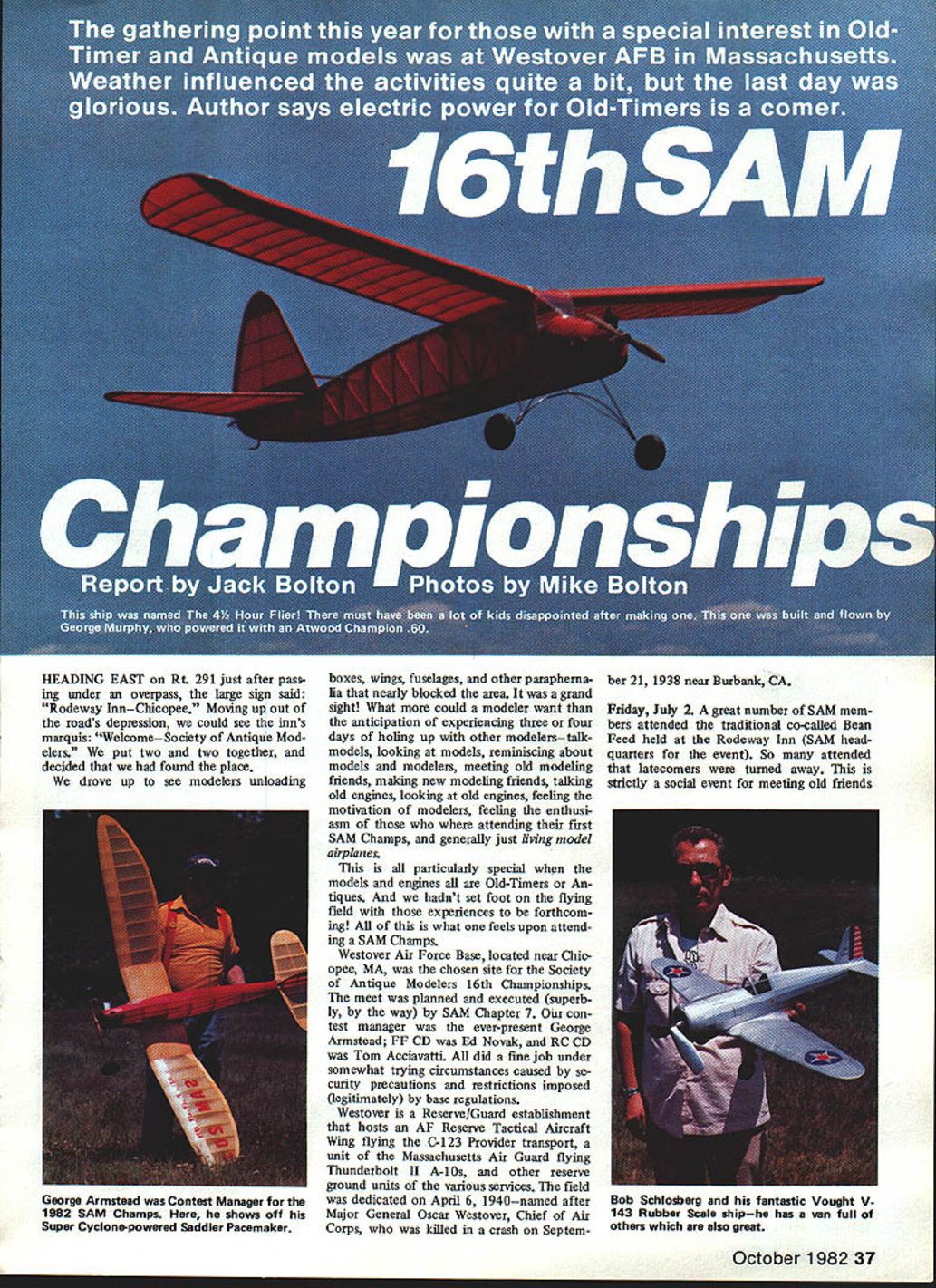
16th SAM Championships
Report by Jack Bolton Photos by Mike Bolton
The gathering point this year for those with a special interest in Old-Timer and Antique models was Westover AFB in Massachusetts. Weather influenced the activities quite a bit, but the final day was glorious. Electric power for Old-Timers proved to be a comer.
Venue and organizers
Westover Air Force Base, near Chicopee, MA, was the site for the Society of Antique Modelers 16th Championships. The meet was planned and executed by SAM Chapter 7. Contest manager was George Armstead; Free Flight Contest Director (FF CD) was Ed Novak; Radio Control Contest Director (RC CD) was Tom Acciavatti. They did a fine job despite security precautions and base restrictions.
Westover is a Reserve/Guard establishment that hosts an AF Reserve Tactical Aircraft Wing flying the C-123 Provider transport, a Massachusetts Air Guard unit flying A-10 Thunderbolt IIs, and other reserve units. The field was dedicated on April 6, 1940, and named after Major General Oscar Westover.
Heading to the meet
Heading east on Rt. 291 just after passing under an overpass, the large sign said: "Rodeway Inn—Chicopee." Moving up out of the road's depression, the inn marquee read: "Welcome—Society of Antique Modelers." We found the place. Modelers were unloading boxes, wings, fuselages, and other paraphernalia that nearly blocked the area. It was a grand sight and a marvelous anticipation of three or four days holed up with fellow modelers—talking and looking at models, reminiscing, meeting old friends and making new ones, and sharing enthusiasm for old engines and aircraft.
Event report
Friday, July 2
A large number of SAM members attended the traditional Bean Feed held at the Rodeway Inn (SAM headquarters for the event). So many attended that latecomers were turned away. The Bean Feed is strictly a social event for meeting old friends. It was held poolside with linen tablecloths and napkins; the food was excellent and the camaraderie great. The evening turned cool, but antifreeze (and animated conversation) provided warmth. Visiting English members Brian Cook and Sid Sutherland thought we were having a heat wave!
Saturday, July 3
Morning arrived bright and cool. The meet was scheduled to start at 9 a.m. Free Flight fliers arrived earlier for testing. Winds picked up, generally running 8–13 knots throughout the day. RC fliers enjoyed booming-up flight after flight; Free Flight (FF) fliers had a tougher time, with prevailing winds across the narrowest portion of the contest area. Numerous models dethermalized into trees; some were retrieved late Monday afternoon. Wind-induced crashes were relatively few, and both RC and FF wind direction and velocity were manageable.
At noon the Baby ROG (Rise Off Ground) Free Flight event was held: a one-flight mass-launch where the winner is the last down. In ten-knot-plus winds it was quite a sight: helpers lined across the runway, tiny machines were launched and promptly behaved like Keystone Kops—dodging legs and faces, buzzing like angry bees.
SAM Chapter 7 included in the Free Flight schedule Small (to .24 cu. in.) and Large (.24 to 1.20 cu. in.) cabin events. Small Pylon was flown on Saturday. SAM 7 also provided events for modelers without ignition engines, and indications were favorable.
The RC side of the field was thoroughly enjoying events, particularly 1/2A Texaco and Class C ignition. Straight RC Old-Timer/Antique requires excellent eyesight—the models are often big and flown high. The author recalls loving this game in 1973–74 but notes the models felt smaller back then.
At noon the Miniature Engine Collectors Association (MECA) met at the Rodeway for their Collectogether. It was a fine gathering with excellent displays and engines for swap or sale. Prices ranged from about $70 to $110; while high compared to original $17–$25 prices, those were 40 years ago. The session closed around 10:30 p.m.
Sunday, July 4
Sunday was cool and overcast. Winds were 10–20 knots, and at times the FF line looked like a demolition derby. The .020 Replica event suffered many crashes. The Compressed-Air fliers skipped the day, though their event was scheduled each day so they could pick a better day.
Free Flighters got a break as the wind direction shifted down the long axis of the allowable flying area. The far end of the area was a runway being repaved; retrieval beyond that point required permission from Base Security and the control tower and an escort, which delayed some model retrievals. A Security guard quipped that models should land farther west; a flier joked he could shift the wind if they did.
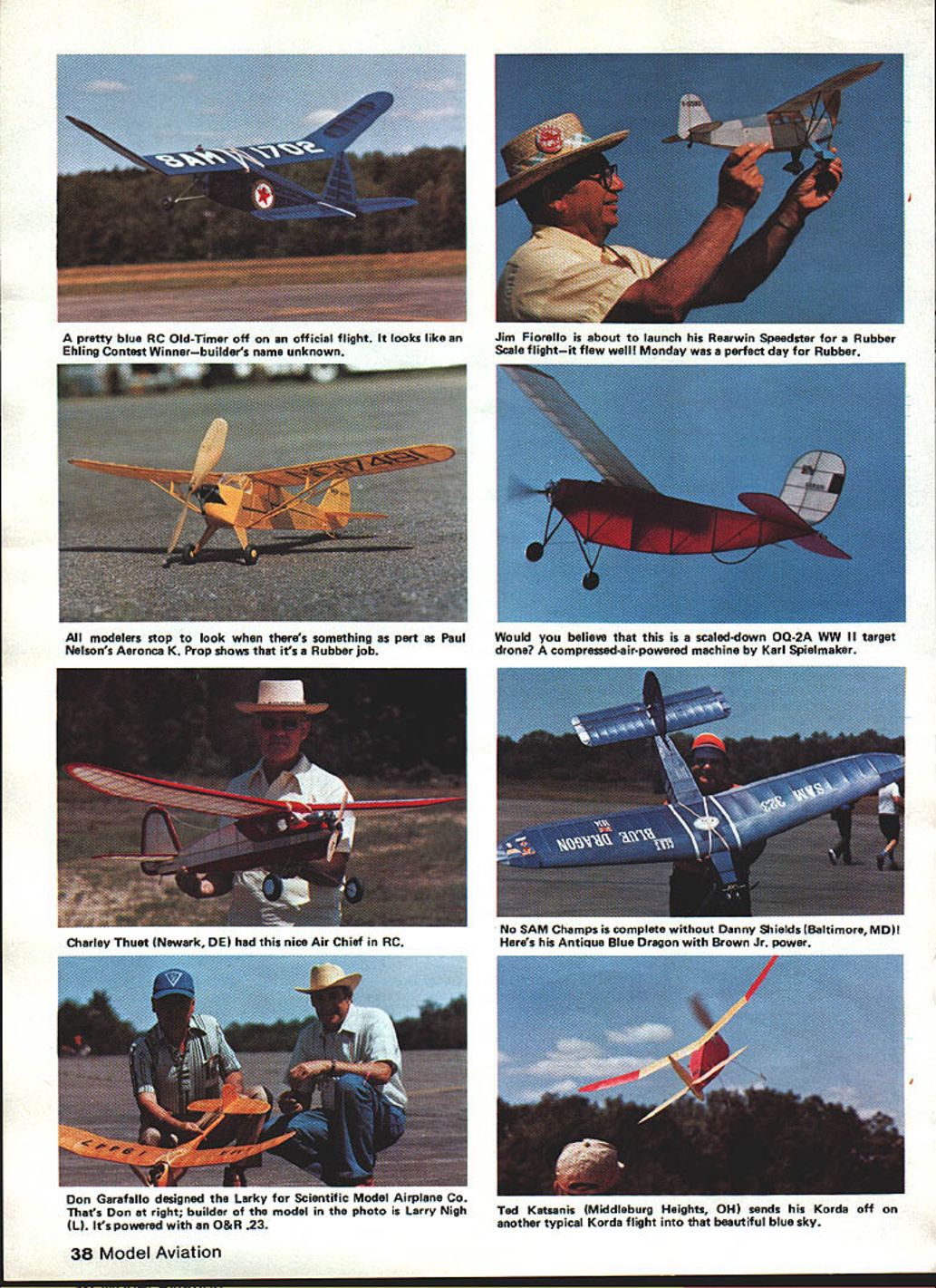
Karl Spielmaker was caught by the wind after ROGing his O&R .23-powered Megow Ranger. A gust flipped a wing, the Ranger looped and ended in the grass at about a 40-degree angle. It homed in on Bob Moulton's large Record Breaker rubber cabin model, which ended up shredded. The Ranger sat on its wheels with a busted prop, like a proud cat that had brought in a field mouse. The scene was comic as the two fliers—old friends who once lived in the same town—recovered their models.
The Twin Pusher event was held at noon as a single mass launch. Most did well despite the wind; more than ten Twin Pushers participated and only one had a problem. Winner was Dave Dodge.
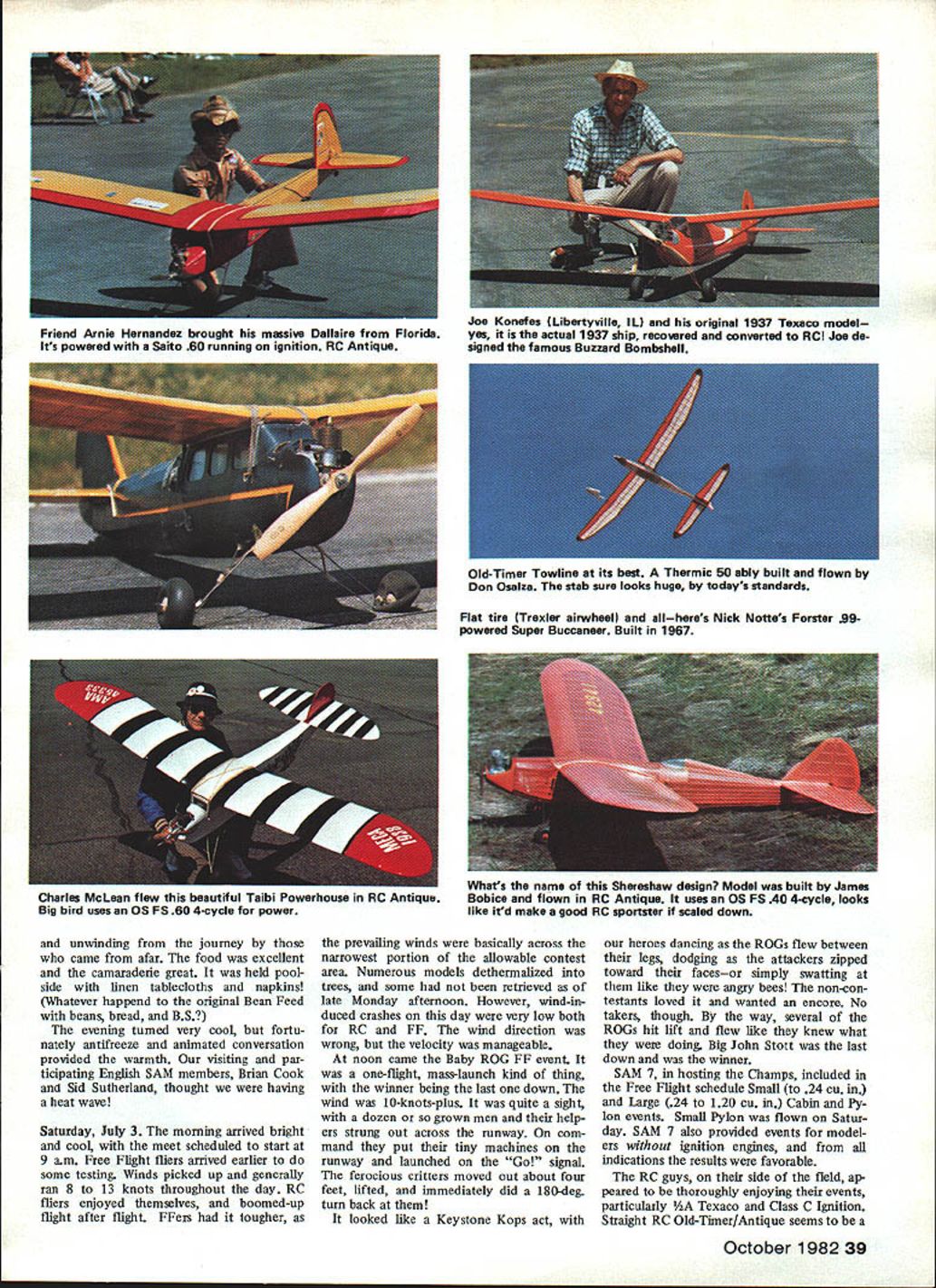
High winds affected the RC side too, causing problems with downwind turns and dead-engine approaches. Wind-induced crashes were higher than Saturday, mostly in the Antique event. The larger, heavier types fared best. The RC flight line was spectacular with huge pre-1939 models—Dallaires, Quakers, Cumuluses, Trenton Terrors, Miss Delawares, etc. One Miss Delaware was especially beautiful; the flier was from Delaware.
The Rodeway hosted the SAM business meeting on Sunday evening. Afterwards, British guests were thanked for the local fireworks display arranged in honor of their visit.
Monday, July 5
Monday was beautiful, bright, and clear with light, variable winds—a modeler's delight. Wind rarely rose above 4 knots. Thermals were booming, especially morning through noon, as the sun heated the ground cooled on previous days. Flying conditions were excellent. A hand-launched (HL) glider towed aloft logged 20–30 minutes while remaining near the launch site.
The Compressed-Air group showcased their models in low-wind conditions; the big, fragile birds lazily made qualifying flights and were a grand sight. John Stott topped the Compressed-Air entries.
One Free Flight after another maxed and landed only yards from the takeoff site. Rubber Scale was delightful; many small models flew like things of beauty, many maxing at two minutes.
Two notable RC events were saved for this fine day. Electric RC demonstrated that large models can be flown seriously with electric power—the motors were impressive and handled the large models extremely well. Texaco (full-size) was spectacular: Dallaires and others climbed slowly with engines throttled for maximum engine run. Chester Lanzo, flying his own Lanzo Boomer powered by a Super Cyclone .60, won with a time of over 45 minutes. Four-cycle engines also proved capable, finishing as top placers and producing a great sound in flight.
All in all, it was a fantastic flying day and a fitting end to the 1982 SAM Champs.
Results and reflections
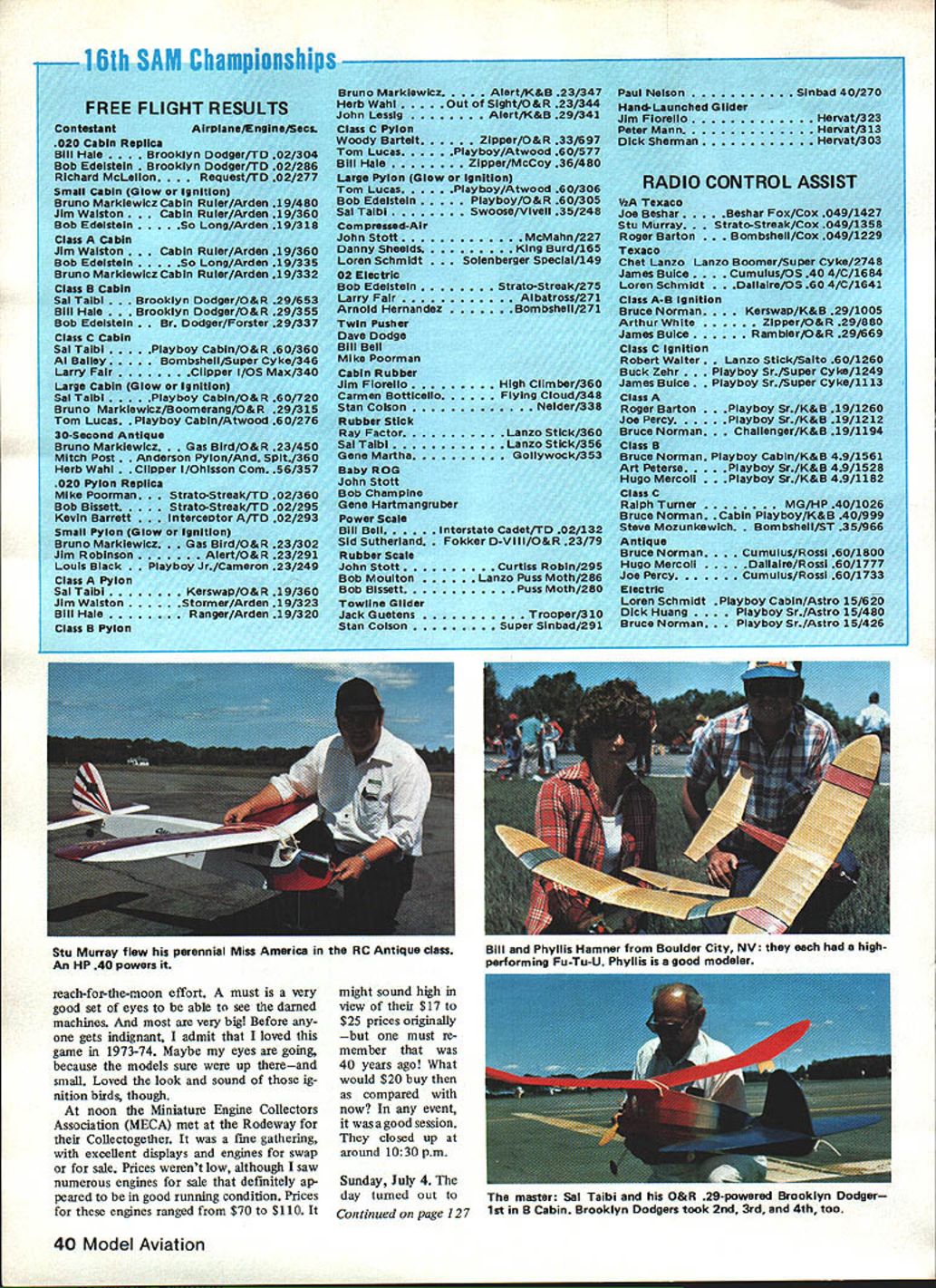
- High-point winners: Bruce Norman (RC) and Bruno Markiewicz (FF). Each received a Herb Wahl Ohlsson Gold Seal .60 engine donated by Herb Wahl.
- Fond memories: seeing friends and modeling greats in action, including:
- Sal Taibi
- Henry Struck
- Chester Lanzo
- Mike Granieri (new SAM president)
- Don Garafallo
- Joe Konefes and his brother Ed
Highlights included Larry Nigh of Ames, IA, meeting Don Garafallo (designer of Larry's Scientific Larkey) and Jim Walston meeting Henry Struck (designer of Jim's Cabin Ruler). These moments were personal memories to add to the author's file.
Next year's SAM Champs is planned for Denver, CO. Don't miss it.
Transcribed from original scans by AI. Minor OCR errors may remain.

