
1911 Voisin Hydroplane
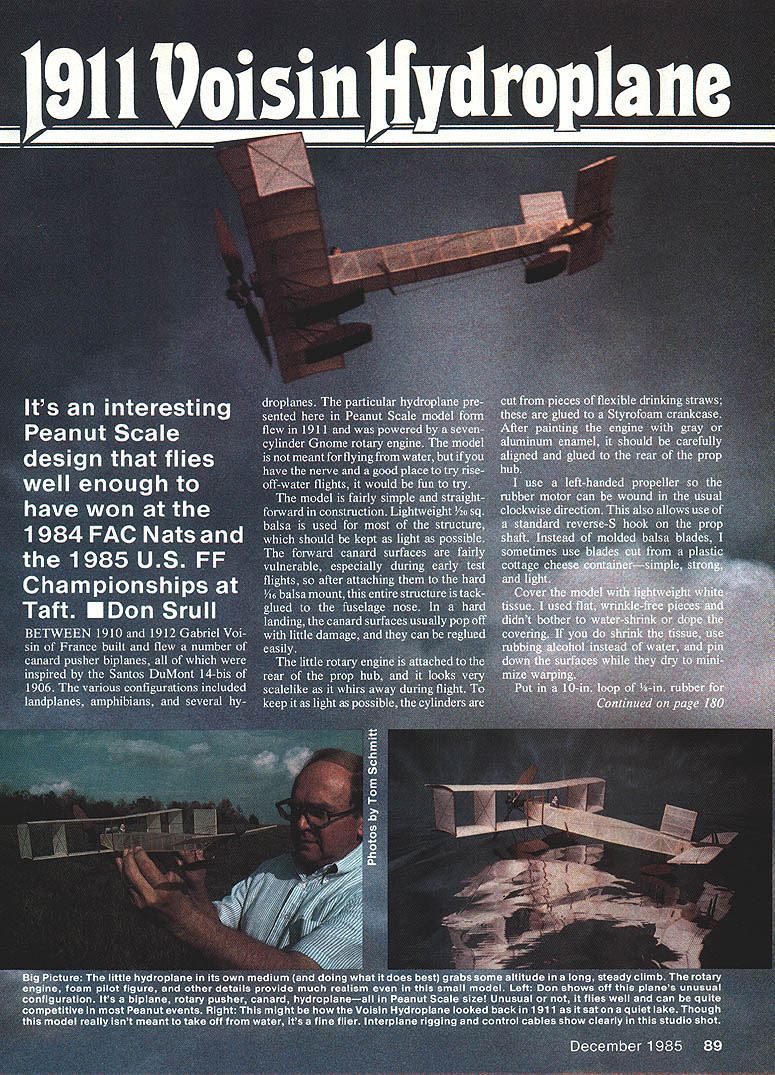
It's an interesting Peanut Scale design that flies well enough to have won at the 1984 FAC Nats and the 1985 U.S. FF Championships at Taft. Between 1910 and 1912 Gabriel Voisin of France built and flew a number of canard pusher biplanes, all inspired by the Santos-Dumont 14-bis of 1906. The various configurations included landplanes, amphibians, and several hydroplanes. The particular hydroplane presented here in Peanut Scale model form flew in 1911 and was powered by a seven-cylinder Gnome rotary engine.
The model is not meant for flying from water, but if you have the nerve and a good place to try rise-off-water flights, it would be fun to try. The model is fairly simple and straightforward in construction. Lightweight 3/32" sq. balsa is used for most of the structure, which should be kept as light as possible.
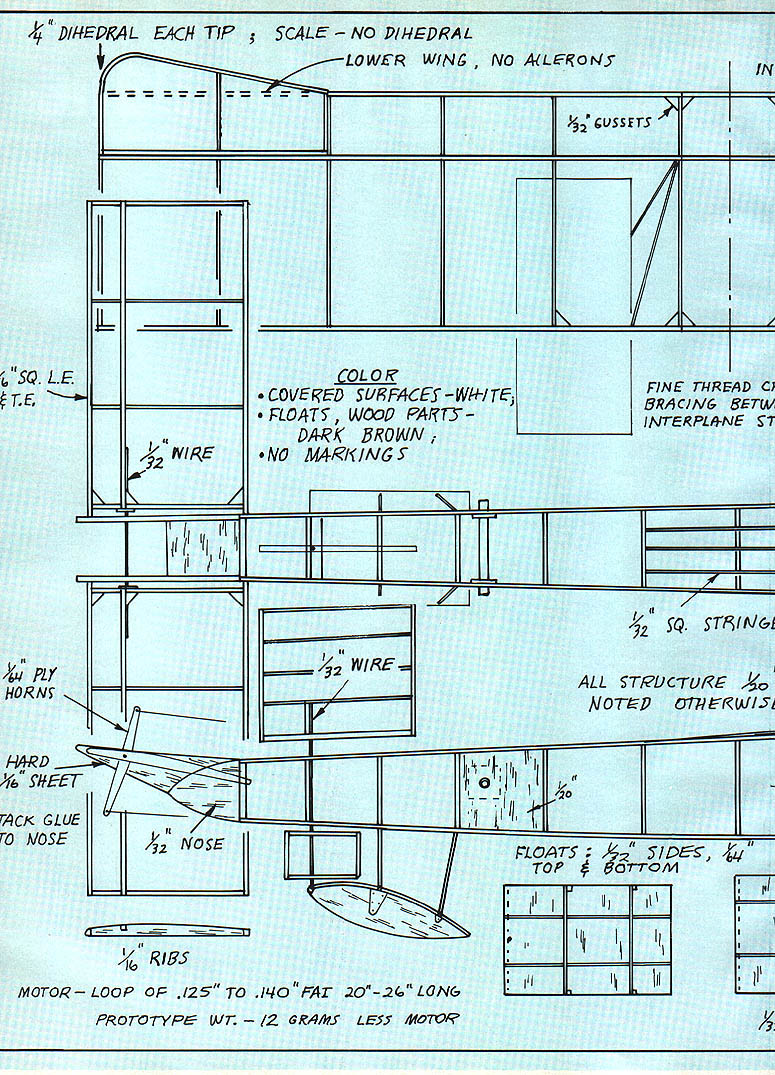
The forward canard surfaces are fairly vulnerable, especially during early test flights. After attaching them to the hard 1/16" balsa mount, tack-glue this entire structure to the fuselage nose. In a hard landing the canard surfaces usually pop off with little damage and can be reglued easily.
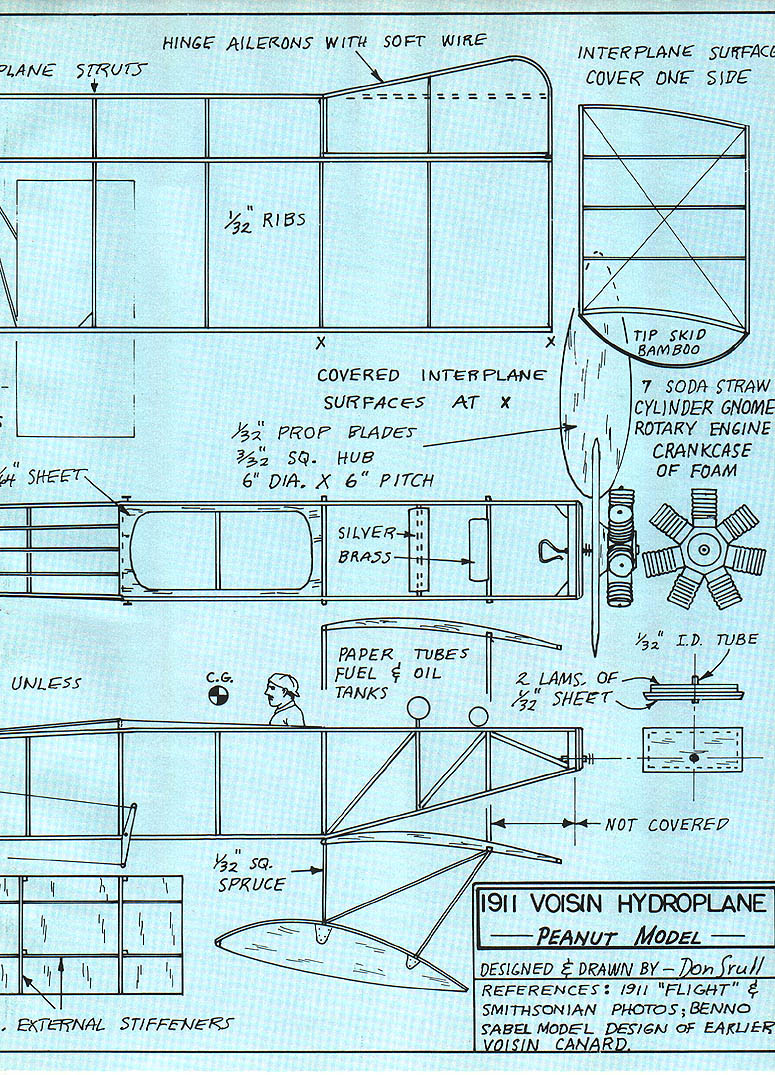
The little rotary engine is attached to the rear of the prop hub and looks very scale-like as it whirs away during flight. To keep it light, the cylinders are cut from pieces of flexible drinking straws and glued to a Styrofoam crankcase. After painting the engine with gray or aluminum enamel, carefully align and glue it to the rear of the prop hub.
I use a left-handed propeller so the rubber motor can be wound in the usual clockwise direction. This also allows use of a standard reverse-S hook on the prop shaft. Instead of molded balsa blades, I sometimes use blades cut from a plastic cottage-cheese container — simple, strong, and light.
Cover the model with lightweight white tissue. I used flat, wrinkle-free pieces and didn't bother to water-shrink or dope the covering. If you do shrink the tissue, use rubbing alcohol instead of water, and pin down the surfaces while they dry to minimize warping.
Put in a 10" loop of 1/8" rubber for the motor — loop diameter: 10"; rubber: .125" to .140" FAT, 20"–26" long. Prototype weight: 12 grams less motor.
Materials & Parts
- All structure 1/16" unless noted otherwise
- 3/32" sq. balsa (most structure)
- Hard 1/16" sheet — tack-glue to nose
- 1/32" nose
- 1/16" ribs
- Floats: 1/32" sides, 1/64" top & bottom
- 1/32" sq. stringer
- 1/32" gussets
- 1/32" ribs (interplane and elsewhere)
- 1/32" sq. spruce (external stiffeners)
- 1/64" ply horns
- 1/32" I.D. tube
- 1/32" prop blades (sometimes plastic)
- 3/32" sq. hub
- 1/32" sheet (2 laminations where noted)
- 1/32" plywood for some fittings
- Tip skid: bamboo
- Hinge ailerons with soft wire
- 1/64" or 1/32" as required for small details
Engine and accessories
- 7 soda-straw cylinders for Gnome rotary engine (cylinders cut from flexible drinking straws)
- Crankcase of foam (Styrofoam)
- Paper tubes for fuel & oil tanks
- 6" dia. x 6" pitch propeller (left-handed)
- Silver brass small parts as needed
Construction Notes
- Lower wing: no ailerons.
- Interplane surfaces: cover one side; covered interplane surfaces at X (see plans).
- Plane struts: as shown on plans.
- Tip dihedral: 1/4" dihedral each tip; scale has no dihedral.
- 1/32" gussets at joints.
- Use 1/32" sq. stringers for float structure.
- Floats: 1/32" sides, 1/64" top & bottom.
- External stiffeners: 1/32" sq. spruce.
- Do not cover some indicated surfaces unless noted otherwise on the plans.
- Use 1/32" ply or appropriate hard mounts for fittings and horns.
Color and Finish
- Covered surfaces: white tissue.
- Floats and wood parts: dark brown.
- No markings specified.
Weight & Rubber Motor
- Motor rubber: .125" to .140" FAT, 20"–26" long (loop 10").
- Prototype weight: 12 grams less motor.
Trimming and Flight Testing
- Add clay to get the center of gravity (CG) at the point shown on the plans.
- Adjust the model to turn in wide circles against torque (to the left with a left-handed prop) by means of the forward rudder and ailerons.
- As with most canards, this little model can handle as much power as you wish to use. With larger motors, you can achieve exhilarating, high-climbing flights.
Finishing Materials — Weight Estimate
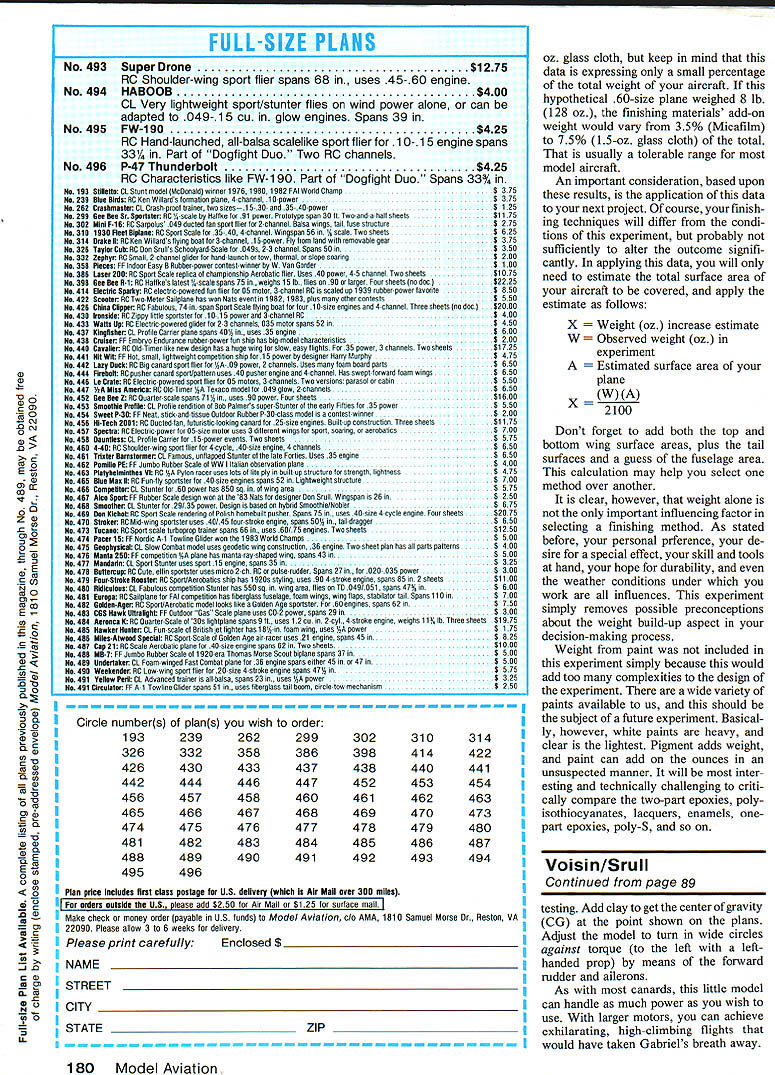
The weight added by finishing materials (tissue, dope, paint, cloth) is only a small percentage of the total weight of your aircraft. For example, on a hypothetical 60-lb. full-size plane that weighed 8 lb. (128 oz.) when scaled, finishing materials' add-on weight might vary from about 3.5% (light tissue methods) to 7.5% (1.5 oz. glass cloth). That range is usually tolerable for most model aircraft.
To estimate the weight increase for your project, use the following formula:
X = (W × A) / 2100
Where:
- X = estimated weight increase (oz.)
- W = observed weight (oz.) in the experiment
- A = estimated surface area of your plane (square inches)
Don't forget to add both the top and bottom wing surface areas, plus the tail surfaces and an estimate for the fuselage area.
Note: Weight alone is not the only factor in choosing a finishing method. Consider personal preference, desired effects, available skills and tools, durability, and work conditions. Paint was not included in the referenced experiment because of the wide variety of paints and their differing weights. In general, white paints are heavier and clear finishes are lighter; pigment adds weight. Comparing types (two-part epoxies, polyester, lacquers, enamels, etc.) would be a useful separate experiment.
Designer, References, Credits
- Peanut model designed & drawn by Don Srull
- References: 1911 Flight and Smithsonian photos; Benno Sabel model design of earlier Voisin canard
1911 Voisin Hydroplane — Peanut model
Transcribed from original scans by AI. Minor OCR errors may remain.

