
From 1944: Whirlaway Revisited
Dick Miner
Pardon the pun, but it was receiving an old ignition engine as a gift that "sparked" this re-creation of a 1940s control-line model.
Some time back a friend gave me a Vivelle .35 model airplane engine. For those of you too young to remember, the Vivelle is an old gasoline-and-ignition engine that was popular during the 1940s. The engine I received was basically OK but needed some tender loving care. To make a long story short, it needed a spark plug, timer arm, new set of points, gasket—and of course the usual coil, condenser, and battery. With the resurging interest in ignition engines, these components can be found today at many hobby shops and through the ads in modeling magazines.
Needed refurbishment parts:
- Spark plug
- Timer arm
- New set of points
- Gasket
- Coil, condenser, and battery
To keep in the spirit of things, I decided the only proper airplane in which to mount my refurbished Vivelle would have to be an airplane from its own era. With that in mind, I went to the Smithsonian Air and Space Museum Library in Washington, D.C., to pick through back issues of Air Trails magazine dating from 1940 to 1950. The library has many periodicals on model aviation, some current and some no longer published. In the May 1944 issue I finally found a tethered (what we now call control-line) racer called the Whirlaway designed by Alfred Pardocchi.
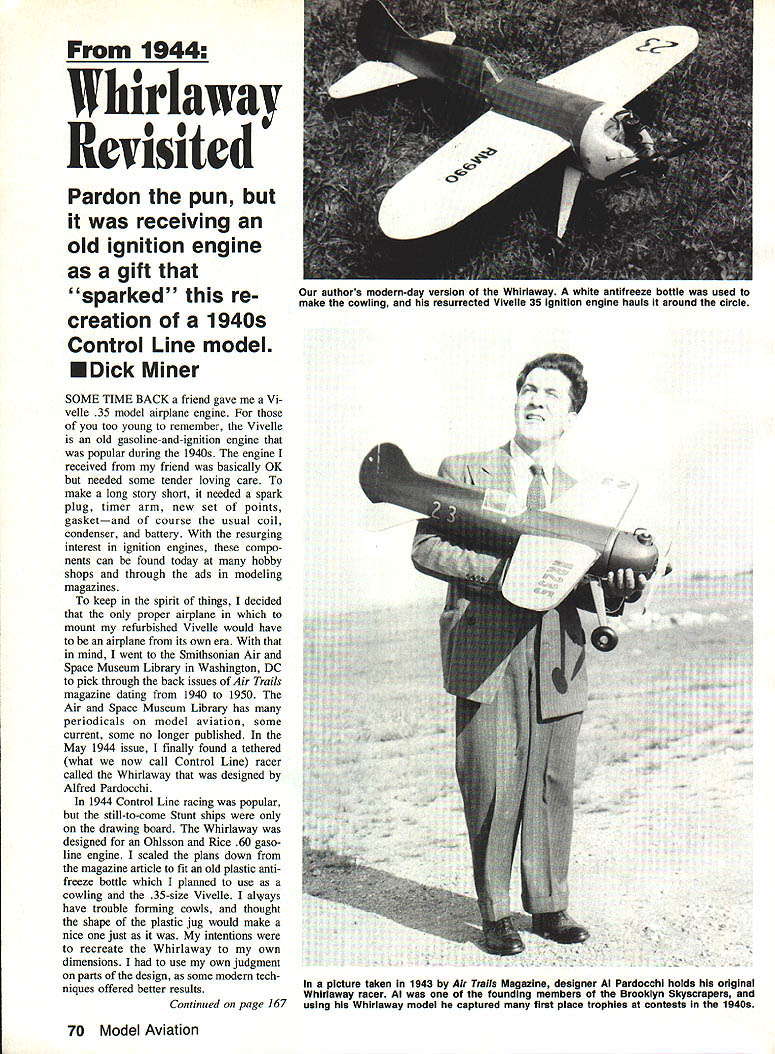
In 1944 control-line racing was popular, though stunt ships were still only on the drawing board. The Whirlaway was designed for an Ohlsson and Rice .60 gasoline engine. I scaled the plans down from the magazine article to fit an old plastic antifreeze bottle I planned to use as a cowling and to suit the .35-size Vivelle. I always have trouble forming cowls and thought the shape of the plastic jug would make a nice one as it was. My intentions were to recreate the Whirlaway to my own dimensions; I used my judgment on parts of the design where modern techniques offered better results.
My version resulted in a 34 in. wingspan. With the Vivelle .35 it was a bit underpowered, but the performance was acceptable as long as I did not try to stunt. Do remember that the Whirlaway was a racer, not a stunter.
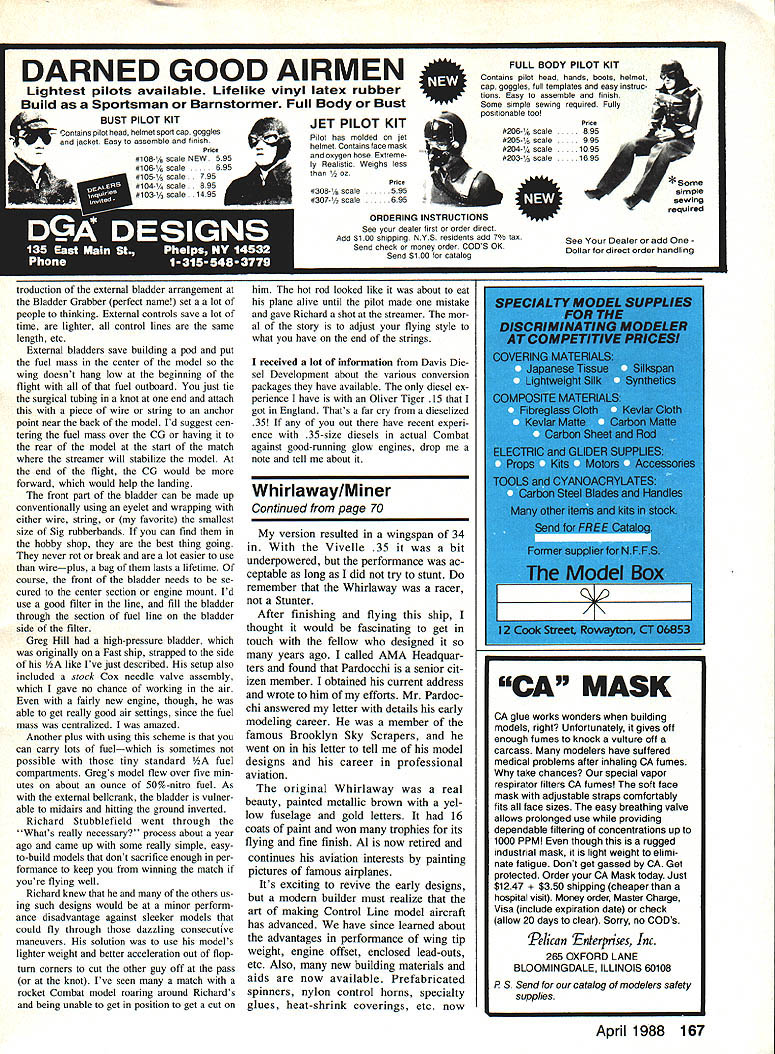
After finishing and flying the ship, I thought it would be fascinating to get in touch with the fellow who designed it so many years ago. I called AMA Headquarters and found that Pardocchi is a senior member. I obtained his current address and wrote to him about my efforts. Mr. Pardocchi answered with details of his early modeling career. He was a member of the famous Brooklyn Skyscrapers and went on to tell me of his model designs and his career in professional aviation.
The original Whirlaway was a real beauty, painted metallic brown with a yellow fuselage and gold letters. It had 16 coats of paint and won many trophies for scale flying and fine finish. He is now retired and still continues his aviation interests by painting pictures of famous airplanes.
It's exciting to revive the early designs, but a modern builder must realize that the art of making control-line model aircraft has advanced. We have since learned about the advantages in performance of wingtip weight, engine offset, enclosed lead-outs, etc. Also, many new building materials and aids are now available, such as:
- Prefabricated spinners
- Nylon control horns
- Specialty glues
- Heat-shrink coverings
These now make it easier to produce a model that will equal or surpass the workmanship of those days.
Construction details: the fuselage is built-up construction with ply formers and sheeted top and bottom. The wing is a single-piece type built up around two spruce spars, balsa ribs, and sheeted with 1/16 in. balsa. I used a 1/16 in. plywood bottom center section to mount the lead-outs and bellcrank. The tail surfaces are 1/8 in. balsa sheet. The O&R .60 originally used a "tail-dragging" type tailwheel; I used a small wheel for ground handling that I could remove for flying. The engine I used was the Vivelle .35 with a timer ignition. The cowling was made from a plastic antifreeze bottle as mentioned earlier. I fabricated a spinner to fit the smaller engine and used a 6-1/2 in. prop.
For the control system I used a standard bellcrank with 1/16 in. music wire lead-outs. The lines were tapered to reduce drag. For balance, I located the CG at 25% of the wing chord. The model weighs 28 ounces ready to fly. Flight trimming was straightforward—power on, small right thrust and slight down thrust to counteract torque and pull. The model flew true in circles and showed good speed for a .35. It landed in a series of easy descending turns.
I took the model to a couple of local contests and was surprised at the interest it generated. Old-timers remembered the original Whirlaway and newcomers liked the elegant lines. It isn't often that you see a model with such classic lines. The Vivelle drew a crowd—its distinctive ignition "pops" and the vintage look made it a conversation piece.
If you wish to build your own Whirlaway, study the original plans and consider scaling to your engine size. Using today's materials and methods will save time and improve performance, but try to keep the spirit and appearance of the original. The little details—paint, pilot figure, and finish—make the difference.
I hope this revisitation encourages others to look back to the early days of our hobby and bring some of the classic designs back into the flying circles.
Dick Miner
Transcribed from original scans by AI. Minor OCR errors may remain.

