
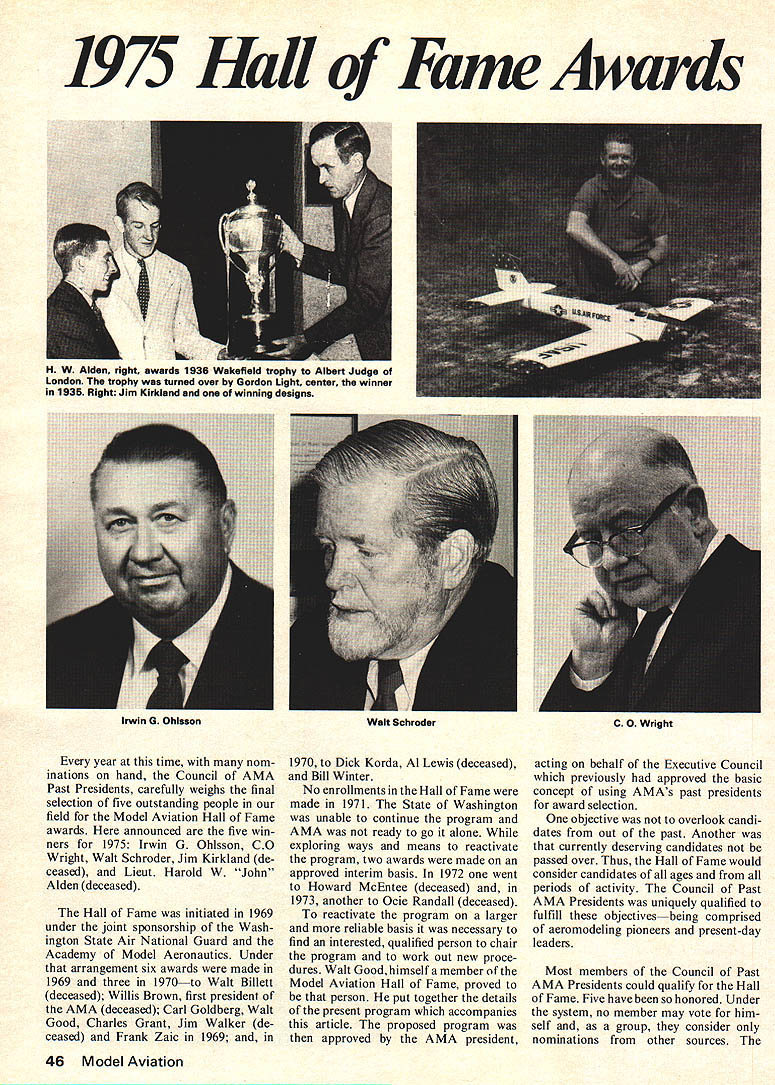
1975 Hall of Fame Awards
Every year at this time, with many nominations on hand, the Council of AMA Past Presidents carefully weighs the final selection of five outstanding people in our field for the Model Aviation Hall of Fame awards. Here announced are the five winners for 1975: Irwin G. Ohlsson, C. O. Wright, Walt Schroder, Jim Kirkland (deceased), and Lieut. Harold W. "John" Alden (deceased).
The Hall of Fame was initiated in 1969 under the joint sponsorship of the Washington State Air National Guard and the Academy of Model Aeronautics. Under that arrangement six awards were made in 1969 and three in 1970 — to Walt Billett (deceased); Willis Brown, first president of the AMA (deceased); Carl Goldberg; Walt Good; Charles Grant; Jim Walker (deceased) and Frank Zaic in 1969; and, in 1970, to Dick Korda, Al Lewis (deceased), and Bill Winter.
No enrollments in the Hall of Fame were made in 1971. The State of Washington was unable to continue the program and AMA was not ready to go it alone. While exploring ways and means to reactivate the program, two awards were made on an approved interim basis. In 1972 one went to Howard McEntee (deceased) and, in 1973, another to Ocie Randall (deceased).
To reactivate the program on a larger and more reliable basis it was necessary to find an interested, qualified person to chair the program and to work out new procedures. Walt Good, himself a member of the Model Aviation Hall of Fame, proved to be that person. He put together the details of the present program which accompanies this article. The proposed program was then approved by the AMA president, acting on behalf of the Executive Council, which previously had approved the basic concept of using AMA's past presidents for award selection.
One objective was not to overlook candidates from out of the past. Another was that currently deserving candidates not be passed over. Thus, the Hall of Fame would consider candidates of all ages and from all periods of activity. The Council of Past AMA Presidents was uniquely qualified to fulfill these objectives — being comprised of aeromodeling pioneers and present-day leaders.
Most members of the Council of Past AMA Presidents could qualify for the Hall of Fame. Five have been so honored. Under the system, no member may vote for himself and, as a group, they consider only nominations from other sources.
The present Council includes the following members and dates of AMA Presidency: Irwin G. Ohlsson 1943-46; C. O. Wright 1948-49; Kenneth G. Held 1950-51; Frank B. Bushey 1952; Keith H. Storey 1953-56; Claude McCullough 1957; Dr. Walter Good 1958-60; Peter J. Sotich 1961-62; John Worth 1963; Maynard L. Hill 1964; Howard E. Johnson 1965-66; Clifford G. Weirick 1967-68; John E. Patton 1969-70; John E. Clemens (incumbent). Note: Willis C. Brown 1936-37 served on the current committee until his passing in June this year — his last bit of service.
Lieut. H. W. "John" Alden (deceased)
Now real oldtimers can recall an important person who, during the late Twenties and early Thirties, promoted model aviation, worked hard and contributed until a break in health compelled retirement from the field. A leader in the noblest sense of the word, very few leaders indeed may safely be said of him. He may have been the one without whom the Academy of Model Aeronautics — or at least its birth — would have been deferred to a later date, perhaps with a different set of objectives. His great achievement overshadows the things he did to put organized model aviation on its feet, but everything he did was quietly heroic in nature.
Ridgefield, N.J., Harold W. "John" Alden was in charge of Youth Aviation for the National Aeronautic Association, the Academy's biggest division. In 1928 NAA co-sponsored the National Model Airplane Meet and for a number of years, as model aviation boomed to such an extent, the NAA was swamped with correspondence from modelers. It fell to John Alden to take over. He did not flinch or fail; he formulated goals and ideas still sound and inspiring today. He became the first Secretary-Treasurer when the new AMA was founded in 1936. The AMA was formed during the Detroit NATS in 1937 and through the early Thirties and through 1936 he conducted the day-by-day operation of the AMA headquarters. The overwork cost him his health. Though forced to retire from active modeling activity, he never lost interest in the beloved model aviation.
Willis Brown, first president of the AMA and a modeling early bird and leader in his own right, recalled Alden's efforts in this way: H. W. Alden was the moving force. His personal model-building experience and NAA connections constantly promoted model-building interests. The NAA signed H. W. Alden as Chairman of the Model Airplane Committee. Evidently NAA selected H. W. Alden for
1975 Hall of Fame Awards
this job to take the load off Bill Enyart (Bill was a 1974 Hall of Famer).
"Champion of youth aviation," Alden was called by some "the typical Boy Scout leader type." He never had an office of his own, preferring to work out of his home. NAA provided a mailing address without office in the then new Rockefeller Center Office Building (in New York City) to add to the prestige of the "American Academy of Model Aeronautics." (Note: In about 1940, Winthrop Rockefeller established in Rockefeller Center the old Air Youth program with a series of beginner-type models.)
1975 Hall of Fame Awards
"Alden was very much the leader of National contests. He saw to it that prizes and trophies were available, and NAA help provided the banquet annually..."
Frank Zaic is another old-timer who recalls working personally with Alden.
"Although there may have been a country-wide feeling in the early thirties," Frank states, "that we needed a national organization, no one volunteered to do the actual organizational work with the exception of Lieut. Alden. He became the center to which others looked for leadership... he was willing to do the work of solidifying the hopes of model builders in having their own mature organization. Without Alden, we may not have an organization as we do today...."
In Part One of the History of the Academy of Model Aeronautics appears a letter from Alden's son, John, who recounts that his father built his first model in 1908. His son still has the propeller from one of his father's twin pushers from before World War I. One wonders how much H. W. Alden did for modeling during the "dark ages" before Lindbergh's flight in 1927. Unfortunately, no scribe reported on the earlier stages of what apparently was a most intensive career in the service of others.
As far as credit for all he had done is concerned, Alden was star-crossed. We all stand deeply in his debt for his all but unknown, though significant promotion of our activity. His end was to be tragic and, typically, in the interest of his country. During and after WWII he was occupied in the defense industry and was killed on October 25, 1951 by a group of Philippine guerrillas while serving on a Navy contract in the Philippine Islands.
Jim Kirkland. It would be difficult to describe all of Jim Kirkland's contributions to model aeronautics — as a flier, a manufacturer, a designer, a magazine contributor, experimenter, contest director, a most active club man, a retailer, a distributor, an AMA officer. The list goes on. At the zenith of a still promising career, he was struck down by a heart attack, at the age of 48, on November 4, 1972. Typically, he was then ready to go with the manufacturing of his own designed Funline radio system, which was the equal of anything on the market. To the great many people who had the pleasure of his company, he was a warm friend, an unforgettable person who never hesitated to put his shoulder to the wheel. He helped many. Rhett Miller, the young flier who won the Nationals RC Pattern Event twice, in 1973 and 1974, was his protégé. Seeing Rhett's future promise, Jim, as Rhett recalls, was a most diligent and valuable coach.
Jim was, perhaps, most widely known as a flier. He was a champion of champions. It is simply not possible to enumerate the meets he entered, or won, or placed in; a listing taken from his trophies shows 65 meets alone, dozens of them first place winners. If he wasn't first, he finished near first. Among his many outstanding performances, he was a Nationals RC winner in 1963 and in 1970. In 1969 he was on the FAI team which flew in Germany where he placed ninth. In the same year he took second at the Masters R/C Tournament at Marietta, Ga. Many might recall him principally for his kit designs, almost all of them flown by nationally known contestants to wins of their own. His first, and probably most famous, was the Beachcomber, a contest classic.
Irwin G. Ohlsson began with a solid model building interest from the mid-1920s and worked steadily to bring new designs and ideas to the field. After Jim's death, Airborne Associates manufactured his Nutcracker in 1973 and, in 1974, Southern R/C Products his Mustang K. For others, it may be his magazine designs that held attention. His Beachcomber, Shoo-String, A-6 Intruder and Mustang Z appeared in Model Airplane News, his Citron in the American Modeler. Top fliers Ron Chidgey, Don Coleman, and Rhett Miller often flew Jim's designs in contests — Rhett winning a second at the 1972 Nats in Class A Pattern with one of them.
Walt Schroder, of Valparaiso, Fla., was known throughout the model aviation world as an experimenter, designer and innovator. His aircraft designs set standards for competitive aircraft configurations of today. His contributions in electronics set the stage for the modern radio control system. He was the first to win a Nationals using proportional control. His final and greatest contribution was the Funline radio system — according to those close to him.
Jim was an activist. In 1961 he established, and was president of, the Eglin Guided Mites, presently known as the Eglin Aero Modelers. At Eglin AFB in 1971, he served as the FAA team hospitality host. He edited Eglin Guided Mites meets and during 1962-63 he served as editor and publisher of the Eglin Flyer Club newsletter. Under the name of Orbit East he was a distributor in the trade. As a manufacturer he produced his own Triton kit. During the period 1964-66 he manufactured under the name Custom Products, at Metairie, La. His sponsor to the Hall of Fame, quite naturally, was the Eglin Aero Modelers.
Jim designed, developed, and field tested various items and systems advertised in the model press, including SACCS (Scaled Auxiliary Control System) in 1966; Mumo (Control System) in 1961; a Simp1-Simul servo in 1960; a Sure Fire Flight Caddy in 1970-71; a Retractable Landing Gear system used in his own design competition craft. Although the Funline System was never to be manufactured, Jim did have the opportunity of placing second with it in the 1972 Masters at Huntsville.
With all these activities it was surprising that he could also be involved, in depth, with AMA affairs. In 1963-64 he was a member of the Advisory Board for AMA Nats Advisory Committee; in 1964 served on the RC Society Committee, in 1965 as a member of the RC Contest Board. In 1967 he was a member of the RC Advisory Committee. By 1968-69 he became Vice President of District V being the thereby a member of the AMA Executive Council. At the same time he was on the AMA RC Contests Committee. In 1969 he was Chairman (at his request) of the 1970 Nats RC Planning Committee and, in 1970, served on the Hall of Fame Award Committee.
At the time of his passing the modeling press extolled him widely in their memorial notices. Individual testimonials came from far and wide but in a recent letter Don Lowe put it best in these few words: "Jim was a good friend and one to be sorely missed. He represented the best in modeling skill, professional pride and personal integrity. To those who knew him, he was friendly, outgoing individual whose whole life was centered around model aircraft.... I know no better candidate, pioneer, designer and leader than Jim Kirkland."
Irwin G. Ohlsson began with solid model building interest from the mid-1920s and went on to world fame such as very few others have seen, with the manufacture of his still famous engines which were in wide international demand. He has served in high posts as the fourth president of the Academy of Model Aeronautics from 1942 through 1945, and as a vice president of the Western District of the Hobby Industry Association of America, which post he held from 1940, the year of the formation of the HIAA, until 1945. Along the way he effectively served youth and the hobby in numerous ways. As long ago as 1929 through 1931 he taught hundreds of youngsters how to build and fly rubber-powered model airplanes under a program sponsored by the Los Angeles Times Playground and Recreation Department Program.
In 1934 he opened a hobby shop in Los Angeles and, as a side line, produced pneumatic model airplane tires and gas-powered model motors. He was an active and successful competitor. He would seem no facet of the model airplane hobby and business escaped his attention — unless it be the distribution of ends things. His name is still remembered world-wide and will be for many, many years to come. He is a still active modeler. Few indeed approach, much less match, his record. With a man like this one can only begin, as they say, at the beginning.
After that non-flying solid model carved at age seven years of age, Irwin G. Ohlsson was inspired at the age of 14 by the Lindbergh flight to Paris, as were so many others who gave impetus to the modern hobby, to attempt his first flying model in 1927, a Spirit of St. Louis. He has many such tales to tell; like the Spad which would easily fly 200 yards. Before long he was building rubber-powered models which could surpass an hour's flight duration and these he called "three-stick commercials." Then, at age 17, he was employed by the Los Angeles Times Playground Association, traveling from playground to playground providing balsa wood, glue, and rubber.
About this time Irwin and Ira Hazard began work on a contest-prepared engine which didn't prove too successful. His first engine design was a 30cc ignition engine which weighed two pounds — these engines were used in model boats. In 1934 he constructed an eight-foot-span cabin ship with which he won the California Championship. Flight time was 1 hr. 6 min. He was then only 17 years old.
In 1934 he went to a contest in Akron, Ohio, but couldn't start his engine. On the way home he stopped in South Bend, Ind., and purchased a South Bend lathe for $75.00, with a down payment of $10. His first aircraft ignition engines were constructed on this lathe and a drill press. Today it would be called moonlighting, because Irwin was then working for Douglas Aircraft in the engine division, making electrical connectors and insulators, for the DC-3. His wage was a magnificent $16.00 a week and Irwin left after six months for lack of incentive. Then he rented a building in Los Angeles where he produced engine kits and spun magnetic wheels with partner Frank Bertelle. His first run was 4,000 engines.
In 1937 Irwin again won the California State Championship using a Gold Seal engine and a Peacemaker. In 1938 the famous Ohlsson-23 was introduced, the first large-bore short-stroke engine in small stock engines. And, oh, how it could scream! The modern era in model engines had truly begun. Following the .23 came the .40, the .19 and the .29 and with them world-wide acclaim. In all, more than 1,000,000 engines were produced. After the end of WWII Irwin permitted a resumption of production, his firm made new models under the O.D. C-3 load of new engines, and the same plane often flew a load of modelers and their planes to faraway meets — such as the famed East-West Challenge Meet in Speed in 1948 at St. Louis, Mo.
In 1951 he sold his interest in the company and began producing ignitions for jet engine...
1975 Hall of Fame Awards
rockets — a spinoff of that was production of glow plugs, in which field he became one of the largest producers. Referring to him as the Henry Ford of model aviation, the Hobbies Industry Association in 1970 chose him to receive its Meritorious Award, a signal honor in the industry.
Today he is still active, flying radio-controlled models off the waters of Lake Elsinore in California. His favorite is a twin-engined Widgeon. On them all he proudly displays his AMA Number Four.
Walt Schroder may not have been Publisher of Model Airplane News today if it had not been for a 10-cent Comet kit back in 1936. The kit wasn't even his. Somehow, Walt's oldest son, only three years of age, was given the kit and, naturally, Pop, like so many dads, had to put it together. And, like so many dads, he failed. What to do? Walt had heard of a new hobby shop in Bamberger's department store in Newark, N. J. It was run by two young fellows, Nat and Irwin Polk no less, who afterwards would have a hobby department store on Fifth Avenue in New York. One of them sold Walt a dollar Megow kit for the Reawin Speedster.
Pop got this one together but with warps every which way after ten coats of colored dope. The prop, he remembers, was a hardwood dowel hub slotted to take two die-cut aluminum blades which were pressed into place. When it was finished he took it out to the local high-school football field, wound it up, placed it on the ground, and let it go. It ran along the ground, took off gracefully, swooped over the low stands to land perfectly. Presumably the warps cancelled out each other.
Given to memories, traditions, stories and love for the whole stream of things that followed, Walt recalls the episode as if it were yesterday. He didn't know it then, but he would twice be into the engine manufacturing business, twice into the kit manufacturing business — once on his own; he would own a hobby shop in Nutley, N. J., and he would be assistant editor, model editor and finally publisher of three modeling magazines. Along the way he managed plenty of modeling. As the old saying went so often, he was "bitten by the bug." Free flight was his dish and he became very proficient at it. The Jersey Javelin became his best known design. Along the way he sold many model plan articles to the magazines.
Let's begin with Walt's manufacturing background. He evidently bore down on his model building because within a few years, just before the war, he went into the business under the name of Model Developments, Inc., a Delaware corporation. It sounded great, like so many "cellar"-started businesses of that period, but his single product was the Pursuit Aire, a free-flight job produced in Glen Ridge, N. J., and advertised in MAN. Always the sentimentalist about the hobby, Walt still has the many-years dormant corporation, the seal and even the checkbook—still with $40 on account. Walt's first recollection of the kit is that one rib was missing a notch and one earnest adult showed up at his house carrying a model with one of the spars bumping over the rib. The man wanted to know the scientific reasoning.
During the war, after a time with the old Air Trails — and he swears that Bill Winter's persuasions induced him to take the post of model editor — "trapped" him into the mag business — joined Harold Hills in the old Eagle Model Airplane Co. (Walt left and later rejoined Air Trails.) He was plant supervisor and responsible for the manufacturing of kits and one of the first American diesels, the Mite. Like the Drome by Leon Shulman, it had fixed compression, and both engines appeared simultaneously. Walt's was an .09. Before, and during the early part of WWII, Walt was plant superintendent for Ben Sheershaw's machine shop which produced the Bantam engine, a spark-ignition .19 on a par with the Ohlsson which stole the show in those formative years.
It was in 1943 that Walt was beguiled into trying his hand on magazines. If all this sounds confusing, it was very much so, because Walt hopped back and forth during those years between building, running a hobby shop, working on magazines, and all the while unable to kick the lure of manufacturing things. Until this day he still builds models and, as Bill Winter recalls — the two built models together for years — they incessantly argued about design, whether Sikorsky span-covered wings leaked after the dope was aged, and which way a rubber job would turn if you kept adding power.
After the post-war demise of Eagle — numerous companies were shaken out of the tree in the trying days of postwar readjustments, and radio was coming in — Walt followed Bill through the posts on Flying Models and Model Airplane News. Walt, of course, found his home with MAN. Starting there in 1960, as editor, he is still going strong as Publisher today, years afterwards. His 18-year tenure on one magazine marks one of the longest associations in this field of one man on one magazine. The marvel of it all is that Walt seems to have been overlooked a bit too long for the Hall of Fame honors and award.
C. O. Wright. The achievements — both in public life and within modeling and the AMA — of C. O. Wright virtually defy description. Born in 1895, C. O.'s has had a remarkable career in public service, notably in the educational field — his work brought him into contact with every President of the U. S. A. since Franklin D. Roosevelt, all of whom he met personally. As an always active modeler — and to this day his workshop is laden with models and materials — he is an Honorary Fellow of the Academy and a Past President (1949-50) which makes him one of the most illustrious members ever to serve on the Executive Council.
The formidable job of compressing a great man's career into relatively few words means that we cannot provide a truly fair picture of this lovable man. C. O. is a grand old gentleman known to a great many modelers who attended the NATS and other meets which C. O. and his son Bob went to — he also has a daughter Hazel Alice. He was a hard-working contestant who thought nothing of rebuilding a smashed wing in a car to complete a winning flight. Almost always he was up among the winners, a first-place winner himself.
C. O. holds an AB and MA degree from the University of Missouri. After his undergraduate work was interrupted by service in World War I, he went on to postgraduate work at Queen's University, Belfast, Ireland, Yale, UCLA, Columbia and New York University. Yet on the modeling field he was indistinguishable from the rest of us, and often would be found sitting on a sun-baked runway in a tattered straw hat, where he chatted with any and all who came along.
It is with a feeling of guilt that we must limit ourselves to C. O.'s modeling achievements — and even here — we can barely skim the highlights. His meaningful contributions would fill pages. Asked about them, C. O. singles out as his most important work the persuasion of the Navy to sponsor the NATS for 20 to 25 years, thereby eliminating always-heavy National funding expenses to the Academy. He worked with U. S. Senator Frank Carlson of Kansas who helped C. O. make contact with the then-Secretary of the Navy Forrestal in the Pentagon to initiate sponsorship. C. O. could and did always get right to the top. Because AMA lacked funds in those early years, C. O. contributed a great deal of his own pocket in these endeavors.
With others, he was instrumental in obtaining changes in F.C.C. regulations in radio-control frequencies in order to get Citizens Band frequencies. He helped set up the Pan American (PAA)-load events. Beginning in 1939 he was a regular Nationals contestant until into the '70s. He attended many regional meets as well, and it was always more important for "his boys" to win than for his own flights to place.
Asked which things meant most to him, C. O. lists the greatest were his wins with an Antoinette in Philadelphia in 1961, at Dallas 1962, Los Angeles in 1963, and Willow Grove in 1964. Then there was his first international recognition and flight with PAA Cargo in 1955, as well as many other PAA events. He liked the "numbering" of our rubber jobs — and the helicopter events and the radio-control events.
He developed a following of boys who needed a father image, a friend, a place to create or just to whittle, experiment, talk or be silent. The numbers increased as the boys grew up and others replaced them.
Throughout his life he has continued to combine the mechanical and philosophical bent of his early youth. His professional life has been devoted — through the Kansas State Teachers Association and the National Education Association and related organizations — to the promotion of educational policies that would improve both the educational program and the profession at state and national levels. Not content with getting the laws enacted or the policies agreed upon, he went to great lengths to make them work.
He was appointed as charter member to the National Council for Accreditation of Teacher Education, and served as vice-chairman of NCATE.
The quiet listener, philosopher and scholar; debater and tenacious fighter; journalist, writer, editor; teacher and administrator as well as counselor, C. O. is an amazing admixture of wisdom, respect for others, patience, courage, who has always placed children and youth first, whether he was working for improved quality of education, higher standards in the education profession, or building model planes.
Lieut. H. W. "John" Alden (deceased). Now real oldtimers can recall an important person who labored during the late Twenties and early Thirties promoting model aviation. He worked hard until a break in health compelled retirement from the field. A leader in the noblest sense of the word, he was one of those very few leaders who may safely be said to have helped put organized model aviation on its feet. Had everything been different, perhaps the Academy of Model Aeronautics — or at least its birth — would have deferred to a later date or had different objectives. The great achievement overshadows things; he put organized model aviation on its feet by quietly heroic effort.
From Ridgefield, N. J., Harold W. "John" Alden was in charge of Youth Aviation for the National Aeronautic Association, the Academy's biggest division. In 1928 NAA co-sponsored the National Model Airplane Meet. For a number of years, as model aviation boomed to such an extent, NAA was swamped with correspondence from modelers. John Alden took over, did not flinch or fail, and formulated goals and ideas still sound and inspiring today. He became the first Secretary-Treasurer of the new AMA when it was founded in 1936 during the Detroit NATS. He co-directed the national meet during the early Thirties and through 1936 conducted the day-by-day operation of the AMA Headquarters in 1935-36-37. Overwork cost him his health. Though forced to retire from active modeling activity, he never lost interest in his beloved model aviation.
Willis Brown, the first president of AMA and a modeling early-bird leader in his own right, recalled Alden's efforts. H. W. Alden was the moving force. By personal model-building experience NAA constantly promoted model-building interests. Model-airplane correspondence in NAA singled H. W. Alden as Chairman of the Model Airplane Committee. Evidently NAA selected H. W. Alden for the job because of his knowledge, interest and tireless work for youth and model aviation.
Transcribed from original scans by AI. Minor OCR errors may remain.

