
1975 League of Silent Flight Tournament
Dan Pruss
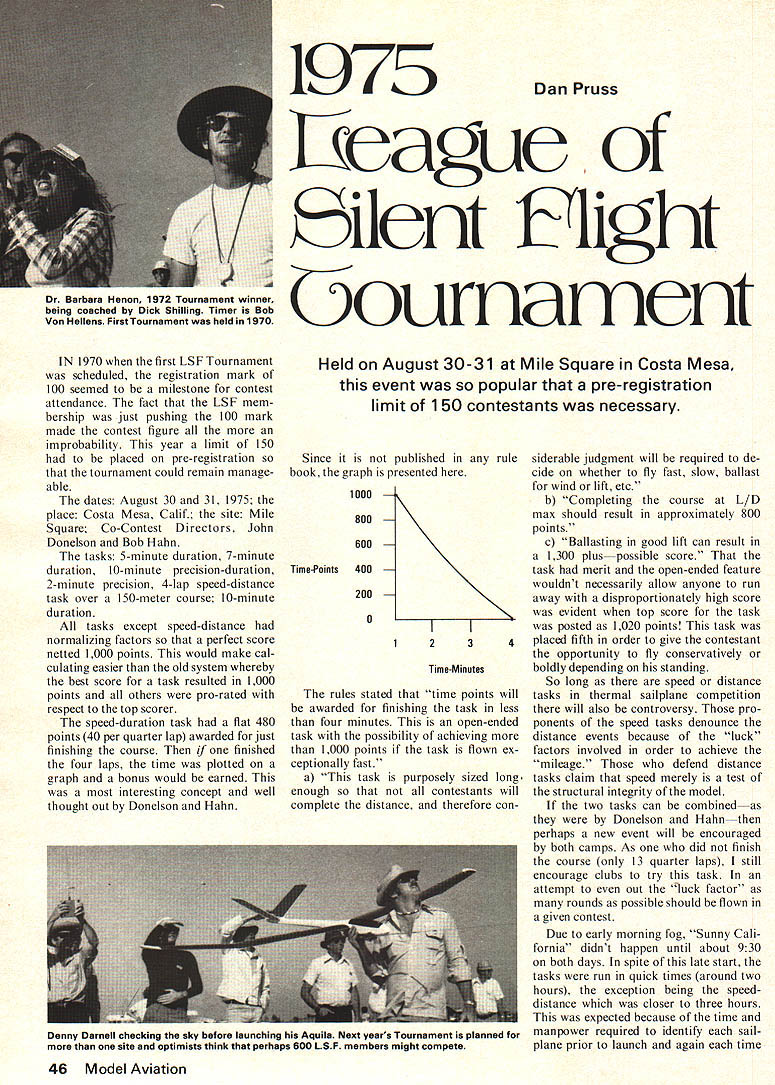
Held on August 30-31 at Mile Square in Costa Mesa, this event was so popular that a pre-registration limit of 150 contestants was necessary.
IN 1970 when the first LSF Tournament was scheduled, the registration mark of 100 seemed to be a milestone for contest attendance. The fact that the LSF membership was just pushing the 100 mark made the contest figure all the more an improbability. This year a limit of 150 had to be placed on pre-registration so that the tournament could remain manageable.
The dates: August 30 and 31, 1975; the place: Costa Mesa, Calif.; the site: Mile Square; Co-Contest Directors, John Donelson and Bob Hahn.
The tasks: 5-minute duration, 7-minute duration, 10-minute precision-duration, 2-minute precision, 4-lap speed-distance task over a 150-meter course.
All tasks except speed-distance had normalizing factors so that a perfect score netted 1,000 points. This would make calculating easier than the old system whereby the best score for a task resulted in 1,000 points and all others were pro-rated with respect to the top scorer.
The speed-duration task had a flat 480 points (40 per quarter lap) awarded for just finishing the course. Then if one finished the four laps, the time was plotted on a graph and a bonus would be earned. This task was a most interesting concept and well thought out by Donelson and Hahn.
Since it is not published in any rule book, the graph is presented here.
The rules stated that "time points will be awarded for finishing the task in less than four minutes. This is an open-ended task with the possibility of achieving more than 1,000 points if the task is flown exceptionally fast."
a) "This task is purposely sized long enough so that not all contestants will complete the distance, and therefore considerable judgment will be required to decide on whether to fly fast, slow, ballast for wind or lift, etc."
b) "Completing the course at L/D max should result in approximately 800 points."
c) "Ballasting in good lift can result in a 1,300 plus—possible score." That the task had merit and the open-ended feature wouldn't necessarily allow anyone to run away with a disproportionately high score was evident when the top score for the task was posted as 1,020 points! This task was placed fifth in order to give the contestant the opportunity to fly conservatively or boldly depending on his standing.
So long as there are speed or distance tasks in thermal sailplane competition there will also be controversy. Those proponents of the speed tasks denounce the distance events because of the "luck" factors involved in order to achieve the "mileage." Those who defend distance tasks claim that speed merely is a test of the structural integrity of the model.
If the two tasks can be combined—as they were by Donelson and Hahn—then perhaps a new event will be encouraged by both camps. As one who did not finish the course (only 13 quarter laps), I still encourage clubs to try this task. In an attempt to even out the "luck factor" as many rounds as possible should be flown in a given contest.
Due to early morning fog, "Sunny California" didn't happen until about 9:30 on both days. In spite of this late start, the tasks were run in quick times (around two hours), the exception being the speed-distance which was closer to three hours. This was expected because of the time and manpower required to identify each sailplane prior to launch and again each time at the far pylon. The flight group call-up system was used and this seems to be the answer for best managing contests of 100 or more fliers. Six winches were used and were assigned by a winch master. Six and 12 volts were available.
Landing zones were two circles—each of a 25-foot radius. One tape per circle with a point per three-in. increments marked for direct read-outs. Landing values were from 0–100 points. Landing judges were utilized for measurements.
Flying was done off of a hard surface runway (Mile Square was once a military airfield used in World War II and has since been made into a recreational park; the hard-surfaced runways remain). Landings at Mile Square are probably the smoothest seen at any sailplane contest. One factor is that skills and techniques have improved over the years. However, with the runway made of concrete, it is best that the virtue of prudence be exercised lest one grind his or her craft's fuselage back to the servo compartment!
Both wind and lift were light when compared to conditions back East, and it was found that anyone who lives east of Sierra Madre is also considered to live "back East."
Saturday, which saw the five-, seven-, and ten-minute duration tasks held, saw some names "in lights" that became just names on the roster after Sunday's two-minute precision task and the speed-duration event.
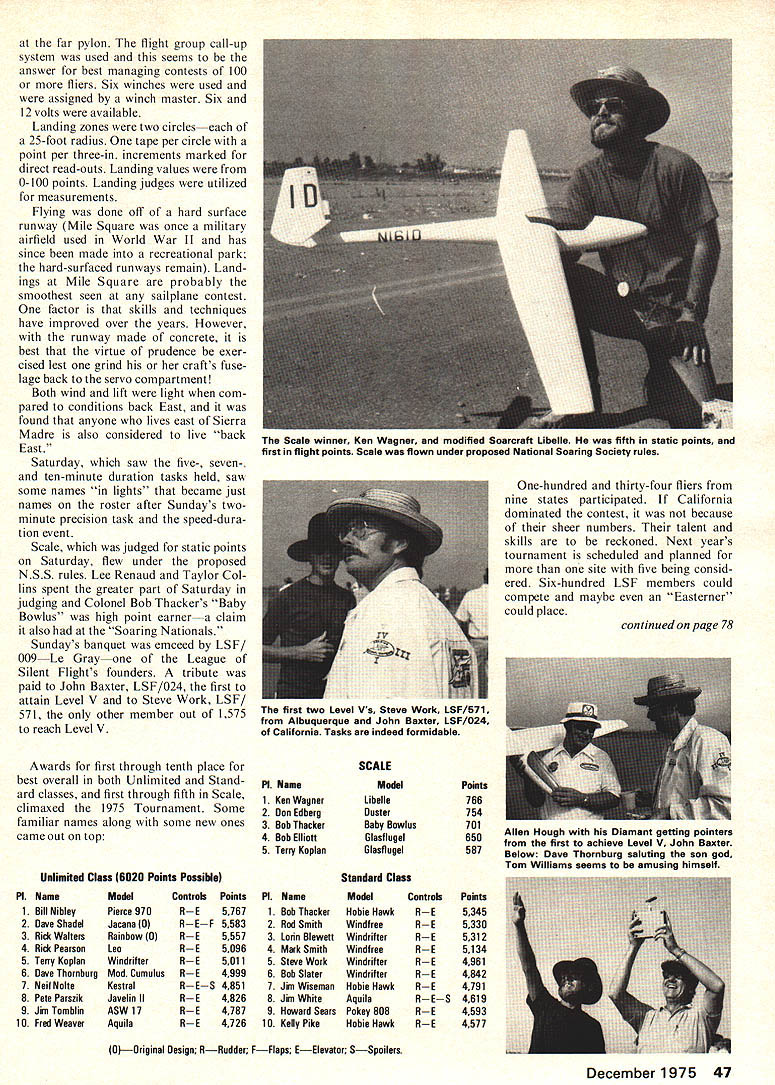
Scale, which was judged for static points on Saturday, flew under the proposed N.S.S. rules. Lee Renaud and Taylor Collins spent the greater part of Saturday in judging and Colonel Bob Thacker's "Baby Bowlus" was high point earner—a claim it also had at the "Soaring Nationals."
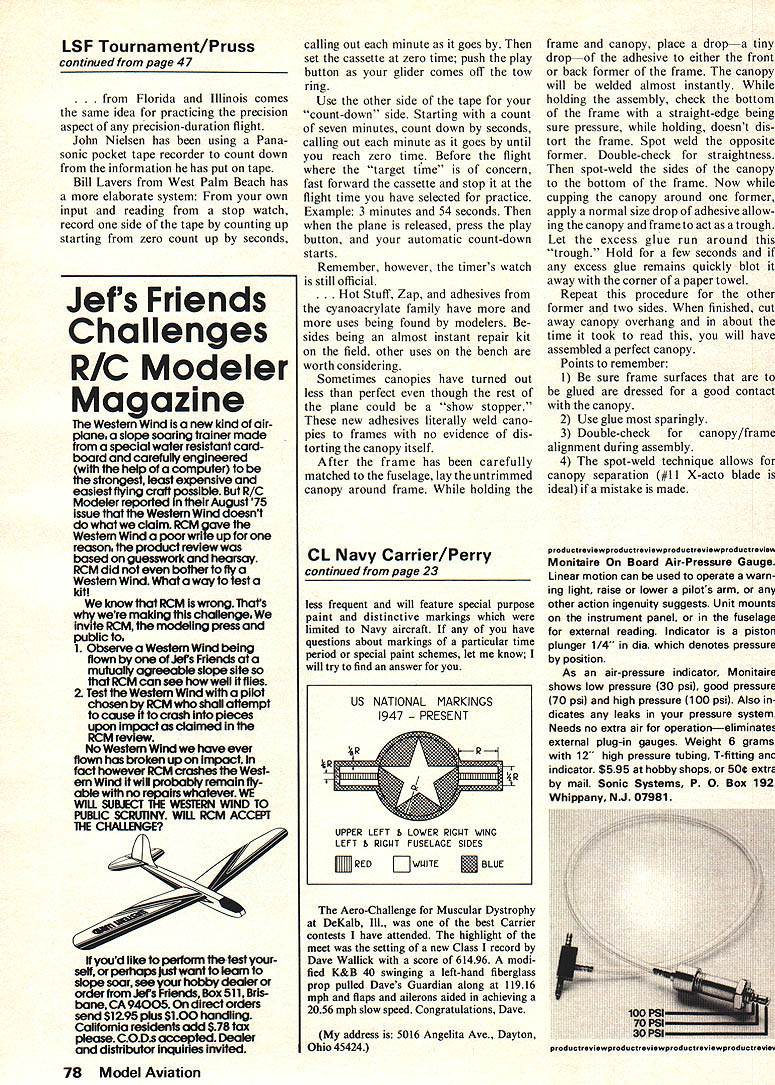
Sunday's banquet was emceed by LSF/009—Lee Gray—one of the League of Silent Flight's founders. A tribute was paid to John Baxter, LSF/024, the first to attain Level V and to Steve Work, LSF/571, the only other member out of 1,575 to reach Level V.
Awards for first through tenth place for best overall in both Unlimited and Standard classes, and first through fifth in Scale, climaxed the 1975 Tournament. Some familiar names along with some new ones came out on top:
SCALE Pl. Name — Model — Points
- Ken Wagner — Libelle — 766
- Don Edger — Duster — 754
- Bob Thacker — Baby Bowlus — 701
- Bob Elliott — Glasflugel — 650
- Terry Koplan — Glasflugel — 587
One-hundred and thirty-four fliers from nine states participated. If California dominated the contest, it was not because of their sheer numbers. Their talent and skills are to be reckoned. Next year's tournament is scheduled and planned for more than one site with five being considered. Six-hundred LSF members could compete and maybe even an "Easterner" could place.
1975 League of Silent Flight Tournament
... from Florida and Illinois comes the same idea for practicing the precision aspect of any precision-duration flight. John Nielsen has been using a Panasound pocket tape recorder to count down from the information he has put on tape.
Bill Lavers from West Palm Beach has a more elaborate system: From your own input and reading from a stopwatch, record one side of the tape by counting up starting from zero; count up by seconds, calling out each minute as it goes by. Then set the cassette at zero time; push the play button as your glider comes off the tow ring.
Use the other side of the tape for your "count-down" side. Starting with a count of seven minutes, count down by seconds, calling out each minute as it goes by until you reach zero time. Before the flight where the "target time" is of concern, fast forward the cassette and stop it at the flight time you have selected for practice. Example: 3 minutes and 54 seconds. Then when the plane is released, press the play button, and your automatic count-down starts.
Remember, however, the timer's watch is still official.
Transcribed from original scans by AI. Minor OCR errors may remain.

