
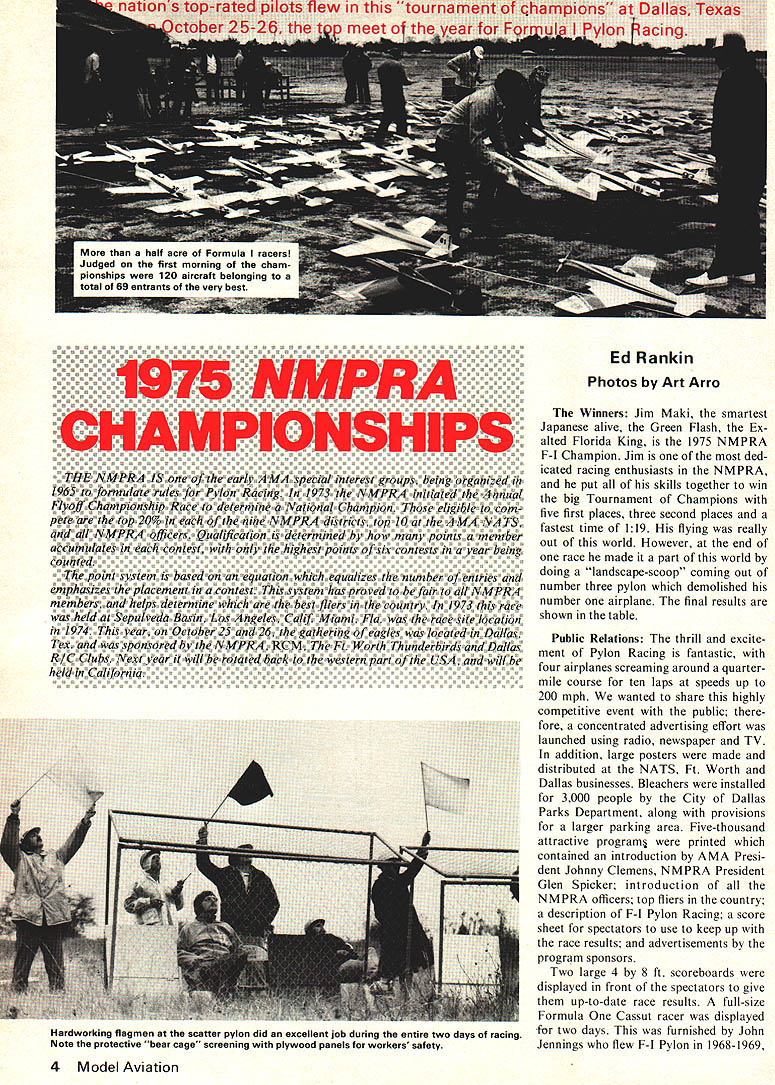
1975 NMPRA CHAMPIONSHIPS
THE NMPRA is one of the early AMA special interest groups, being organized in 1965 to formulate rules for Pylon Racing. In 1973 the NMPRA initiated the Annual F-I Championship Race to determine a National Champion. Those eligible to compete are the top 20% in each of the nine NMPRA districts, top 10 at the AMA NATS and all NMPRA officers. Qualification is determined by how many points a member accumulates in each contest, with only the highest points of six contests in a year being counted.
The point system is based on an equation which equalizes the number of entries and emphasizes the placement in a contest. This system has proved to be fair to all NMPRA members, and helps determine which are the best fliers in the country. In 1973 the race was held at Sepulveda Basin, Los Angeles, Calif.; Miami, Fla. was the race site location in 1974. This year, on October 25 and 26, the gathering of eagles was located in Dallas, Tex. and was sponsored by the NMPRA, RCM, the Ft. Worth Thunderbirds and Dallas R/C Clubs. Next year it will be rotated back to the western part of the U.S.A. and will be held in California.
Ed Rankin Photos by Art Arro
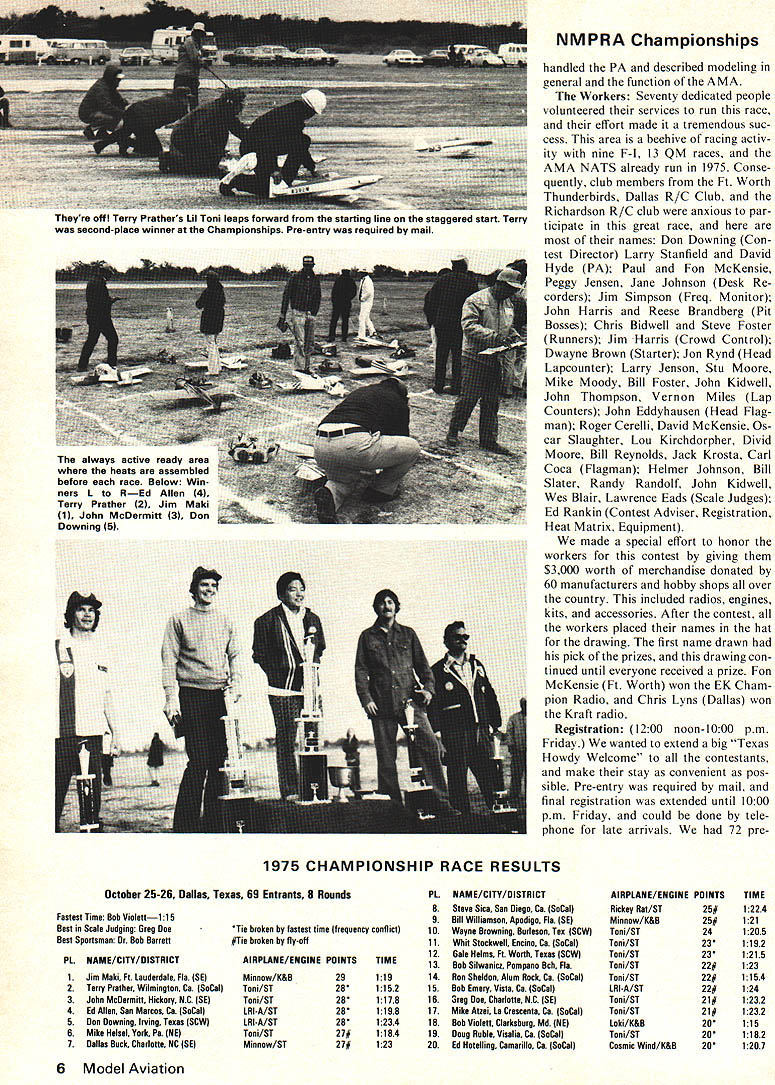
The Winners: Jim Maki, the smartest Japanese alive, the Green Flash, the Exalted Florida King, is the 1975 NMPRA F-I Champion. Jim is one of the most dedicated racing enthusiasts in the NMPRA, and he put all of his skills together to win the big Tournament of Champions with five first places, three second places and a fastest time of 1:19. His flying was really out of this world. However, at the end of one race he made it a part of this world by doing a "landscape-scoop" coming out number three pylon which demolished his number one airplane. The final results are shown in the table.
Public Relations: The thrill and excitement of Pylon Racing is fantastic, with four airplanes screaming around a quarter-mile course for ten laps at speeds up to 200 mph. We wanted to share this highly competitive event with the public; therefore, a concentrated advertising effort was launched using radio, newspaper and TV. In addition, large posters were made and distributed at the NATS, Ft. Worth and Dallas businesses. Bleachers were installed for 3,000 people by the City of Dallas Parks Department, along with provisions for a larger parking area. Five-thousand attractive programs were printed which contained an introduction by AMA President Johnny Clemens, NMPRA President Glen Spickler; introduction of all the NMPRA officers; top fliers in the country; a description of F-I Pylon Racing; a score sheet for spectators to use to keep up with the race results; and advertisements by the program sponsors.
Two large 4 by 8 ft. scoreboards were displayed in front of the spectators to give them up-to-date race results. A full-size Formula One Cassut racer was displayed for two days. This was furnished by John Jennings who flew F-I Pylon in 1968-1969.
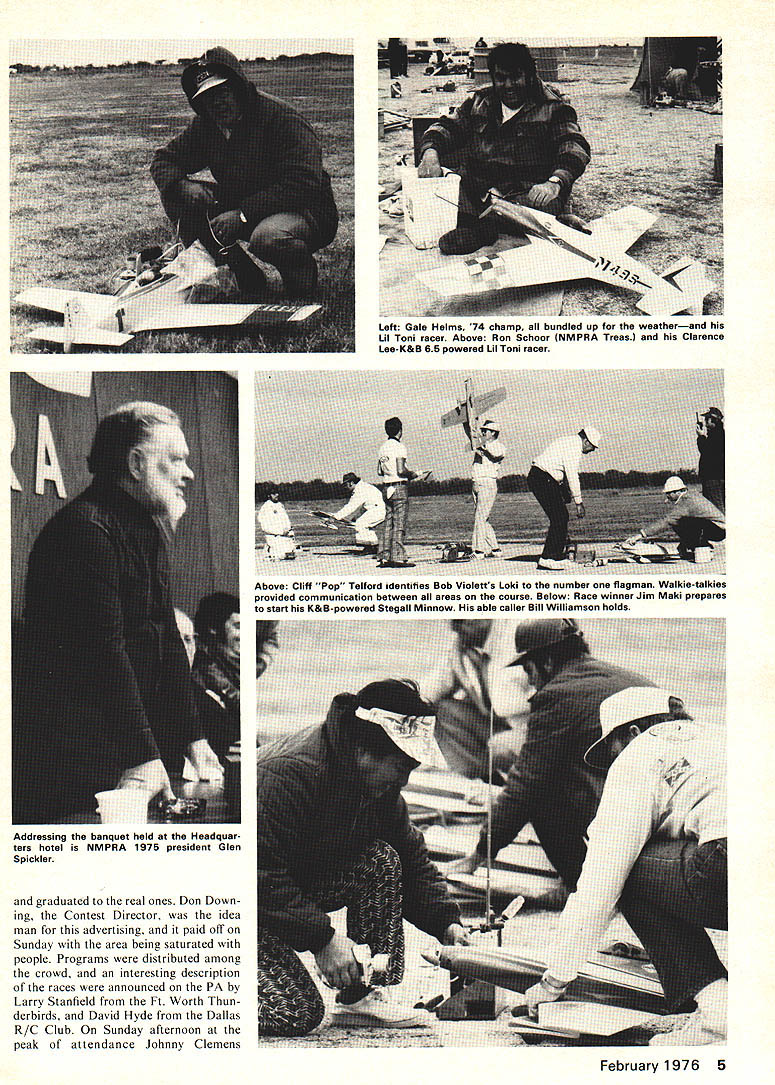
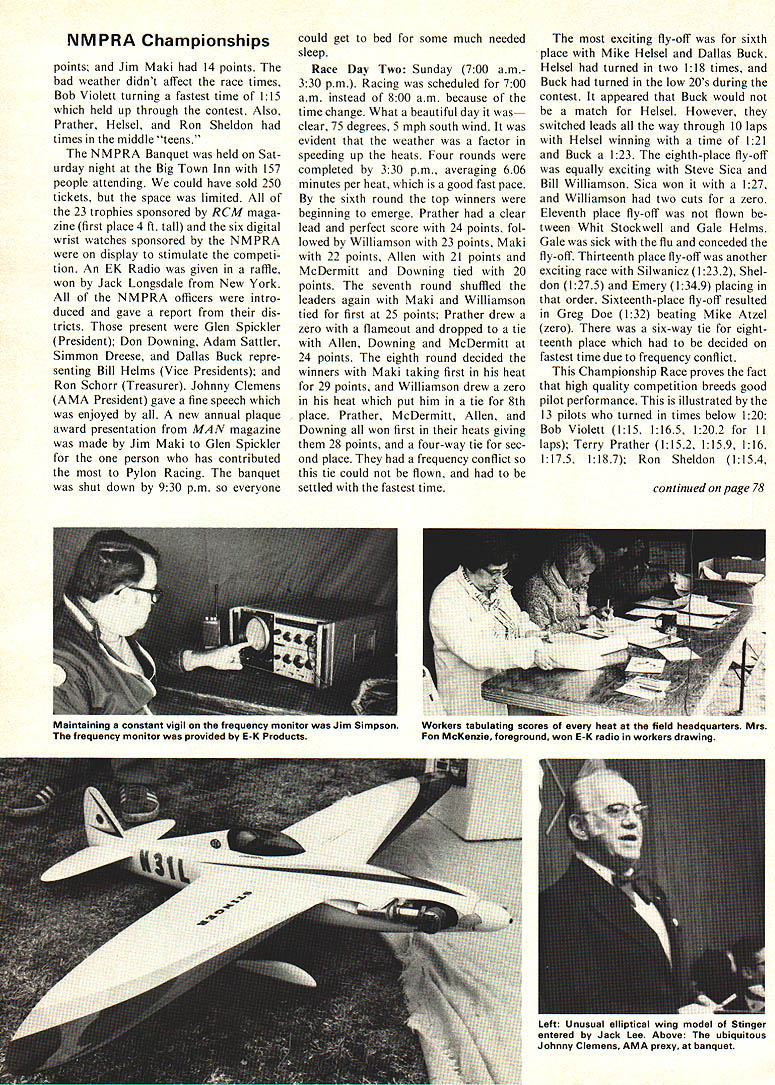
Addressing the banquet held at the headquarters hotel, NMPRA 1975 President Glen Spickler handled the PA and described modeling and the general function of the AMA. Workers: Seventy dedicated people volunteered their services to run the race. The effort made a tremendous success. The area was a beehive of racing activity with nine F-I and 13 QM races. AMA NATS had already run in 1975. Consequently, club members from the Ft. Worth Thunderbirds, Dallas R/C Club and Richardson R/C Club were anxious to participate in the great race. Names included: Don Downing, Contest Director; Larry Stanfield; David Hyde, PA; Paul Fon McKensie; Peggy Jensen; Jane Johnson, Desk Recorders; Jim Simpson, Freq. Monitor; John Harris; Reese Brandberg, Pit Bosses; Chris Bidwell; Steve Foster, Runners; Jim Harris, Crowd Control; Dwayne Brown, Starter; Jon Rynd, Head Lapcounter; Larry Jenson; Stu Moore; Mike Moody; Bill Foster; John Kidwell; John Thompson; Vernon Miles, Lap Counters; John Eddyhausen, Head Flagman; Roger Cerelli; David McKensie; Oscar Slaughter; Lou Kirchdorfer; David Moore; Bill Reynolds; Jack Krosta; Carl Coca, Flagmen; Helmer Johnson; Bill Slater; Randy Randolph; John Kidwell; Wes Blair; Lawrence Fads, Scale Judges; Ed Rankin, Contest Adviser.
Registration and Heat Matrix Equipment made a special effort to honor workers by giving $3,000 worth of merchandise donated by 60 manufacturers and hobby shops from all over the country, including radios, engines, kits and accessories. After the contest workers placed their names in a hat and a drawing was held. The first name drawn could pick prizes. The drawing continued until everyone received a prize. and graduated to the real ones. Don Downing, the Contest Director, was the idea man for this advertising, and it paid off on Sunday with the area being saturated with people. Programs were distributed among the crowd, and an interesting description of the races were announced on the PA by Larry Stanfield from the Ft. Worth Thunderbirds, and David Hyde from the Dallas R/C Club. On Sunday afternoon at the peak of attendance Johnny Clemens
1975 NMPRA Championships
handled the PA and described modeling in general and the function of the AMA.
The Workers: Seventy dedicated people volunteered their services to run this race, and their effort made it a tremendous success. This area is a beehive of racing activity with nine F-I, 13 QM races, and the AMA NATS already run in 1975. Consequently, club members from the Ft. Worth Thunderbirds, Dallas R/C Club, and the Richardson R/C Club were anxious to participate in this great race, and here are most of their names: Don Downing (Contest Director); Larry Stanfield and David Hyde (PA); Paul and Fon McKensie, Peggy Jensen, Jane Johnson (Desk Recorders); Jim Simpson (Freq. Monitor); John Harris and Reese Brandberg (Pit Bosses); Chris Bidwell and Steve Foster (Runners); Jim Harris (Crowd Control); Dwayne Brown (Starter); Jon Rynd (Head Lapcounter); Larry Jenson, Stu Moore, Mike Moody, Bill Foster, John Kidwell, John Thompson, Vernon Miles (Lap Counters); John Eddyhausen (Head Flagman); Roger Cerelli, David McKensie, Oscar Slaughter, Lou Kirchdorfer, David Moore, Bill Reynolds, Jack Krosta, Carl Coca (Flagmen); Helmer Johnson, Bill Slater, Randy Randolph, John Kidwell, Wes Blair, Lawrence Eads (Scale Judges); Ed Rankin (Contest Adviser), Registration, Heat Matrix, Equipment.
We made a special effort to honor the workers for this contest by giving them $3,000 worth of merchandise donated by 60 manufacturers and hobby shops all over the country. This included radios, engines, kits, and accessories. After the contest, all the workers placed their names in the hat for the drawing. The first name drawn had his pick of the prizes, and this drawing continued until everyone received a prize. Fon McKensie (Ft. Worth) won the EK Champion Radio, and Chris Lyons (Dallas) won the Kraft radio.
Registration: (12:00 noon-10:00 p.m. Friday.) We wanted to extend a big "Texas Howdy Welcome" to all the contestants, and make their stay as convenient as possible. Pre-entry was required by mail, and final registration was extended until 10:00 p.m. Friday, and could be done by telephone for late arrivals. We had 72 pre-entries.
1975 CHAMPIONSHIP RACE RESULTS
October 25-26, Dallas, Texas, 69 Entrants, 8 Rounds
1975 NMPRA Championships
registered at the Big Town Racing Headquarters, which is a really good turn-out. Transportation was provided to contestants from airports to the motel. The motel provided a shuttle bus to the field, and to downtown Dallas for the women. Phill Bussell (famous Control Line Speed flier and MA columnist) mixed fuel to the contestant's specifications for a minimum fee, which was a real convenience for those traveling by air.
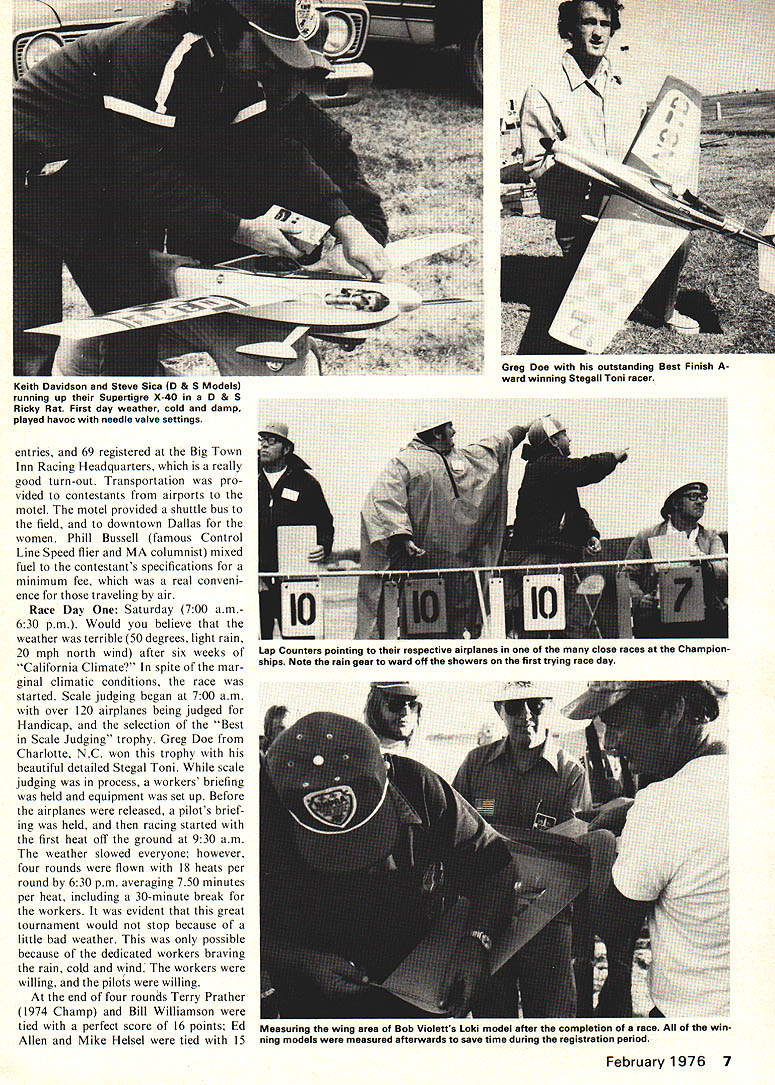
Race Day One: Saturday (7:00 a.m.-6:30 p.m.). Would you believe that the weather was terrible (50 degrees, light rain, 20 mph north wind) after six weeks of "California Climate?" In spite of the marginal climatic conditions, the race was started. Scale judging began at 7:00 a.m. with over 120 airplanes being judged for Handicap, and the selection of the "Best in Scale Judging" trophy. Greg Doe from Charlotte, N.C. won this trophy with his beautiful detailed Stegall Toni. While scale judging was in process, a workers' briefing was held and equipment was set up. Before the airplanes were released, a pilot's briefing was held, and then racing started with the first heat off the ground at 9:30 a.m. The weather slowed everyone; however, four rounds were flown with 18 heats per round by 6:30 p.m., averaging 7.50 minutes per heat, including a 30-minute break for the workers. It was evident that this great tournament would not stop because of a little bad weather. This was only possible because of the dedicated workers braving the rain, cold and wind. The workers were willing, and the pilots were willing.
At the end of four rounds Terry Prather (1974 Champ) and Bill Williamson were tied with a perfect score of 16 points; Ed Allen and Mike Heisel were tied with 15 points. and Jim Maki had 14 points. The bad weather didn't affect the race times. Bob Violett turning a fastest time of 1:15 which held up through the contest. Also Prather, Helsel, and Ron Sheldon had times in the middle "teens."
The NMPRA Banquet was held on Saturday night at the Big Town Inn with 157 people attending. We could have sold 250 tickets, but the space was limited. All of the 23 trophies sponsored by RCM magazine (first place 4 ft. tall) and the six digital wrist watches sponsored by the NMPRA were on display to stimulate the competition. An E-K radio was given in a raffle, won by Jack Longsdale from New York. All of the NMPRA officers were introduced and gave a report from their districts. Those present were Glen Spickler (President); Don Downing, Adam Sattler, Simmons Dreese, and Dallas Buck representing Bill Helms (Vice Presidents); and Ron Schorr (Treasurer). Johnny Clemens (AMA President) gave a fine speech which was enjoyed by all. A new annual plaque award presentation from MAN magazine was made by Jim Maki to Glen Spickler for the one person who has contributed the most to Pylon Racing. The banquet was shut down by 9:30 p.m. so everyone could get to bed for some much needed sleep.
Race Day Two: Sunday (7:00 a.m. - 3:30 p.m.). Racing was scheduled for 7:00 a.m. instead of 8:00 a.m. because of the time change. What a beautiful day it was — clear, 75 degrees, 9 mph south wind. It was evident that the weather was a factor in speeding up the heats. Four rounds were completed by 3:30 p.m., averaging 6.06 minutes per heat, which is a good fast pace. By the sixth round the top winners were beginning to emerge. Prather had a clear lead and perfect score with 24 points, followed by Williamson with 23 points, Maki with 22 points, Allen with 21 points and McDermitt and Downing tied with 20 points. The seventh round shuffled the leaders again with Maki and Williamson tied for first at 25 points; Prather drew a zero with a flameout and dropped to a tie with Allen, Downing and McDermitt at 24 points. The eighth round decided the winners with Maki taking first in his heat for 29 points, and Williamson drew a zero in his heat which put him in a tie for 8th place. Prather, McDermitt, Allen, and Downing all won first in their heats giving them 28 points, and a four-way tie for second place. They had a frequency conflict so this tie could not be flown, and had to be settled with the fastest time.
The most exciting fly-off was for sixth place with Mike Helsel and Dallas Buck. Helsel had turned in two 1:18 times, and Buck had turned in the low 1:20s during the contest. It appeared that Buck would not be a match for Helsel. However, they switched leads all the way through 10 laps with Helsel winning with a time of 1:21 and Buck a 1:23. The eighth-place fly-off was equally exciting with Steve Sica and Bill Williamson. Sica won it with a 1:27, and Williamson had two cuts for a zero. Eleventh-place fly-off was not flown between Whit Stockwell and Gale Helms. Gale was sick with the flu and conceded the fly-off. Thirteenth-place fly-off was another exciting race with Silvanicz (1:23.2), Sheldon (1:27.5) and Emery (1:34.9) placing in that order. Sixteenth-place fly-off resulted in Greg Doe (1:32) beating Mike Atzert (zero). There was a six-way tie for eighteenth place which had to be decided on the fastest time due to frequency conflict.
This Championship Race proves the fact that high quality competition breeds good pilot performance. The results were characterized by the 13 pilots who turned in times below 1:20. Bob Violett (1:15; 1:16.5; 1:20.2 for 11 laps); Terry Prather (1:15.2; 1:15.9; 1:16; 1:17.5; 1:18.7); Ron Sheldon (1:15.4, 1:16.5); John McDermitt (1:17.8); Bill Preis (1:18, 1:19.6); Doug Rubie (1:18.2); Mike Helsel (1:18.4, 1:18.5); Jim Maki, Clay/Moncrief Team; Irwin Funderburk (1:19); Whit Stockwell (1:19.2); Pete Reed (1:19.5); and Ed Allen (1:19.8). Can you imagine a contest with these 13 pilots? In addition to these good performances I counted six Texans who clocked close to 1:20 which was 3 to 10 seconds better than they had ever recorded.
A committee of five officials selected the best sportsman, Dr. Bob Barrett of the Ft. Worth Thunderbirds. Bob loaned two airplanes to fellow modelers to fly in the race and they were both crashed. In addition, he pitched in and helped other pilots both days. I am sure that there were other cases of good sportsmanship demonstrated since the contest was entirely composed of high caliber modelers who know how to win and lose and help others.
The trophy presentation was made with the top five being photographed on a pyramid platform. The finale of the awards presentation was the custom ceremony of Champion, Jim Maki, to drink champagne from the silver bowl. Jim must have taken the whole quart in one swallow.
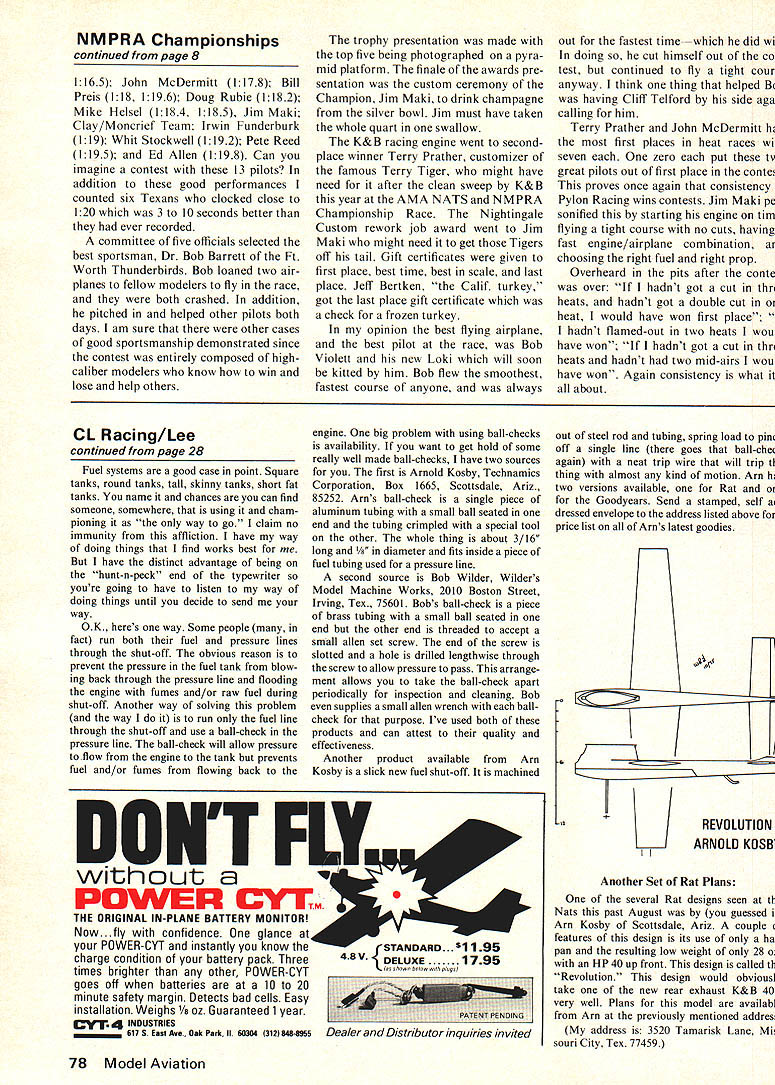
The K&B racing engine went to second-place winner Terry Prather, customizer of the famous Terry Tiger, who might have need for it after the clean sweep by K&B this year at the AMA NATS and NMPRA Championship Race. The Nightingale Custom rework job award went to Jim Maki who might need it to get those Tigers off his tail. Gift certificates were given to first place, best time, best in scale, and last place. Jeff Bertken, the "Calif. turkey," got the last place gift certificate which was a check for a frozen turkey.
In my opinion the best flying airplane, and the best pilot at the race, was Bob Violett and his new Loki which will soon be kitted by him. Bob flew the smoothest, fastest course of anyone, and was always out for the fastest time — which he did win. In doing so, he cut himself out of the contest, but continued to fly a tight course anyway. I think one thing that helped Bob was having Cliff Telford by his side again calling for him.
Terry Prather and John McDermitt had the most first places in heat races with seven each. One zero each put these two great pilots out of first place in the contest. This proves once again that consistency in Pylon Racing wins contests. Jim Maki proved this by starting his engine on time and flying a tight course with no cuts, having a fast engine/airplane combination, and choosing the right fuel and right prop.
Overheard in the pits after the contests were: "If I hadn't got a cut in three heats, and had got a double cut in one heat, I would have won first place." "If I hadn't flamed-out in two heats I would have won." "If I hadn't got a cut in three heats and hadn't had two mid-airs I would have won." Again, consistency is what it is all about.
Public relations: The thrill and excitement of Pylon Racing — four airplanes screaming around the quarter-mile course, ten laps, speeds up to 200 mph — was shared with the public by a concentrated advertising effort using radio, newspaper and TV. In addition, large posters were made and distributed to NATS, Ft. Worth and Dallas businesses. Bleachers were installed to seat 3,000 people. The City of Dallas Parks Department made provisions for a larger parking area. Five thousand attractive programs were printed containing an introduction by AMA President Johnny Clemens, NMPRA President Glen Spickler, introductions of NMPRA officers, top fliers in the country, a description of F-I Pylon Racing, a score sheet spectators could use to keep up with race results, and advertisements from program sponsors. Two large 4' x 8' scoreboards were displayed in front of the spectators to give up-to-date race results. A full-size Formula Class A racer was displayed two days, furnished by John Jennings who flew F-I Pylon in 1968-1969.
Addressing a banquet held at the headquarters hotel, NMPRA 1975 President Glen Spickler described the modeling and general function of the AMA. Workers: Seventy dedicated people volunteered their services to run the race. The effort made it a tremendous success; the area was a beehive of racing activity with nine F-I and 13 QM races. AMA NATS had already run in 1975, consequently club members from the Ft. Worth Thunderbirds, Dallas R/C Club and Richardson R/C Club were anxious to participate in this great race.
Workers and officials included: Don Downing, Contest Director; Larry Stanfield; David Hyde, PA; Paul Fon McKensie; Peggy Jensen; Jane Johnson, Desk Recorders; Jim Simpson, Frequency Monitor; John Harris; Reese Brandberg, Pit Bosses; Chris Bidwell; Steve Foster, Runners; Jim Harris, Crowd Control; Dwayne Brown, Starter; Jon Rynd, Head Lapcounter; Larry Jenson; Stu Moore; Mike Moody; Bill Foster; John Kidwell; John Thompson; Vernon Miles, Lap Counters; John Eddyhausen, Head Flagman; Roger Cerelli; David McKensie; Oscar Slaughter; Lou Kirchdorfer; David Moore; Bill Reynolds; Jack Krosta; Carl Coca, Flagmen; Helmer Johnson; Bill Slater; Randy Randolf; Wes Blair; Lawrence Fads, Scale Judges; Ed Rankin, Contest Adviser. Registration, heat matrix and equipment personnel made a special effort to honor the workers. Contest prizes totalling $3,000 worth of merchandise were donated by 60 manufacturers and hobby shops across the country and included radios, engines, kits and accessories. After the contest workers' names were placed in a hat for a drawing; the first name drawn could pick prizes. The drawing continued until everyone received a prize.
Transcribed from original scans by AI. Minor OCR errors may remain.

