
1976 Hall of Fame Awards
INITIATED IN 1969 under joint sponsorship of the Washington State Air National Guard and the Academy of Model Aeronautics, the Model Aviation Hall of Fame made nine awards through 1971. AMA then took over sole responsibility for the program in 1972. Since that time the former AMA presidents and the current president have served as the Hall of Fame Selection Committee, with Walt Good—himself a Hall of Famer—as chairman.
Objectives are to recognize candidates from out of the past as well as currently deserving candidates. Thus, the Hall of Fame considers candidates of all ages and from all periods of activity. The past AMA presidents are uniquely qualified to fulfill these objectives, since many are themselves aeromodeling pioneers and present-day leaders.
Most AMA presidents could qualify for the Hall of Fame. Five have been so honored. But no past president may vote for himself and, as a group, they consider only nominations from other sources. The current Committee, also known as the Council of Past Presidents, includes the following current members, with dates of AMA presidency: Irwin G. Ohlsson, 1943-46; C. O. Wright, 1948-49; Kenneth G. Held, 1950-51; Frank B. Bushey, 1952; Keith H. Storey, 1953-56; Claude McCullough, 1957; Dr. Walter A. Good, 1958-60; Peter J. Sotich, 1961-62; John Worth, 1963; Maynard L. Hill, 1964; Howard E. Johnson, 1965-66; Clifford G. Weirick, 1967-68; John E. Patton, 1969-70; John E. Clemens, incumbent.
There were 24 nominations for the 1976 Hall of Fame. The selection committee narrowed these down to five, as per normal balloting procedures. Description of the winners follow. (Anyone who would like to submit a nomination for 1977 should request an application from AMA HQ and submit same before next March 31.)
Harold deBolt, owner of the former deBolt Model Engineering Company (recently changed to deBolt Radio Control) in Buffalo, N.Y., is known as "Hal" or, more affectionately, "Pappy" by his numerous aeromodeling friends throughout the U.S. and Canada. His career spans almost 50 years since he began organizing inter-club contests in Geneva, N.Y., during the twenties. He competed in rubber power until 1938 when he won Free Flight Gas at Rome, N.Y. He flew FF until the end of WWII and then began an impressive string of victories in Control Line Speed and Stunt. During his career he has held four World and National CL Speed records.
Hal's aeromodeling endeavors include R/C and he pioneered early radio-control model aircraft kits. His Trainer and Rebel designs have taught thousands to fly R/C and his interest in R/C Pattern carried him to many top places in National Competition and earned him a spot on the U.S. team to the World Championships in 1960 where he placed 7th.
Turning to Pylon Racing, Pappy deBolt won many local, regional and national honors in this category. He also held the FAI Closed Course R/C Distance Record.
From 1944 to the present, deBolt has published over 13 designs and kitted more than 45 models. He has also produced more than six different accessories for models including the first dural landing gears and electric power-driven R/C servos.
Hal organized five model airplane clubs, including the first Navy model club at Patuxent Naval Air Base in Maryland. He has directed numerous contests and served on both the AMA Control Line and Radio Control Contest Boards as well as an AMA Vice President. In 1958 he became an AMA Fellow and Life Member. Hal continues today as an active competitor in R/C Pylon Racing and as an industry leader.
Frank Ehling, a native of New Jersey now living in Maryland, has been a modeler for over 50 years. He was an early commercial success, cutting and selling balsa wood at his home while still in high school. Plans for more than 80 different Ehling-designed planes have been published in modeling magazines through the years and many of his original designs have been kitted by Jasco, Scientific and Polk's. His designs have won a great number of contests and have been responsible for starting many new trends in model plane design. Since many of Frank's models were designed with the newer and younger modelers in mind, they were simple and fool-proof yet always maintained a high level of performance.
As a result his model designs were instrumental in attracting many young people into the aeromodeling field.
Ehling has always been an innovator. His early competitor expertise in recognizing loopholes in rules has contributed to his success as Technical Director for the Academy of Model Aeronautics. In the 20's competition rules were much simpler than they are today. Intended for the new (then) compressed-air model motors, the rules stated "any power may be used." A famous story has it that at one contest Frank walked along the flightline with a string attached to it, which ran into a cigar box. Ehling launched his ship for an official flight by opening the box. Out flew a pigeon, pulling the model aloft for an O.O.S. max!
Frank's crowning achievement is his Delta Dart. No single model design has done more to create good will and good publicity for model aviation, as well as to introduce more youngsters, all over the world, to this wonderful sport of building and flying model planes. Hundreds of thousands of these kits have been produced to date, all without any profit to Ehling (other than personal satisfaction), since he donated the design to AMA and the modeling industry.
As Technical Director of the Academy of Model Aeronautics and also as Advertising Manager of AMA's monthly magazine, Model Aviation, Frank is currently a key figure in our national organization. He is very much respected by everyone in the model aviation industry for his abilities and accomplishments. Few men in aeromodeling are as well known all over the world. Merrill C. Hamburg, deceased, was an aviation pioneer and educator of national prominence. He earned a Bachelor of Science degree from Wayne University in 1927 and an M.A. in 1942.
A dedicated aeromodeler, in 1928 he was Secretary/Treasurer of the Airplane Model League of America, co-sponsored by American Boy and the National Aeronautic Association — the A.M.L.A. was forerunner of the Academy of Model Aeronautics. Hamburg is believed to be a founder of the Detroit Model Airplane Club and started several school clubs during his career as a manual arts training teacher, from 1923 through 1942. He directed national competition in 1928, 1929, and 1930.
Hamburg's professional association affiliations are as impressive as his academic endeavors, including: The Engineering Society of Detroit, American Vocational Association, American Council on Industrial Arts Supervisors, and the National Education Ass'n. He wrote Beginning To Fly in 1929; Demonstrations And Laboratory Exercises In The Science Of Aeronautics, 1944; and co-authored The American Student Flyer in 1942; also Riding On Air in 1942 and 1944. From 1927 to 1931 Hamburg wrote an aviation series for American Boy which was later syndicated in 55 daily newspapers throughout the U.S. His "How To Make" series for the Detroit News (1931-1942) was syndicated in 30 newspapers and he had a series of six articles in Popular Science during 1931.
He was also a model designer. His "Baby R.O.G." and other designs were distributed by George Warner in Detroit.
Outstanding educator, aeromodeling pioneer, author and scholar, the late Merrill C. Hamburg rates as one of the most distinguished of all Hall of Famers. Willis C. Brown, the first AMA president (1936-37) who served on the Hall of Fame Committee until his death in 1975, was proud to nominate Hamburg as his final act of service to AMA. Willis felt the recognition was long overdue.
The Model Aviation Hall of Fame
How to make Nominations for 1977
Because it is not generally realized that everyone is invited to make nominations, in this case for 1977, with an early deadline of April 30, the following information is compiled for your convenience. Note that the instructions below advise that information is to be presented on a Nomination Form, available by writing AMA Headquarters.
Purpose: The Model Aviation Hall of Fame has been established to recognize aeromodelers who have made outstanding contributions to model aviation over the years, their contributions having improved the hobby and increased its prestige and stature. Each year several modelers are selected as members of the Model Aviation Hall of Fame. The selection is based on the individual's contributions to model aviation as a competitor, designer, experimenter, leader, organizer, Contest Director, writer, publisher, manufacturer — and other related activities. The emphasis is on the accumulated contribution in one or more of these categories over a period of years. The program is operated by the Academy of Model Aeronautics and by the Hall of Fame Selection Committee, which is the Council of Past AMA Presidents, whose accumulated knowledge of American aeromodeling and aeromodelers is unparalleled.
Eligibility: A person is eligible for nomination to the Hall of Fame if he is:
- A modeler who has made the kinds of contributions listed above.
- A U.S. citizen.
- An AMA or non-AMA member.
- Living or deceased.
- Nominated by the submission of a nomination form by a sponsor who knows of his contributions.
Mechanism of Nomination: A sponsor should submit a nomination form to AMA HQ — Model Aviation Hall of Fame prior to April 30, 1977. Forms are available from AMA HQ. Nominations may be submitted by any person, club or organization in the U.S.A.
Selection: 1. Each year the Hall of Fame Committee, composed of the Council of Past AMA Presidents, will select five Hall of Fame recipients from the nominations which have been submitted. At least three of the recipients must be living.
- Announcements and presentations of the Hall of Fame Awards will be made at appropriate model aviation occasions during the remainder of the year.
Chester Lanzo of Valley City, Ohio has been an active aeromodeler for over 50 years and was a member of the U.S. Wakefield Team in 1936. He was the first Nats Radio Control winner in 1937 and winner of the rubber-powered Outdoor Stick event in 1940. He has held records in Outdoor Stick, Cabin and Rubber Speed.
An outstanding designer, Lanzo's work has been published in Air Trails, Flying Models, Air World and Model Airplane News, from the 1930's through the 1960's. Budd Models kitted several of his free-flight designs which have been successfully flown by many in competition.
Chet's outdoor rubber models set trends and were forerunners of the majority of contest winners over a 30-year period. It has been said that many novices became experts using Lanzo's designs and that today, his 300 sq. in. rubber winner of the 1940 Nats is considered to be competitive.
Chester Lanzo is still a very active flier and his designs from the 30's are currently popular in Old Timer events. He has concentrated recently on RC soaring but is no newcomer to radio control. Long before World War II he flew an indoor rubber-powered RC model — he used a powerful transmitter to radiate energy which heated up a taut wire on the model to move the rudder!
Chet also gained some fame at the 1949 Nats when he used RC on a free-flight glider. The rules at that time didn't say it couldn't be done, so Chet did it — and got an immediate Contest Board ruling against the use of RC for F.F. More recently, Chet has used RC to help retrieve his F.F. models during test flying.
Lanzo has one other distinction. He is universally admired as a gentle man. He has friends everywhere who attest to his pleasant personality and mild manner, yet he is acknowledged to be a great competitor — an outstanding combination.
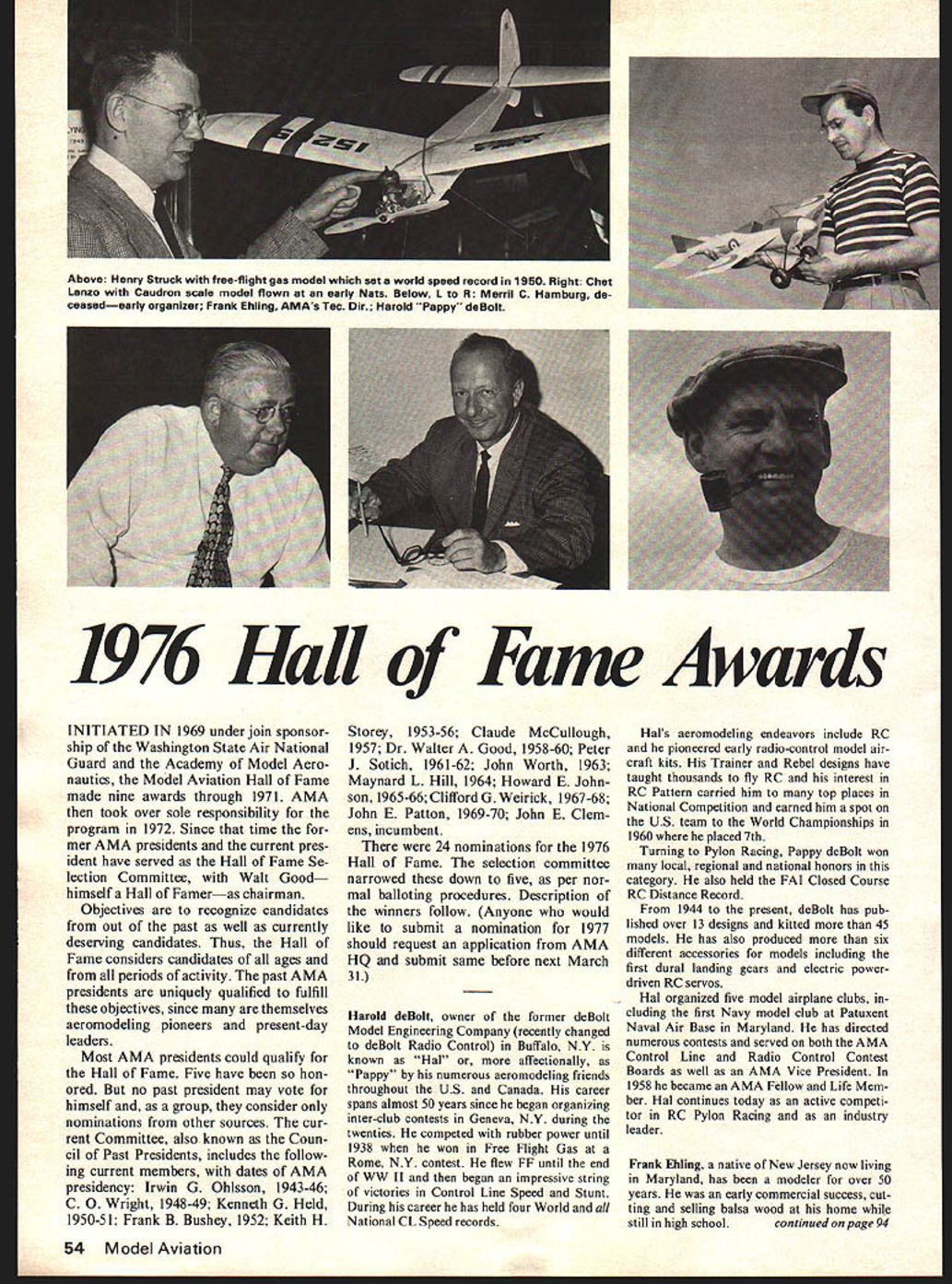
Henry Struck of Lyme, Conn. is one of the most dedicated, creative and prolific aeromodel designers — and has been for nearly 40 years. His work has been published in Flying Aces, Air Trails, Model Builder, and Model Airplane News. Numerous kits of his designs were produced by the Berkeley Company through the years. Struck's New Ruler (1940) was one of the most popular free-flights ever. Other familiar designs include: Trail Blazer, Flying Cloud, Sinbad, Interstate Cadet, Stinson Sentinel, Apache, KGS, and the Record Hound.
In 1937, Hank started the Queens N.Y. Aero Model Association; in 1961, SCATTA in Connecticut; in 1963 the RC Propbusters (Conn.) in which he served as President and is still a very active Club Secretary. He has served nationally as FF Contest Board chairman and is currently the New England area representative.
As a competitor, Struck was National Champion in 1941, holds a Nats record, won Scale in 1938, '41, and '46 to retire the perpetual trophy. He won in Indoor and Outdoor FF in 1935. Indoor in 1938, and was a triple winner in 1940 (Indoor and Outdoor). He won a place on the 1937 Wakefield Team (one year after another Hall of Famer, Chester Lanzo) and directed local and regional competition during 1964-70. His 1950 World FF gas model speed record stood for 20 years, with the model now in the Smithsonian Institution.
Henry has been an avid experimenter with research in aerodynamics including ducted wings, smoke-tunnel work, and RC meteorological probes from 1950 through 1968.
He has spent a lifetime organizing and participating in Indoor and Outdoor Free Flight, Control Line and RC activities. Over 50 of his plans and designs have been published; 45 kitted. Struck is active in FAI Team Competition.
Currently, Henry Struck is involved with light aircraft autopilot systems and the design of a new amphibious light plane. Like Chet Lanzo, Henry is one of the gentlemen who is a tough competitor, with friends everywhere—one of the most respected of our pioneers who is still active.
Transcribed from original scans by AI. Minor OCR errors may remain.

