
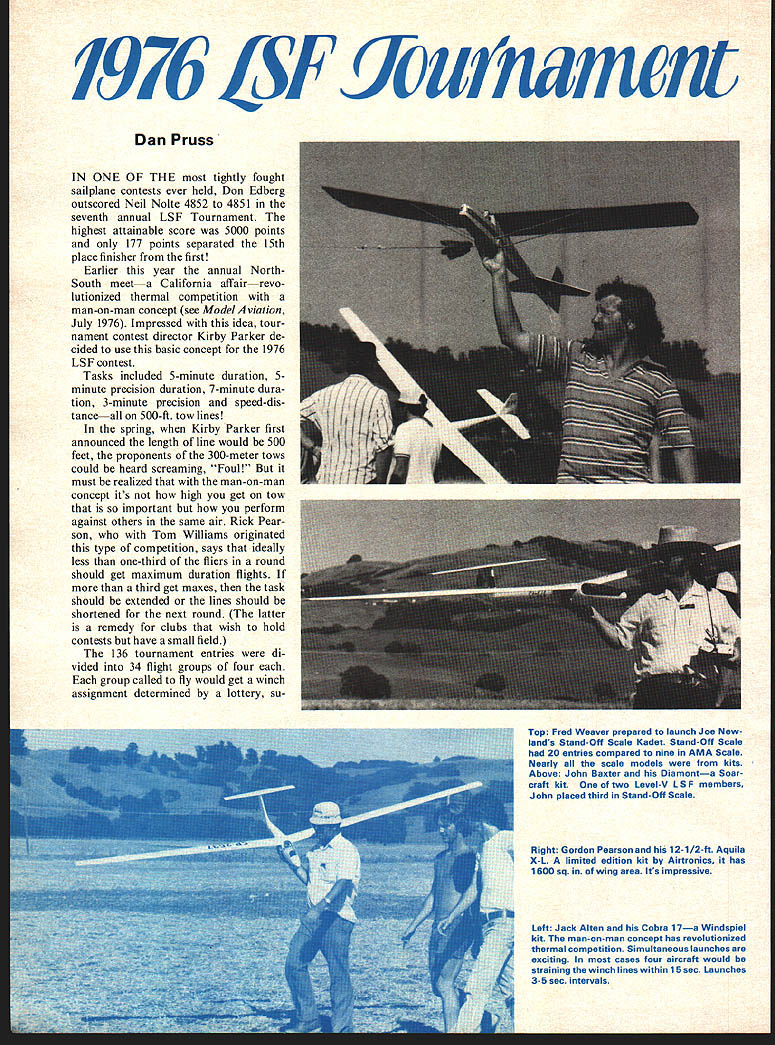
1976 LSF Tournament
Dan Pruss
IN ONE OF THE most tightly fought sailplane contests ever held, Don Edberg outscored Neil Nolte 4852 to 4851 in the seventh annual LSF Tournament. The highest attainable score was 5000 points and only 177 points separated the 15th place finisher from the first!
Earlier this year the annual North-South meet — a California affair — revolutionized thermal competition with a man-on-man concept (see Model Aviation, July 1976). Impressed with this idea, tournament contest director Kirby Parker decided to use this basic concept for the 1976 LSF contest.
Tasks included 5-minute duration, 5-minute precision duration, 7-minute duration, 3-minute precision and speed-distance — all on 500-ft tow lines!
In the spring, when Kirby Parker first announced the length of line would be 500 feet, the proponents of the 300-meter tows could be heard screaming, "Foul!" But it must be realized that with the man-on-man concept it's not how you get on tow that is so important but how you perform against others in the same air. Rick Pearson, who with Tom Williams originated this type of competition, says that ideally less than one-third of the fliers in a round should get maximum duration flights. If more than a third get maxes, then the task should be extended or the lines should be shortened for the next round. (The latter is a remedy for clubs that wish to hold contests but have a small field.)
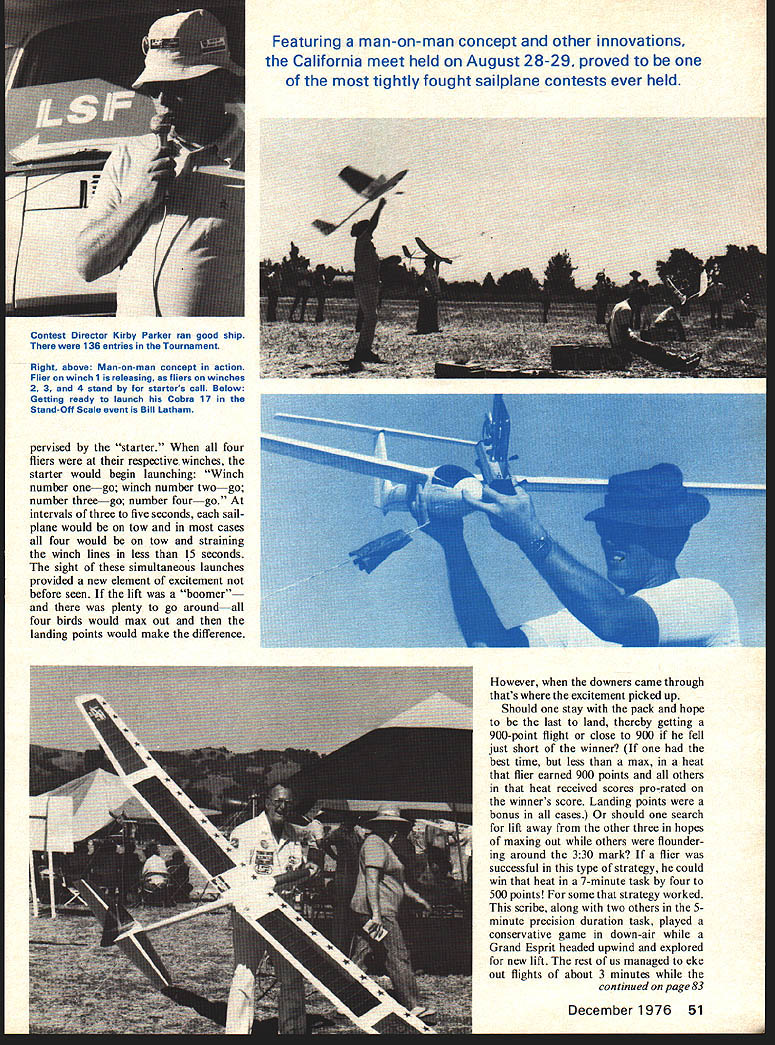
The 136 tournament entries were divided into 34 flight groups of four each. Each group called to fly would get a winch assignment determined by a lottery. Supervised by the "starter." When all four fliers were at their respective winches, the starter would begin launching: "Winch number one—go; winch number two—go; number three—go; number four—go." At intervals of three to five seconds, each sailplane would be on tow and in most cases all four would be on tow and straining the winch lines in less than 15 seconds. The sight of these simultaneous launches provided a new element of excitement not before seen. If the lift was a "boomer" and there was plenty to go around—all four birds would max out and then the landing points would make the difference.
However, when the downers came through that's where the excitement picked up. Should one stay with the pack and hope to be the last to land, thereby getting a 900-point flight or close to 900 if he fell just short of the winner? (If one had the best time, but less than a max, in a heat that flier earned 900 points and all others in that heat received scores pro-rated on the winner's score. Landing points were a bonus in all cases.) Or should one search for lift away from the other three in hopes of maxing out while others were floundering around the 3:30 mark? If a flier was successful in this type of strategy, he could win that heat in a 7-minute task by four to 500 points! For some that strategy worked. This scribe, along with two others in the 5-minute precision duration task, played a conservative game in down-air while a Grand Esprit headed upwind and explored for new lift. The rest of us managed to eke out flights of about 3 minutes while the Grand sniffed out a thermal and rode it back downwind for a max and a spot landing. That was the man-on-man concept at its best. An added element to that type of daring was a ground rule imposed by Parker & Co. The general landing area was about once again as big as the four 50-ft.-diameter circles. If one missed his landing bonus, flight points were still awarded. But if one failed to land within the general landing boundaries, it was a zero flight score!
This head-to-head competition kept up all day Saturday in clear blue skies and 90+ degree weather. When the third round was posted Neil Nolte was ahead of Don Edberg by one point!
Traditionally, the League of Silent Flight tournaments have been innovative with regards to tasks and events. This year saw the recognition of Stand-Off Scale besides the AMA Scale event. Nine entries pre-registered for the latter event—which is about normal. However, Stand-Off Scale had 20 entries! AMA Scale entries were judged statically and flew under the unofficial rules as published in the AMA rule book. Meanwhile, Stand-Off Scale flew the regular contest tasks and so the sole four scale ships launch together then peel-off for the first pylon in the speed-distance task as a sight more clubs should provide. Jon Lowe, LSF/1261, with his Glasflugel 604 gathered 3850 points to take top honors in this event. An interesting note is that nearly all of the planes including Jon's—were kits.
In AMA Scale (referred to by some as museum scale) Don Edberg's 814 points out of a possible 1000 earned him first place. Don's 464 flight points were high for the flight category, and Gordon Pearson's 495 out of 500 were high in static points. Gordon's model of Stan Hall's Vector I is a most difficult scale subject and truly exemplifies the craftsmanship of its builder/flier.
On Saturday evening, Ken Willard amused and bemused the audience as he MCed the banquet. Throwing friendly barbs at fellow modelers seems to be Ken's forte when he isn't designing airplanes.
On Sunday, except for some early fog, the weather was identical to Saturday and lift was everywhere—most of the time. First round was a 5-minute duration task and Fred Weaver, LSF/283, posted the only 1000-point score in precision or duration for the meet. This means he was less than one-half of a second off his time and less than three inches from the center of the landing circle!
Last year's tournament saw a new concept in speed-distance. Basically, the flier is given three minutes to complete three laps crosswind, a lap being a round-trip out and back (unlike the FAI definition). Due to the size of this year's flying site, the course was cut to 360 feet. Forty points were awarded for each quarter lap with a bonus for finishing in under three minutes. Again, the event was run in heats and the excitement of four sailplanes rounding a pylon has to be experienced to be appreciated. Best time for the task was by Rick Pearson and his 10-pound Saliare who flew the course one second faster than Ray Hayes and his Aquila. Rick's time was 53 seconds!
That this task holds excitement for the spectator as well as the contestants was evidenced by the crowd that stood around the start/finish line.
The hard luck award of the meet has to go to Pat Potega. One of the rules of the speed/distance task stated that after release from tow the flier could not seek out lift but had to reenter the course. Any lift that was then found could be used, however, to the flier's advantage. This ruling resulted in very spectacular starts and bunched up first turns. As Pat entered the start of the course, another plane collided with his and knocked one-half of the polyhedral section from the right wing of the Paragon. As both birds tumbled they recovered and continued on course to the cheer of the crowd. However, by the time the recovery was affected the other two planes were a half lap ahead. The Paragon, with 24 ounces of lead, started to gain on the leaders and with a little over a lap to go everyone had a feeling that Potega would pull ahead, perhaps in the next turn. It wasn't to be.
As Pat turned to begin the third and final lap the same plane that collided with him before met him with him again, this time taking off the tail of the Paragon. The heavily loaded ship went straight in and the pound-and-a-half of lead all but pulverized the radio and Thermic Sniffer. In over 700 launches, those were the only mid-airs and they occurred during the same flight!
When the dust and excitement settled late on Sunday afternoon, the South Bay Soaring Society and the Redwood Silent Flyers could stand proud for managing one of the most prestigious sailplane contests ever. The standings reflect the winners and the planes they flew. The standings don't measure the camaraderie and good-fellowship that exists at these tournaments. Perhaps in 1977 it will be possible for more of the now 2100 LSF members to participate. For at least eight clubs across the U.S. have indicated they are eager to host such events. This means at least eight contests across the country.
LSF shortlines... Of the 136 entries, 16 were from outside California... included were Illinois, Michigan and Indiana... only one combined class of sailplane in this year's competition... no real difference when man-on-man except in speed/distance task... Stand-Off Scale should be pursued... a real delight seeing six to eight high aspect ratio motes wing sparking with the hawks... and speaking of wings, a Dave Jones design, the Raven, the only flying wing at the contest, performed well... circled for two solid minutes in tight lift no higher than 50 feet... great watching Ken Willard giving duel to Sid "Monokote" Axelrod... top 15 fliers all from California... lift was good in times, lines could have been shortened to 300 feet... line retrieval by N.Y.P.U.M., National Youth Program Using Mini-bikes, a YMCA organization aided by the clubs... check your local YMCA and solve your contest's line retrieving problems. The groups have done an outstanding service at the Milwaukee Suds City Soar-In, the S.O.A.R. Nationals and this tournament.
Transcribed from original scans by AI. Minor OCR errors may remain.

