
1977LSF: National Tournament
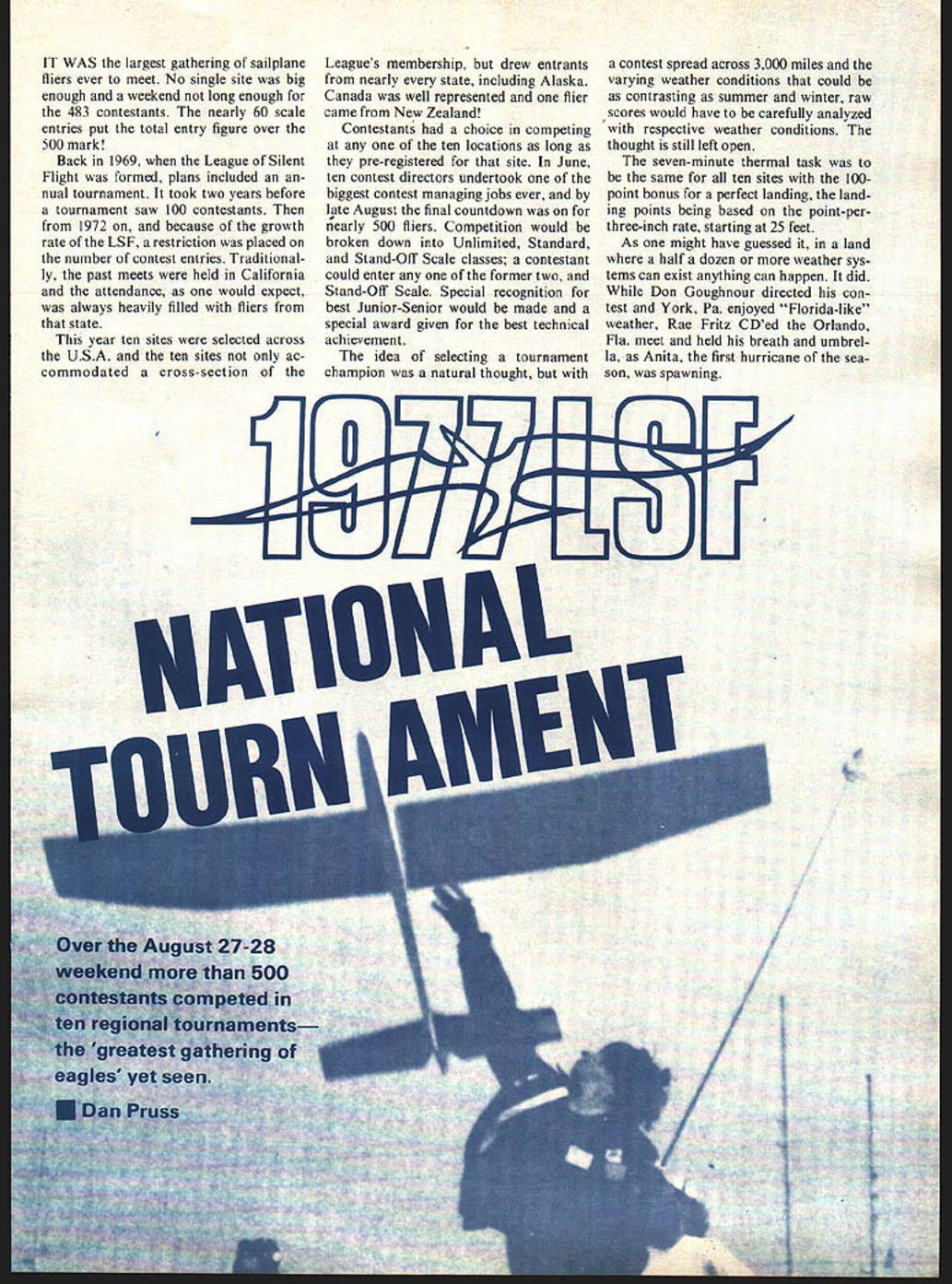
IT WAS the largest gathering of sailplane fliers ever to meet. No single site was big enough and a weekend not long enough for the 483 contestants. The nearly 60 scale entries put the total entry figure over the 500 mark!
Back in 1969, when the League of Silent Flight was formed, plans included an annual tournament. It took two years before a tournament saw 100 contestants. Then from 1972 on, and because of the growth rate of the LSF, a restriction was placed on the number of contest entries. Traditionally, the past meets were held in California and the attendance, as one would expect, was always heavily filled with fliers from that state.
This year ten sites were selected across the U.S.A. and the ten sites not only accommodated a cross-section of the League's membership, but drew entrants from nearly every state, including Alaska. Canada was well represented and one flier came from New Zealand!
Contestants had a choice in competing at any one of the ten locations as long as they pre-registered for that site. In June, ten contest directors undertook one of the biggest contest-managing jobs ever, and by late August the final countdown was on for nearly 500 fliers. Competition would be broken down into Unlimited, Standard, and Stand-Off Scale classes; a contestant could enter any one of the former two, and Stand-Off Scale. Special recognition for best Junior-Senior would be made and a special award given for the best technical achievement.
The idea of selecting a tournament champion was a natural thought, but with a contest spread across 3,000 miles and the varying weather conditions that could be as contrasting as summer and winter, raw scores would have to be carefully analyzed with respective weather conditions. The thought is still left open.
The seven-minute thermal task was to be the same for all ten sites with the 100-point bonus for a perfect landing, the landing points being based on the point-per-three-inch rate, starting at 25 feet.
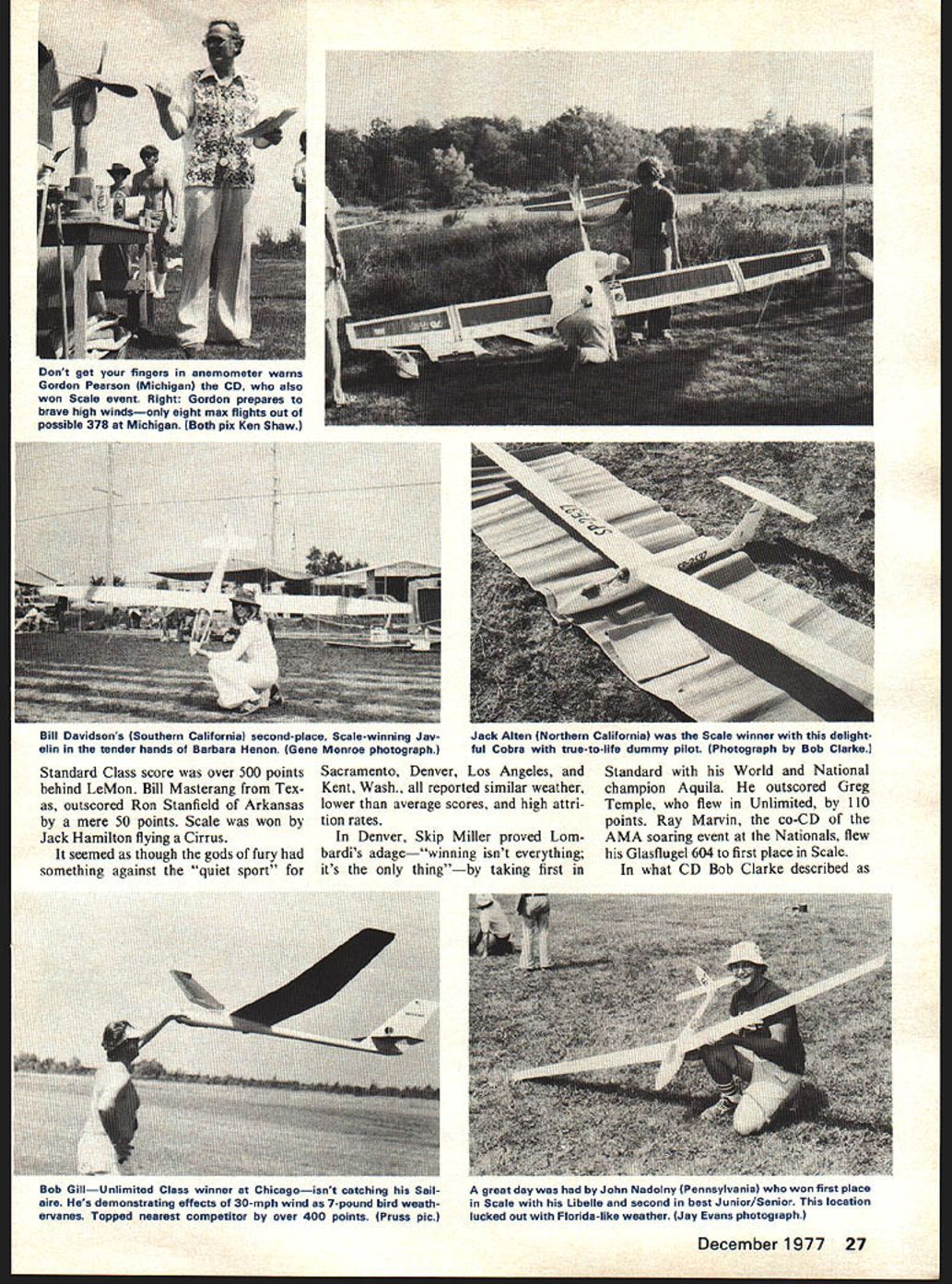
As one might have guessed it, in a land where a half a dozen or more weather systems can exist anything can happen. It did. While Don Goughnour directed his contest at York, Pa., enjoying "Florida-like" weather, Rae Fritz CD'ed the Orlando, Fla. meet and held his breath and umbrella, as Anita, the first hurricane of the season, was spawning. Ann Arbor, Mich., and contest director Gordon Pearson saw 96-degree weather and up to 30-knot winds plague some of the midwest's best fliers. Eight max flights were recorded out of a possible 378! Highest attainable score was 2600 points. Pat Flinn's 1524 was the highest at the meet.
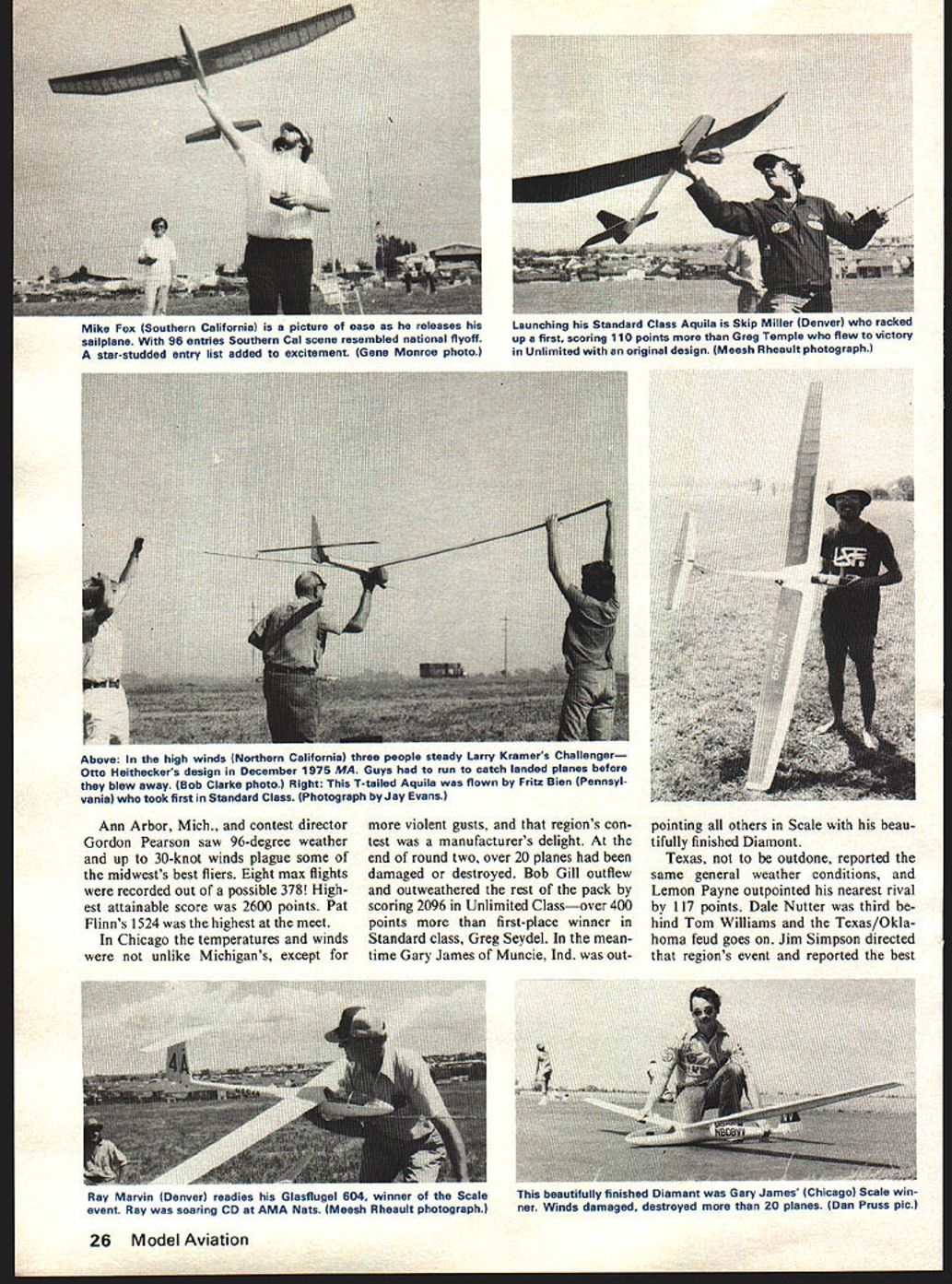
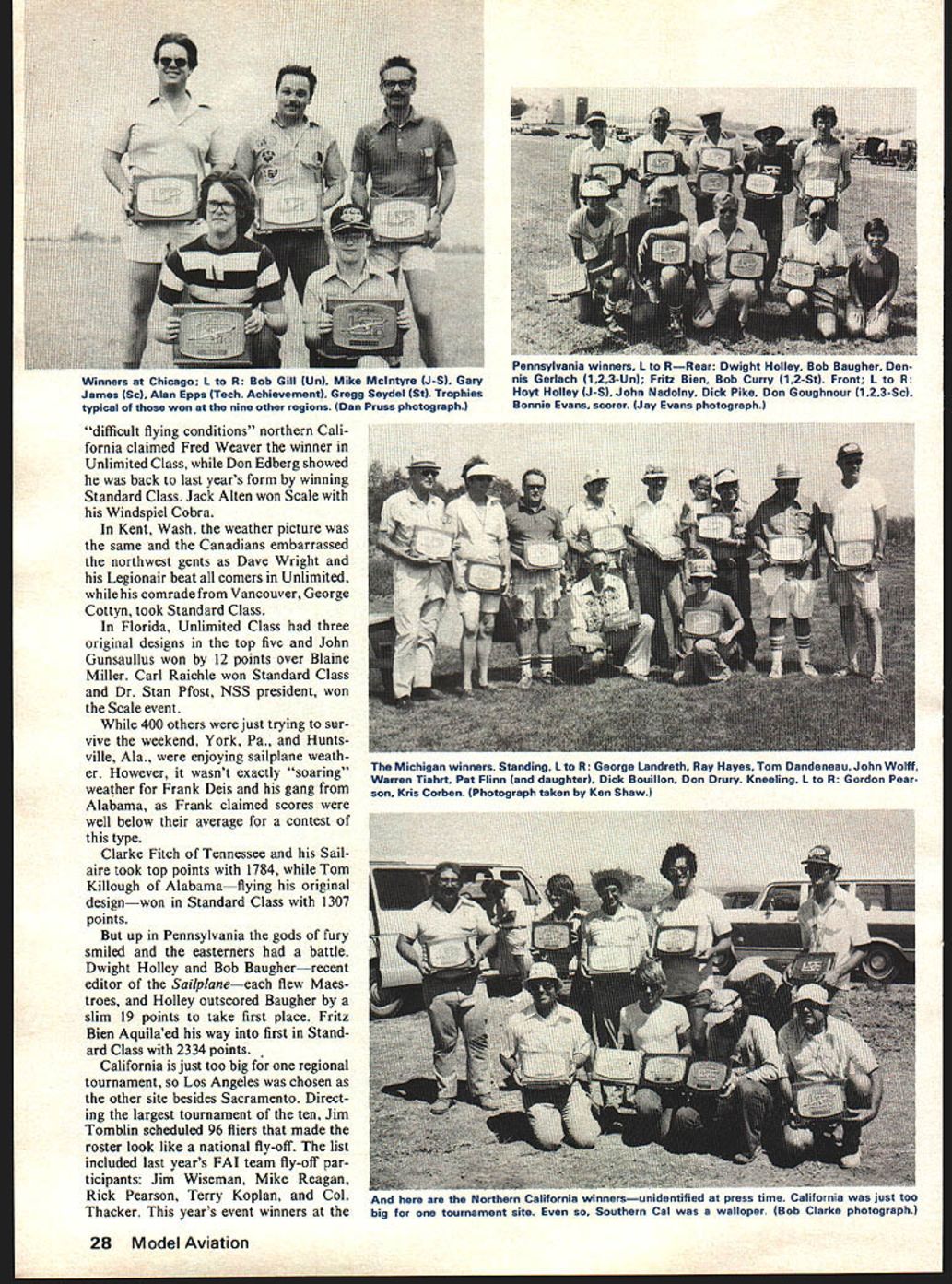
In Chicago the temperatures and winds were not unlike Michigan's, except for more violent gusts, and that region's contest was a manufacturer's delight. At the end of round two, over 20 planes had been damaged or destroyed. Bob Gill outflew and outweathered the rest of the pack by scoring 2096 in Unlimited Class — over 400 points more than first-place winner in Standard class, Greg Seydel. In the meantime Gary James of Muncie, Ind. was outpointing all others in Scale with his beautifully finished Diamant.
Texas, not to be outdone, reported the same general weather conditions, and Lemon Payne outpointed his nearest rival by 117 points. Dale Nutter was third behind Tom Williams and the Texas/Oklahoma feud goes on. Jim Simpson directed that region's event and reported the best Standard Class score was over 500 points behind LeMon. Bill Masterang from Texas, outscored Ron Stanfield of Arkansas by a mere 50 points. Scale was won by Jack Hamilton flying a Cirrus.
It seemed as though the gods of fury had something against the "quiet sport" for Sacramento, Denver, Los Angeles, and Kent, Wash., all reported similar weather, lower than average scores, and high attrition rates.
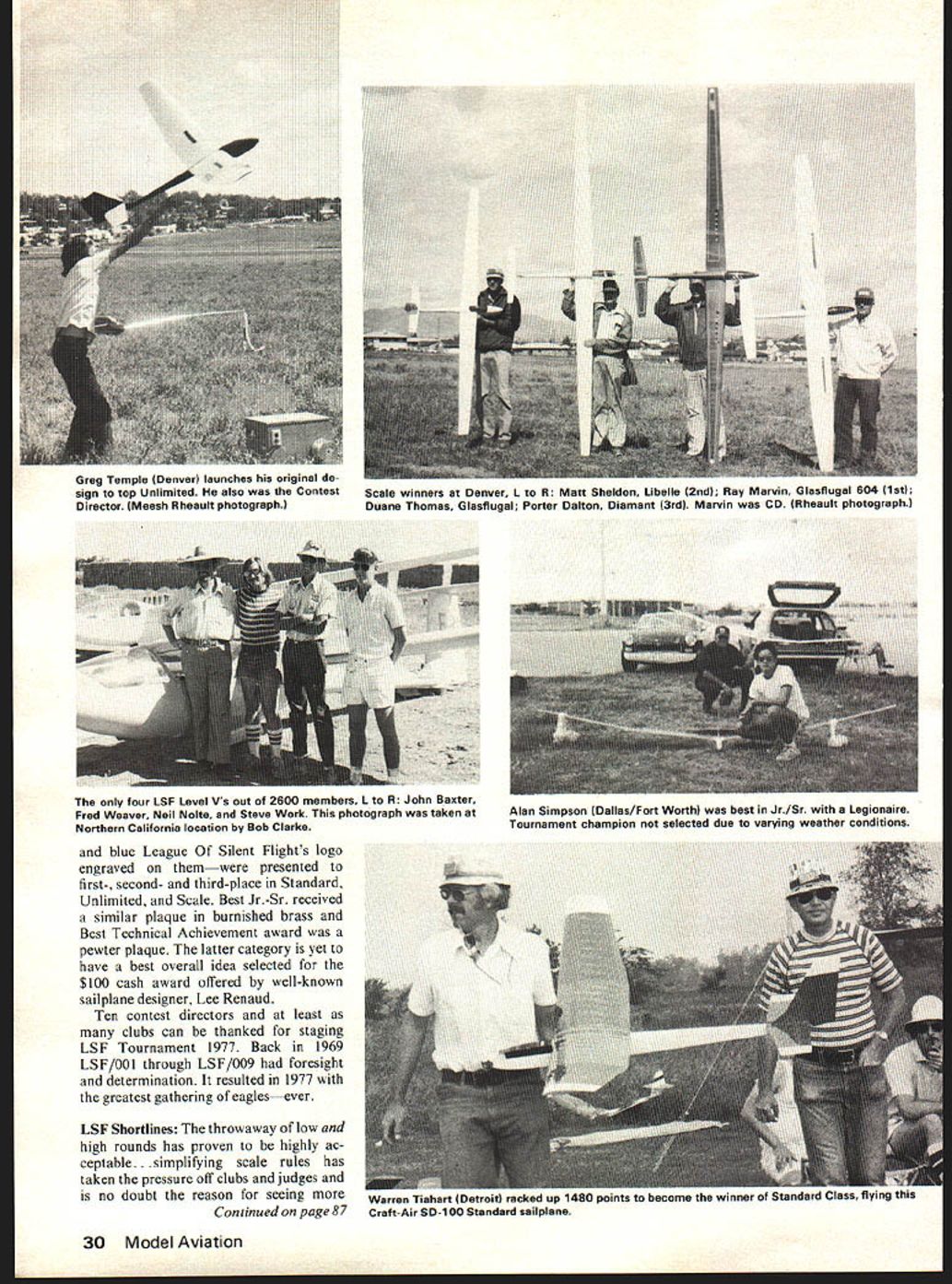
In Denver, Skip Miller proved Lombardi's adage—"winning isn't everything; it's the only thing"—by taking first in Standard with his World and National champion Aquila. He outscored Greg Temple, who flew in Unlimited, by 110 points. Ray Marvin, the co-CD of the AMA soaring event at the Nationals, flew his Glasflugel 604 to first place in Scale.
In what CD Bob Clarke described as "difficult flying conditions" northern California claimed Fred Weaver the winner in Unlimited Class, while Don Edberg showed he was back to last year's form by winning Standard Class. Jack Alten won Scale with his Windspiel Cobra.
In Kent, Wash., the weather picture was the same and the Canadians embarrassed the northwest gents as Dave Wright and his Legionair beat all comers in Unlimited, while his comrade from Vancouver, George Cottyn, took Standard Class.
In Florida, Unlimited Class had three original designs in the top five and John Gunsaullus won by 12 points over Blaine Miller. Carl Raichle won Standard Class and Dr. Stan Pfost, NSS president, won the Scale event.
While 400 others were just trying to survive the weekend, York, Pa., and Huntsville, Ala., were enjoying sailplane weather. However, it wasn't exactly "soaring" weather for Frank Deis and his gang from Alabama, as Frank claimed scores were well below their average for a contest of this type.
Clarke Fitch of Tennessee and his Sailaire took top points with 1784, while Tom Killough of Alabama—flying his original design—won in Standard Class with 1307 points.
But up in Pennsylvania the gods of fury smiled and the easterners had a battle. Dwight Holley and Bob Baugher—recent editor of the Sailplane—each flew Maestros, and Holley outscored Baugher by a slim 19 points to take first place. Fritz Bien Aquila'ed his way into first in Standard Class with 2334 points.
California is just too big for one regional tournament, so Los Angeles was chosen as the other site besides Sacramento. Directing the largest tournament of the ten, Jim Tomblin scheduled 96 fliers that made the roster look like a national fly-off. The list included last year's FAI team fly-off participants; Jim Wiseman, Mike Reagan, Rick Pearson, Terry Koplan, and Col. Thacker. This year's event winners at the
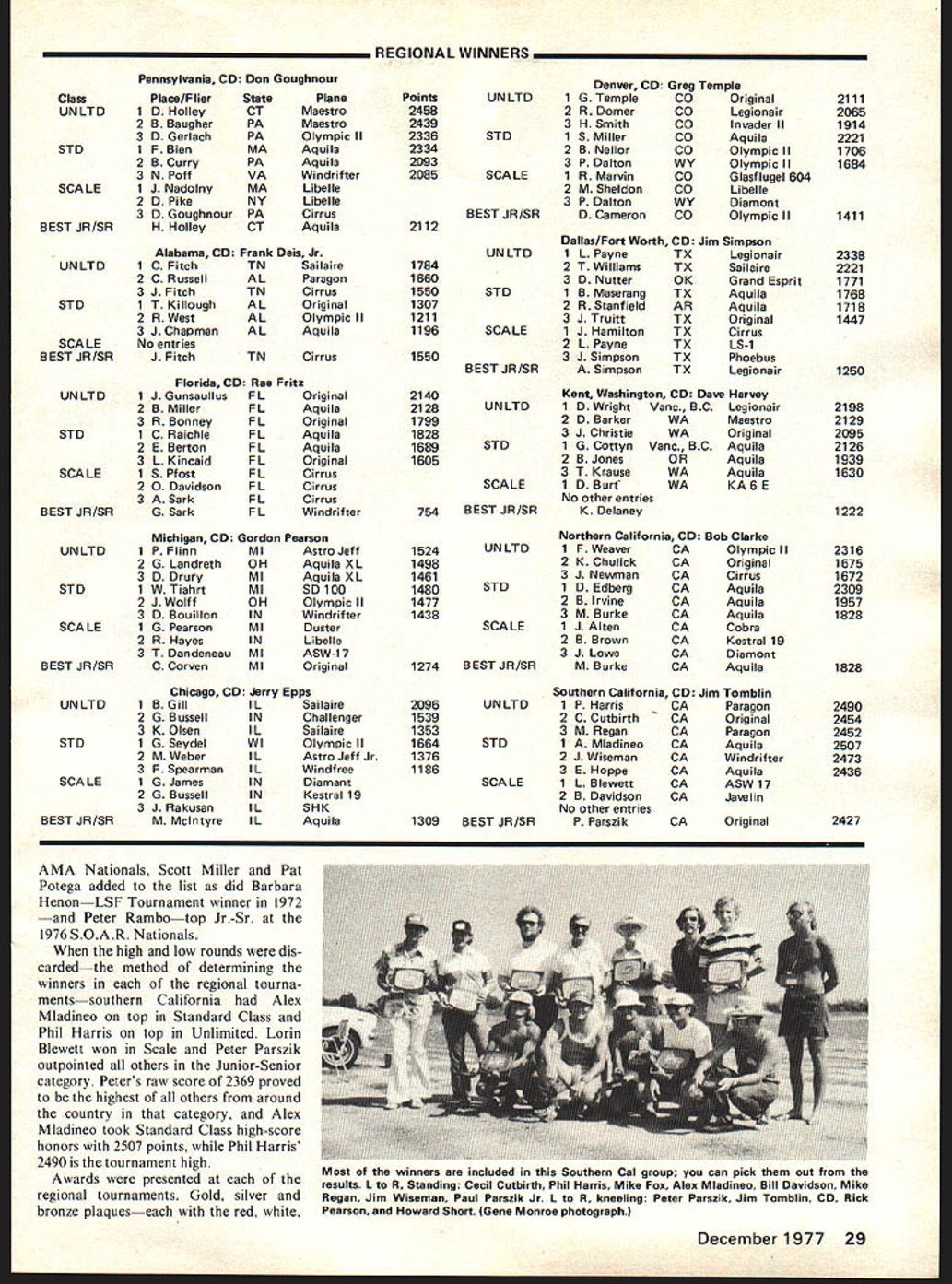
REGIONAL WINNERS
Pennsylvania, CD: Don Goughnour Class Place/Flier State Plane Points UNLTD 1 D. Holley CT Maestro 2458 2 B. Baugher PA Maestro 2439 3 D. Gerlach PA Olympic II 2336 STD 1 F. Bien MA Aquila 2334 2 B. Curry PA Aquila 2093 3 N. Poff VA Windrifter 2085 SCALE 1 J. Nadolny MA Libelle 2 D. Pike NY Libelle 3 D. Goughnour PA Cirrus BEST JR/SR H. Holley CT Aquila 2112
Alabama, CD: Frank Deis, Jr. UNLTD 1 C. Fitch TN Sailaire 1784 2 C. Russell AL Paragon 1660 3 J. Fitch TN Cirrus 1550 STD 1 T. Killough AL Original 1307 2 R. West AL Olympic II 1211 3 J. Chapman AL Aquila 1196 SCALE No entries BEST JR/SR J. Fitch TN Cirrus 1550
Florida, CD: Rae Fritz UNLTD 1 P. Gunsaullus FL Original 2140 2 B. Miller FL Aquila 2128 3 R. Bonney FL Original 1799 STD 1 C. Raichle FL Aquila 1828 2 E. Berton FL Aquila 1689 3 L. Kincaid FL Original 1605 SCALE 1 S. Prost FL Cirrus 2 O. Davidson FL Cirrus 3 A. Sark FL Cirrus BEST JR/SR G. Sark FL Windrifter 754
Michigan, CD: Gordon Pearson UNLTD 1 P. Flinn MI Astro Jeff 1524 2 G. Landreth OH Aquila XL 1498 3 D. Drury MI Aquila XL 1461 STD 1 W. Tiahrt MI SD 100 1480 2 J. Wolff OH Olympic II 1477 3 D. Bouillon IN Windrifter 1438 SCALE 1 G. Pearson MI Duster 2 R. Hayes IN Libelle 3 T. Dandeneau MI ASW-17 BEST JR/SR C. Corven MI Original 1274
Chicago, CD: Jerry Epps UNLTD 1 B. Gill IL Sailaire 2096 2 G. Bussell IN Challenger 1539 3 K. Olsen IL Sailaire 1353 STD 1 G. Seydel WI Olympic II 1664 2 M. Weber IL Astro Jeff Jr.1376 3 F. Spearman IL Windfree 1186 SCALE 1 G. James IL Diamant 2 G. Bussell IN Kestrel 19 3 J. Rakusan IL SHK BEST JR/SR M. McIntyre IL Aquila 1309
Denver, CD: Greg Temple UNLTD 1 G. Temple CO Original 2111 2 R. Domer CO Legionair 2065 3 H. Smith CO Invader II 1914 STD 1 S. Miller CO Aquila 2221 2 B. Neller CO Olympic II 1706 3 P. Dalton WY Olympic II 1684 SCALE 1 R. Marvin CO Glasflugel 604 2 M. Sheldon CO Libelle 3 P. Dalton WY Diamant BEST JR/SR D. Cameron CO Olympic II 1411
Dallas/Fort Worth, CD: Jim Simpson UNLTD 1 L. Payne TX Legionair 2338 2 T. Williams TX Sailaire 2221 3 D. Nutter OK Grand Esprit 1771 STD 1 B. Massuram TX Aquila 1768 2 R. Stanfield AR Aquila 1718 3 J. Truitt TX Original 1447 SCALE 1 J. Hamilton TX Cirrus 2 L. Payne TX LS-1 3 J. Simpson TX Phoebus BEST JR/SR A. Simpson TX Legionair 1250
Kent, Washington, CD: Dave Harvey UNLTD 1 D. Wright Vanc., B.C. Legionair 2198 2 D. Barker WA Maestro 2129 3 J. Christie WA Original 2095 STD 1 G. Cotryn Vanc., B.C. Aquila 2126 2 B. Jones OR Aquila 1939 3 T. Krause WA Aquila 1630 SCALE 1 D. Burt WA KA 6 E No other entries BEST JR/SR K. Delaney 1222
Northern California, CD: Bob Clarke UNLTD 1 F. Weaver CA Olympic II 2316 2 K. Chulick CA Original 1675 3 J. Newman CA Cirrus 1672 STD 1 D. Edberg CA Aquila 2309 2 B. Irvine CA Aquila 1957 3 M. Burke CA 1828 SCALE 1 J. Alten CA Cobra 2 B. Brown CA Kestral 19 3 J. Lowe CA Diamant BEST JR/SR M. Burke CA Aquila 1828
Southern California, CD: Jim Tomblin UNLTD 1 P. Harris CA Paragon 2490 2 C. Cutbirth CA Original 2454 3 M. Regan CA Paragon 2452 STD 1 A. Mladineo CA Aquila 2507 2 J. Wiseman CA Windrider 2473 3 E. Hoppe CA Aquila 2436 SCALE 1 L. Blewett CA ASW 17 2 B. Davidson CA Javelin No other entries BEST JR/SR P. Parszik CA Original 2427
AMA Nationals. Scott Miller and Pat Potega added to the list as did Barbara Henon—LSF Tournament winner in 1972—and Peter Rambo—top Jr.-Sr. at the 1976 S.O.A.R. Nationals.
When the high and low rounds were discarded—the method of determining the winners in each of the regional tournaments—southern California had Alex Mladineo on top in Standard Class and Phil Harris on top in Unlimited. Lorin Blewett won in Scale and Peter Parszik outpointed all others in the Junior-Senior category. Peter's raw score of 2369 proved to be the highest of all others from around the country in that category, and Alex Mladineo took Standard Class high-score honors with 2507 points, while Phil Harris' 2490 is the tournament high.
Awards were presented at each of the regional tournaments. Gold, silver and bronze plaques—each with the red, white, and blue ribbons—were presented. and blue League of Silent Flight's logo engraved on them—were presented to first-, second- and third-place in Standard, Unlimited, and Scale. Best Jr.-Sr. received a similar plaque in burnished brass and Best Technical Achievement award was a pewter plaque. The latter category is yet to have a best overall idea selected for the $100 cash award offered by well-known sailplane designer, Lee Renaud.
Ten contest directors and at least as many clubs can be thanked for staging LSF Tournament 1977. Back in 1969 LSF/001 through LSF/009 had foresight and determination. It resulted in 1977 with the greatest gathering of eagles—ever.
LSF Shortlines: The throwaway of low and high rounds has proven to be highly acceptable... simplifying scale rules has taken the pressure off clubs and judges and is no doubt the reason for seeing more
1977LSF: National Tournament
scale participation ... all LSF level V's competed; three of the four finished in the top five in their respective categories. Only one protest was filed! Comparing weather and scores it's safe to say bigger planes fly better. All scheduled rounds (7) were flown at all sites. Rice, from Alaska, missed third place by a point. Forty-two entered best-technical-achievement forms; more will be heard about these at a later date. Forty-one Junior/Seniors competed. This was the first year manufacturers were not solicited for support — a thanks for their past sponsorship.
The League's membership was over the 2,500 mark at tournament time; 500 are from outside the U.S.A. The League gains financial support from its membership through contributions sent in with PDV forms and through the tournaments. Membership is free and can be obtained by writing to: League Of Silent Flight, Box 39068, Chicago, IL 60639.
Transcribed from original scans by AI. Minor OCR errors may remain.

