
1978 Indoor World Championships
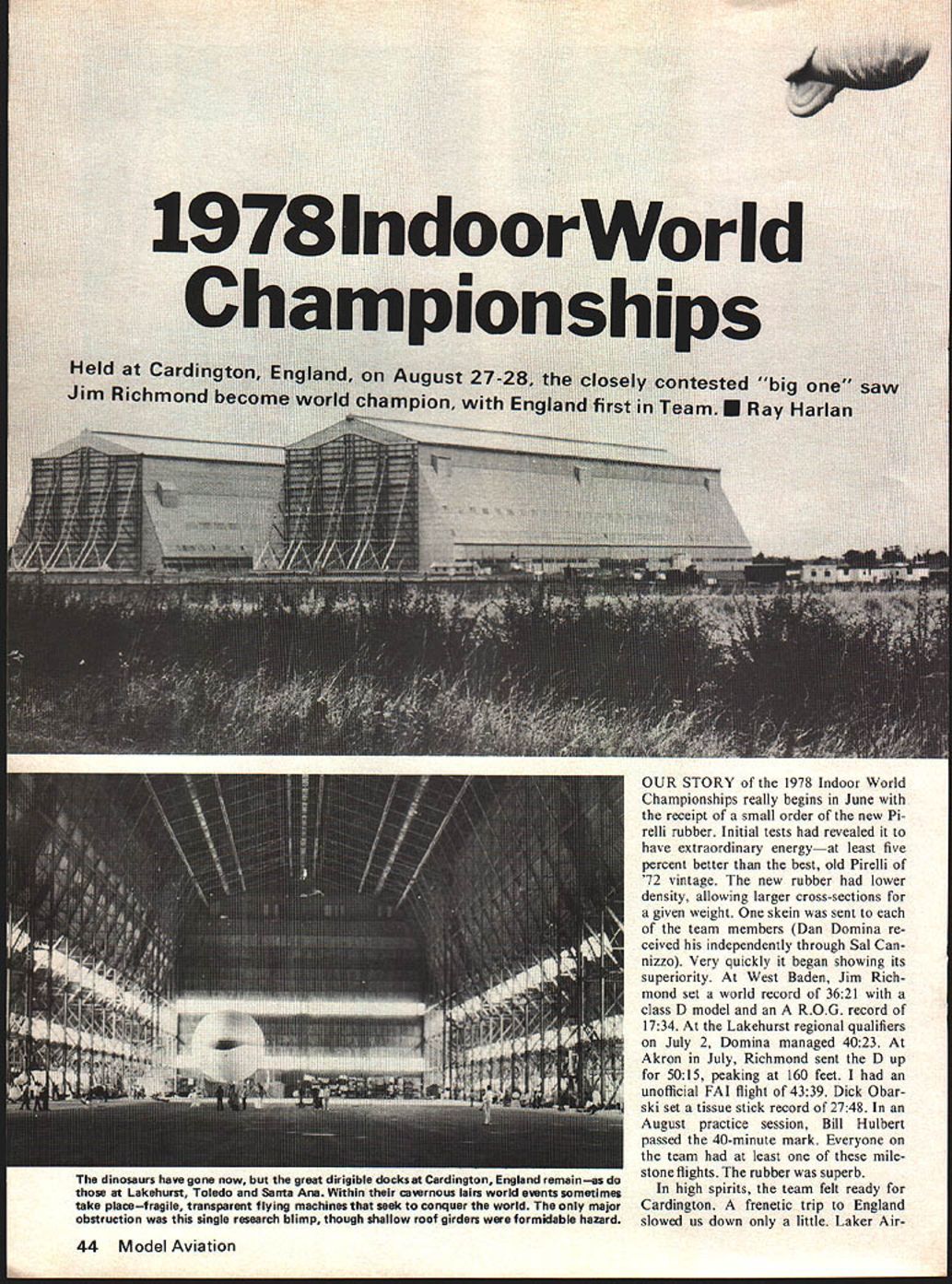
Held at Cardington, England, on August 27–28, the closely contested "big one" saw Jim Richmond become world champion, with England first in team. ■ Ray Harlan
Overview
Our story of the 1978 Indoor World Championships really begins in June with the receipt of a small order of the new Pirelli rubber. Initial tests had revealed it to have extraordinary energy—at least five percent better than the best old Pirelli of '72 vintage. The new rubber had lower density, allowing larger cross-sections for a given weight. One skein was sent to each of the team members (Dan Domina received his independently through Sal Cannizzo). Very quickly it began showing its superiority.
At West Baden, Jim Richmond set a world record of 36:21 with a class D model and an A.R.O.G. record of 17:34. At the Lakehurst regional qualifiers on July 2, Domina managed 40:23. At Akron in July, Richmond sent the D up for 50:15, peaking at 160 feet. I had an unofficial FAI flight of 43:39. Dick Obarski set a tissue stick record of 27:48. In an August practice session, Bill Hulbert passed the 40-minute mark. Everyone on the team had at least one of these milestone flights. The rubber was superb.
In high spirits, the team felt ready for Cardington. A frenetic trip to England slowed us down only a little.
Captions and Notable Competitors
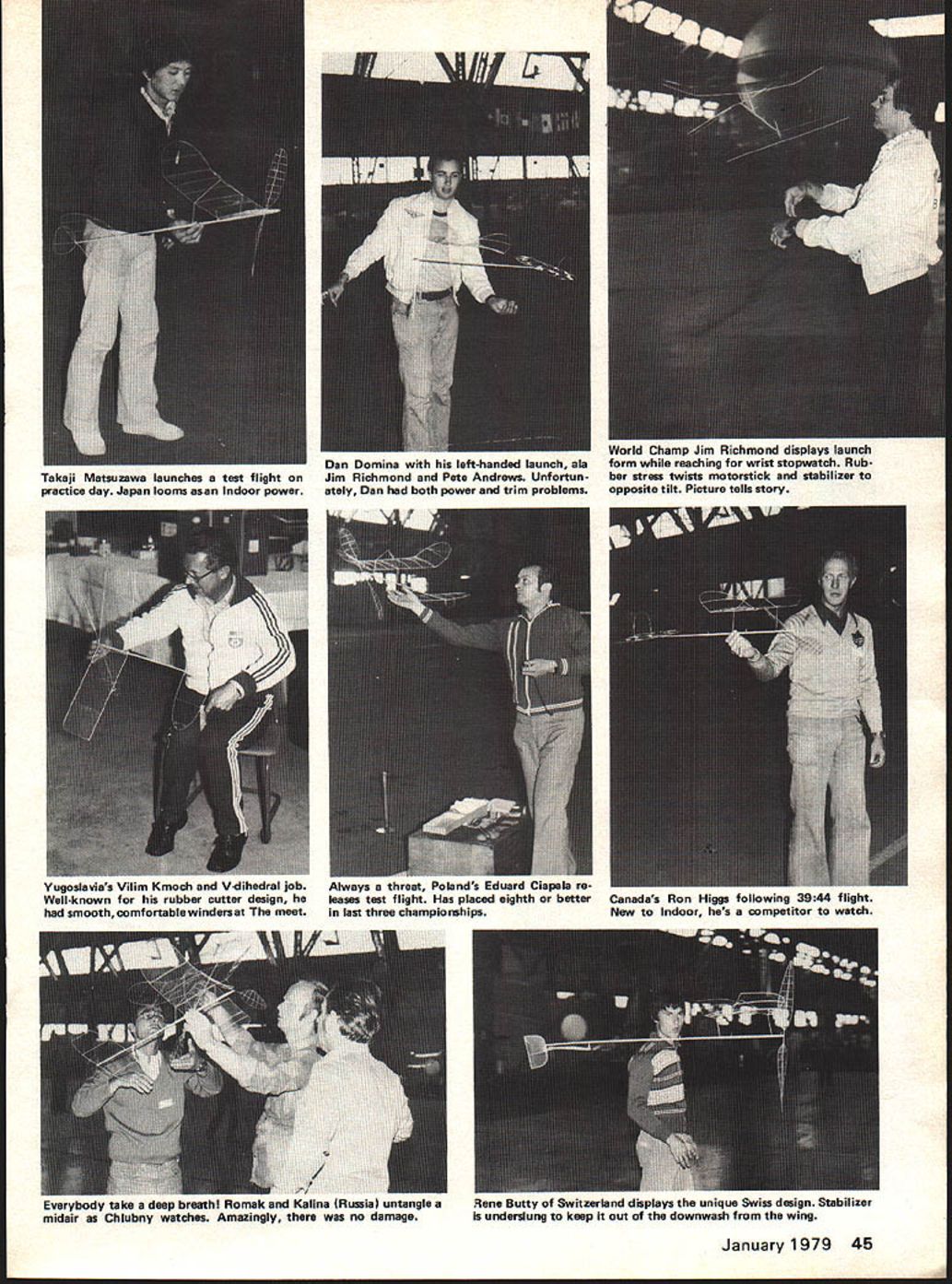
Takaji Matsuzawa launches a test flight on practice day. Japan looms as an indoor power.
Dan Domina with his left-handed launch, à la Jim Richmond and Pete Andrews. Unfortunately, Dan had both power and trim problems.
World Champ Jim Richmond displays launch form while reaching for a wrist stopwatch. Rubber stress twists motorstick and stabilizer to opposite tilt. The picture tells the story.
Yugoslavia's Vilim Kmoch and his V-dihedral job. Well known for his rubber cutter design, he had smooth, comfortable winders at the meet.
Always a threat, Poland's Eduard Ciapala releases a test flight. He has placed eighth or better in the last three championships.
Canada's Ron Higgs following a 39:44 flight. New to indoor, he's a competitor to watch.
Everybody take a deep breath! Romak and Kalina (Russia) untangle a midair as Chlubny watches. Amazingly, there was no damage.
Rene Butty of Switzerland displays the unique Swiss design. The stabilizer is underslung to keep it out of the wing's downwash.
Arrival and Preparation
The airline was sympathetic to our special handling needs and took care to see everything loaded safely. They even brought boxes up the elevator of the DC-10 so we could hand-carry them off the plane. What a relief it was to find no model damage in transit.
But the battle wasn't over; there were no microbuses to be found at Gatwick and we had to work out a way to get one reserved in the heart of London. Richmond and his gear went with Dave Hagen of Oregon, who had offered to meet us at the airport. The rest of us crowded into a Volvo station wagon and set out to rendezvous with our microbus. The entire day was spent going from Gatwick to Bedford, only about 90 miles. We certainly were glad we chose to arrive early and have two days to rest and overcome jet lag.
Friday was check-in day, a time for some of us to renew old acquaintances and for others to make new ones. It is an indescribable thrill to mingle with the great European indoor fliers. English seemed more common than at past championships, so the chatter was excited. It was a perfect opportunity to drop a few hints of our 40-minute flights to let the competition worry a bit.
We met Peter Freebrey, head of the FAI jury, and expressed our concern with the unlimited steering rules adopted this year. We felt the meet would be reduced to a steering contest wherein models would be deliberately overwound and held back from hitting the roof with a balloon string. He was very sympathetic and set out to define the intent of the steering rules as would be interpreted by the jury.
Steering Rules (Jury Interpretation)
At the manager's meeting the next day, Peter Freebrey outlined the jury's position. Although they were not empowered to change the rules, they felt obliged to interpret the current rules through a four-point statement:
- Steering should only be used as an emergency. It was not to be a control competition.
- Low-altitude steering should only be used when there is imminent danger of collision with walls, contents, or another model. No steering should take place when the flight path of the model is in clear space.
- Steering must act on a point of the model forward of the wing leading edge. The line must not be able to catch on any part of the model forward of the leading edge, other than the propeller and propeller assembly.
- The intent of the rules is such that steering should only be used to avert collision, principally on a horizontal plane, and is not to be used as an altitude control.
The net result was the removal of "shark's teeth" from motorsticks, and a warning that blasting models to the roof and steering them would not be tolerated. The shark's teeth helped prevent balloon strings from snagging propellers and could be used to pull the model. In effect, if steering was used by a competitor to keep the model from overclimbing, it would require some skill to avoid catching the propeller, which invariably terminates a flight since the string can't be freed. However, the question of when a competitor was allowed to steer remained judgmental and left room for abuse of the intent of the rule.
Practice Day (Saturday)
Practice day opened with a 60-degree temperature and a heavy overcast. This broke off at midday to give us a warming sun. Many fliers began to make flights in the mid-30s. The drift was inconsistent from one part of the hangar to another, and there was no well-defined pattern. Fortunately, there was very little, if any, side drift. As the temperature rose, so did the times. The best were posted after 7:00.
Wolthoorn of the Netherlands had a 37:17. Butty of Switzerland a 38:50. Bud Romak joined the 40-minute FAI club with 41:12 and followed that with 41:38. He and his manager, Erv Rodensky, had worked closely together to find just the right power combination. It quickly became obvious that the new Pirelli was a necessity; everyone else had it also.
The U.S. team practiced cautiously. Bill Hulbert had several flights in the mid-30s. Dan Domina had three over 36½. Jim Richmond put models halfway up and saw 34s and 35s. Everyone was satisfied.
Day One (Sunday)
On Sunday morning we arose to a cloudless sky. A very light ground fog shrouded Cardington but would burn off by 11:00. It was 62 degrees inside the hangar at floor level. We began to practice. Bill and Dan posted mid-25s, getting 80 to 100 feet. Jim tested with a little more zing and put his model to the top in eight minutes. He ballooned successfully, dropped 30 feet, and finished with 41:50!
The contest started at 11:00 and we had eight hours to initiate nine flights, so there was little time to waste. We waited a little for the weather to clear. Jim stressed the need for two conservative first flights from each team member to get us solidly on the board. Bill offered to go first and started with 190 turns. He landed safely with 34:39.
Dan was next. He put his model just above 100 feet, but the motor walked off the front hook, bunched at the rear, and the model stalled down from 100 feet for a time of 23:14. This visibly upset Dan, rightfully so.
Ron Green of the United Kingdom powered his first flight to the top in 6:15. In discussion of the steering rule at the manager's meeting, the jury said they didn't want to see models blasted to the roof. No fixed time was set, but comments to the effect that eight minutes or more was normal to peak met with general agreement. Green was forced to balloon and touched it on a girder while steering. The balloon exploded, destroying the model and ending concern over steering-rule intent, for that flight at least.
Early in the contest, an unbelievable tragedy struck Dieter Siebenmann of Switzerland. He opened a box of propellers and a pigeon, searching for food, landed in it and destroyed four propellers. It even hit a tailplane while landing. The Swiss moved to a new location more than 100 feet away but later suffered yet another pigeon bombing which broke one of Butty's wings.
Richmond continued to emphasize conservatism and expressed it by using the same motor as for the test flight, wound to the same number of turns. That, of course, would give him "less energy" since the motor was broken in a little better. True, the model didn't quite reach the top, but posted 41:49 anyway. Romak flew simultaneously and landed with 40:55. The contest was on!
By 3:30 the Canadians were showing their steam with three flights over 35, two by Jack McGillivray. No other big flights had been posted. Hulbert went for his second flight and got to within 20 feet of the top. A loose brace wire had led to excess wash-in of the left fin tip and the drag slowed the model. By 16 minutes the model had dropped to 80 feet and landed at 26:38. Domina put a flight to the top, drifted a little, and hung at 11:23.
Barr put up a second flight of 37:23 to get the British momentum going. The Japanese put together two 35s and a 34 for an impressive showing. Higgs of Canada, who is new to the sport, put up a 39:44 for his second flight. Poland's Ciapala had a 38:15 and his team members had some mid-30s. Richmond's second was 36:52, finally exemplifying his conservative exhortations. Romak followed his first flight with a 40:27, thrusting him into the lead by nearly 2½ minutes over Richmond.
As the day grew long the temperature rose, although it was still cool enough for jackets on the floor. Hulbert had power-stall problems, got halfway up and clocked 23:48. Domina managed his best of the day, 30:33, but got only halfway up.
Near 6:30, Richmond readied his third flight. It seemed a match of his first, although it didn't get quite as high, peaking at 130 feet. The air had become more buoyant. Late in the flight, after some flirtation with the lone blimp in the hangar, ground drift moved the model away from the blimp and other ground clutter and it settled to the floor with a magnificent 42:53. He had gained the lead from Romak. Bud challenged, but hung his third flight at 13:43.
Shortly thereafter, thunderous applause rose from a contingent of Japanese huddled around Nonaka. He had just finished his third flight with a superb 40:36 and put his team in a strong position. Curiously, a few minutes later more applause rang out as Barr landed with 39:22. Since only one team member was allowed to fly at a time, it was questionable how he had made an official flight. When the Canadians learned of this, and that the third Japanese model also was flying officially, they filed a protest. It was upheld by the jury, giving the Canadians first-place team standing at the end of the first day. Poland had made some mid-to-high-30s flights for second place, and the U.S. and United Kingdom followed.
Day Two
Day two began with a solid overcast but extraordinary calm. The hangar was a chilly 59 degrees. In early testing, there was evidence of an inversion layer near 100 feet, which was difficult to break through. Drift was negligible. Since it seemed clear that Richmond had won the contest, we felt the pressure of flying a tight schedule would be eased if he passed up at least some of his flights. But the air was not well tested and when the contest began, Jim offered to take an official for this purpose. He managed only 31:16. Meanwhile Bill and Dan continued to practice, working toward getting their models safely under the roof.
By 1:30 the sun had partly broken through and had begun to warm the hangar. Bill flew his first official of the day, getting to within ten feet of the top and clocking 33:10, the longest first flight posted, which improved his position by 6½ minutes. Dan followed, getting very high. Drift took the model off center by about one circle diameter. To gauge its proximity to the girders, Richmond stooped below the closest cross girder while I went down the hangar in line with the outside edge of the circle. When he signaled the model's passing the cross girder, I could judge the clearance. It seemed at least seven feet when, on the third or fourth pass, the model stopped! It had hit a rope slung under a longitudinal girder, invisible to any of us. Once again Dan fell victim to fate. He was down to his last two flights to put something together.
Near 3:00, Bill sent up his second flight. About half a minute after he launched, Sitar of Australia launched right under him. The models brushed but continued flying. I asked Bob Bailey, his team manager, if he would steer his model away from Bill's since we were in strong contention for the team prize. In a very sporting gesture, he agreed. Unfortunately, he broke the wing while steering. Bill's flight didn't appear destined for glory, so he called for a refight after the collision.
By 3:30, Green had flown to 39:18, helping the British considerably. McGillivray moved the Canadians up a little with a 36:19. A little later Barr flew to 36:34, boosting his total by nearly 12 minutes and catapulting the British into the lead by about 11 minutes over Canada and 12 minutes over the U.S.
Hulbert restarted, putting the model within ten feet of the top. Just as it was settling into a cruise, a knot moved and began rubbing the motorstick, slowing the model. By fifteen minutes the model had dropped to 100 feet. It finished with 31:49.
Domina, probably in fear of another hangup, wound cautiously, got his model halfway up, and managed only 25:51. Since the air seemed to be slowly improving, we obtained permission for him to test-fly, and encouraged him to do so until he was satisfied with his power combination.
Both Hulbert and Britain's Morley launched their last flights at about the same time near 5:00. Morley landed with 33:22, helping the British by half a minute. Hulbert reached 34:38, improving our score by a minute and a half. The British still had an eight-minute lead over us.
Laurie Barr, under the pressure of a possible strong finish by Domina, wound tightly for his last flight. The strain straightened the climb and carried the model to the side girders. Before Laurie could balloon it, it had touched, stalled, and tailslid to the ground just after a minute of flight.
Domina needed 33:56 for us to win the team championship. Using a new model, he wound tightly to ensure reaching the roof. On launch, it appeared the motor stick was bowed enough to keep the model from climbing too fast. We thought it would work out within the first minute. It did begin to climb a bit faster after a minute, but it was clear something else was amiss. The model never exceeded 80 feet, spinning off turns rapidly because it was under-elevated. That it clocked 29:53 was somewhat surprising. Upon examination, the rear wing post was discovered to be loose and the launch lift had popped the rear of the wing up 1/16 inch. The only redeeming feature of the flight was that it pushed us past the Canadians.
Results and Observations
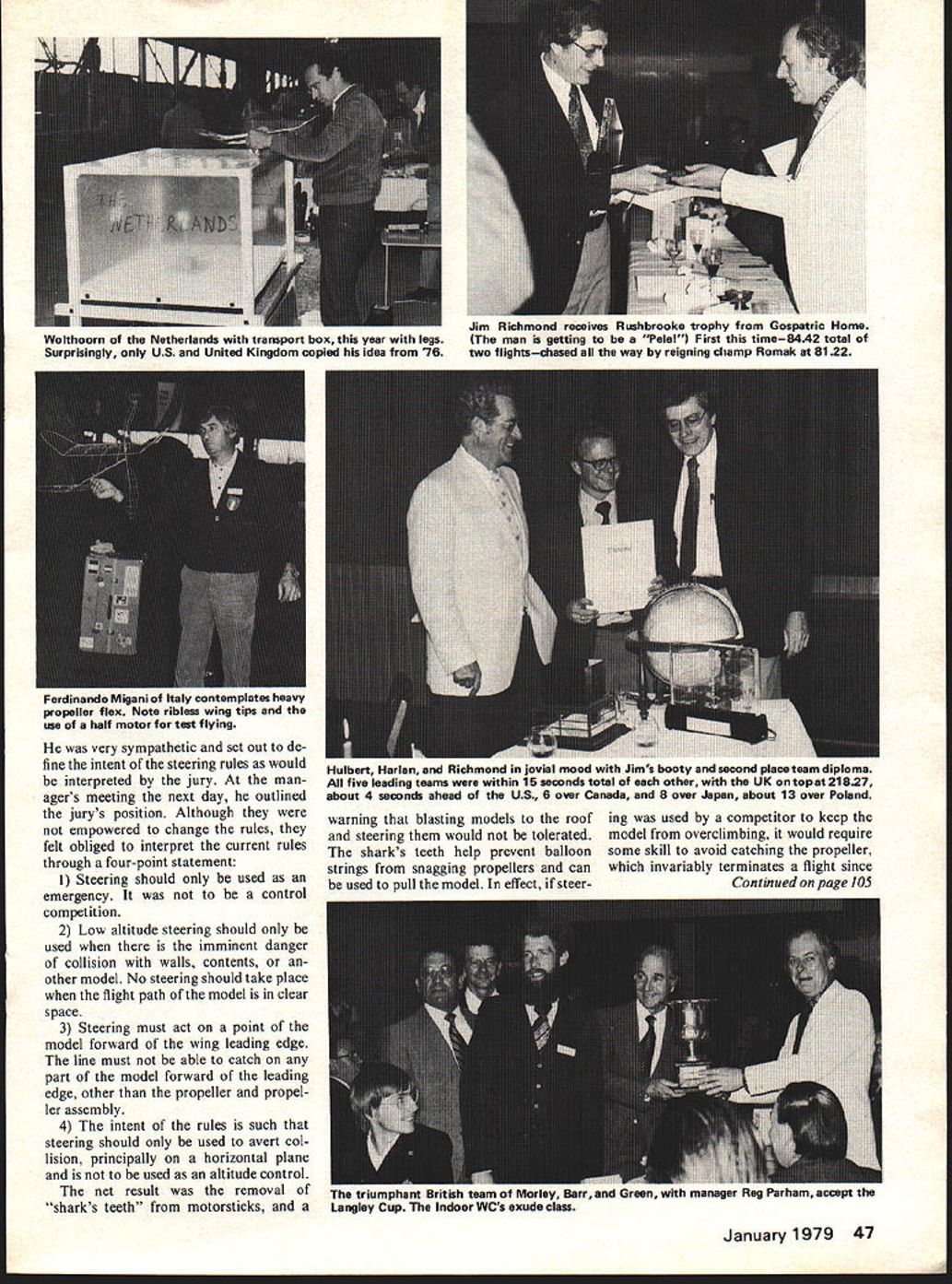
The contest was over. The British team had won by four minutes, placing their men in a tight cluster at fifth, ninth, and eleventh. The U.S. rode on Jim Richmond's exceptional world-champion performance to garner the second-place team award. The defending world champion Bud Romak distinguished himself by placing a strong second individually. Canada finished behind the U.S. for the team award.
Notable points:
- Jim Richmond won the individual world championship with outstanding flights, including a 42:53 on Day One.
- Bud Romak placed a strong second, with multiple 40-minute flights.
- The Japanese team improved markedly, moving from tenth place in 1976 to fourth in 1978.
- The Swiss team progressed steadily despite being hampered by pigeon damage and lacking a third member to challenge for the team cup.
- Many fliers achieved personal bests, and this was one of the rare contests where bad weather did not determine the outcome.
Jim Richmond last won the World Championship in 1968. Let's hope he doesn't limit it to once a decade.
Transcribed from original scans by AI. Minor OCR errors may remain.

