
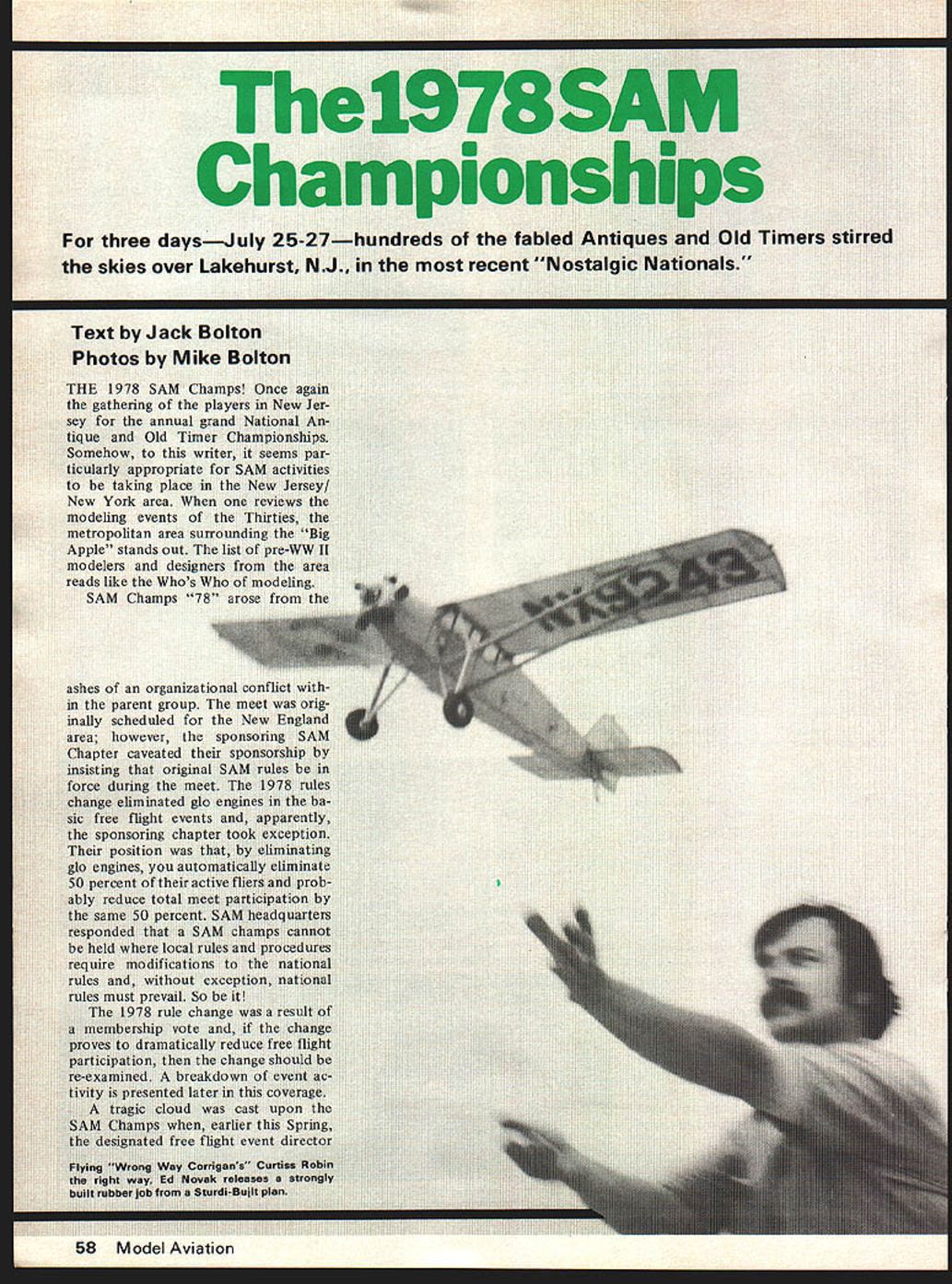
The 1978 SAM Championships
For three days—July 25–27—hundreds of the fabled Antiques and Old Timers stirred the skies over Lakehurst, N.J., in the most recent "Nostalgic Nationals."
Text by Jack Bolton Photos by Mike Bolton
THE 1978 SAM Champs! Once again the gathering of the players in New Jersey for the annual grand National Antique and Old Timer Championships. Somehow, to this writer, it seems particularly appropriate for SAM activities to be taking place in the New Jersey/New York area. When one reviews the modeling events of the Thirties, the metropolitan area surrounding the "Big Apple" stands out. The list of pre-WW II modelers and designers from the area reads like the Who's Who of modeling.
SAM Champs '78 arose from the ashes of an organizational conflict within the parent group. The meet was originally scheduled for the New England area; however, the sponsoring SAM chapter caveated their sponsorship by insisting that original SAM rules be in force during the meet. The 1978 rules change eliminated glow engines in the basic free flight events and, apparently, the sponsoring chapter took exception. Their position was that, by eliminating glow engines, you automatically eliminate 50 percent of their active fliers and probably reduce total meet participation by the same 50 percent. SAM headquarters responded that a SAM champs cannot be held where local rules and procedures require modifications to the national rules and, without exception, national rules must prevail. So be it!
The 1978 rule change was a result of a membership vote and, if the change proves to dramatically reduce free flight participation, then the change should be re-examined. A breakdown of event activity is presented later in this coverage.
A tragic cloud was cast upon the SAM Champs when, earlier this spring, the designated free flight event director—Jack Florenzie—died of a heart attack while flying at a local meet. Jack was a stalwart personality and a dedicated long-time modeler. The loss is great. Jack's good friend, Don Garafalo, took up the reins as free flight director.
Coyle Drop Zone
The site of the three-day affair, Coyle Drop Zone, is located some 15 miles south-southeast of NAS Lakehurst. The terrain is typically South Jersey with rather sandy soil, predominantly covered by small pines, scrub oaks, and tough blueberry bushes. The zone itself is normally used by military units as a landing and drop zone. For the fliers, sand and grit was a problem, but not as bad as reported at Taft.
The drop zone is constructed with a center hub area and radial spokes extending out from the hub. The purpose of the radial extensions is to facilitate movement in the area, ostensibly for air-dropped equipment retrieval. For the SAM participants, once off these prepared areas, retrieval by footpower was the order of the day, since soft sand abounded. The topography is undulating. Models were timed and plotted to the point of disappearance, only to be located at various distances from the predetermined point. Retrieval was difficult. For most of the meet, except for Wednesday, the winds ranged from eight to 30 knots. Motor runs were reduced and a two-minute max became the standard. Even so, many models ended up off site in some of the thickest stuff imaginable. Some were lost. Larry Boyer lost a Clipper and a Ranger. However, most ships landing off site were victims of indiscrete and arbitrary fusing. Many were going four and five minutes before dethermalizing. Of course, this didn't hold true during the 30-knot gales on Thursday. Two minutes normally would put you off the drop zone that day.
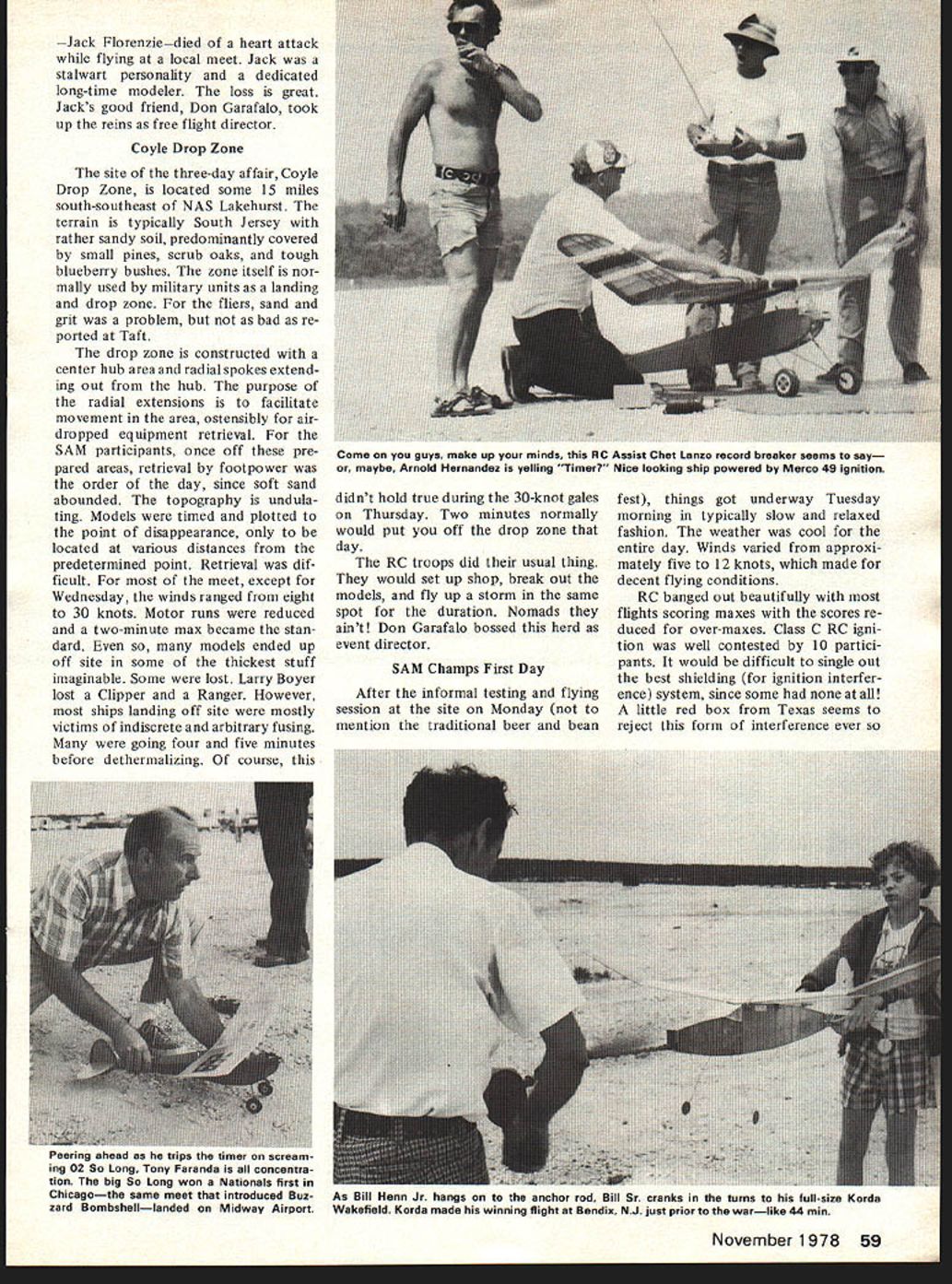
The RC troops did their usual thing. They would set up shop, break out the models, and fly up a storm in the same spot for the duration. Nomads they ain't! Don Garafalo bossed this herd as event director.
SAM Champs — First Day
After the informal testing and flying session at the site on Monday (not to mention the traditional beer and bean fest), things got underway Tuesday morning in typically slow and relaxed fashion. The weather was cool for the entire day. Winds varied from approximately five to 12 knots, which made for decent flying conditions.
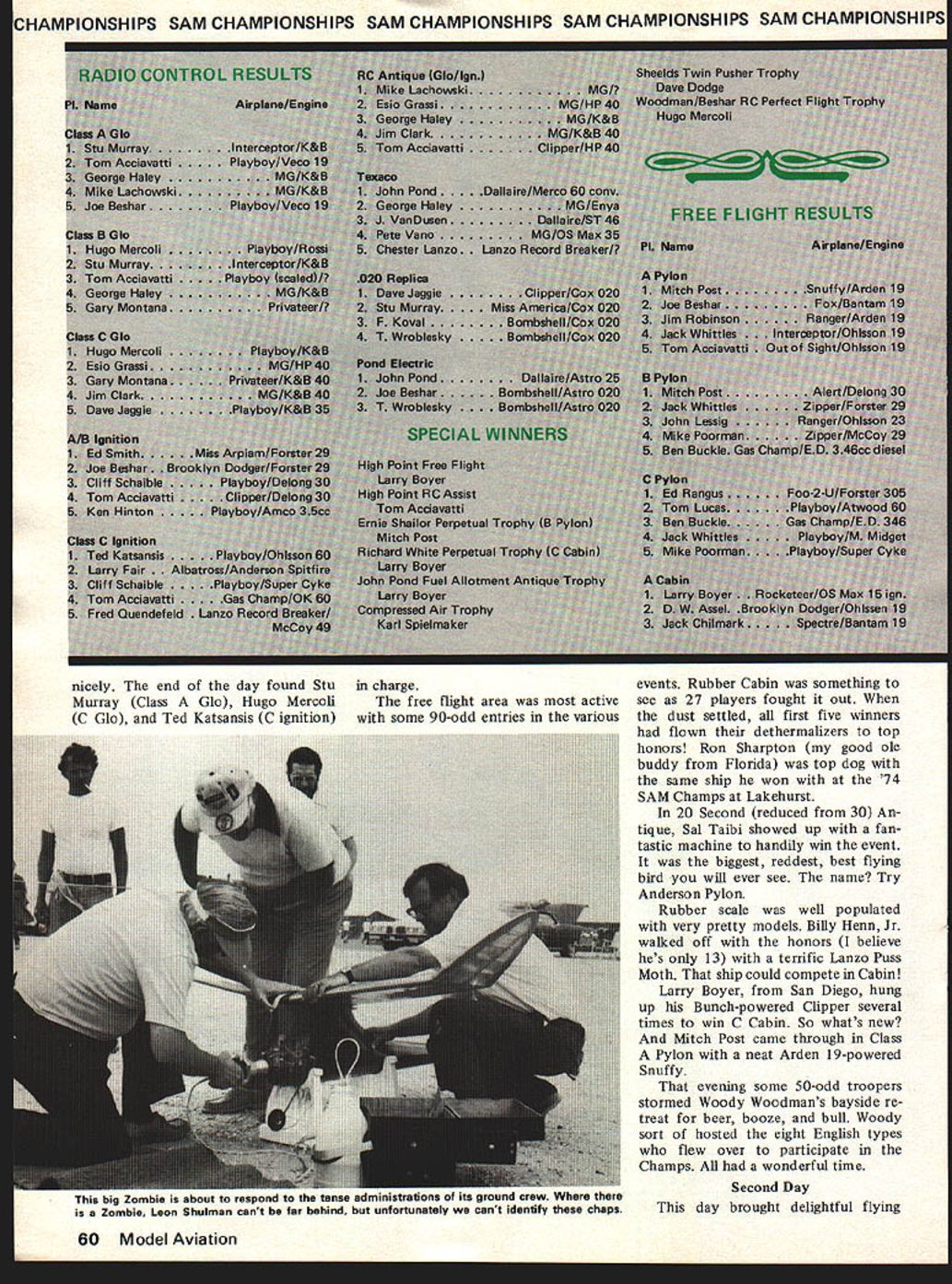
RC banged out beautifully with most flights scoring maxes with the scores reduced for over-maxes. Class C RC ignition was well contested by 10 participants. It would be difficult to single out the best shielding (for ignition interference) system, since some had none at all! A little red box from Texas seems to reject this form of interference ever so nicely. The end of the day found Stu Murray (Class A glow), Hugo Mercoli (Class C glow), and Ted Katsansis (Class C ignition) in charge.
The free flight area was most active with some 90-odd entries in the various events. Rubber Cabin was something to see as 27 players fought it out. When the dust settled, all first five winners had flown their dethermalizers to top honors! Ron Sharpton (my good ole buddy from Florida) was top dog with the same ship he won with at the '74 SAM Champs at Lakehurst.
In 20 Second (reduced from 30) Antique, Sal Taibi showed up with a fantastic machine to handily win the event. It was the biggest, reddest, best flying bird you will ever see. The name? Try Anderson Pylon.
Rubber scale was well populated with very pretty models. Billy Henn, Jr. walked off with the honors (I believe he's only 13) with a terrific Lanzo Puss Moth. That ship could compete in Cabin! Larry Boyer, from San Diego, hung up his Bunch-powered Clipper several times to win C Cabin. And Mitch Post came through in Class A Pylon with a neat Arden 19-powered Snuffy.
That evening some 50-odd troopers stormed Woody Woodman's bayside retreat for beer, booze, and bull. Woody sort hosted the eight English types who flew over to participate in the Champs. All had a wonderful time.
Second Day
This day brought delightful flying conditions. Up until 11 a.m. free-flighters were launching and recovering models within a couple hundred feet of the launch area. Winds ranged from calm up to 10 knots the entire day. Sunbathing was in order, but the temperature was mild.
The RC'ers were once again out in force and commenced logging their maxes with apparent ease. Winners were mostly determined by the flier's ability to land his machine as close to the five-minute max as possible. Posted scores reflected this fact with very few seconds separating 1st through 5th. RC participants were caught in a dilemma. Since the 5-minute max was adopted, and the 10-minute max abandoned, it has become routine to max continuously, with the outcome determined by the flier's ability to touch down on the max. The 20-second engine run has been retained, and rightfully so, for a reduction in engine run would simply drive up the power requirement. It is a really critical dilemma. Something must be done, but at this point no one knows what.
At any rate, there were five participating in the event. Hugo Mercoli, one more time, was first in B glow. Ed Smith topped out in A/B ignition, and Mike Lachowski took the honors in RC Antique.
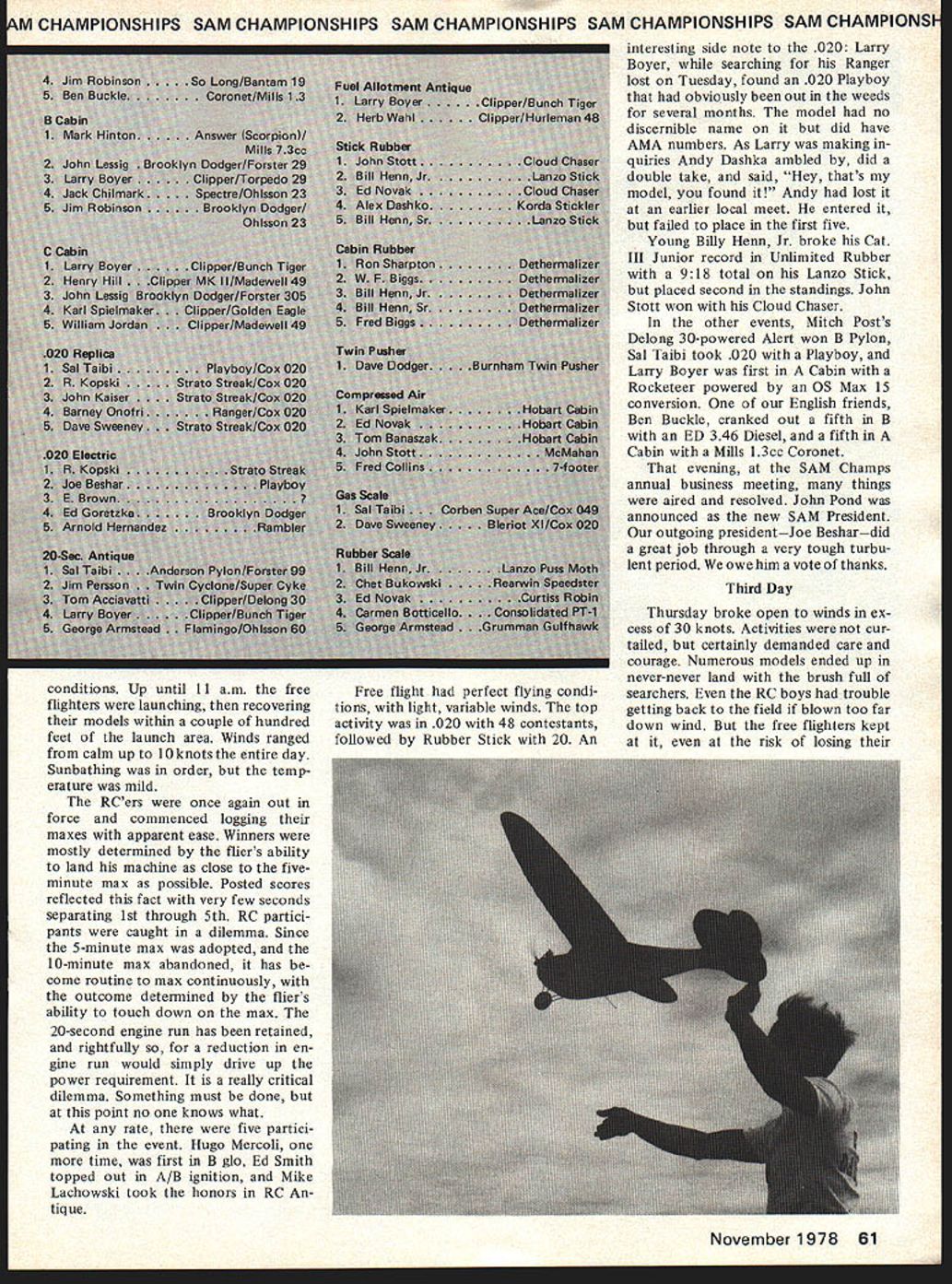
Free flight had perfect flying conditions, with light, variable winds. The top activity was in .020 with 48 contestants, followed by Rubber Stick with 20. An interesting side note to the .020: Larry Boyer, while searching for his Ranger lost on Tuesday, found an .020 Playboy that had obviously been out in the weeds for several months. The model had no discernible name on it but did have AMA numbers. As Larry was making inquiries Andy Dashka ambled by, did a double take, and said, "Hey, that's my model, you found it!" Andy had lost it at an earlier local meet. He entered it, but failed to place in the first five.
Young Billy Henn, Jr. broke his Cat. III Junior record in Unlimited Rubber with a 9:18 total on his Lanzo Stick, but placed second in the standings. John Stott won with his Cloud Chaser.
In the other events, Mitch Post's Delong 30-powered Alert won B Pylon, Sal Taibi took .020 with a Playboy, and Larry Boyer was first in A Cabin with a Rocketeer powered by an OS Max 15 conversion. One of our English friends, Ben Buckle, cranked out a fifth in B with an ED 3.46 diesel, and a fifth in A Cabin with a Mills 1.3cc Coronet.
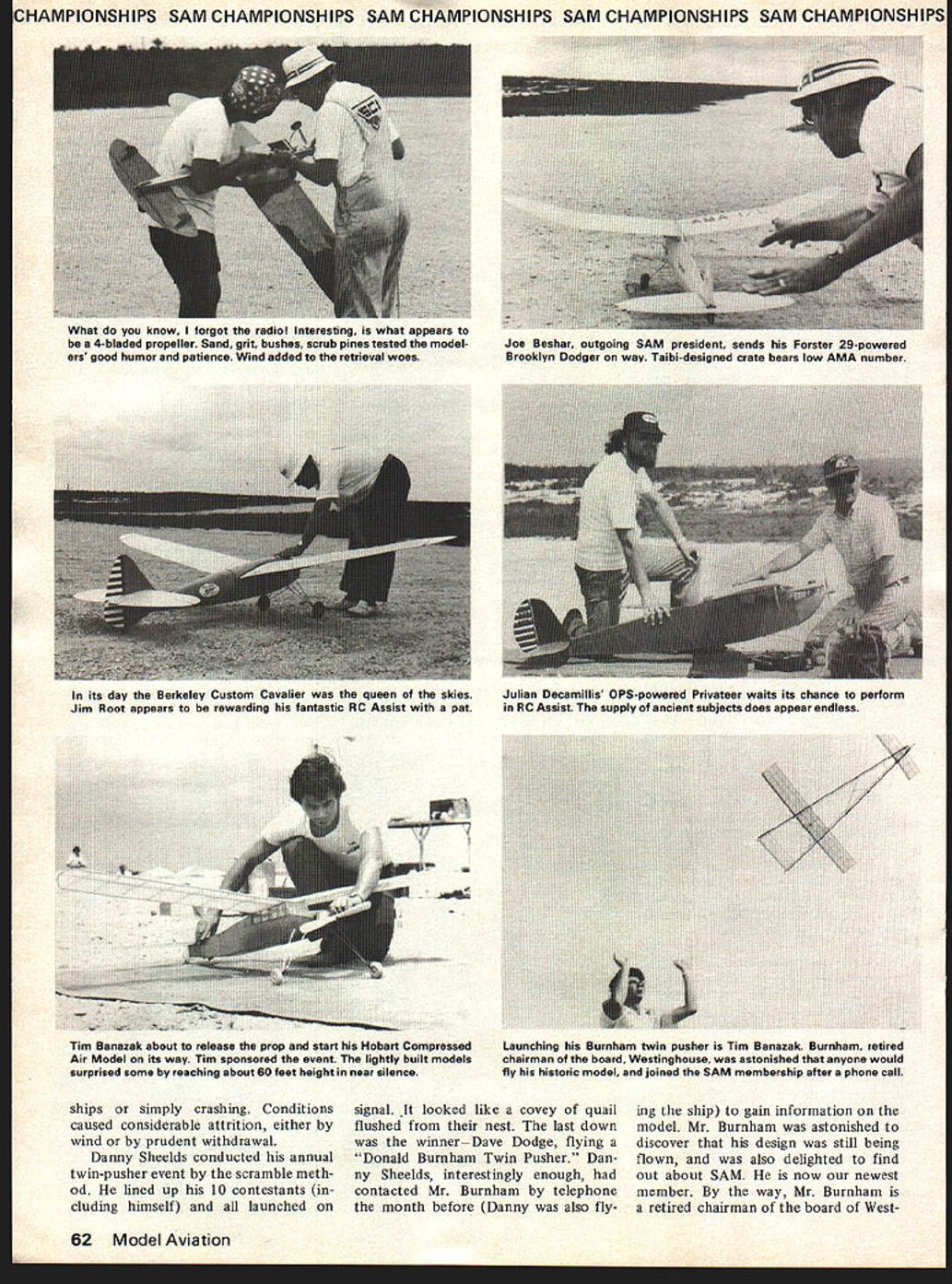
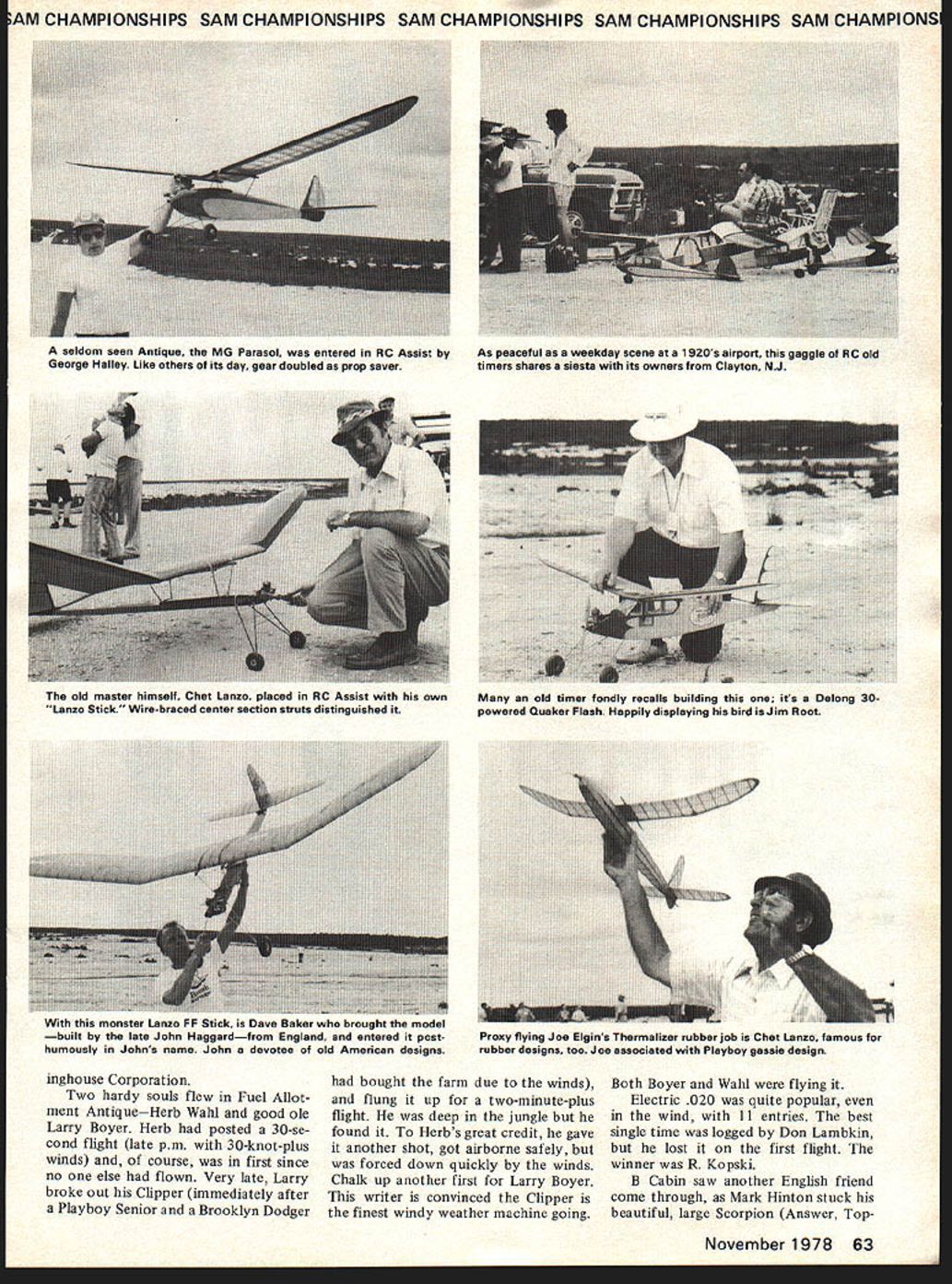
Two hardy souls flew in Fuel Allotment Antique—Herb Wahl and good ole Larry Boyer. Herb had posted a 30-second flight (late p.m. with 30-knot-plus winds) and, of course, was in first since no one else had flown. Very late, Larry broke out his Clipper (immediately after a Playboy Senior and a Brooklyn Dodger had bought the farm due to the winds), and flung it up for a two-minute-plus flight. He was deep in the jungle but he found it. To Herb's great credit, he gave it another shot, got airborne safely, but was forced down quickly by the winds. Chalk up another first for Larry Boyer. This writer is convinced the Clipper is the finest windy weather machine going. Both Boyer and Wahl were flying it.
Electric .020 was quite popular, even in the wind, with 11 entries. The best single time was logged by Don Lambkin, but he lost it on the first flight. The winner was R. Kopski.
B Cabin saw another English friend come through, as Mark Hinton stuck his beautiful, large Scorpion (Answer, Top-Up) for the best time. Ed Rangus won out in C Pylon, and Sal Taibi took Gas Scale with his fine Corben Ace. Dave Sweeney, from Dallas, flew his fine Bleriot to second, incurring minor damage as the model went over the top and hit the ground, almost completing the loop.
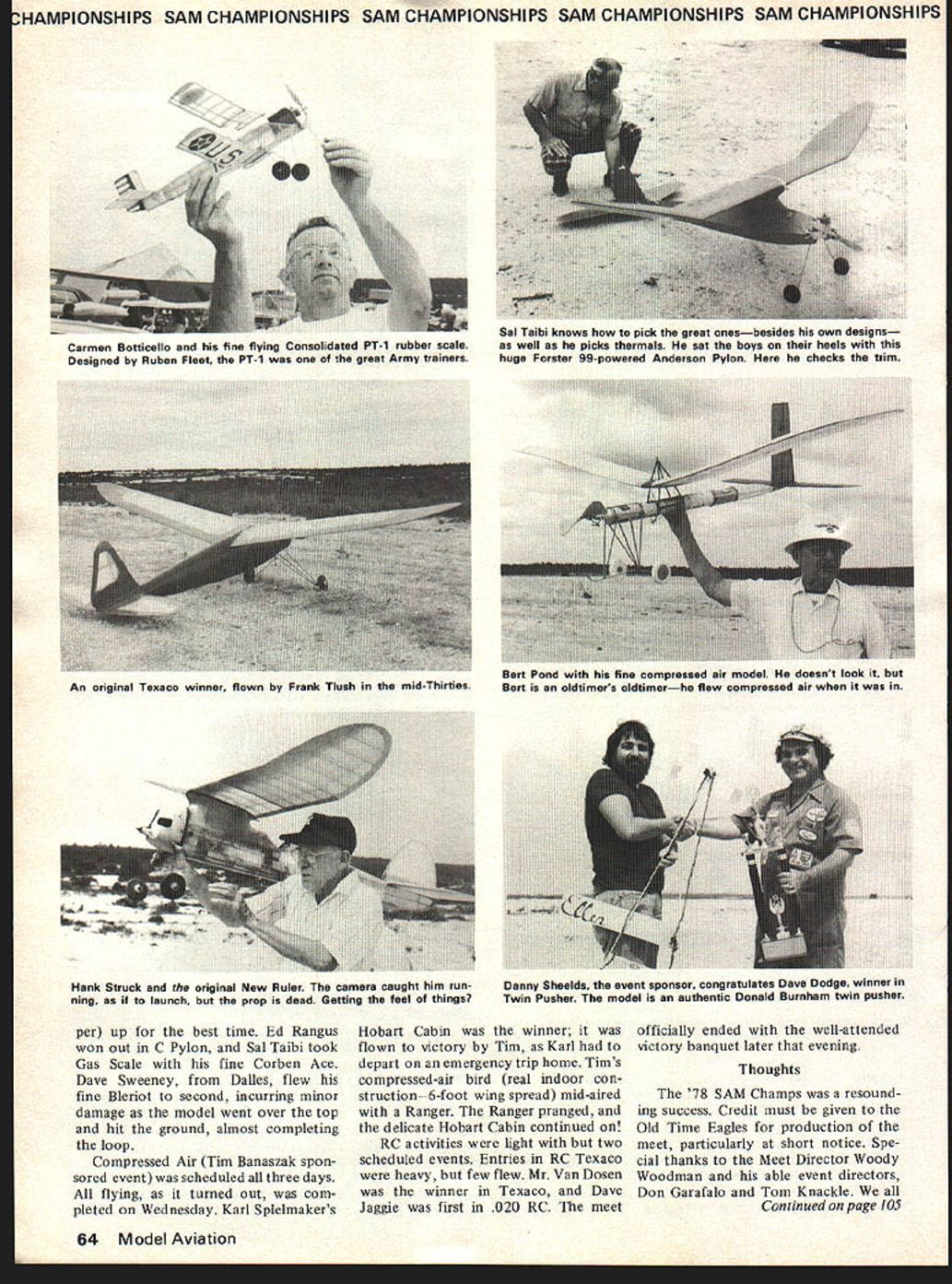
Compressed Air (a Tim Banaszak-sponsored event) was scheduled all three days. All flying, as it turned out, was completed on Wednesday. Karl Spielmaker's Hobart Cabin was the winner; it was flown to victory by Tim, as Karl had to depart on an emergency trip home. Tim's compressed-air bird (real indoor construction—6-foot wingspan) mid-aired with a Ranger. The Ranger pranged, and the delicate Hobart Cabin continued on!
RC activities were light with but two scheduled events. Entries in RC Texaco were heavy, but few flew. Mr. Van Dosen was the winner in Texaco, and Dave Jaggie was first in .020 RC. The meet officially ended with the well-attended victory banquet later that evening.
Third Day
Thursday broke open to winds in excess of 30 knots. Activities were not curtailed, but certainly demanded care and courage. Numerous models ended up in never-never land with the brush full of searchers. Even the RC boys had trouble getting back to the field if blown too far downwind. But the free flighters kept at it, even at the risk of losing their ships or simply crashing. Conditions caused considerable attrition, either by wind or by prudent withdrawal.
Danny Sheelds conducted his annual twin-pusher event by the scramble method. He lined up his 10 contestants (including himself) and all launched on signal. It looked like a covey of quail flushed from their nest. The last down was the winner — Dave Dodge, flying a "Donald Burnham Twin Pusher." Danny Sheelds, interestingly enough, had contacted Mr. Burnham by telephone the month before (Danny was also flying the ship) to gain information on the model. Mr. Burnham was astonished to discover that his design was still being flown, and was also delighted to find out about SAM. He is now our newest member. By the way, Mr. Burnham is a retired chairman of the board of Westinghouse.
Thoughts and Acknowledgments
The '78 SAM Champs was a resounding success. Credit must be given to the Old Time Eagles for production of the meet, particularly at short notice. Special thanks to the Meet Director Woody Woodman and his able event directors, Don Garafalo and Tom Knaackle. We all thank SAM for making it possible to watch and participate in the classic era (reincarnated) of model aviation.
Special kudos to our favorite eight "Brits" who showed up with the finest models, and thanks to our participants from Mexico and Canada.
It was good to see Chester Lanzo, Sal Taibi, Leon Shulman and Hank Struck at the meet. Their presence lends a special aura to the happenings, and it was a special treat to watch Hank Struck flying his original New Ruler in competition.
Oh yes, free flight participation totaled out at a respectable 90 individuals. Apparently, the rule change deleting glow engines didn't exert quite the negative impact anticipated. Surprisingly, there were very few ignition conversions in evidence, yet these engines are legal for competition and certainly provide good stable performance, and they are available.
See you all at Salt Lake City in '79.
Additional Notes
Change. Again, very small ("pitifully small," to quote one frustrated flier) thermals were the challenge/nemesis in the early part of the day. Later in the day the lift was better, the breeze died, and the air became super hot and humid.
The first round saw a respectable number of maxes plus some very close ones. Dale Segle, second to Bob Isaacson in last year's fly-off, missed his max by 0.1 second. Bob Klipp noticed that his DT-timer was set for less than three minutes. Rather than take the time to reset the timer, Bob gambled that he would be high enough when he DT'd that he would still max. Almost. Bob did in fact DT early and touched down at 177. Bob went on to score six straight maxes, for second place, but missed forcing a flyoff with Lewis by those same three seconds.
It was a good day for Don Chancey designs as Klipp flew a Poacher and Jim Lewis a modified Hyperion V. Jim's Hyperion was only his second A-2; the first one was a Poacher.
Jim worked hard for his well-deserved win, circle-towing upwind to pick his own air each round. Jim had been running a couple of miles each evening to keep in shape for the event but the Louisiana heat/humidity was almost too much. Jim spent half an hour in air conditioning prior to the last round so as to regain his composure. Lucky that he did, as he towed into a monster downer in the last round, eventually ending up a long way downwind before releasing for a max to complete his perfect score.
After Lewis and Klipp came Herb Mieras, the first of three Seniors in the top seven, followed by Jon Watson in sixth, and Andrew Barron seventh. The Seniors are tough competition.
Transcribed from original scans by AI. Minor OCR errors may remain.

