
1978 U.S. C/L Model Airplane Championships
Text and photos by John Gimbel
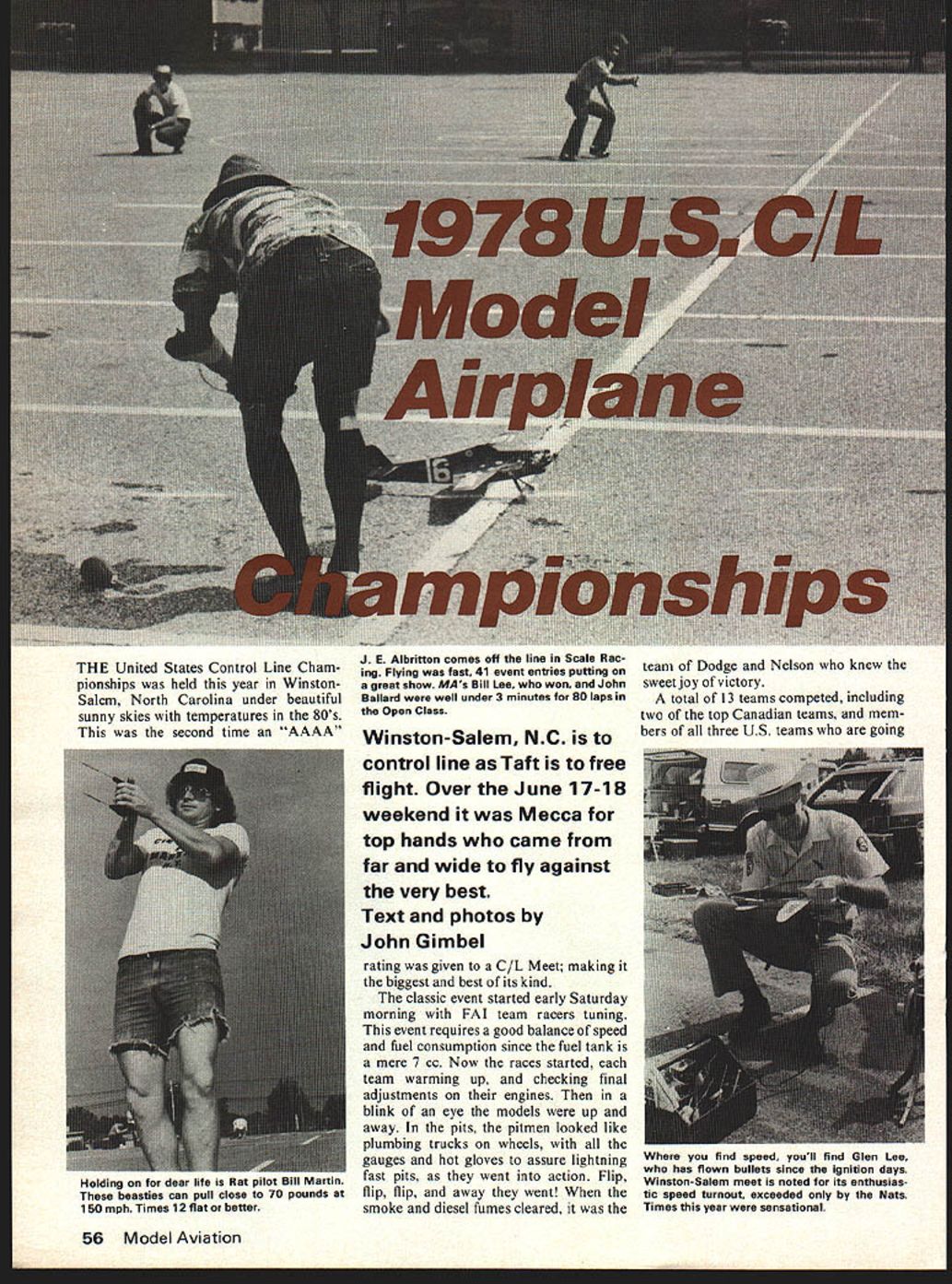
The United States Control Line Championships was held this year in Winston-Salem, North Carolina under beautiful sunny skies with temperatures in the 80s. This was the second time an "AAAA" rating was given to a C/L meet, making it the biggest and best of its kind.
Winston-Salem is to control line as Taft is to free flight. Over the June 17–18 weekend it was Mecca for top hands who came from far and wide to fly against the very best.
FAI Team Racing
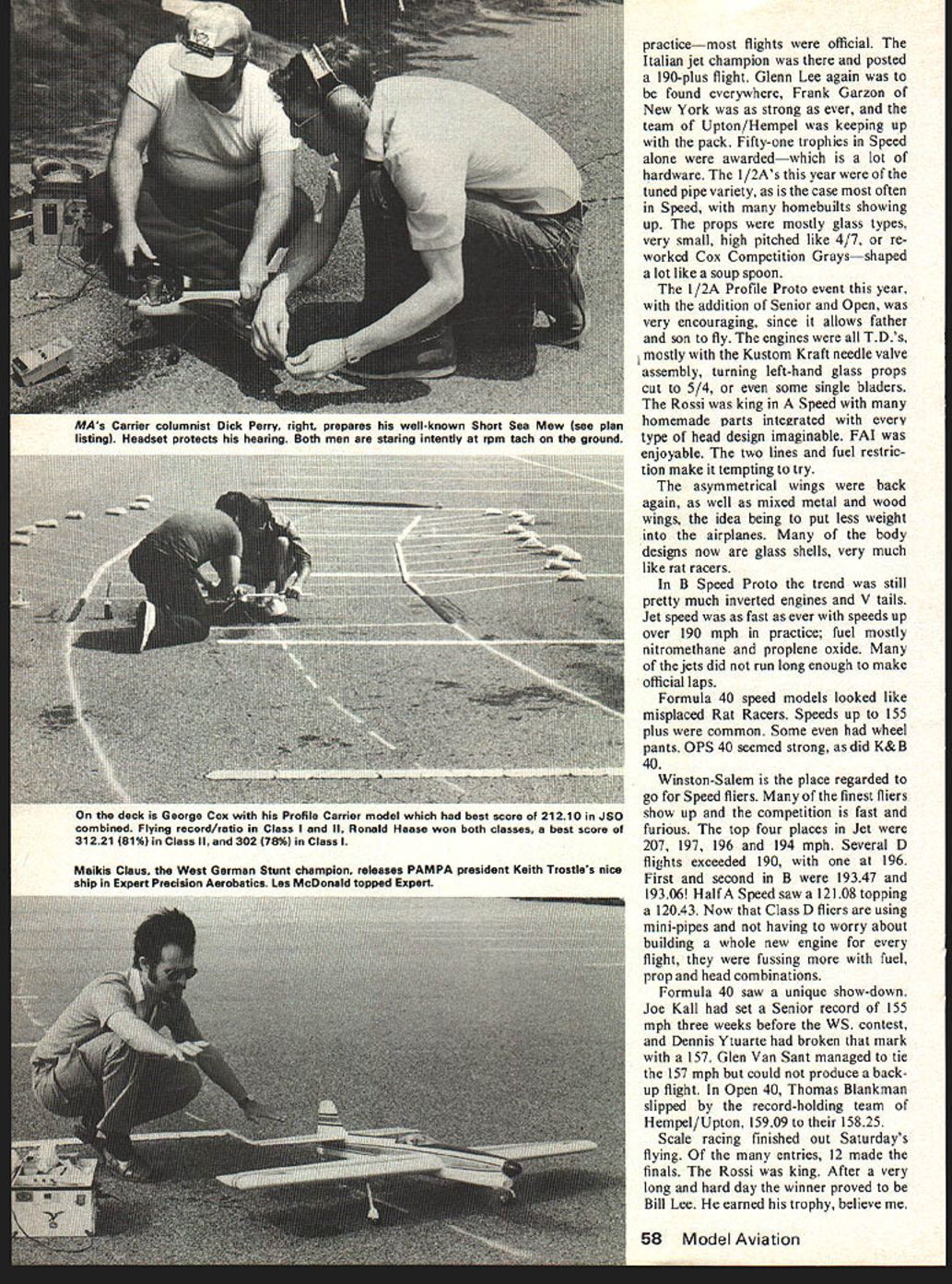
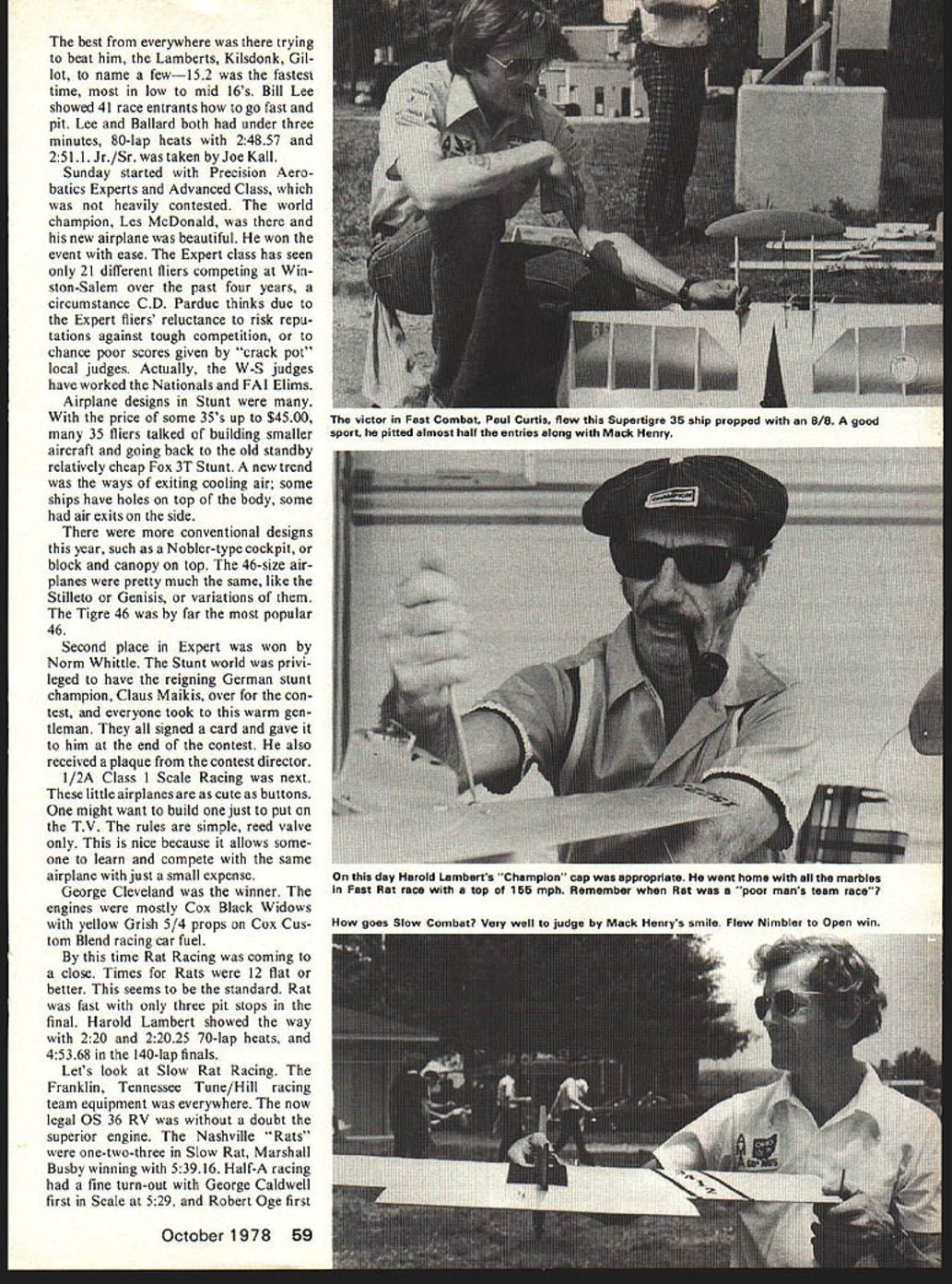
The classic event started early Saturday morning with FAI team racers tuning. This event requires a good balance of speed and fuel consumption since the fuel tank is a mere 7 cc. Teams warmed up and checked final adjustments on their engines, and then the models were up and away. In the pits, the pitmen looked like plumbing trucks on wheels, with gauges and hot gloves to assure lightning-fast pits. When the smoke and diesel fumes cleared, the team of Dodge and Nelson took the victory.
A total of 13 teams competed, including two of the top Canadian teams and members of all three U.S. teams who are going to the World Championships.
U.S. Navy Carrier
Over at the U.S. Carrier event in Winston-Salem, the Navy Carrier planes were tuning up. The event was lightly contested but that did not detract from the skill and quality of the competition.
- Profile class winner: George Cox
- Class I & II combined: Ronald Haase (Haase also finished second overall; he posted a percent-of-record ratio of 81% in Class II for first and 78% in Class I for second)
In spite of an impressive quantity and quality of trophies, only five individuals flew this event. After 1977's poor showing in Carrier, C.D. Bill Pardue had written over 30 Carrier fliers inviting them to the '78 competition. It is likely the event will be scheduled for a half day next year.
Slow Combat
Meanwhile, on the grass, the Slow Combat fliers were in their glory. Nothing much was new this year—same Flite Streaks, Nimblers, etc., with Tigres pretty much the rule. Speeds in the high 80s were common. Mack Henry showed great cunning; using a K & B 35 Series 75 on a Nimbler, his plane was often the slower but it turned exceptionally well. Consistency and practice made a big difference. When it was over there was half a 50-gallon drum full of broken, pitiful-looking airplanes. The pilots looked a bit worn themselves.
Fast Combat
Fast Combat went into Sunday for finals because the field had to be vacant by 5:00 p.m. Sunday. Final results:
- 1st: Paul Curtis
- 2nd: Eric Taylor
- 3rd: Melissa Hartman (flew a box-stock Fox M.K. III C.S.; her Voodoo beat Dick Tyndle of Toothpick fame)
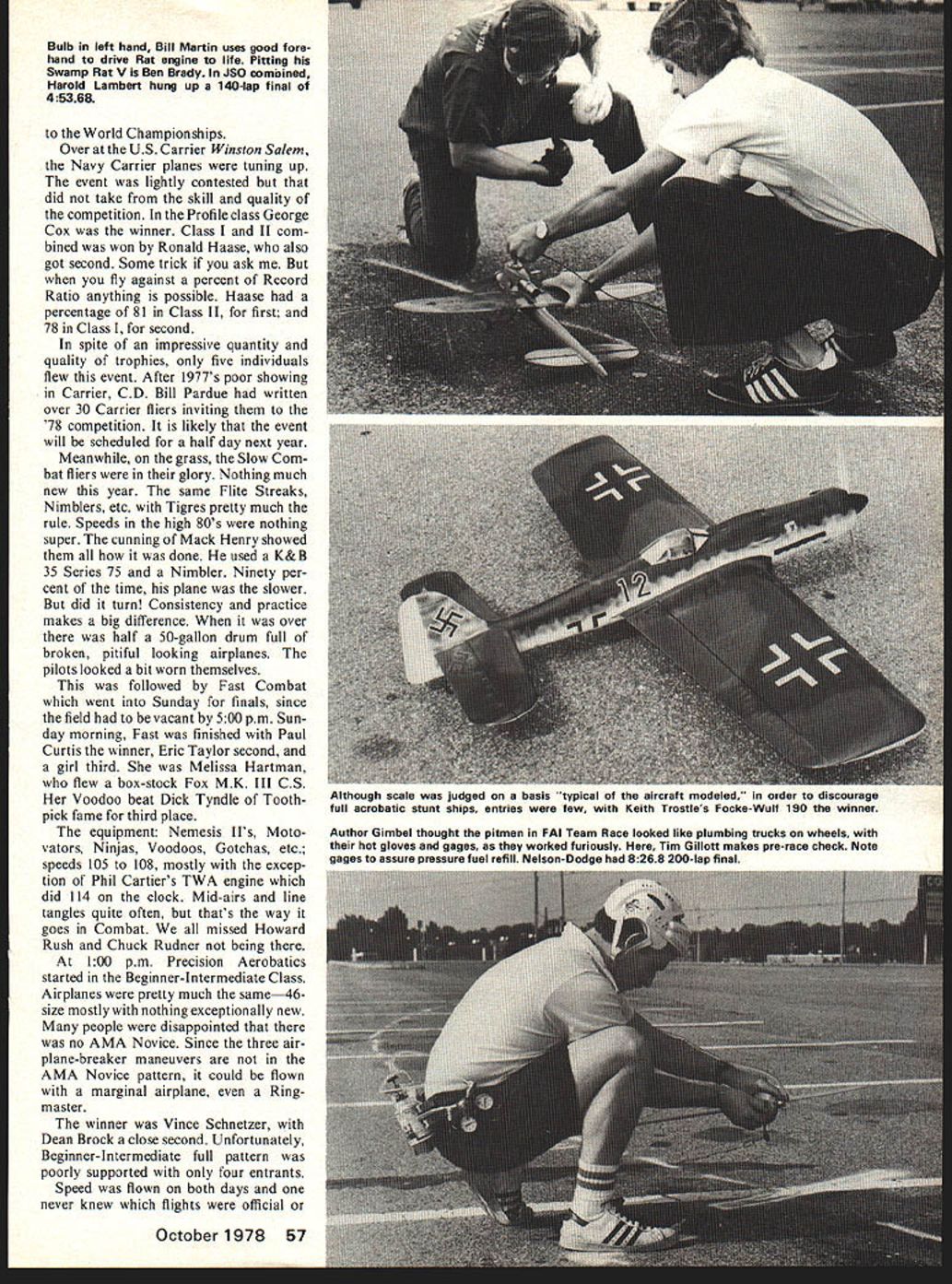
Equipment in Fast Combat included Nemesis II's, Moto-vators, Ninjas, Voodoos, Gotchas, etc. Speeds were typically 105–108 mph, with Phil Cartier's TWA engine doing 114 on the clock. Mid-airs and line tangles were common—the nature of Combat. Noted absentees included Howard Rush and Chuck Rudner.
Precision Aerobatics — Beginner/Intermediate
At 1:00 p.m. Saturday, Precision Aerobatics began in the Beginner–Intermediate class. Planes were mostly .46-size with nothing exceptionally new. Many were disappointed there was no AMA Novice class; since the three airplane-breaker maneuvers are not in the AMA Novice pattern, it could be flown with a marginal airplane, even a Ringmaster.
- Winner: Vince Schnetzer
- 2nd: Dean Brock
Beginner–Intermediate full pattern was poorly supported, with only four entrants.
Speed (All Classes)
Speed was flown on both days, and flights were often indistinguishable between practice and official attempts. The Italian jet champion posted a 190-plus practice flight. Glenn Lee was again prominent, Frank Garzon of New York was as strong as ever, and the team of Upton/Hempel kept up with the pack. Fifty-one trophies in Speed alone were awarded.
Trends and notes:
- 1/2A speed entries were mostly tuned-pipe types and many homebuilts. Props were mostly glass types, very small and high-pitched (like 4/7) or reworked Cox Competition Grays shaped like a soup spoon.
- The 1/2A Profile Proto event, with additions of Senior and Open classes, was encouraging—allowing father and son to fly together. Engines were mostly TDs with Kustom Kraft needle valves, turning left-hand glass props cut to 5/4 or even single bladers.
- Rossi engines dominated A Speed with many homemade parts and varied head designs.
- Asymmetrical wings returned, and mixed metal-and-wood wings aimed to reduce weight. Many fuselages were glass shells, much like rat racers.
- In B Speed Proto, inverted engines and V-tails were common.
- Jet speeds in practice exceeded 190 mph; fuel was mostly nitromethane and propylene oxide. Many jets did not run long enough for official laps.
- Formula 40 speed models resembled misplaced Rat Racers; speeds of 155+ mph were common. O.P.S. 40 (OPS 40) and K&B 40 motors seemed strong.
Top recorded speeds:
- Jet top four: 207, 197, 196, 194 mph
- Several D flights exceeded 190, one at 196
- B top two: 193.47 and 193.06
- Half A Speed: 121.08 topping 120.43
Class D fliers were using mini-pipes and focused more on fuel, prop, and head combinations rather than on building new engines for every flight.
Formula 40 showdown highlights:
- Joe Kall had set a Senior record of 155 mph three weeks before the contest.
- Dennis Vturate broke that mark with a 157.
- Glen Van Sant tied the 157 but could not produce a backup flight.
- In Open 40, Thomas Blankman edged the record-holding team of Hempel/Upton, 159.09 to 158.25.
Scale Racing
Scale racing finished out Saturday. Of many entries, 12 made the finals. The Rossi engine dominated. After a long hard day the winner was Bill Lee, who showed 41 race entrants how to go fast and pit.
- Fastest time: 15.2 seconds (fastest noted)
- Most times in low to mid 16s
- Bill Lee and Ballard both had under-three-minute 80-lap heats: 2:48.57 and 2:51.10
- Jr./Sr. winner: Joe Kall
Precision Aerobatics — Expert & Advanced
Sunday started with Precision Aerobatics Expert and Advanced classes, which were not heavily contested. World champion Les McDonald attended with a beautiful new airplane and won the event with ease.
The Expert class has seen only 21 different fliers competing at Winston-Salem over the past four years. C.D. Pardue attributes this to Expert fliers' reluctance to risk reputations against tough competition or to chance poor scores from local judges. The Winston-Salem judges have worked at the Nationals and FAI eliminations.
Airplane designs in Stunt varied. With prices for some .35 engines as high as $45.00, many .35 fliers discussed building smaller aircraft and returning to the relatively inexpensive Fox 3T Stunt. A new trend was varied methods of exiting cooling air—holes on top of the fuselage or side exits were seen. There were also more conventional designs such as Nobler-type cockpits or block-and-canopy tops. The .46-size airplanes were similar to the Stiletto or Genesis or variations thereof. The Tigre .46 remained the most popular .46 engine.
- 2nd place Expert: Norm Whittle
- Guest: Claus Maikis, reigning German stunt champion, who was warmly received; contestants signed a card and presented him with it and a plaque from the contest director.
1/2A Class I Scale Racing
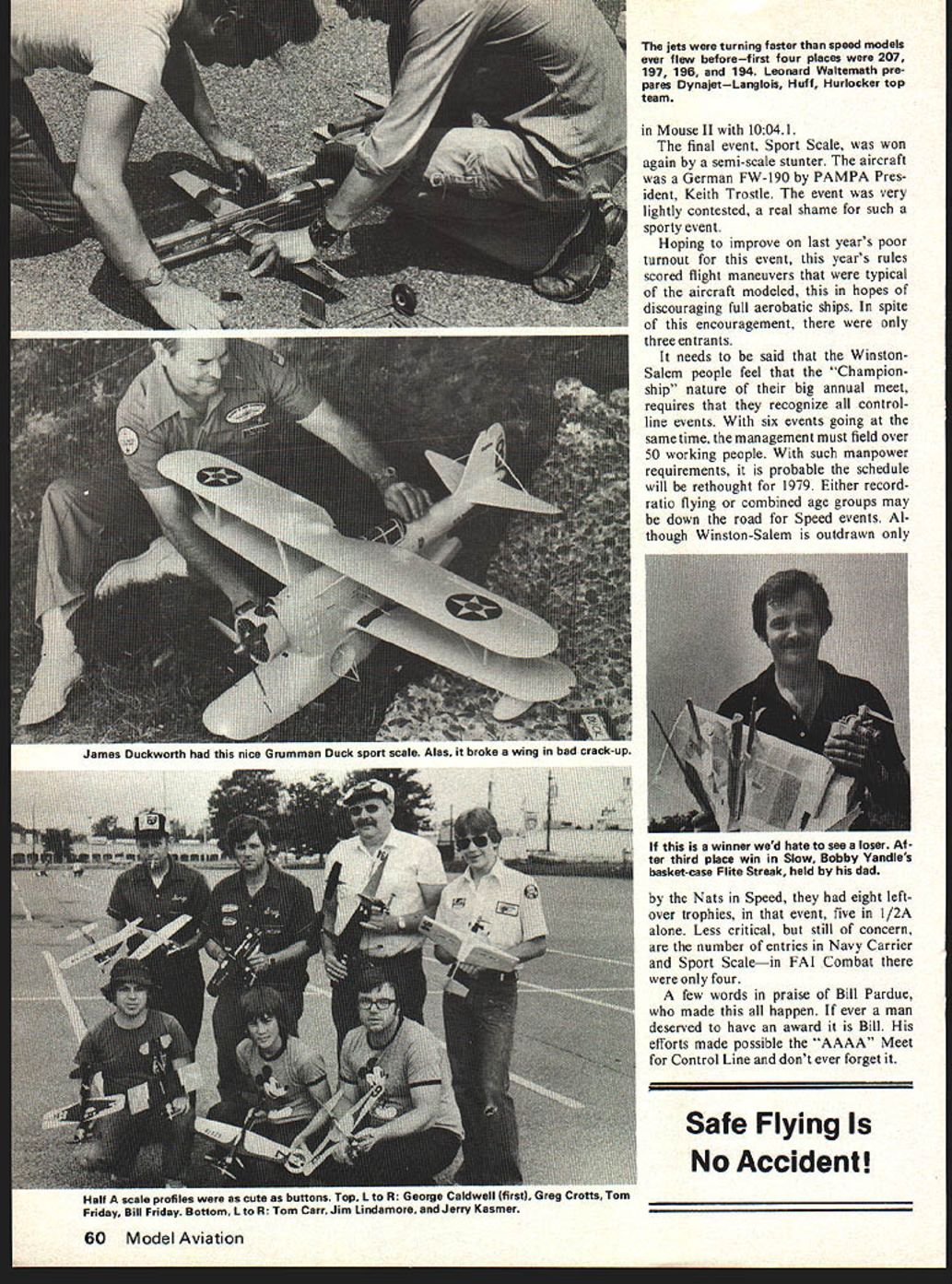
These small airplanes are as cute as buttons and attractive to build just for display or low-cost competition. Rules were simple—reed valve only—allowing competitors to learn and compete with minimal expense.
- Winner: George Cleveland
- Engines: Mostly Cox Black Widows with yellow Gish 5/4 props on Cox Custom Blend racing car fuel
Rat Racing
Rat racing produced fast times—12 seconds flat or better seemed standard. Rat was fast with only three pit stops in the final. Harold Lambert led with 70-lap heats of 2:20 and 2:20.25, and a 140-lap final time of 4:53.68.
Slow Rat Racing and Other Events
Slow Rat Racing featured equipment from the Franklin, Tennessee Tune/Hill racing team. The new legal OS 36 RV was a superior engine. The Nashville "Rats" finished one-two-three in Slow Rat:
- Slow Rat winner: Marshall Busby — 5:39.16
Half-A racing turnout was fine:
- George Caldwell first in Scale — 5:29
- Robert Ogle first in Mouse II — 10:04.1
Sport Scale
The final event, Sport Scale, was won again by a semi-scale stunter. The aircraft was a German FW-190 flown by PAMPA President Keith Trostle. The event was lightly contested, which was unfortunate for such a sporty event. Organizers had hoped new scoring rules—rewarding flight maneuvers typical of the aircraft modeled to discourage full aerobatic ships—would improve turnout. Despite the encouragement, there were only three entrants.
Organization, Staffing, and Future Considerations
The Winston-Salem organizers feel that the "Championship" nature of their big annual meet requires recognizing all control-line events. With six events going simultaneously, management must field over 50 working people. Given such manpower requirements, the schedule will probably be rethought for 1979. Options under consideration include record-ratio flying or combined age groups for Speed events.
Although Winston-Salem is outdrawn only by the Nationals in Speed, there were eight leftover trophies in Speed—five in 1/2A alone. Other concerns include low entry numbers in Navy Carrier and Sport Scale—and in FAI Combat there were only four entrants.
A few words in praise of Bill Pardue are in order: his efforts made this "AAAA" meet possible. If ever a man deserved recognition, it is Bill. His work made the event happen—don't ever forget it.
Transcribed from original scans by AI. Minor OCR errors may remain.

