
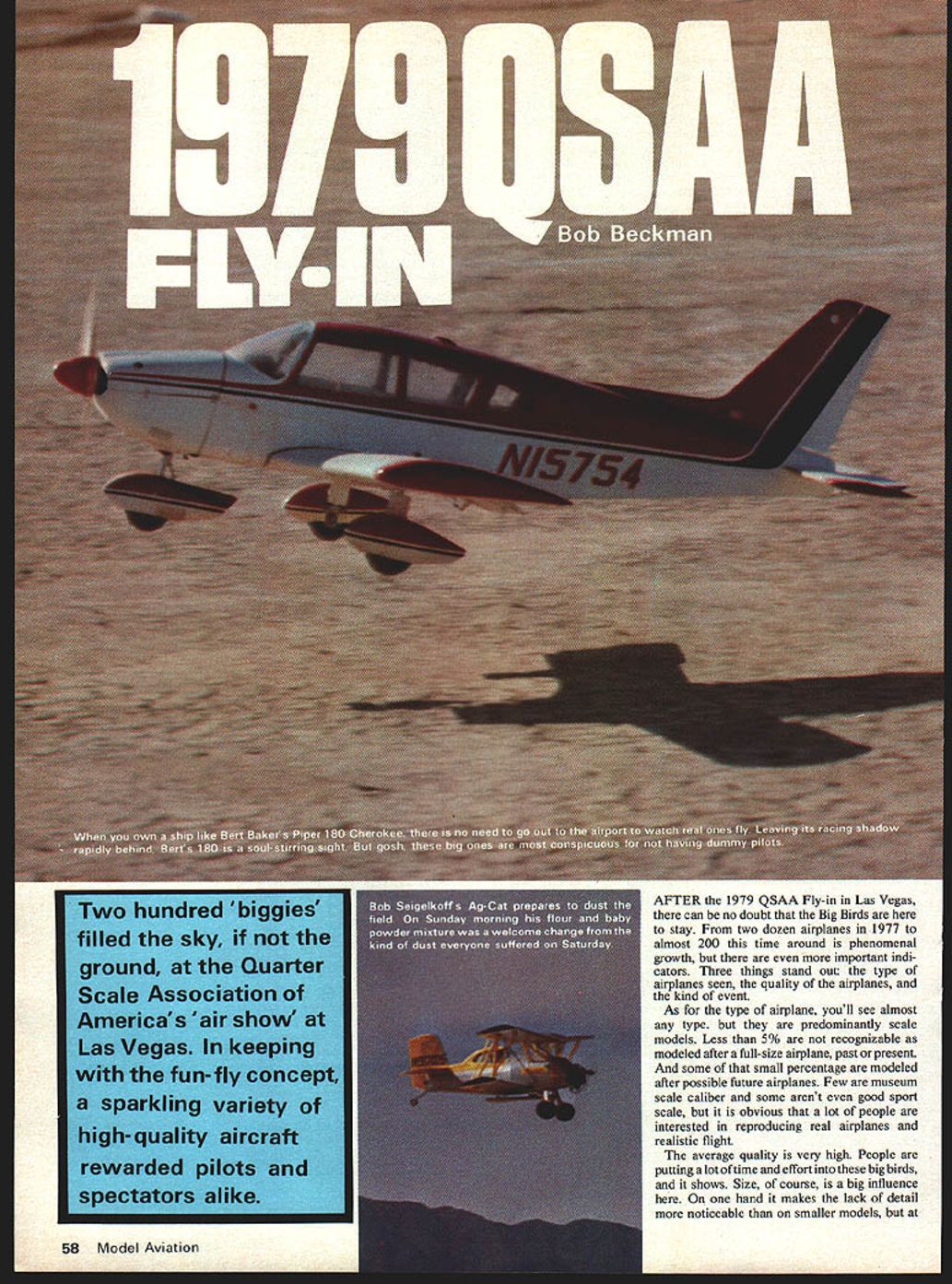
1979 QSAA Fly-in
Bob Beckman
Overview
After the 1979 QSAA Fly-in in Las Vegas, there can be no doubt that the Big Birds are here to stay. Growth has been phenomenal — from two dozen airplanes in 1977 to almost 200 this year — but three things stand out as even more important indicators of the event's success:
- the type of airplanes seen,
- the quality of the airplanes, and
- the kind of event.
Types of Airplanes
Almost any type of model was represented, but the gathering was predominantly scale models. Fewer than 5% were not recognizable as modeled after a full‑size airplane, past or present, and some of that small percentage were modeled after possible future airplanes. Few were museum‑scale caliber, and some weren't even good sport scale, but many builders are clearly interested in reproducing real airplanes and realistic flight.
Quality and Scale Details
The average quality was very high. People are investing a lot of time and effort into these big birds, and it shows. Size makes lack of detail more noticeable than on smaller models, yet it also relieves some difficulties (weight, size, accessibility, etc.) encountered when adding scale details. Adding fine scale features takes a long time, but the overall workmanship was impressive.
Event Format and Awards
There have been rumblings about competition — the majority of RCers are interested in fun‑fly rather than competition. The fly‑in format has been used before, but never with this kind of response for Quarter Scale. With no competition pressure, both pilots and spectators were relaxed, enjoying the flying, the rubber‑necking and the gabbing.
QSAA presented several trophies; recipients were selected by voting of the entire group. A few participants expressed interest in awards and attendant speechifying, but the general feeling seemed to be, "Let the airplanes speak for themselves." And they certainly did, both in the air and on the ground.
Static Display (Thursday)
Thursday was static display day in the Riviera Hotel ballroom. By 10 a.m. most of the 80 or so tables were occupied; by noon latecomers were leaving planes in their cars. Although only a handful of manufacturers were present, a significant trade show may develop in the future. Over the next few months the magazine will give more details on items seen and heard about at the show.
Flying Sessions and Field Conditions (Friday–Sunday)
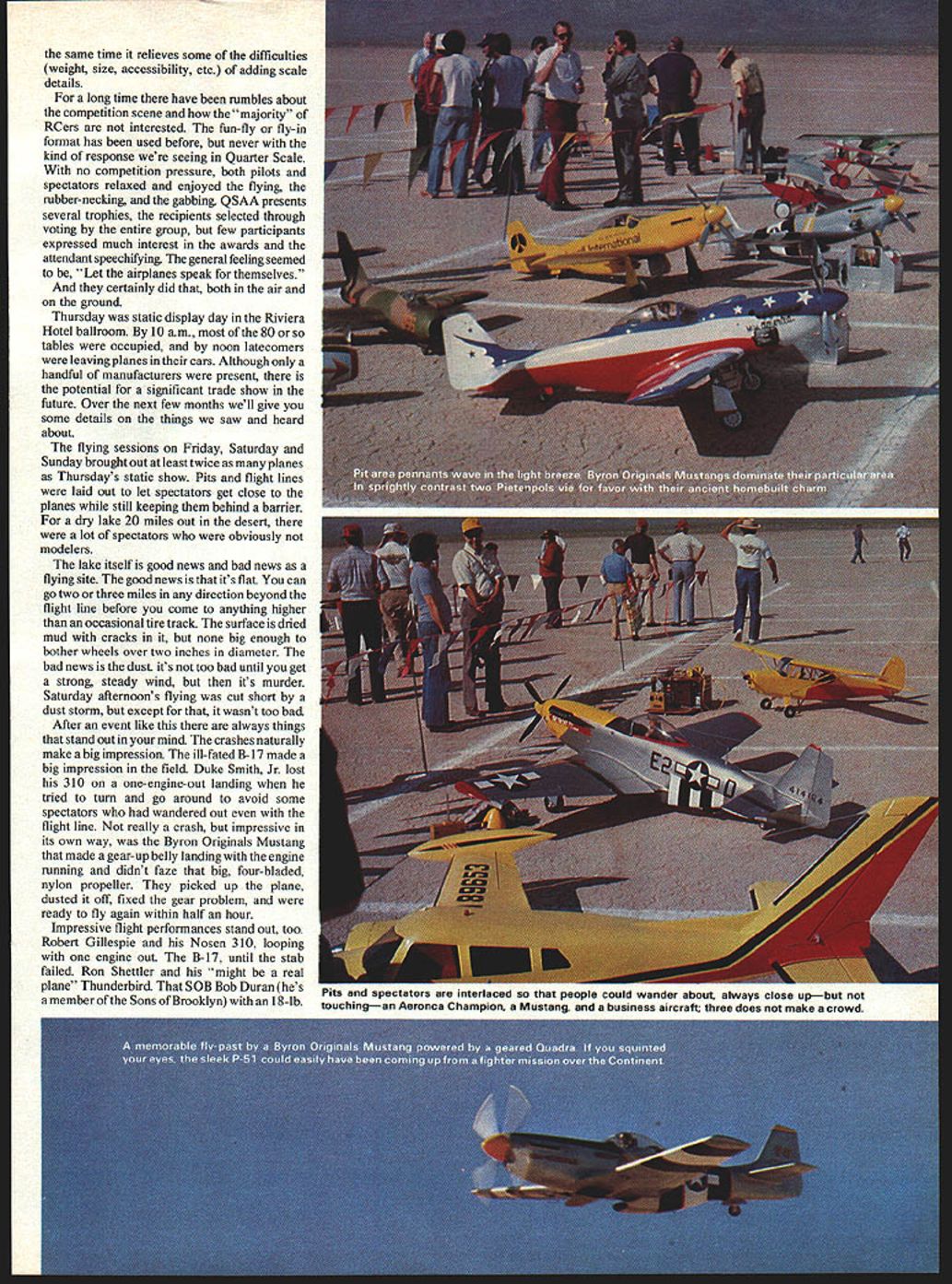
Flying sessions on Friday, Saturday and Sunday brought out at least twice as many planes as Thursday's static show. Pits and flight lines were laid out so spectators could get close to the planes while still being kept behind barriers. The dry lake site, about 20 miles out in the desert, attracted many spectators who were not modelers.
The lake surface offered mixed blessings:
- Good: it was flat — you could go two or three miles in any direction beyond the flight line before encountering anything higher. Occasional tire tracks and dried‑mud cracks were present but generally not a problem for wheels over two inches in diameter.
- Bad: dust. It wasn't too bad until a strong, steady wind kicked up, then it was "murder." Saturday afternoon's flying was cut short by a dust storm.
Incidents and Crashes
After a big event, crashes naturally make a strong impression. Notable incidents included:
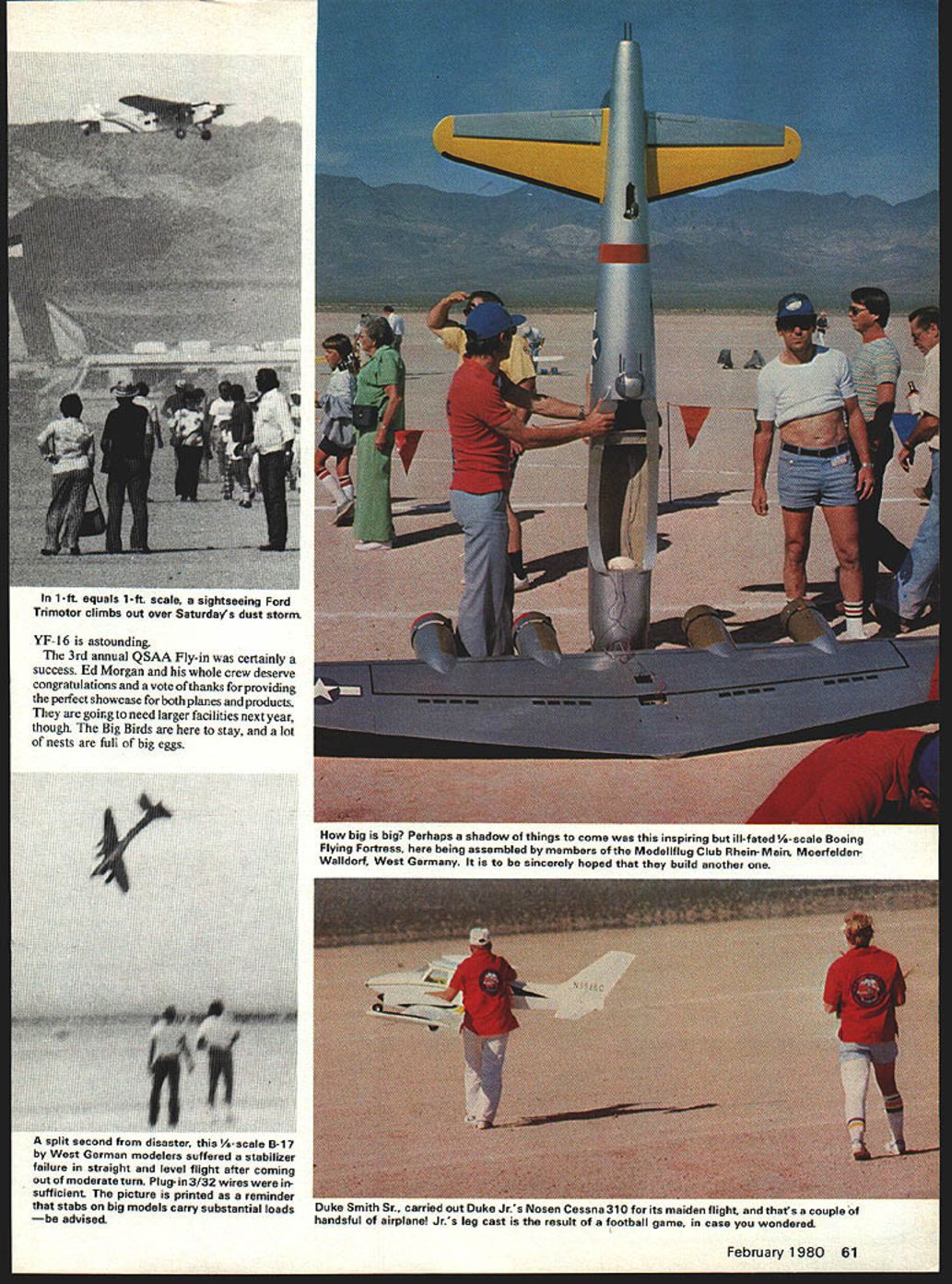
- The ill‑fated quarter‑scale B‑17, which made a dramatic impression at the field when the stabilizer later failed in flight.
- Duke Smith Jr.'s Nosen 310, which was lost on a one‑engine‑out landing when he tried to turn and go around to avoid spectators who had wandered onto the flight line.
- A Byron Originals Mustang that made a gear‑up belly landing while the engine was still running. The big four‑bladed nylon propeller took the impact in stride; the plane was dusted off, the gear problem fixed, and it was ready to fly again within half an hour.
Notable Flights and Demonstrations
There were many impressive flight performances and demonstrations:
- Robert Gillespie's Nosen 310 looped with the engine out.
- The B‑17 flew until its stabilizer failed.
- Ron Shettler's Thunderbird and other "might be a real plane" entries drew attention.
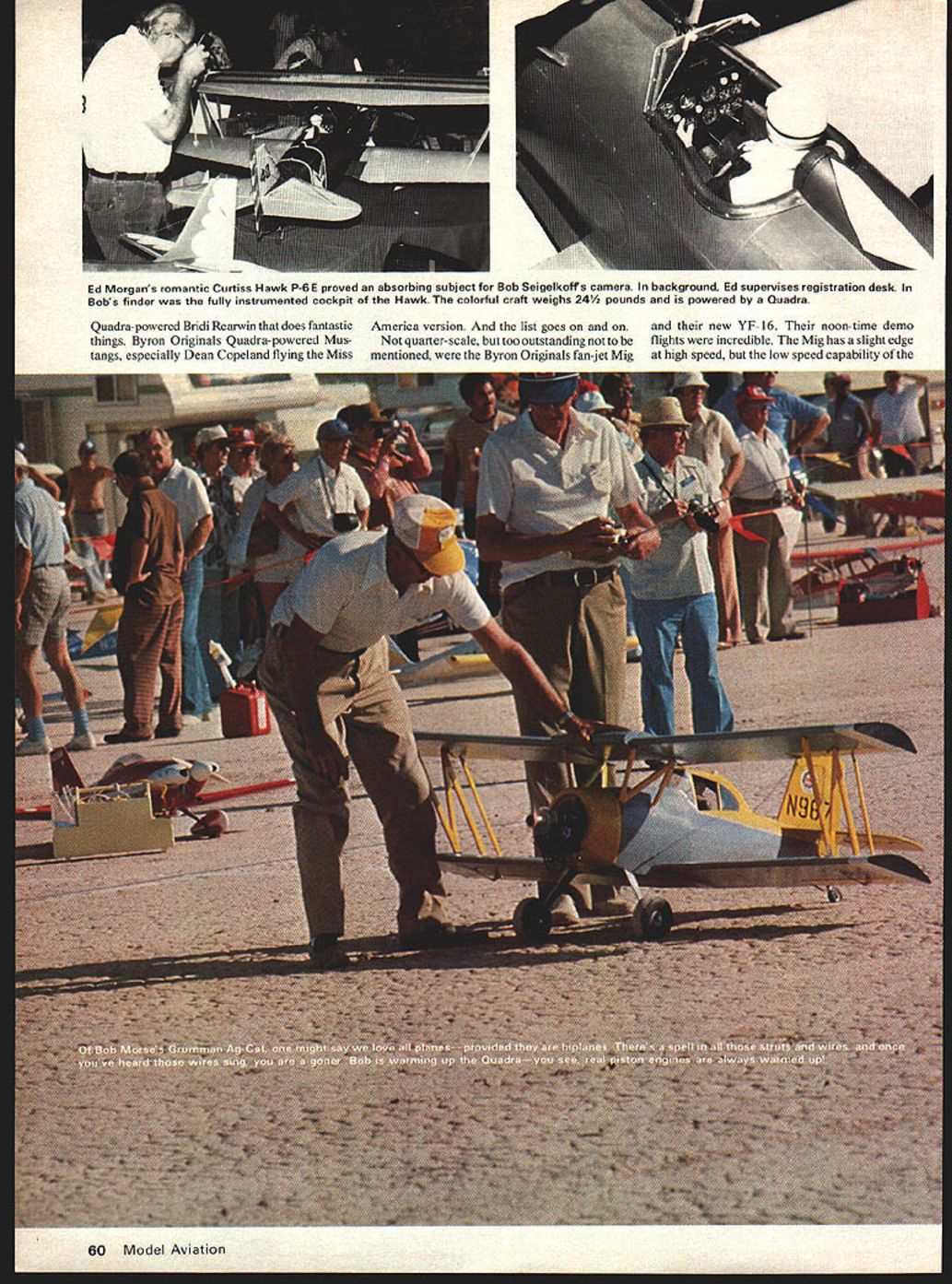
- Quadra‑powered Bridi Rearwin and Byron Originals Quadra‑powered Mustangs (notably Dean Copeland flying the Miss America version) performed spectacularly.
- Byron Originals' fan‑jet Mig and their new YF‑16 gave incredible noon‑time demo flights. The Mig had a slight edge at high speed, while the YF‑16's low‑speed capability was astounding.
Conclusion
The 3rd annual QSAA Fly‑in was certainly a success. Ed Morgan and his whole crew deserve congratulations and a vote of thanks for providing a near‑perfect showcase of both planes and products. We will need larger facilities next year — Big Birds are here to stay, and there are still lots of nests full of big eggs.
Transcribed from original scans by AI. Minor OCR errors may remain.

