
1982 AMA Nats: CL Combat
By Charlie Johnson
THE FIRST THING that happens to most of us when we return home after a Nationals is that the phone starts ringing and all our friends want to know who won what. If you just can't wait, turn to the complete results a few pages back in this issue — we're starting at the beginning.
Field conditions and early impressions
The story really begins about three years earlier when Lincoln was used for the 1979 Nationals. It appeared that there had been no significant rainfall on the Combat site since then; the ground had hardened up and the field would score high on the Rockwell hardness scale. Only a little mist one morning softened the streamer-type grass and weeds, which otherwise didn't lend themselves to being marked out easily — the circle markings just melted away. After the first day or two the center circle was very well broken in and should be easy to find for the next year or two.
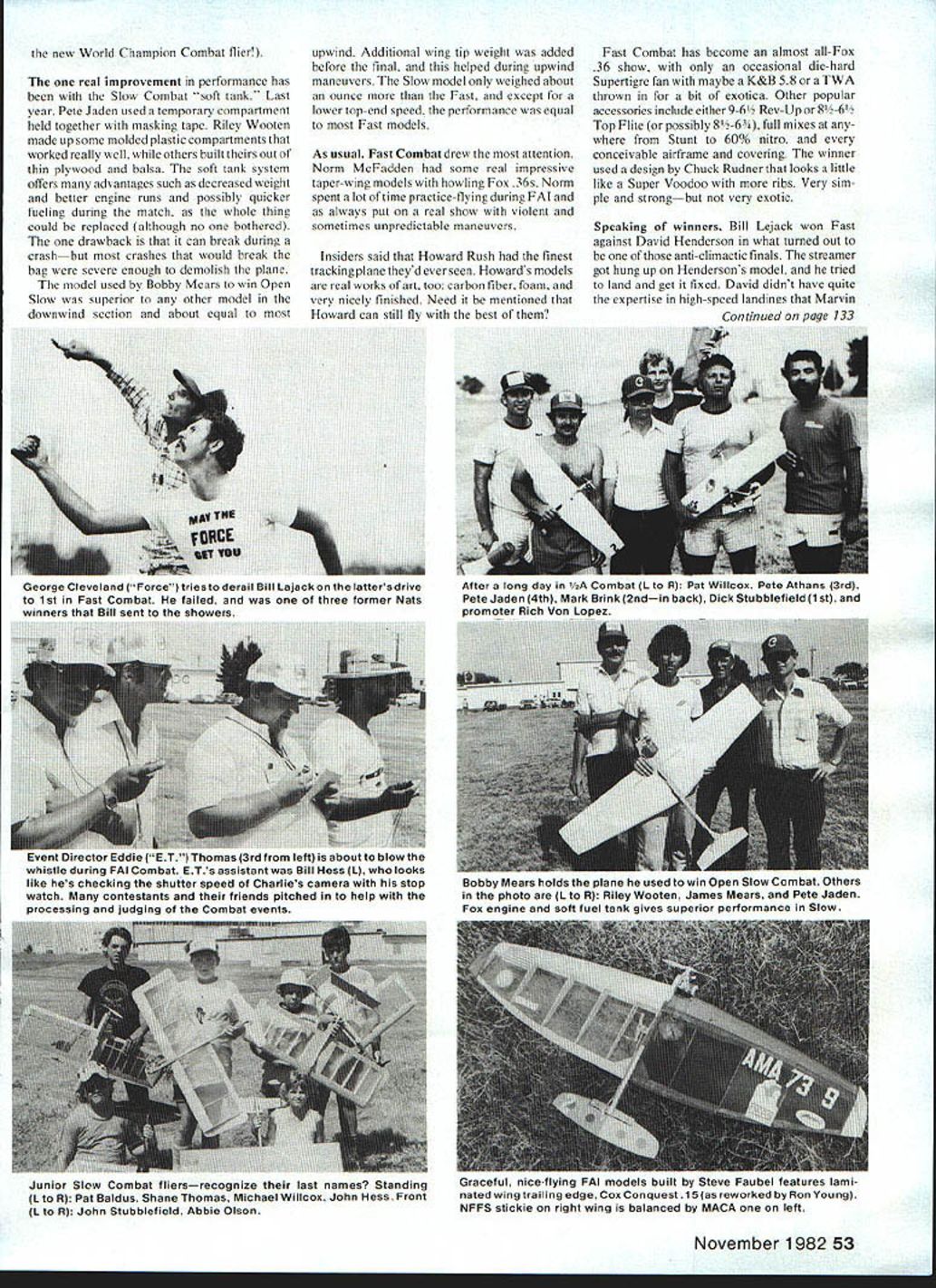
The first three days were warm and windy. The Juniors and Seniors felt it most on Monday during Slow Combat. Last names in the events were much the same as in Open — Stubblefield, Cleveland, Wilcox, Jaden, etc. The kids had their own group, and any available adult pitched in to help not only his own kids but everyone else's too.
FAI and age-group entries
In FAI Combat, Juniors and Seniors were separated from Open, which left only two Senior entries and five Juniors. Half-A was combined and presented no problems across age groups, so maybe FAI could be combined similarly in the future to give younger flyers more experience. After all, there aren't separate age categories at the World Championships. Senior Tom Fluker Jr. attended the Nats in preparation for the team’s trip to the World Championships in Kiev, USSR.
Slow Combat — soft tanks and trends
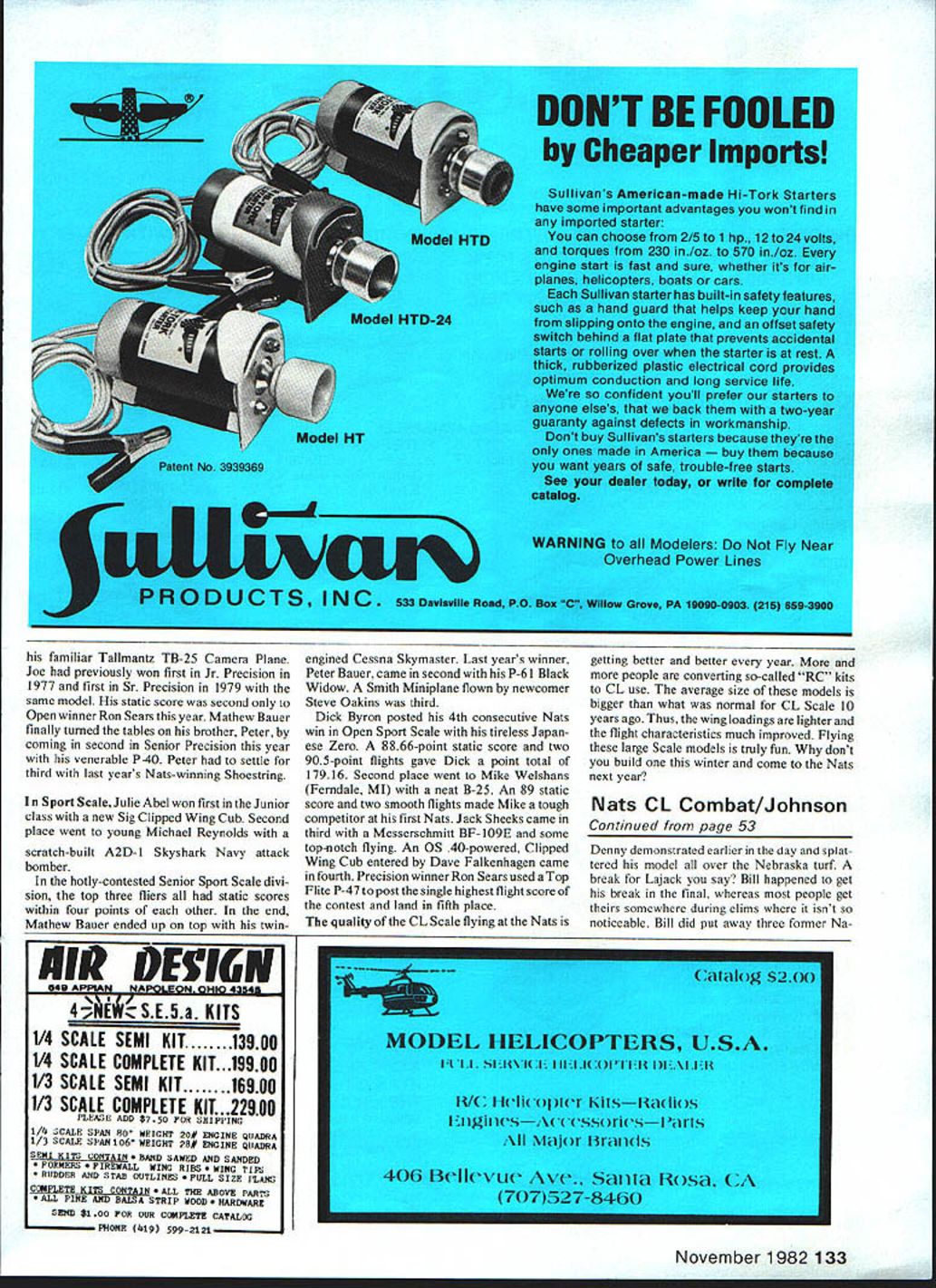
One real improvement has been the Slow Combat "soft tank." Last year Pete Jaden used a temporary compartment held together with masking tape. Riley Wooten made up molded plastic compartments that worked very well, while others built theirs out of thin plywood and balsa. The soft-tank system offers advantages such as decreased weight, better engine runs, and possibly quicker fueling during the match since the whole bag could be replaced (though few bothered). The one drawback is that it can break during a crash — but most crashes that would break the bag were severe enough to demolish the plane anyway.
Bobby Mears used a model that was superior in the downwind section and about equal to most upwind during Open Slow. Additional wing-tip weight fitted before the final helped on upwind maneuvers. The Slow model weighed only about an ounce more than the Fast, and except for a lower top speed, its performance matched most Fast models.
A number of Rossi .15s were still in use, though few of the new Rossi models were seen. Quite a few Nelson .15s were used; Gary Arnold, for one, switched to a Nelson from the STX .15 he used in Sweden. Duke Fox shared a fuel formula used in Sweden and by many fliers in Lincoln: 40% nitromethane, 20% nitroethane, 20% alcohol, and 20% Ucon oil. The nitroethane produces less power than an equivalent amount of nitromethane but seems to stabilize the mixture over a wide range of atmospheric conditions and engine tune.
Fast Combat — equipment and winners
As usual, Fast Combat drew the most attention. Norm McFadden flew some impressive taper-wing models with howling Fox .36s; he spent a lot of time practice-flying during FAI and put on a show with violent and sometimes unpredictable maneuvers. Howard Rush brought what insiders called the finest tracking plane they'd ever seen — carbon fiber and foam models, very nicely finished — and he can still fly with the best of them.
Fast Combat has become an almost all-Fox .36 show, with only the occasional die-hard Super Tigre fan or a K&B .58 or TWA for variety. Popular props and accessories included 9-6 Rev-Up or 8-1/2-6-1/2 Top Flite props, full mixes, and nitro anywhere from about 5-turn settings up to 60% in some cases. The winner used a design by Chuck Rudner that resembles a Super Voodoo with more ribs: simple, strong, and not very exotic.
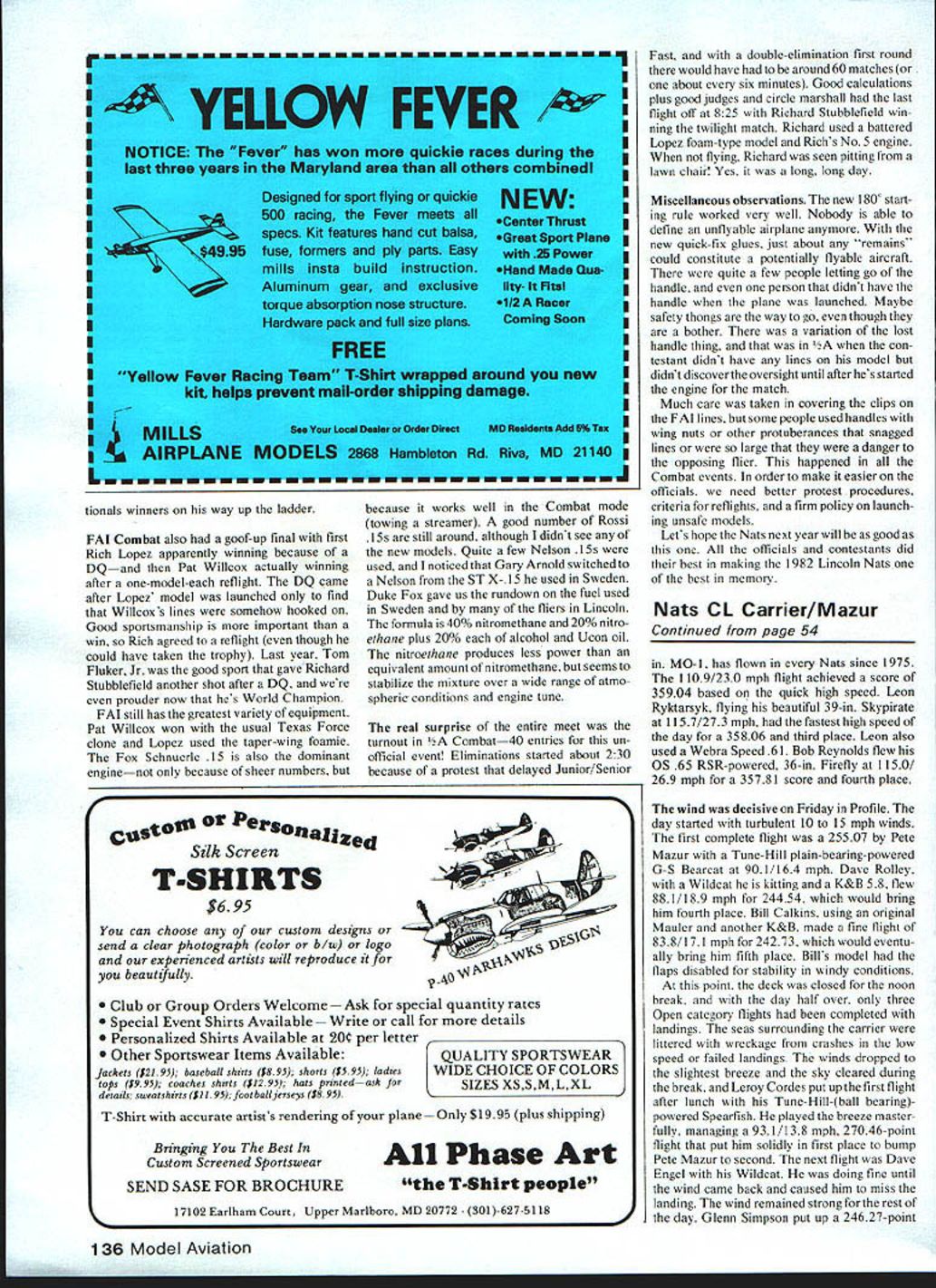
Bill Lejack won Fast against David Henderson in a somewhat anticlimactic final. Henderson's streamer got hung up on his model; he attempted to land and fix it, but didn't complete a successful high-speed landing and crashed, handing the title to Lejack. Bill did put away three former national champions on his way to the win.
1/2 A Combat — surprise turnout
The real surprise of the meet was the turnout in 1/2 A Combat — 40 entries for this unofficial event. Eliminations started about 2:30 p.m. because a protest delayed Junior/Senior Fast, and with a double-elimination first round there would have had to be roughly 60 matches. Good calculations plus reliable judges and circle marshals kept things moving; the last flight went off at 8:25 p.m., with Richard Stubblefield winning the twilight match. Richard used a battered Lopez foam-type model powered by a No. 5 engine and was seen pitting from a lawn chair. Yes, it was a long, long day.
Miscellaneous observations and safety
- The new 180° starting rule worked very well.
- With quick-fix glues, almost any remains could be patched into a potentially flyable airplane, so defining an "unflyable" plane has become difficult.
- There were several instances of contestants letting go of the handle; one person launched without the handle at all. A variant occurred in 1/2 A when a contestant discovered he had no lines on his model only after starting the engine.
- Much care was taken in covering the clips on FAI lines, but some handles with wing nuts or other protuberances snagged lines or were so large they posed a danger to the opposing flier. This happened in all Combat events.
To make it easier on officials, the contest needs:
- Better protest procedures.
- Clear criteria for refights.
- A firm policy on launching unsafe models.
Conclusion
Let's hope next year's Nats are as good as this one. All the officials and contestants did their best in making the 1982 Lincoln Nats one of the best in memory.
Transcribed from original scans by AI. Minor OCR errors may remain.

