
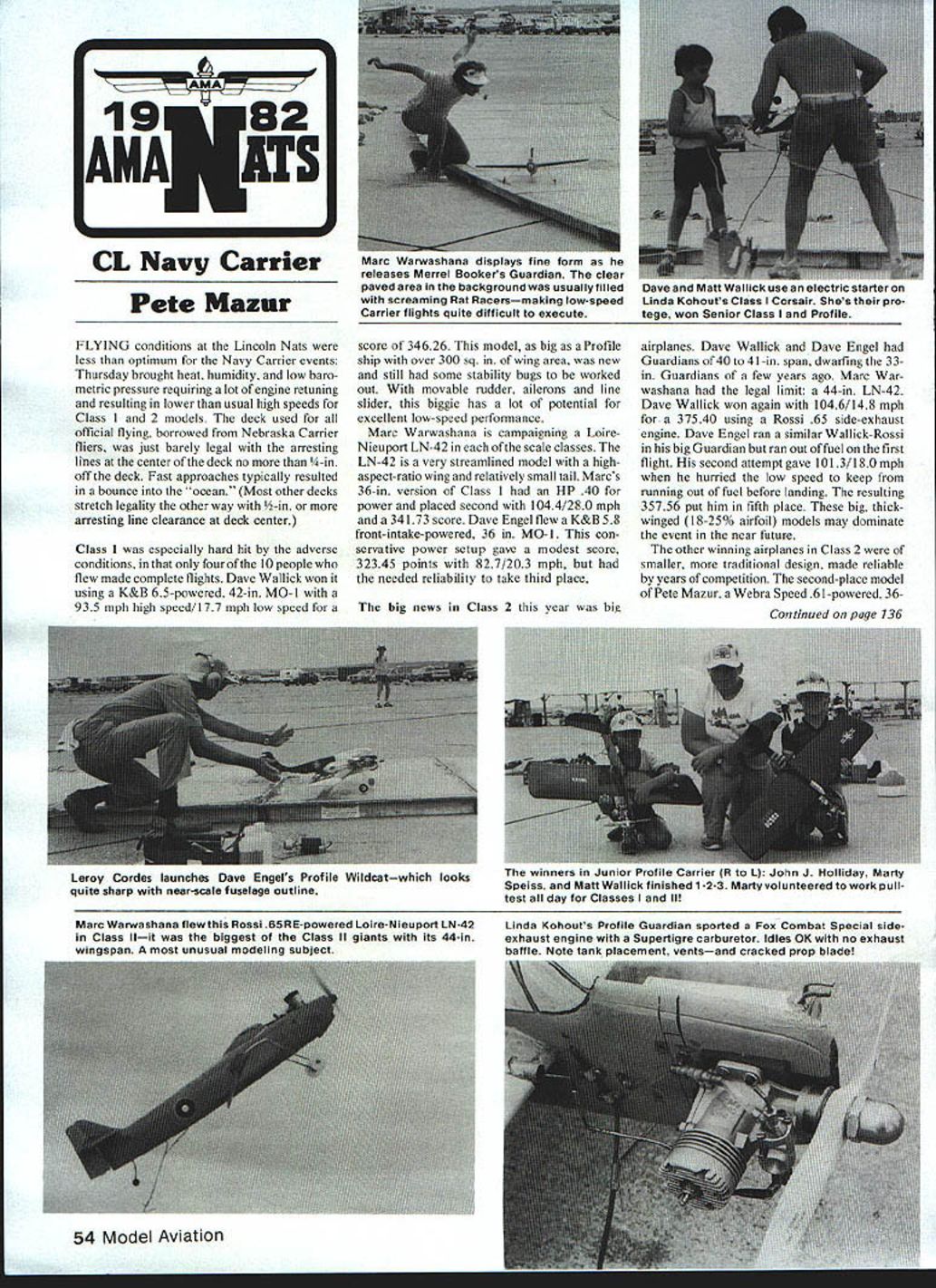
1982 AMA Nats: CL Navy Carrier
Pete Mazur
Conditions
Flying conditions at the Lincoln Nats were less than optimum for the Navy Carrier events. Thursday brought heat, humidity, and low barometric pressure, requiring a lot of engine retuning and resulting in lower-than-usual high speeds for Class I and II models. The deck used for all official flying, borrowed from Nebraska Carrier fliers, was just barely legal — the arresting lines at the center of the deck were no more than 4 in. off the deck. Fast approaches typically resulted in a bounce into the "ocean." (Most other decks stretch legality the other way with 1/2 in. or more arresting-line clearance at deck center.)
Class I
Class I was especially hard hit by the adverse conditions: only four of the ten contestants who flew made complete flights.
- Dave Wallick won using a K&B .6.5-powered, 42-in. MO-1 with a 93.5/17.7 mph high/low speed for a score of 346.26. This model, as big as a profile ship with over 300 sq. in. of wing area, was new and still had some stability bugs to be worked out. With movable rudder, ailerons, and line slider, this biggie has a lot of potential for excellent low-speed performance.
- Marc Warwashana campaigned a Loire-Nieuport LN-42 in the scale classes. Marc's 36-in. version in Class I had an HP .40 for power and placed second with 104.4/28.0 mph and a 341.73 score.
- Dave Engel flew a K&B 5.8 front-intake-powered, 36-in. MO-1. This conservative power setup gave a modest but reliable performance: 82.7/20.3 mph and 323.45 points, good for third place.
Class II
The big news in Class II this year was large airplanes. Dave Wallick and Dave Engel had Guardians of 40–41 in. span, dwarfing the 33-in. Guardians of a few years ago. Marc Warwashana had the legal limit with a 44-in. LN-42.
- Dave Wallick won again with 104.6/14.9 mph for a 375.40 using a Rossi .65 side-exhaust engine.
- Dave Engel ran a similar Wallick-Rossi in his big Guardian but ran out of fuel on the first flight. His second attempt produced 101.3/18.0 mph when he hurried the low-speed run to keep from running out of fuel before landing; the resulting 357.56 put him in fifth place.
These big, thick-winged (18–25% airfoil) models may dominate the event in the near future.
Other top Class II finishers flew smaller, more traditional designs made reliable by years of competition:
- Pete Mazur — Webra Speed .61-powered, 36-in. MO-1: 110.9/23.0 mph, 359.04 (second place).
- Leon Rykartysky — 39-in. Skypirate: 115.7/27.3 mph, 358.06 (third place). Leon also used a Webra Speed .61.
- Bob Reynolds — OS .65 RSR-powered, 36-in. Firefly: 115.0/26.9 mph, 357.81 (fourth place).
Profile
The wind was decisive on Friday in Profile. The day started with turbulent 10–15 mph winds.
- The first complete flight was a 255.07 by Pete Mazur with a Tune-Hill plain-bearing-powered G-S Bearcat at 90.1/16.4 mph.
- Dave Rolley flew a Wildcat (which he is kitting) with a K&B 5.8 for 88.1/19.9 mph and 244.54, which eventually brought him fourth place.
- Bill Calkins, using an original Mauler and another K&B, made a fine flight of 83.8/17.1 mph for 242.73 and placed fifth. Bill's model had the flaps disabled for stability in the wind.
At noon the deck was closed for the break. By then only three Open-category flights had been completed with landings. The seas around the carrier were littered with wreckage from crashes in the low-speed runs or failed landings. During the break the winds dropped to a light breeze and the sky cleared.
- Leroy Cordes put up the first flight after lunch with his Tune-Hill (ball-bearing) powered Spearfish, managing 93.1/13.8 mph and a 270.46-point flight that put him solidly in first place and bumped Pete Mazur to second.
- Dave Engel followed with his Wildcat but missed the landing when the wind returned.
- Glenn Simpson posted a 246.27 flight with 83.8/15.9 mph speeds to capture third with his Tune-Hill-powered Kingfisher.
- Dave Wallick attempted to challenge for first, but his tail-heavy Spearfish — nearly unbeatable in calm weather — lacked the stability needed in the windy conditions; he touched down in the low-speed run and ended up out of the money.
Junior and Senior Profile
- John J. Holliday won Junior Profile Carrier with a Super Tigre–powered Guardian and 192.04 points. His 100-point landing in the turbulent conditions was the only perfect flight in the Junior category.
- In Senior, Linda Kohout, using a Fox Combat engine with a Super Tigre carb, won with 197.7 points.
- Bill Rutledge placed second in Senior with a Tigre-powered STOL Bearcat non-scale at 185.72 points.
Engines and Equipment
This is the first year ball-bearing engines were allowed in Profile, and that rule change resulted in K&B 5.8s, Tune-Hills, TWAs, and Fox rear-exhaust engines appearing with ball bearings instead of the plain bearings they sported last year. Only one Super Tigre was flown in the Open category, marking the passing of an engine that dominated the event for a decade.
Two Fox Combat engines appeared with Tigre carburetors, flown by Matt Wallick and Linda Kohout. These are the first of the anticipated Combat engine conversions and show a lot of promise: they idle fine without an exhaust baffle.
Awards and Organization
The Navy Carrier Society held its annual meeting Friday evening at a local restaurant and presented the traditional Eugene Ely award to 1982 Navy Carrier Champion Dave Engel. This coveted trophy is given to the person with the highest total score for all three classes of competition. Dave scored well in all classes and was the only contestant to make a landing in each class.
The Nats Carrier operation was smoothly run by Event Director Gerry Deeble, assisted by Mike Ruby and Larry Fagan in the pull test. Timing and scorekeeping by Carolyn Cordes, Mitzi Hawk, and Pam Rolley were enthusiastic, efficient, and accurate. The experienced, professional approach of these people and others resulted in a pleasant, hassle-free Nats. All these workers were warmly applauded by the contestants at the Navy Carrier Society meeting for a job well done.
Transcribed from original scans by AI. Minor OCR errors may remain.

