
CL Racing
John Ballard
Since the Control Line circles were relocated slightly from where they were at the Nats formerly held at Lincoln, I think the circles were nearly in perfect condition. Special thanks should be given to the Nats crew who laid out the circles, filled any remaining holes in the vicinity, and installed a rope barrier with permanently mounted wire posts to control spectators. This cordoning of the Control Line area was appreciated by Speed, Carrier and Racing participants.
This year the Nats were held with the same schedule as in Seguin:
- Open Scale Racing — Monday
- FAI Team Race — Tuesday
- Junior and Senior Scale Racing — Wednesday
- Open Rat (Fast Rat) — Thursday
- Fast and Slow Rat events — Friday
- Open Slow Rat — Saturday
Scale Racing
It was my observation that the majority of the Racing competitors arrived on Sunday and spent most of that day practice-flying in the 90-plus-degree heat. Henry Nelson's new, slightly modified .15 engine was sported by Vic Garner of California and had excellent airspeed. On several clockings we found that it was approximately 0.2 to 0.3 (units unspecified) faster than the standard Rossi .15. Tim Gillott (Salinas, CA) caused a stir when his initial practice flights were sent up at 141–143. Typically, the speed of the majority of competitors was around 151–156. Unfortunately, Tim could not keep his engine consistent; he had to make head and carburetor changes, slowing his airspeed into the range of the rest of the field.
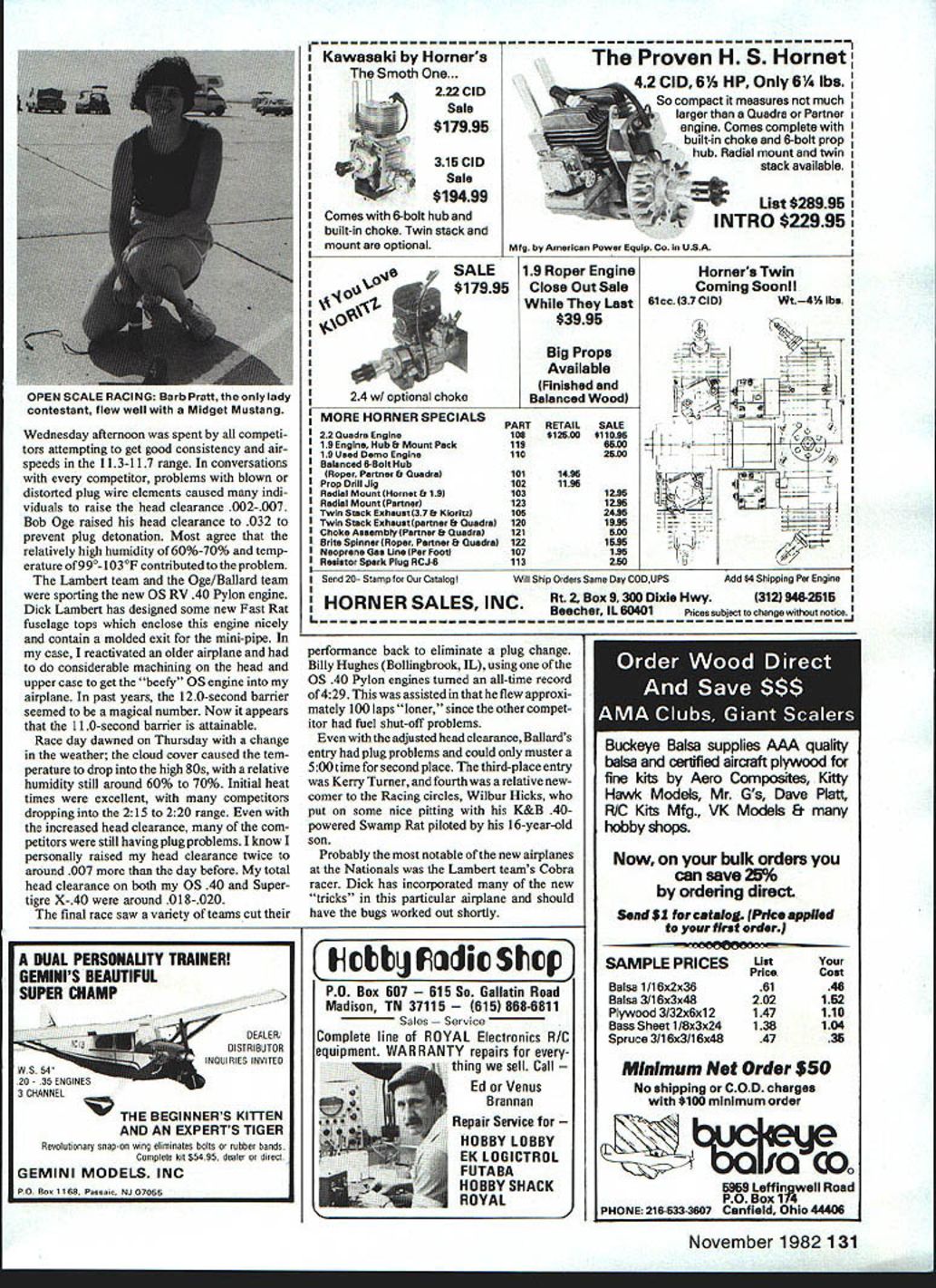
Scale Racing entries were up slightly. The Pratt entry was piloted by Ms. Barbara Pratt, who handled the Midget Mustang very well in traffic. Qualifying times on Monday in the 90-plus-degree heat ranged from 2:52 to 3:00; the best qualifying time was turned by John Ballard at 2:52. In the finals the Lambert team, piloted by Harold “Pops” Lambert, turned an excellent time of 5:53 to become only the second three-time winner of the event. His success was largely due to his son Dick performing quick and flawless pit stops. Bob Oge and John Ballard teamed up as pitman and pilot for 5:59 and 5:58, respectively, to place third and second.
In past years the nitro content of the fuel has been somewhere between 50% and 60%; however, I believe the majority of competitors were running in the 70% to 75% range this year.
Team Racing
The Team Race at Lincoln was as exciting as ever, despite the conspicuous absence of the Perkins/Albritton team and the California teams of Jolly/Kusik and McCollum/Knoppi. This year saw Carl Dodge “revived from retirement,” and Bill Lee sporting a new pilot and a “hot-stuff” special fuselage on his racer. The Oge/Hughes team had eliminated their consistency problems and turned in several consistent heat times. The posted heat times and the winning times were respectable from a consistency standpoint. When the dust settled, the Gillott/Ballard team took the win, followed closely by Shew/Pardue and Oge/Hughes.
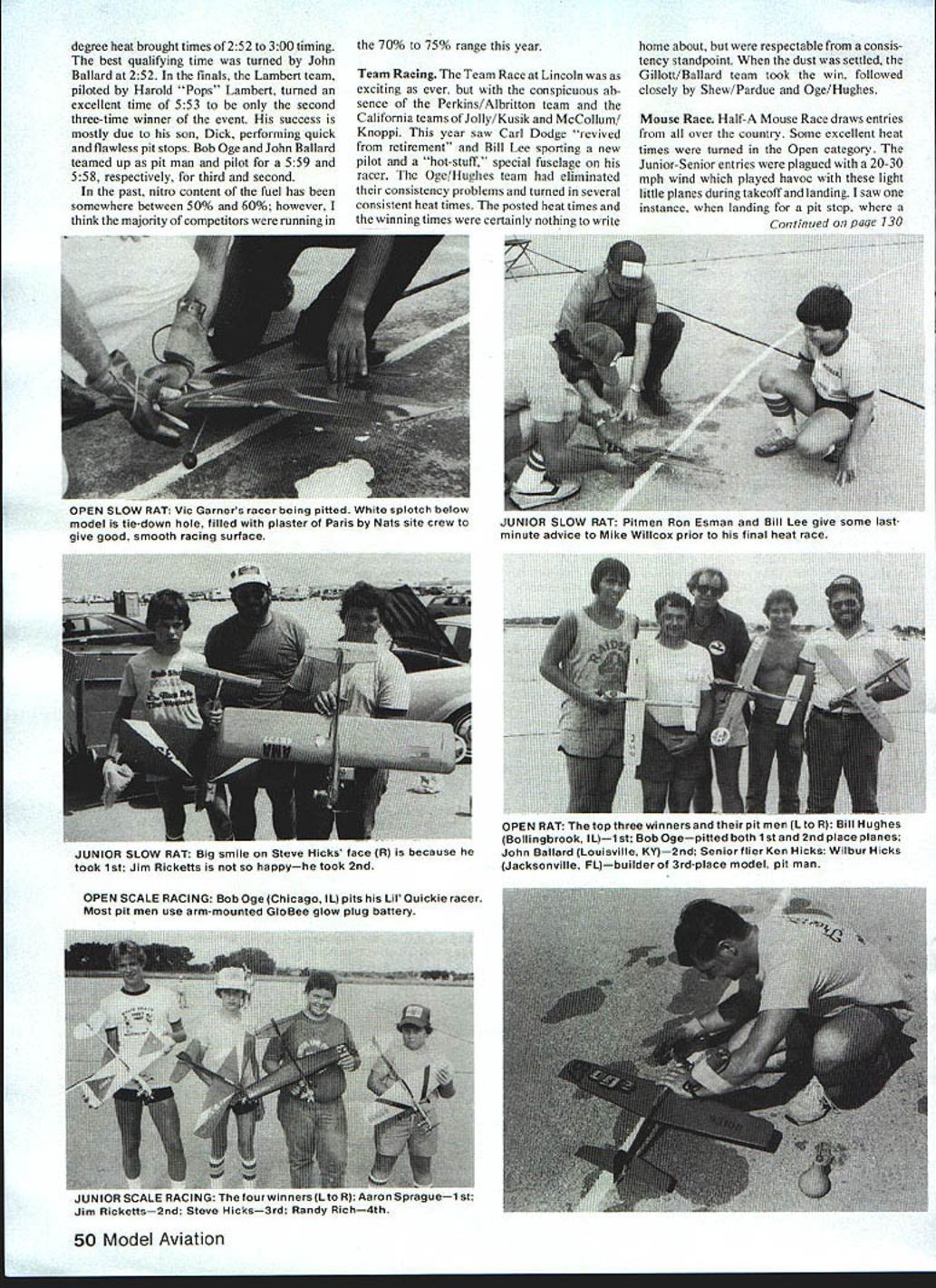
FAI Team Race — Winning teams:
- L. R. Ballard / Gillott — 1st
- Shew / Pardue — 2nd
- Hughes / Oge — 3rd
Mouse Race
The Half-A Mouse Race draws entries from all over the country. Some excellent heat times were turned in the Open category. The Junior-Senior entries were plagued with a 20–30 mph wind which played havoc with these light little planes during takeoff and landing. I saw one instance, when landing for a pit stop, where a gust of wind caught the plane and caused it to do a complete wingover in slow motion, and the pilot caught the airplane with no damage in the center of the circle.
The designs of these miniature racers have been perfected to the point where they have excellent characteristics. Observing other fliers, I found the Open entries had constructed fast-fills for their tanks, used “hot” glow plugs on the body, and experimented with wheel locations to improve takeoff and landing characteristics.
A heavy concentration of 1/2A Racers from the East Coast did not make it to the Nats; had they attended, turnout—and thus the apparent popularity of the event in the Midwest/East Coast area—would have been better.
Fast Rat
Thursday was Open Fast Rat day. Attempts were made to repair engines that wouldn't run. In one instance a combined effort of about 57 minutes by Glen Meador, Lou Dudka, Ken Purzycki Sr., Windy Urtnowski, Jim Casale, and Jeff Anderson rebuilt Ken’s plane. Damage consisted of:
- Foam wing with broken center wing joint
- Stabilizer broken in half
- Broken tank
- Engine with broken case/crank
- Severely splintered fuselage
The second round saw Jim McClellan’s flight score lower as the winds really picked up. Rich Siefert put in a beautiful flight—Open pilots were watching and clapping after the maneuver. In the extremely windy conditions, Siefert determined to put the bottoms at five feet—no wind—and the big Enya .49X was really hauling the 60-in.-span plane around. Ken Purzycki put the patched-up plane in the air again; Open fliers applauded after the maneuver. The final tally came out: Ken winning 41,350; Siefert 40,850.
Wednesday afternoon had been spent by many competitors attempting to get good consistency and airspeeds in the 11.3–11.7 range. In conversations with competitors, problems with blown or distorted plug wire elements caused many to raise the head clearance by .002–.007. Bob Oge raised his head clearance to .032 to prevent plug detonation. Most agree that the relatively high humidity of 60%–70% and temperatures of 99°–103°F contributed to the problem.
The Lambert team and the Oge/Ballard team were sporting the new OS RV .40 Pylon engine. Dick Lambert designed some new Fast Rat fuselage tops which enclose the engine nicely and contain a molded exit for the mini-pipe. In my case I reactivated an older airplane and had to do considerable machining on the head and upper case to get the “beefy” OS engine into my airframe. In past years the 12.0-second barrier seemed to be a magical number; now it appears the 11.0-second barrier is attainable.
Race day dawned on Thursday with a change in the weather; the cloud cover caused the temperature to drop into the high 80s, with relative humidity still around 60%–70%. Initial heat times were excellent, with many competitors dropping into the 2:15 to 2:20 range. Even with increased head clearance, many competitors were still having plug problems. I personally raised my head clearance twice to about .007 more than the day before; my total head clearance on both my OS .40 and Super-Tigre X .40 was around .018–.020.
The final race saw a variety of teams cut their performance back to eliminate a plug change. Billy Hughes (Bolingbrook, IL), using one of the OS .40 Pylon engines, turned an all-time record of 4:29. This was assisted by the fact that he flew approximately 100 laps as a “loner,” since the other competitor had fuel shut-off problems.
Even with adjusted head clearance, Ballard’s entry had plug problems and could only muster a 5:00 time for second place. The third-place entry was Kerry Turner, and fourth was newcomer Wilbur Hicks, whose 16-year-old son piloted a K&B .40-powered Swamp Rat with some nice pitting.
Probably the most notable of the new airplanes at the Nationals was the Lambert team’s Cobra racer. Dick has incorporated many of the new tricks in this particular airplane and should have the bugs worked out shortly.
Jr.-Sr. Rat and Slow Rat
This year the Junior and Senior entries in both events were down considerably. That is not to say the two events were not extremely exciting. Pitting and flying for the Junior and Senior entries were certainly commendable, and a variety of excitement was afforded the Carrier circle when one of these Slow Rats took a tour of their circle. Jim Ricketts, Control Line Racing Director, did an admirable job of keeping the competitors organized while maintaining safety at all times.
Certainly in the future we can see these Junior-Senior pilots and pitmen in the pro ranks—individuals such as Aaron Sprague, Mike Wilcox, Jim Ricketts, Jr., Robbie Frink, and Ken Hicks. It was also refreshing to find several youngsters coming up from the “Old Rat Pilots Association,” namely John Stubblefield and Dickie Rich, Jr.
Open Slow Rat
As in past Nats, Saturday was Open Slow Rat Racing. Most of the day preceding the event saw everyone practicing. Of note was Vic Garner’s new red airplane with wheel pants and streamlined landing gear to lessen drag. Bill Lee had been thrashing in his shop and brought out a new Slow Rat which certainly had promise.
Speeds were a little better this year than in past years, with the majority of competitors running right at the 14.0-sec range. As last year, Vic Garner apparently had the fastest Slow Rat with clockings in the 13.3–13.5 range. Engine choices included the Texas contingent running the K&B .35 and other competitors generally running the OS .36 (Tune/Hill) combination.
With only 11 competitors, Race Director Jim Ricketts decided to run only the 140-lap final. In one of the first heats Bill Lee turned an excellent time of 5:29; the majority of competitors figured that would hold up for the win. He was assisted in this heat by Dick Stubblefield doing his usual excellent job of piloting, and by the other competitor dropping out after 70 laps. This was an unfortunate situation for Vic Garner in that heat, since his needle valve shook loose after approximately 60 laps. Frank Williams and Ron Esman were sporting the Lickety Split Slow Rat designed by Frank Williams and were powered by HP .36s.
Unquestionably Ron Esman has the fastest pit stops of all competitors. Ron’s entry was flown by Dick Stubblefield in the race in which John Ballard’s entry was pitted by Vic Garner and Bob Kerr. Vic’s rework of the Tune/Hill OS .36 resulted in a time of 5:26, which—combined with good pitting—was good enough to win the event. Bob Kerr, in his role as pitman, managed some good pits to take fifth. The father-and-son team of Dziak had two excellent performances without the tank problems that plagued them at last year’s Nats.
In the final shakeout, the top five included three competitors from Texas, one from the Midwest, and one from California.
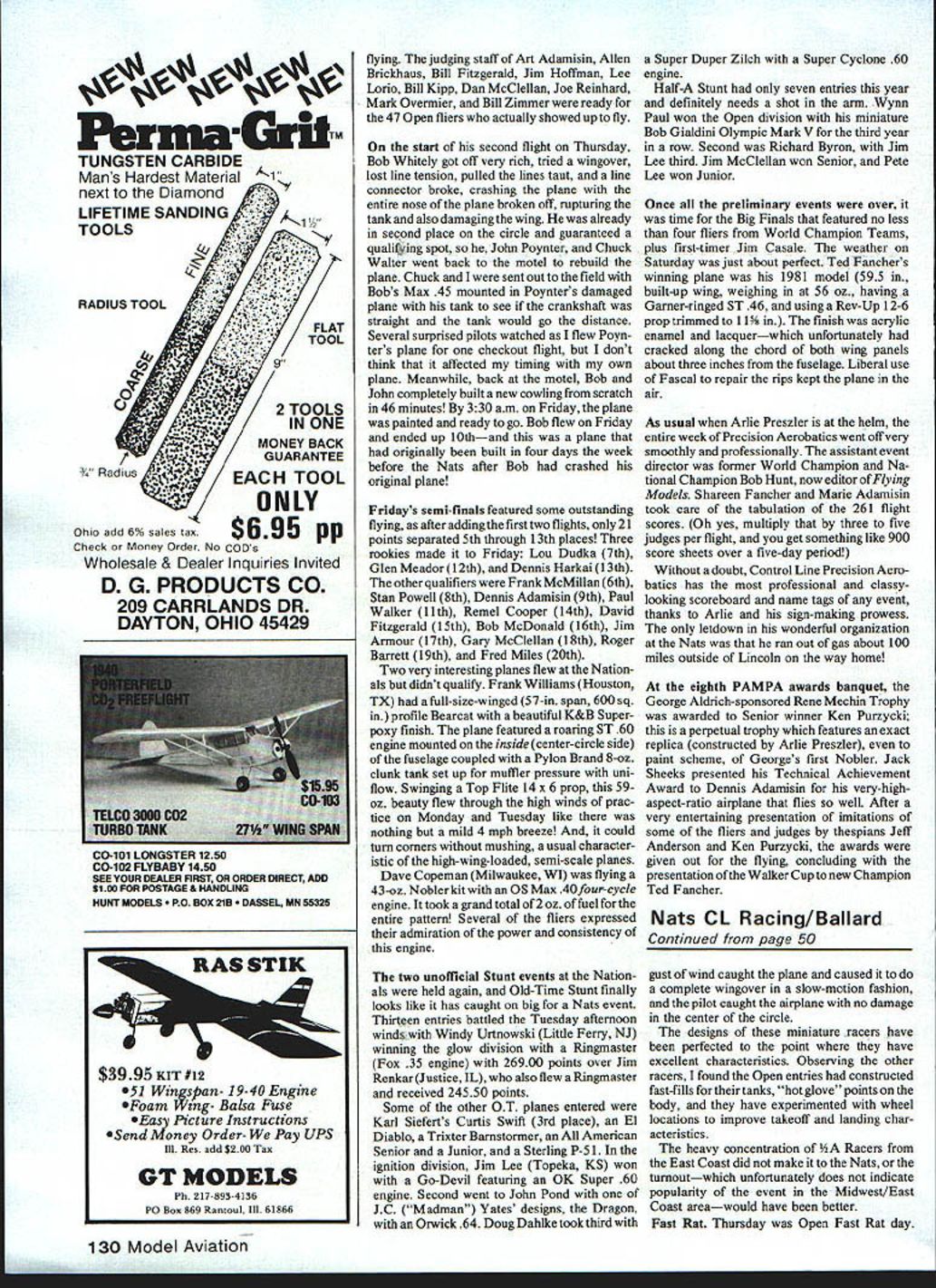
Open Slow Rat — Race Director: Jim Ricketts
- 1st — John Ballard
- 2nd — Dick Stubblefield
- 3rd — Ron Esman
- 4th — Bill Lee
- 5th — Bob Kerr
Transcribed from original scans by AI. Minor OCR errors may remain.

