
1982 AMA Nats: CL Scale
Mike Gretz
Early June: plenty of time. The Nats is still two months away. Take the kids to the circus, get out for a few calm evenings of fun flying, go on a picnic, give a couple of flight demos out of town, sit on the porch and watch neighbors mow their lawns, help coach little league, work the Sig contest over Father's Day, the family reunion weekends in June? Pretty soon the wife asks, "Wanna go camping over the 4th?" Sure, let's go! Get back, cool off, take some aspirin for the noise.
Wow! The Nats is only three weeks away, time to buckle down. Gotta get the new ship down, get the old ones limbered up. Tell the truth, was there a July 1982? Only endless hours in the model shop for me! No time to weed the garden, mow the lawn, wash the car—gotta load up the stuff tonight. "Be careful there where the paint's not dry!" Save those last-minute emergency details for fixing at the motel.
Get to Lincoln and check into the room. "You kids can't go swimming now; we've got to get out to the field." There's AMA Nats Headquarters, and lots of people. Everything's laid out kinda like it was in 1979. Find a place to park, put the airplane together, and turn it over to Cathy and Bob. There's Dave and Jack and Dolly, Mathew, Mark, and John. Lots of "howdy", "good to see ya", "how ya been". What's the competition look like? "Dick brought Zero back going for four in a row." "Check out that PT-17; it's got everything!" "Isn't that Gee Bee neat?" "That B-25 is going to be tough." On and on. As Jeff Perez says, "It's time for tellin' lies and believin' 'em."
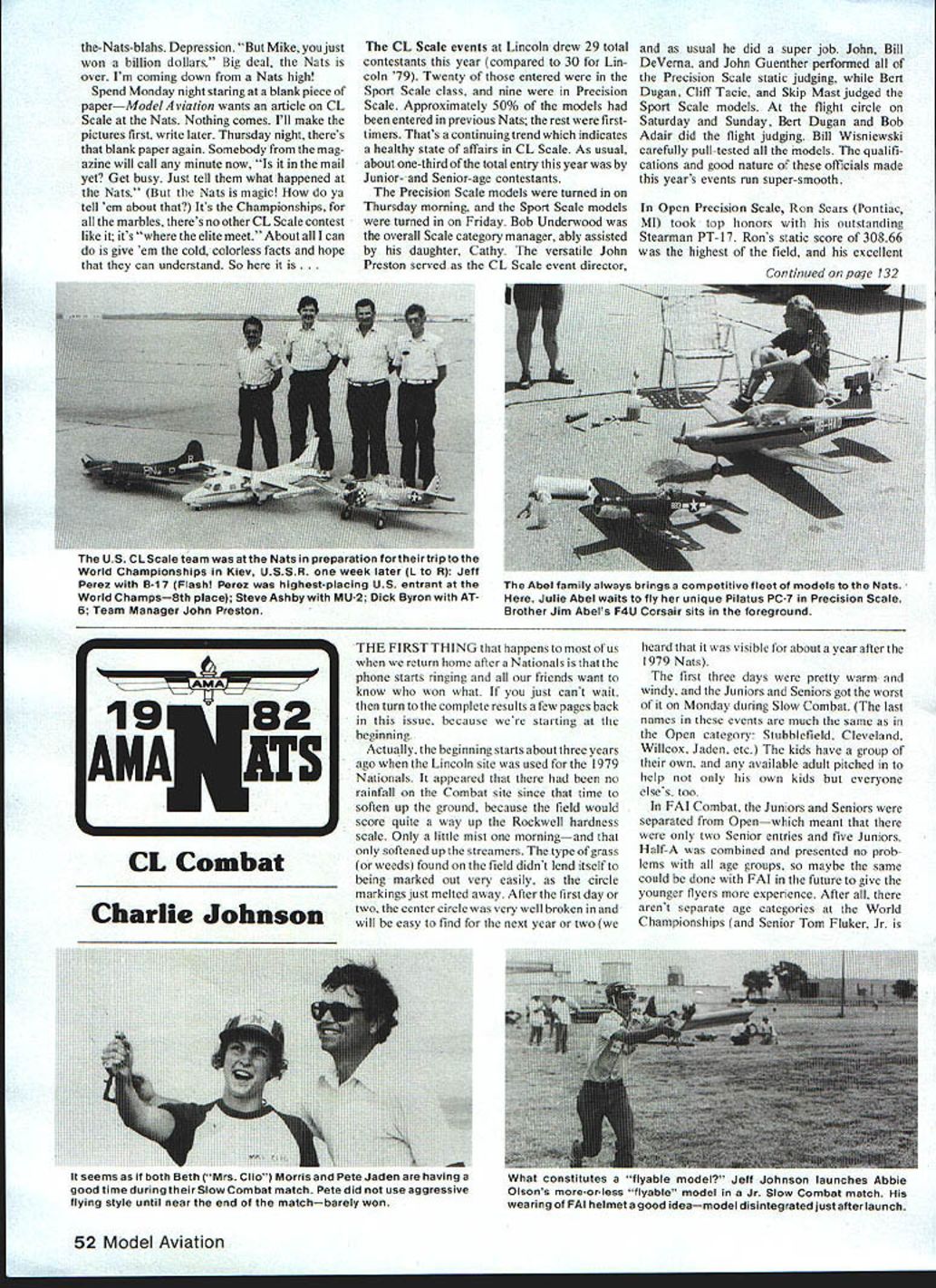
Who are those guys in the sparkling blue uniforms? That's Jeff, Dick, Steve, and John, our country's team for the Scale World Championships. They leave for Russia next Friday. Here for a team meeting and to have their WC models static-judged. Jeff wants to fly his at the Nats, but Team Manager John threatens to hide his lines. Good luck, guys!
Saturday morning—this is it, time to fly, go for the glory—oops, noseover! Wipe down the model, answer questions, take a few pictures. Takeoff for second flight, last chance to catch Dick—darn, engine quit! Oh well, I'll get 'em next year. Try to act like it doesn't matter? Congratulations. Help someone else fly. Pack up. Go back to AMA Nats HQ. "Whatta ya mean the Nats is over?" Long dull ride home. Oh no, here it comes, the after-Nats low. I'm coming down—Nats high.
Model Aviation wants an article on CL Scale Nats. Nothing comes. I'll make pictures first, write later. Thursday night there's blank paper again. Somebody from the magazine will call any minute, no mail yet. Get busy. Just tell what happened. Nats, Nats magic, ya tell 'em about it. It's championships, marbles; there's no other CL Scale contest like its elite meet. About all I can give 'em are cold colorless facts—hope you can understand.
Event overview
- Total CL Scale contestants: 29 (compared to 30 at Lincoln '79)
- Sport Scale entries: 20
- Precision Scale entries: 9
- Approximately 50% of models were previous Nats entries; the rest were first-timers
- About one-third of the total entry were Junior-age contestants
- Precision Scale models turned in Thursday morning; Sport Scale models turned in Friday
Officials
The events were efficiently run by qualified and good-natured officials:
- Bob Underwood — overall Scale category manager (assisted by his daughter Cathy)
- John Preston — CL Scale event director
- Precision static judges: John, Bill DeVerna, John Guenther
- Sport static judges: Bert Dugan, Cliff Tasic, Skip Mast
- Flight judges (Saturday & Sunday): Bert Dugan, Bob Adair
- Pull-test: Bill Wisniewski
Their qualifications and organization made this year's events run super-smooth.
Open Precision Scale
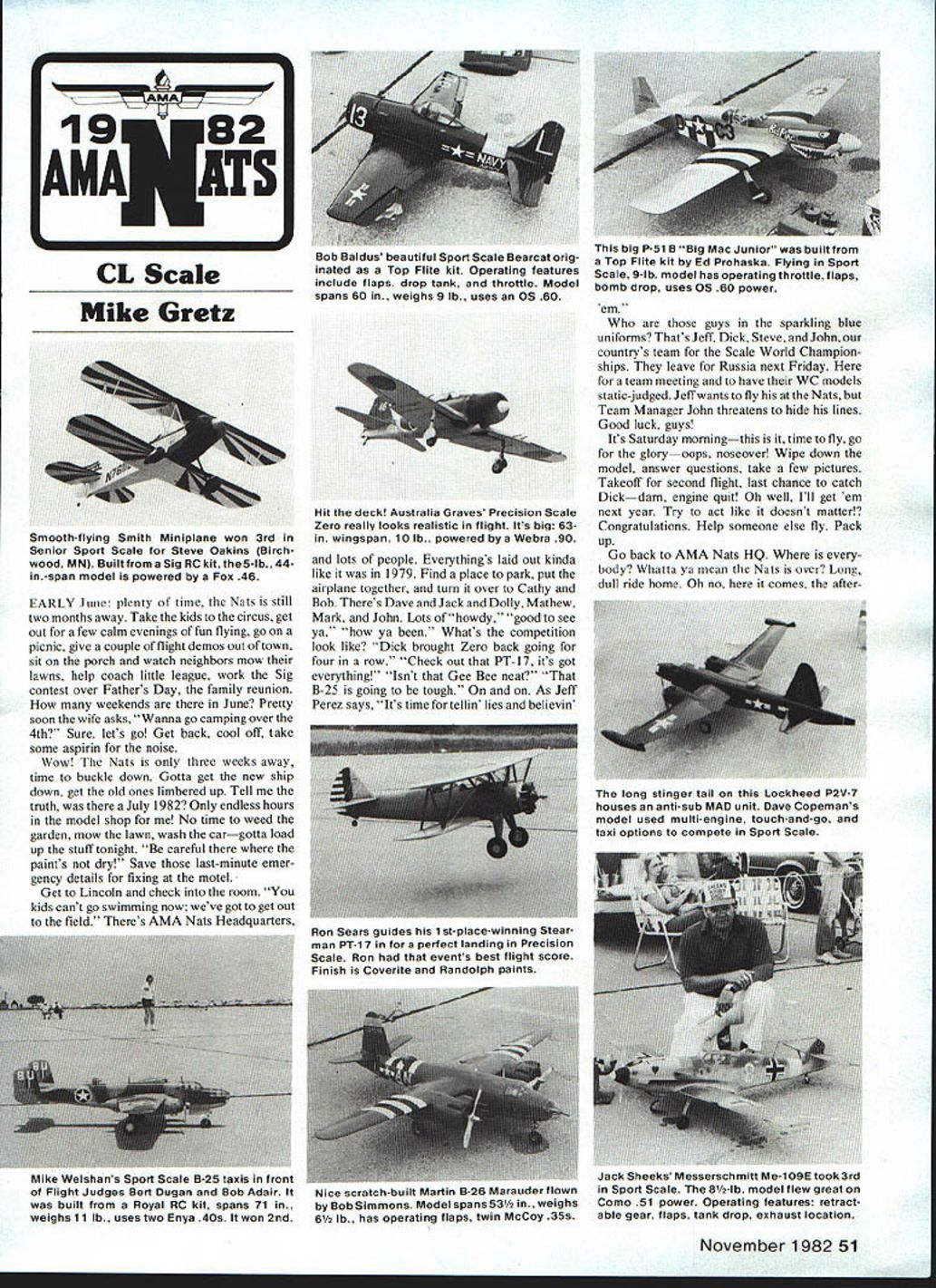
Ron Sears (Pontiac, MI) took top honors with an outstanding Stearman PT-17. Ron's static score of 308.66 was the highest of the field, and his excellent flying easily clinched the competition. The PT-17 was based on the Sterling kit but was obviously highly modified; it had a wingspan of 72 in., weighed 11½ lb., and was powered by a .60. Ron is a true champion whose performance and model were equal to any past Nats winners. I hope he tries for the FAI CL Scale Team next year.
Second place in Open Precision went to Austin Graves with his Japanese A6M5 Zero. Problems at the flight line left Graves at the end of Saturday with no qualifying flight, only one attempt left, and badly rebroken landing gear (for the second time that day). Repairs lasting until 3 a.m. paid off Sunday when he finally got in an official flight to claim a well-deserved second place. Third place went to Charles Bauer flying a familiar .60-powered Pitts Special. Gary Oakins was fourth with a small Fox .35-powered Fokker D-7.
Joe Kirn won first in Senior Precision Scale with his familiar Tallmantz TB-25 camera plane. Joe had previously won first in Jr. Precision in 1977 and first in Sr. Precision in 1979 with the same model. His static score was second only to Open winner Ron Sears this year.
Mathew Bauer came in second in Senior Precision with his venerable P-40, finally turning the tables on his brother Peter, who took third with last year's Nats-winning Shoestring.
Julie Abel was the only Junior Precision Scale contestant this year, flying the same Pilatus PC-7 Turbo Trainer that she won with last year. Julie's static and flight scores would have been good enough to place her third in the Open class or second in Senior.
Jr.-Sr. Rat and Slow Rat
This year the Junior and Senior entries in both events were down considerably, but that did not lessen the excitement. The Junior and Senior pilots and pit crews turned in commendable performances. The Carrier circle enjoyed a bit of extra excitement when one Slow Rat took a tour of their circle.
Jim Ricketts, Control Line Racing Director, did an admirable job of keeping the competitors organized while maintaining safety at all times. We can expect to see many of these Junior-Senior pilots and pit men in the pro ranks in the future, especially individuals like Aaron Sprague, Mike Willcox, Jim Ricketts, Jr., Robbie Frink, and Ken Hicks. It was also refreshing to see youngsters coming up from the "Old Rat Pilots Association," namely John Stubblefield and Dickie Rich, Jr.
Open Slow Rat
As in past Nats, Saturday was Open Slow Rat Racing. Most of the day preceding the event saw everyone practicing. Notable entries included Vic Garner's new red airplane with wheel pants and streamlined landing gear to lessen drag, and Bill Lee's newly finished Slow Rat. Speeds were a little better this year than in past years, with the majority of competitors running right at the 14.0-second range. Vic Garner apparently had the fastest Slow Rat with clockings in the 13.3–13.5 range. Engine choices included the Texas contingent running the K&B .35 and other competitors generally running the OS .36 (Tune/Hill).
With only 11 competitors, Race Director Ricketts decided to run only the 140-lap final. In one of the early heats, Bill Lee turned an excellent time of 5:29, which many thought would hold up for the win. He was assisted in this heat by Dick Stubblefield doing his usual excellent job of piloting, and with some help from another competitor dropping out after 70 laps. Vic Garner was unfortunate in this heat when his needle valve shook loose after approximately 60 laps. Frank Williams and Ron Esman were flying Lickety Split Slow Rats designed by Frank Williams and powered by .36s.
Unquestionably, Ron Esman has the fastest pit stops of all competitors. Ron's entry was flown by Dick Stubblefield in the race in which John Ballard's entry was pitted by Vic Garner and Bob Kerr. Vic's rework of the Tune/Hill OS .36 resulted in a winning time of 5:26, aided by good pitting. Bob Kerr, as pit man, managed some good pits to take fifth. The father-and-son team of Dziak had two excellent performances without the tank problems that plagued them at last year's Nats. In the final top five there were three competitors from Texas, one from the Midwest, and one from California.
Sport Scale
In Sport Scale, Julie Abel won first in the Junior class with a new Sig Clipped Wing Cub. Second place in Junior went to Michael Reynolds with a scratch-built A2D-1 Skyshark Navy attack bomber.
The Senior Sport Scale division was hotly contested; the top three fliers all had static scores within four points of each other. Matthew Bauer ended up on top with his twin-engined Cessna Skymaster. Last year's winner, Peter Bauer, came in second with his P-61 Black Widow. A Smith Miniplane flown by newcomer Steve Oakins was third.
Open Sport Scale
Dick Byron posted his fourth consecutive Nats win in Open Sport Scale with his tireless Japanese Zero. An 88.66-point static score and two 90.5-point flights gave Dick a point total of 179.16. Second place went to Mike Welshans (Ferndale, MI) with a neat B-25; an 89 static score and two smooth flights made Mike a tough competitor at his first Nats. Jack Shecks came in third with a Messerschmitt Bf-109E and some top-notch flying. An OS .40-powered Clipped Wing Cub entered by Dave Falkenhagen came in fourth. Precision winner Ron Sears used a Top-Flite P-47 to post the single highest flight score of the contest and land in fifth place.
Conclusion
The quality of CL Scale flying at the Nats continues to improve every year. More and more people are converting so-called "R/C" kits to CL use. The average size of these models is larger than what was normal for CL Scale ten years ago, resulting in lighter wing loadings and much improved flight characteristics. Flying these large Scale models is truly fun. Why don't you build one this winter and come to the Nats next year?
Transcribed from original scans by AI. Minor OCR errors may remain.

