
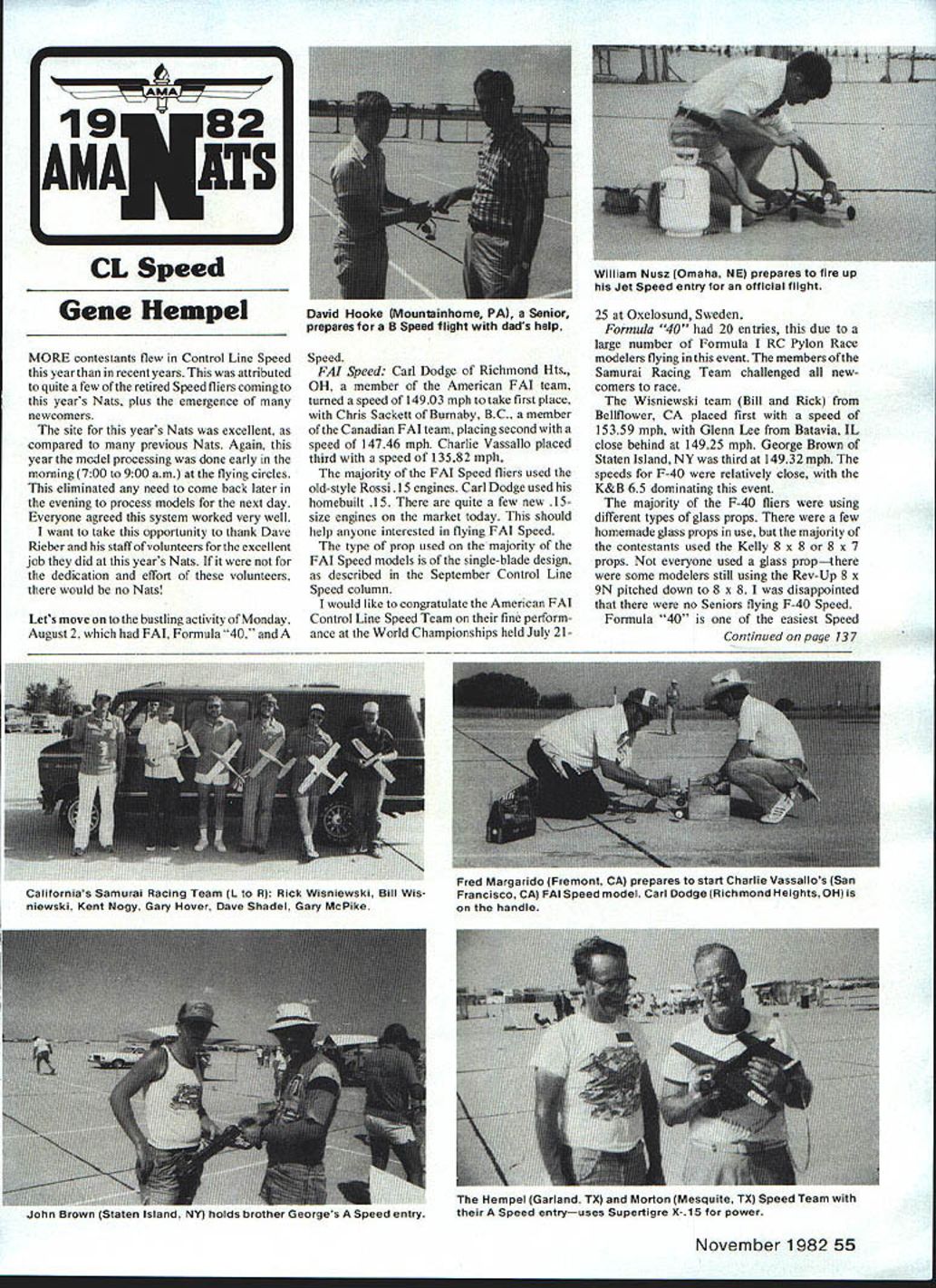
CL Speed
Gene Hempel
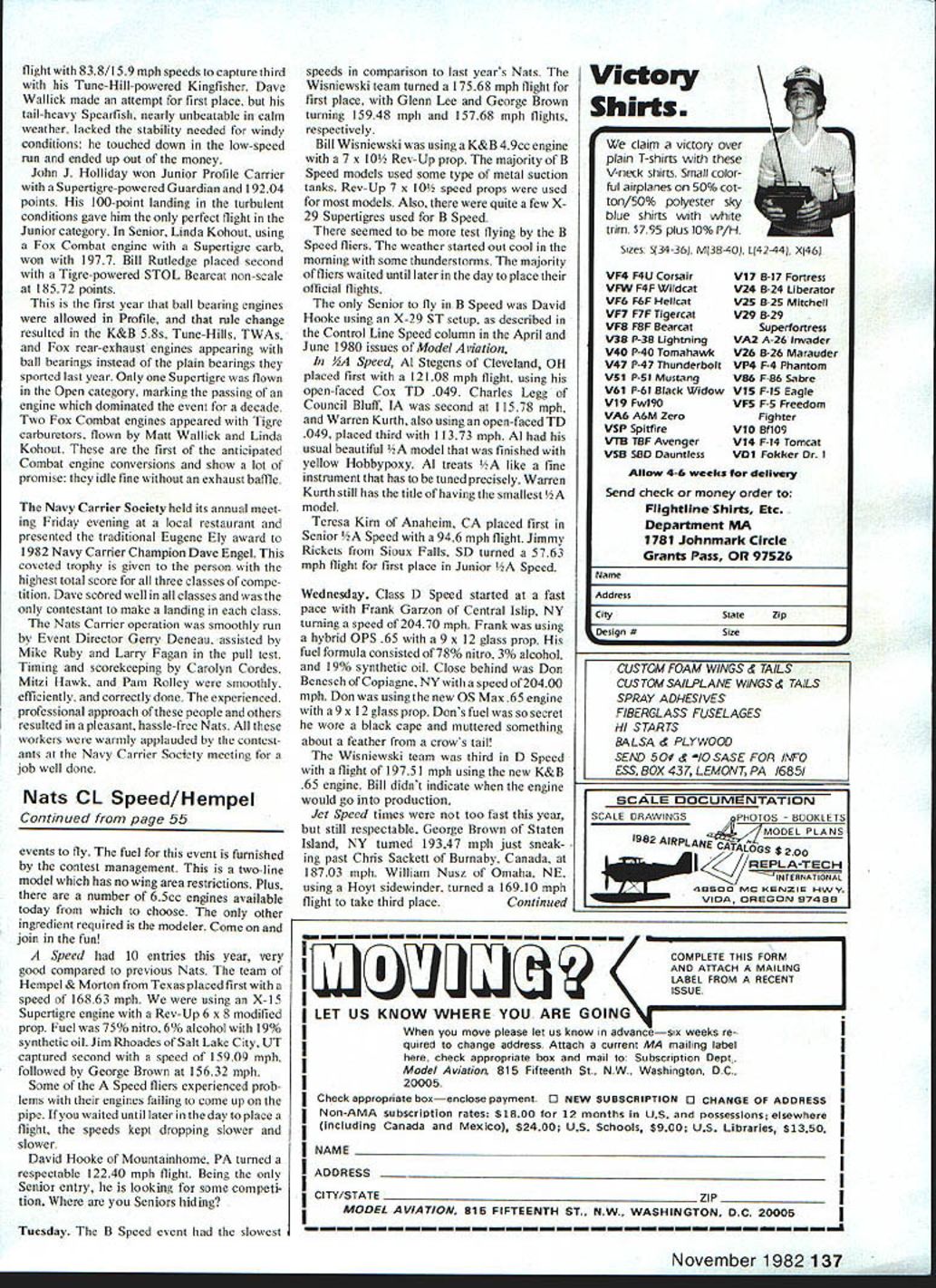
MORE contestants flew in Control Line Speed this year than in recent years. This was attributed to quite a few retired Speed fliers returning to this year's Nats, plus the emergence of many newcomers.
The site for this year's Nats was excellent compared to many previous Nats. Model processing was done early in the morning (7:00 to 9:00 a.m.) at the flying circles. This eliminated any need to come back later in the evening to process models for the next day. Everyone agreed this system worked very well.
I want to thank Dave Rieber and his staff of volunteers for the excellent job they did at this year's Nats. If it were not for the dedication and effort of these volunteers, there would be no Nats!
Let's move on to the bustling activity of Monday, August 2, which featured FAI, Formula "40", and A Speed.
FAI Speed
Carl Dodge of Richmond Heights, OH, a member of the American FAI team, turned 149.03 mph to take first place. Chris Sackett of Burnaby, B.C., a member of the Canadian FAI team, placed second with 147.46 mph. Charlie Vassallo placed third with 135.82 mph.
The majority of FAI Speed fliers used the old-style Rossi .15 engines. Carl Dodge used his homebuilt .15. There are quite a few new .15-size engines on the market today, which should help anyone interested in flying FAI Speed. The type of prop used on the majority of the FAI Speed models is of the single-blade design, as described in the September Control Line Speed column.
I would like to congratulate the American FAI Control Line Speed Team on their fine performance at the World Championships held July 21–25 at Oxelosund, Sweden.
Formula "40" (F-40)
Formula "40" had 20 entries, due in part to a large number of Formula 1 RC pylon race modelers flying in this event. The members of the Samurai Racing Team challenged all newcomers to race.
- First: Wisniewski team (Bill and Rick) of Bellflower, CA — 153.59 mph
- Second: Glenn Lee, Batavia, IL — 149.25 mph
- Third: George Brown, Staten Island, NY — 149.32 mph
Speeds for F-40 were relatively close, with the K&B .65 dominating this event. The majority of F-40 fliers were using glass props. There were a few homemade glass props in use, but most contestants used the Kelly 8 x 8 or 8 x 7 props. Not everyone used a glass prop—some modelers still used the Rev-Up 8 x 9N pitched down to 8 x 8.
I was disappointed that there were no Seniors flying F-40 Speed. Formula "40" is one of the easiest Speed events to fly. The fuel for this event is furnished by the contest management. This is a two-line model which has no wing area restrictions. There are a number of 6.5 cc engines available today from which to choose. The only other ingredient required is the modeler. Come on and join in the fun!
A Speed
A Speed had 10 entries this year, very good compared to previous Nats.
- First: Hempel & Nestor (Texas) — 168.63 mph
- Setup: X-15 Supertigre engine with a Rev-Up 6 x 8 modified prop
- Fuel: 75% nitro, 6% alcohol, 19% synthetic oil
- Second: Jim Rhodes, Salt Lake City, UT — 159.09 mph
- Third: George Brown — 156.32 mph
Some A Speed fliers experienced problems with their engines failing to come up on the pipe. If you waited until later in the day to place a flight, the speeds tended to drop. David Hooke of Mountainhome, PA turned a respectable 122.40 mph flight. Being the only Senior entry, he is looking for some competition.
Tuesday — B Speed and 1/2 A
B Speed had slower speeds compared to last year's Nats.
- First: Wisniewski team — 175.68 mph
- Second: Glenn Lee — 159.48 mph
- Third: George Brown — 157.68 mph
Bill Wisniewski was using a K&B 4.9 cc engine with a 7 x 10½ Rev-Up prop. The majority of B Speed models used some type of metal suction tanks. Rev-Up 7 x 10½ speed props were common. There were quite a few X-29 Supertigres used for B Speed.
There seemed to be more test flying by the B Speed fliers. The weather started cool in the morning with some thunderstorms, so many fliers waited until later in the day to place their official flights.
The only Senior to fly in B Speed was David Hooke, using an X-29 ST setup (described in the Control Line Speed column in the April and June 1980 issues of Model Aviation).
1/2 A Speed results:
- First: Al Steegens, Cleveland, OH — 121.08 mph (open-faced Cox TD .049)
- Second: Charles Legg, Council Bluffs, IA — 115.78 mph
- Third: Warren Kurth — 113.73 mph (open-faced TD .049)
Al had his usual beautiful 1/2 A model finished with yellow Hobbyopoxy. Al treats 1/2 A like a fine instrument that must be tuned precisely. Warren Kurth still holds the distinction of having the smallest 1/2 A model.
Senior and Junior 1/2 A:
- Senior 1/2 A: Teresa Kim, Anaheim, CA — 94.6 mph
- Junior 1/2 A: Jimmy Rickets, Sioux Falls, SD — 57.63 mph
Wednesday — Class D and Jet Speed
Class D Speed started at a fast pace.
- First: Frank Garzon, Central Islip, NY — 204.70 mph
- Setup: hybrid OPS .65 with a 9 x 12 glass prop
- Fuel: 78% nitro, 3% alcohol, 19% synthetic oil
- Second: Don Benscoth, Copiague, NY — 204.00 mph
- Setup: OS Max .65 with a 9 x 12 glass prop
- (Don’s fuel remained his secret.)
- Third: Wisniewski team — 197.51 mph (new K&B .65)
Bill Wisniewski did not indicate when the new K&B .65 engine would go into production.
Jet Speed times were respectable, though not as fast as some years.
- First: George Brown, Staten Island, NY — 193.47 mph
- Second: Chris Sackett, Burnaby, Canada — 187.03 mph
- Third: William Nusz, Omaha, NE (Hoyt sidewinder) — 169.10 mph
Steven P. Oakins of Birchwood, MN, the only Senior in his class, turned a 165.53 mph flight for first among Seniors.
Profile Carrier and Profile (continued notes)
(Note: the following event notes were included on the Nats continuation page.)
A competitor captured third with his Tune-Hill–powered Kingfisher after flight runs scoring 83.8 and 15.9 mph (reported as combined results). Dave Wallick attempted for first place, but his tail-heavy Spearfish—nearly unbeatable in calm weather—lacked the stability needed for windy conditions; he touched down in the low-speed run and ended up out of the money.
John J. Holliday won Junior Profile Carrier with a Supertigre-powered Guardian and 192.04 points. His 100-point landing in the turbulent conditions gave him the only perfect flight in the Junior category. In Senior Profile Carrier, Linda Kohout, using a Fox Combat engine with a Supertigre carb, won with 197.71 points. Bill Rutledge placed second with a Tigre-powered STOL Bearcat non-scale at 185.72 points.
This is the first year that ball-bearing engines were allowed in Profile, and that rule change resulted in K&B .58s, Tune-Hills, TWAs, and Fox rear-exhaust engines appearing with ball bearings instead of plain bearings. Only one Supertigre was flown in the Open category, marking the passing of an engine that dominated the event for a decade. Two Fox Combat engines appeared with Tigre carburetors, flown by Matt Wallick and Linda Kohout. These are the first of the anticipated Combat engine conversions and show a lot of promise; they idle fine without an exhaust baffle.
The Navy Carrier Society held its annual meeting Friday evening at a local restaurant and presented the traditional Eugene Ely award to 1982 Navy Carrier Champion Dave Engel. This coveted trophy is given to the person with the highest total score for all three classes of competition. Dave scored well in all classes and was the only contestant to make a landing in each class.
The Nats Carrier operation was smoothly run by Event Director Gerry Deneau, assisted by Mike Ruby and Larry Fagan in the pull test. Timing and scorekeeping by Carolyn Cordes, Mitzi Hawk, and Pam Rolley were done smoothly, efficiently, and correctly. The experienced, professional approach of these people and others resulted in a pleasant, hassle-free Nats. All these workers were warmly applauded by the contestants at the Navy Carrier Society meeting for a job well done.
Social and Rule Meeting
For the Speed modelers who missed this year's Nats—you certainly missed one of the highlights of the year. There was an excellent get-together for refreshments at Dave Rieber's house on Wednesday. Everyone had an opportunity to swap stories and complain about how Speed flying is degenerating.
The North American Speed Society, in conjunction with the AMA Speed Advisory Committee, held an informal meeting at Nats AMA headquarters. There were numerous discussions concerning FAI team selections and what proposals were necessary to make the rules more uniform. The majority felt the rules are satisfactory as is. The only proposal endorsed by all members was to require all AMA Speed events to use the F-40 fuel restrictions:
- 40% nitro
- 40% alcohol
- 20% oil
Under this proposal the fuel would be furnished by the contest management and dispensed from a single can for all fliers. The majority of the Speed fliers expressed their agreement with this plan.
Transcribed from original scans by AI. Minor OCR errors may remain.

