
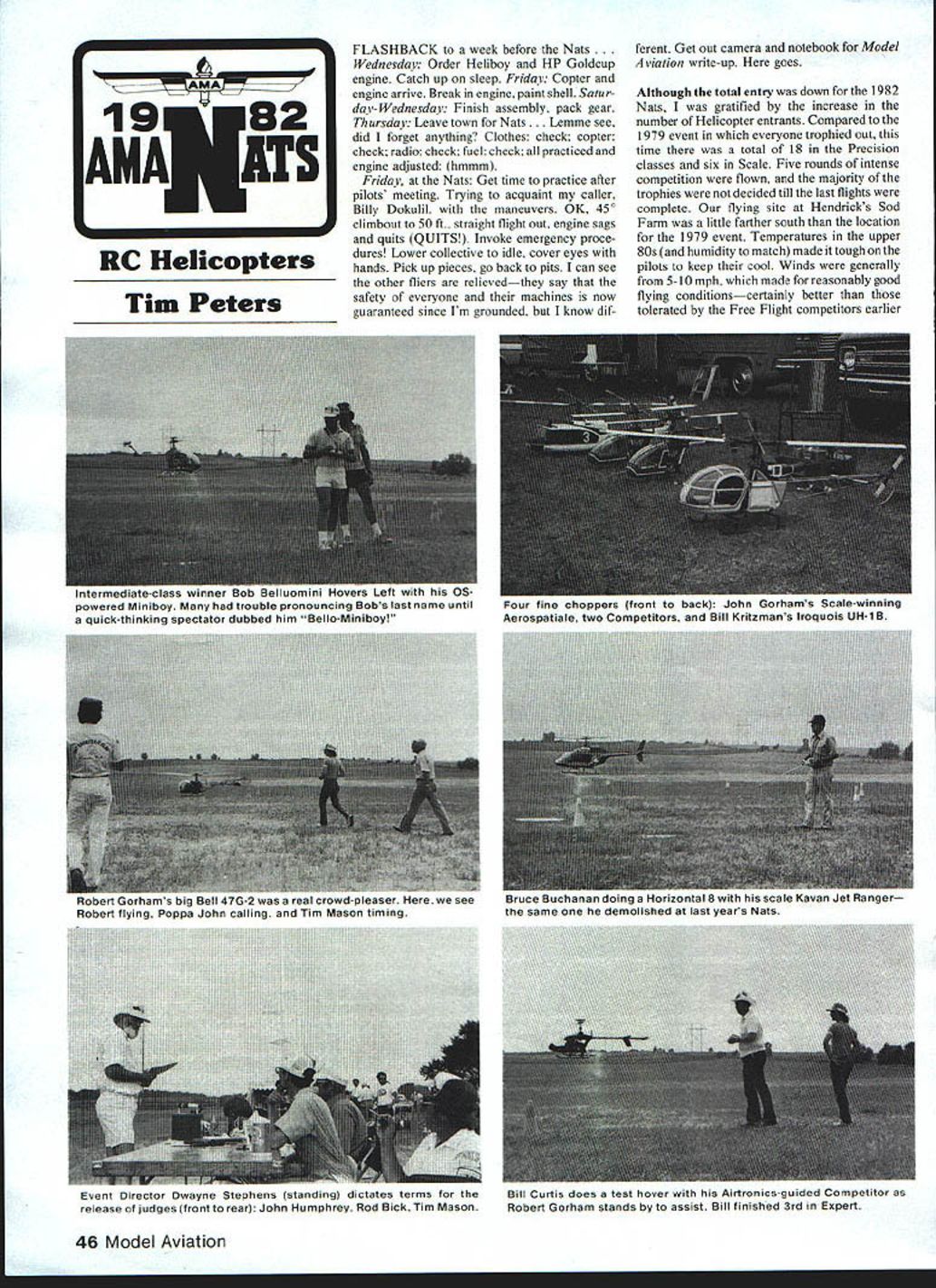
1982 AMA Nats: RC Helicopters
Tim Peters
Flashback
A week before the Nats . . .
- Wednesday: Order Heliboy and HP Goldcup engine. Catch up on sleep.
- Friday: Copter and engine arrive. Break in engine, paint shell.
- Saturday–Wednesday: Finish assembly, pack gear.
- Thursday: Leave town for Nats.
Lemme see, did I forget anything? Clothes: check; copter: check; radio: check; fuel: check; all practiced and engine adjusted: (hmmm).
Friday, at the Nats: I got time to practice after the pilots' meeting and tried to acquaint my caller, Billy Dokulil, with the maneuvers. OK, 45° climbout to 50 ft., straight flight out — engine sags and quits (QUITS!). Invoke emergency procedures: lower collective to idle, cover eyes with hands. Pick up pieces, go back to pits. I could see the other fliers were relieved—they said that the safety of everyone and their machines was now guaranteed since I was grounded. But I knew different. I got out my camera and notebook for the Model Aviation write-up. Here goes.
Event overview
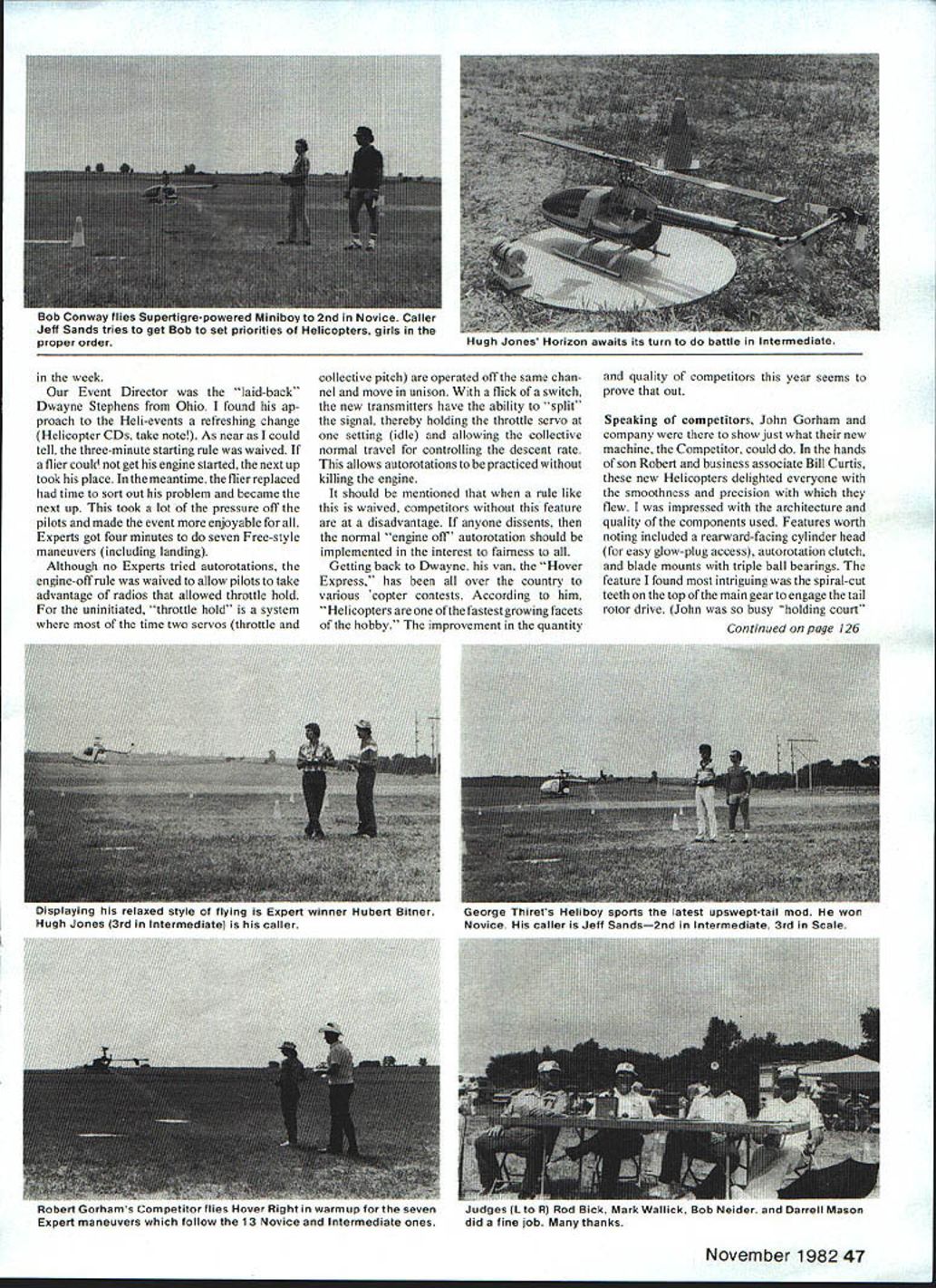
Although total entry was down for the 1982 Nats, I was gratified by the increase in the number of helicopter entrants. Compared to the 1979 event in which everyone trophied out, this time there was a total of 18 in the Precision classes and six in Scale. Five rounds of intense competition were flown, and the majority of the trophies were not decided until the last flights were complete.
Our flying site at Hendricks Sod Farm was a little farther south than the location for the 1979 event. Temperatures in the upper 80s (and humidity to match) made it tough on the pilots to keep their cool. Winds were generally from 5–10 mph, which made for reasonably good flying conditions—certainly better than those tolerated by the Free Flight competitors earlier.
Rules and format
As near as I could tell, the three-minute starting rule was waived. A flier could get his engine started and the next up would take his place. In the meantime, if a flier had to replace an engine or sort out a problem, he became next up. This took a lot of pressure off pilots and made the event enjoyable.
Experts got four minutes and seven freestyle maneuvers, including landing. Although no Experts tried autorotations, the engine-off rule was waived to allow pilots to take advantage of radios that allow throttle-hold. To the uninitiated, throttle-hold is a system in which the throttle and collective pitch servos operate off the same channel and move in unison; flick a switch—new transmitters have the ability to split the signal—thereby holding the throttle servo setting at idle while allowing the collective normal travel. Controlling descent rate allows autorotations to be practiced. It should be mentioned that waiving a rule like this was felt by some competitors to be a disadvantage; anyone dissenting felt normal engine-off autorotation should be implemented in the interest of fairness.
Competitors and highlights
Dwayne Stephens has flown Hover-Express at various copter contests around the country. According to him, helicopters are the fastest-growing facet of the hobby; the improvement in both the quantity and quality of competitors this year seems to prove it.
John Gorham's machines showed what a new machine in the hands of a capable pilot could do. Son Robert and business associate Bill Curtis, with their new helicopters, delighted everyone; the smoothness and precision in flight impressed me, as did the architecture and quality components used. Features worth noting included a rearward-facing cylinder head for easy glow-plug access, an autorotation clutch, blade mounts, and triple ball bearings. An intriguing feature was spiral-cut teeth on the top main gear to engage the tail-rotor drive — they look like they might wear better. John was so busy holding court with interested spectators that I never found out the reason for this feature.
Robert and Bill placed second and third, respectively, in the Expert class with their Comets. Both flew some of the best loops I’ve ever seen. After his last official flight, Bill "hot-dogged" for us all with a flight that included a really smooth roll. Most fliers had to set up for rolls by pitching up first; Bill did his with no set-up at all. Robert was last year's Intermediate champ and will have to be reckoned with in the Expert class as a leading contender.
Top finisher in Expert was Hubert Bitner of Houston, TX. You may remember him as Expert champ in 1978, the first year that Helicopter was an official Nats event. Many of you also know that Hubert designed and markets the airblade wonder known as the Horizon. The "Texas contingent" included Hubert, Hugh Jones, and Dave Edwards; all used Horizons, and all placed in the precision events.
One of the best-looking non-scale helicopters present was a Horizon belonging to Ron Davis of Houston. According to Hubert, the Horizon has been selling well even though national advertising started only recently. The newest improvement involves double ball bearings on the tail-rotor blade mounts. I checked out the modification, and it really makes for a solid attachment. He mentioned that all kits are assembled on demand from parts, so every kit includes the latest mods.
Horizons impressed me with their very stable hover. Without a doubt, Hubert made the softest helipad landings at the Nats. During breaks he demonstrated the Horizon's aerobatic capabilities, including some fantastic inverted flying. Congratulations, Hubert; you deserve the championship. His Horizon, with its "ducted fan" style cooling air intakes, was powered by an Enya .60 and used a JR Unlimited radio.
Other Expert competitors included Florida's Bill Youmans, one of the first Heliboy owners in the U.S., and Minnesota's Bob Onori. Bruce Buchanan, a perennial Nats contestant, competed this year with a Miniboy.
Intermediate
- 1st: Bob Bellomini — Miniboy (swept-up tail mod), OS .40 ABC engine, JR radio.
- 2nd: Hugh Jones (Austin, TX) — Horizon, Futaba 5JH radio.
- 3rd: Jeff Sands (Denver) — Schluter SX 81.
Other Intermediate competitors: Dave Davis, Bill Kritzman, and Frank Dykes.
Novice
- 1st: George Theret (Colorado) — swept-tail Heliboy, piped ST X-60, JR radio. (Only five and a half months of helicopter flying.)
- 2nd: Bob Conway (Junior, Florida, 15 years old) — Miniboy, Supertigre .40, JR Apollo radio. (Flying copters eight months.)
- 3rd: Dave Edwards (Houston, TX) — Horizon.
Other Novice competitors: Bob Steinberg, Don Morrow, Sam Newhouse, and Ken Kershaw.
Scale
- 1st: John Gorham — Hirobo Aerospatiale SA-315.
- 2nd: Robert Gorham — Hirobo Bell-47G-2.
- 3rd: Jeff Sands — Schluter Aerospatiale Twin Star.
Tied for high static score with the Bell 47G was Bruce Buchanan's Channel 4 "Live Eye In The Sky" Jet Ranger, recently rebuilt after a devastating crash at last year's Texas Nats. Heli-Center West took the top two places in Scale. The Scale flying was a real crowd pleaser. Event Director Dwayne Stephens wisely alternated Scale flying into the Precision events to keep spectators' interest high. Other Scale machines included Bill Curtis' Hughes 200 (.25-power) and Bill Kritzman's UH-1B.
Judges and thanks
No contest can be run without those hard-working, often unappreciated judges. This year's group included:
- Francis Kelson
- Tim Mason
- John Humphrey
- Bob Neider
- Darnell Mason
- Mark Wallick
- Rod Bick
You can be certain your efforts were appreciated. Thanks!
Equipment and trends
- JR Unlimited radios were prominent — used by nearly half the competitors.
- Tuned pipes seem to be out; Magic Mufflers and Heliball mufflers are in.
- Fiberglass rotor blades "full length" are out; apparently resin does not sink in and makes the blade too rigid. Hot-stuffing the root and using Schluter Metal Blade Covering is in.
- Watch for a new Super HeliBoy late this winter or early spring; a new head with no "wear points" is in the works. New heavy-duty autorotation clutches are being implemented for the Miniboy.
- OS FSR engines (.25 to .60) are in — used by a majority of competitors.
Conclusion
RC helicopter flying is clearly in. So are the Nats!
Transcribed from original scans by AI. Minor OCR errors may remain.

