
RC Pattern
Chuck Shade
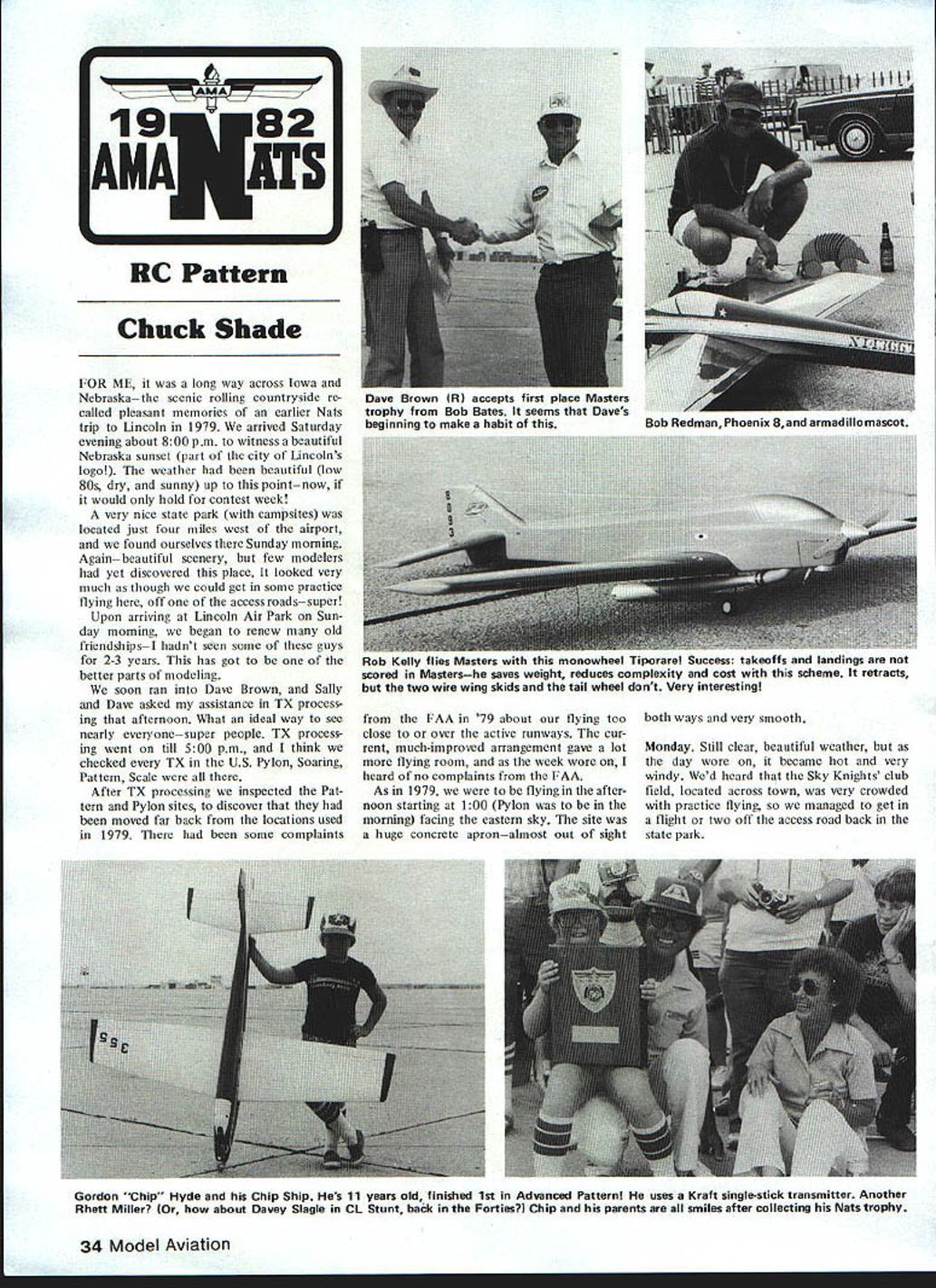
For me, it was a long way across Iowa and Nebraska—the scenic rolling countryside recalled pleasant memories of an earlier Nats trip to Lincoln in 1979. We arrived Saturday evening about 8:00 p.m. to witness a beautiful Nebraska sunset (part of the city of Lincoln's logo!). The weather had been beautiful (low 80s, dry, and sunny) up to this point—now, if it would only hold for contest week!
A very nice state park (with campsites) was located just four miles west of the airport, and we found ourselves there Sunday morning. Again—beautiful scenery, but few modelers had yet discovered this place; it looked very much as though we could get in some practice flying here, off one of the access roads—super!
Upon arriving at Lincoln Air Park on Sunday morning, we began to renew many old friendships—I hadn't seen some of these guys for two to three years. This has got to be one of the better parts of modeling.
We soon ran into Dave Brown, and Sally and Dave asked my assistance in transmitter (TX) processing that afternoon. What an ideal way to see nearly everyone—super people. TX processing went on until 5:00 p.m., and I think we checked nearly every TX in the U.S. Pylon, Soaring, Pattern, and Scale were all there.
After TX processing we inspected the Pattern and Pylon sites, to discover that they had been moved far back from the locations used in 1979. There had been some complaints from the FAA in '79 about our flying too close to or over the active runways. The current, much-improved arrangement gave a lot more flying room, and as the week wore on I heard of no complaints from the FAA.
As in 1979, we were to be flying in the afternoons starting at 1:00 p.m. (Pylon was to be in the morning), facing the eastern sky. The site was a huge concrete apron—almost out of sight.
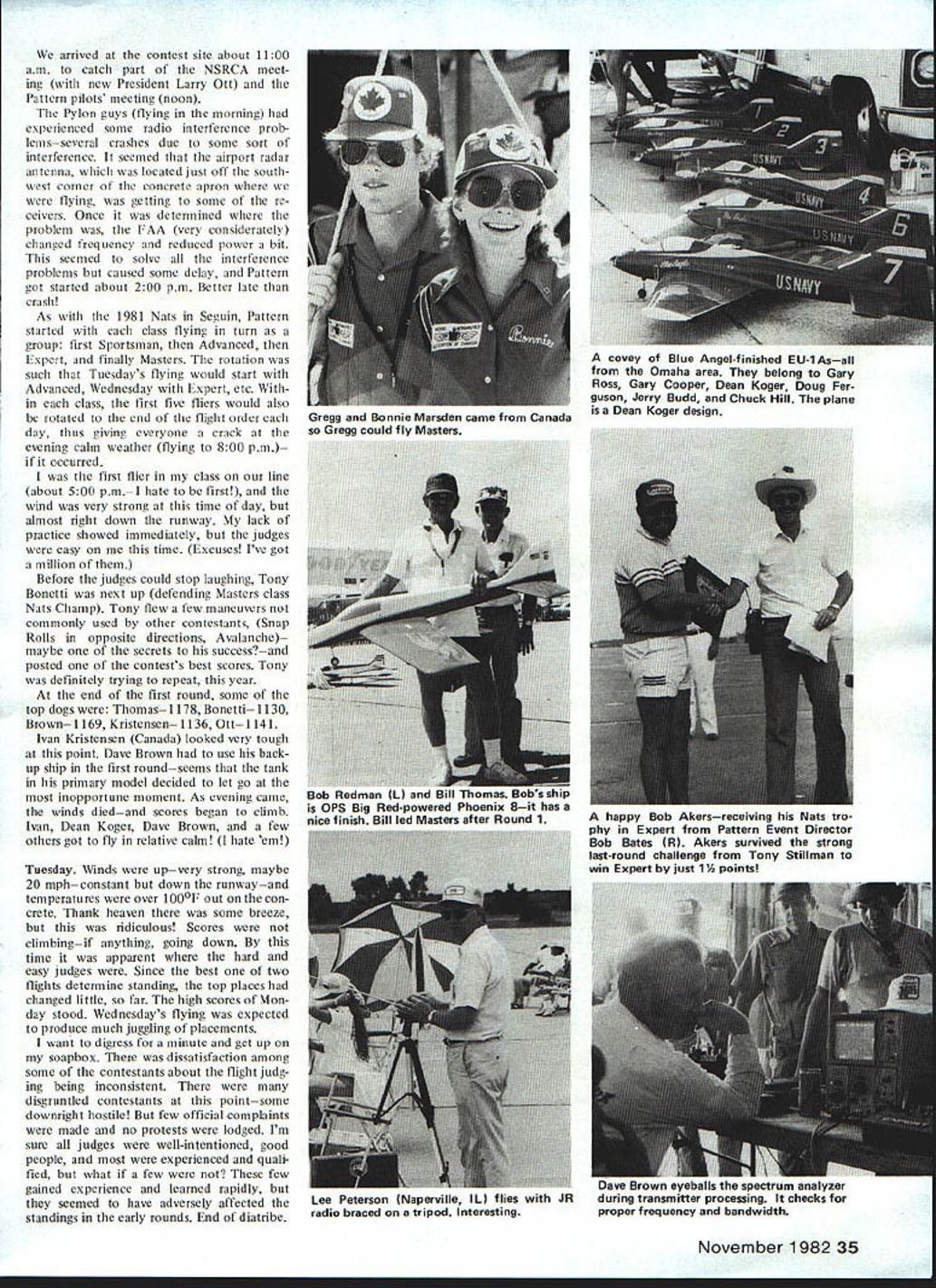
Early in the day we experienced interference problems. Once the problem was determined, the FAA very considerately changed frequency, reduced power a bit, and that seemed to solve the interference. This caused some delay. Pattern got started about 2:00 p.m. Better late than never.
As in the 1981 Nats at Seguin, Pattern started class flying in turn groups—first Sportsman, then Advanced, then Expert, and finally Masters. The rotation was such that Tuesday's flying would start with Advanced, Wednesday with Expert, etc. The first five fliers were also rotated to the end of the flight order that day, thus giving everyone a crack. In the evening, calm weather about 8:00 p.m. occurred for the first flier of each class.
By about 5:00 p.m. the wind became very strong, almost right down the runway. The lack of practice showed immediately. Judges had an easy time—excuses: "I've got a million." Before judges could stop laughing, Tony Bonetti, next up and defending Masters class Nats champ, flew a few maneuvers commonly used by other contestants—snap rolls in opposite directions, avalanche—maybe the secrets to his success—and posted the contest's best scores. Tony was definitely trying to repeat last year's win.
As evening came, the winds died and scores began to climb. Ivan, Dean Koger, Dave Brown and a few others got to fly in relatively calm weather.
Tuesday, winds came up very strong, maybe 20 mph, constant down the runway, and temperatures over 100°F on the concrete. Thank heaven for some breeze—ridiculous. Scores tended to fall. Since the best two flights determine the standings, the top places changed little from the high scores posted Monday and stood for Wednesday's flying.
I want to digress for a minute and get up on my soapbox. There was dissatisfaction among some contestants about the flight judging being inconsistent. There were many disgruntled contestants at this point—some downright hostile! A few official complaints were made, though no protests were lodged. I'm sure all judges were well-intentioned, good people, and most were experienced and qualified, but what if a few were not? These few gained experience and learned rapidly, but they seemed to have adversely affected the standings in the early rounds. End of diatribe.
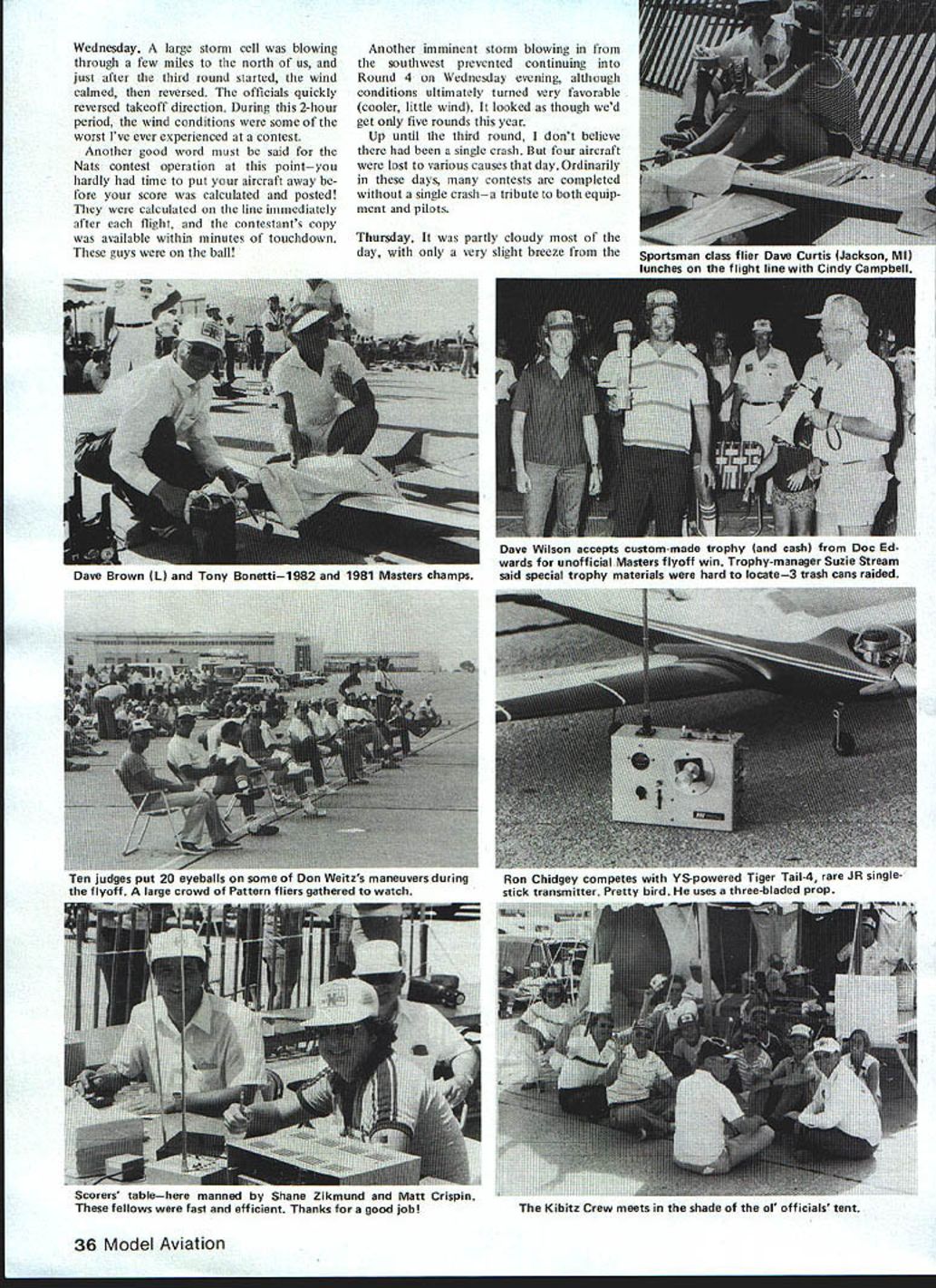
Wednesday a large storm cell was blowing through a few miles to the north of us, and just after the third round started, the wind calmed, then reversed. The officials quickly reversed takeoff direction. During this two-hour period the wind conditions were some of the worst I've ever experienced at a contest.
Another good word must be said for the Nats contest operation at this point—you hardly had time to put your aircraft away before your score was calculated and posted! Scores were computed on the line immediately after each flight, and the contestant's copy was available within minutes of touchdown. These guys were on the ball!
Another imminent storm blowing in from the southwest prevented continuing into Round 4 on Wednesday evening, although conditions ultimately turned very favorable (cooler, little wind). It looked as though we'd get only five rounds this year.
Up until the third round, I don't believe there had been a single crash. But four aircraft were lost to various causes that day. Ordinarily in these days many contests are completed without a single crash—a tribute to both equipment and pilots.
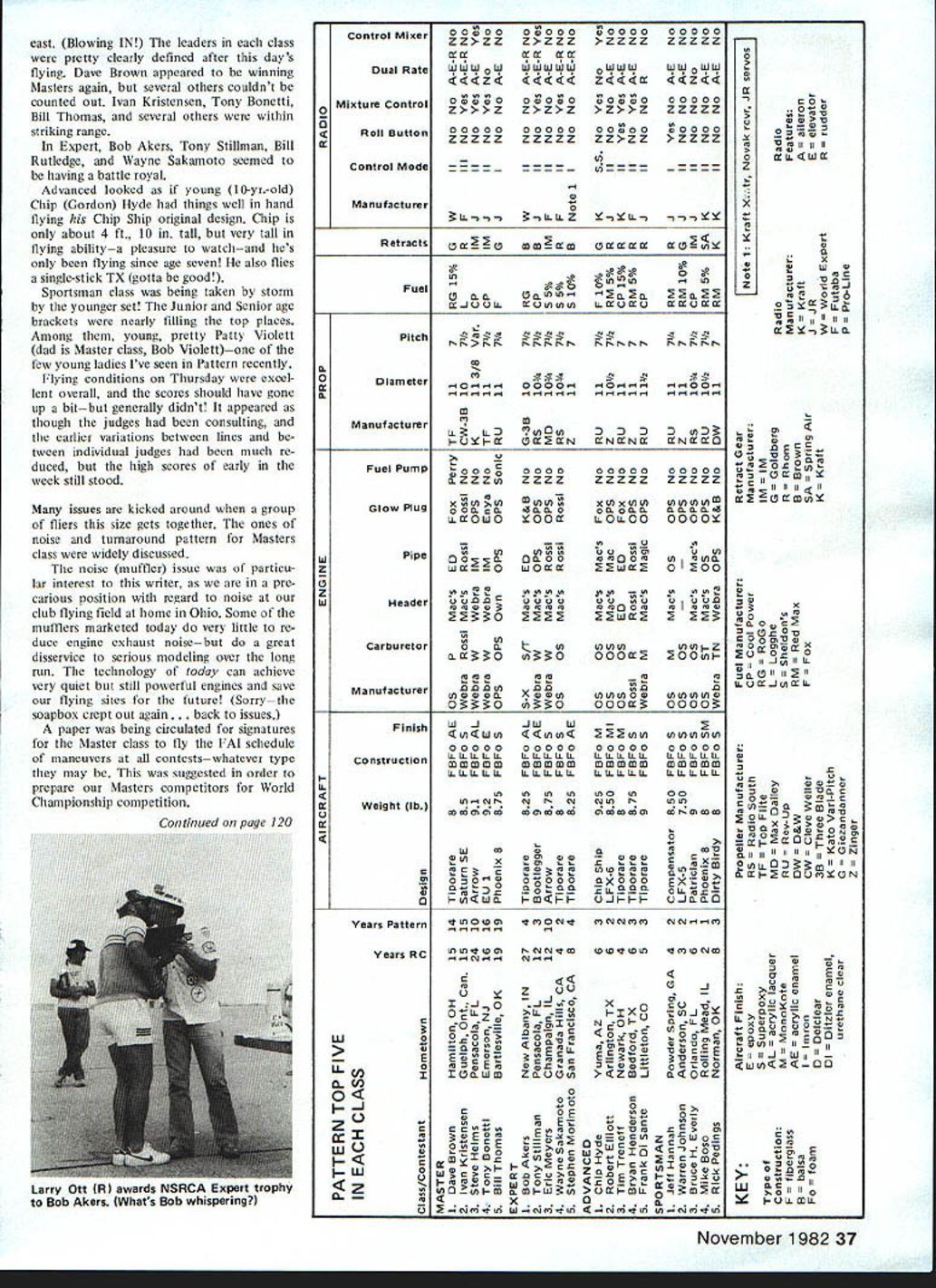
Thursday was partly cloudy most of the day, with only a very slight breeze from the southwest (blowing in). The leaders in each class were pretty clearly defined after this day's flying. Dave Brown appeared to be winning Masters again, but several others couldn't be counted out. Ivan Kristensen, Tony Bonetti, Bill Thomas, and several others were within striking range.
In Expert, Bob Akers, Tony Stillman, Bill Rutledge, and Wayne Sakamoto seemed to be having a battle royal.
Advanced looked as if young Chip (Gordon) Hyde, age ten, had things well in hand flying his Chip Ship original design. Chip is only about 4 ft., 10 in. tall, but very tall in flying ability—a pleasure to watch—and he's only been flying since age seven! He also flies a single-stick transmitter (gotta be good!).
Sportsman class was being taken by storm by the younger set. The Junior and Senior age brackets were nearly filling the top places. Among them we saw pretty Patty Violett (dad is Master class Bob Violett)—one of the few young ladies I've seen in Pattern recently.
Flying conditions on Thursday were excellent overall, and the scores should have gone up a bit—but generally didn't. It appeared as though the judges had been consulting, and the earlier variations between lines and between individual judges had been much reduced, but the high scores from early in the week still stood.
Many issues are kicked around when a group of fliers this size gets together. The ones of noise and turnaround pattern for Masters class were widely discussed.
The noise (muffler) issue was of particular interest to this writer, as we are in a precarious position with regard to noise at our club flying field at home in Ohio. Some of the mufflers marketed today do very little to reduce engine exhaust noise—but do a great disservice to serious modeling over the long run. The technology of today can achieve very quiet but still powerful engines and save our flying sites for the future. Sorry—the soapbox crept out again... back to issues.
A paper was being circulated for signatures for the Masters class to fly the FAI schedule of maneuvers at all contests—whatever type they may be. This was suggested in order to prepare our Masters competitors for World Championship competition.
Nats RC Pattern/Shade — Continued
Some talked about the new frequencies soon to be available and things that this will permit at a contest to reduce interference, speed up flying, and provide more even exposure to judge sets.
So many things occur at a Nats this size, it's hard to catch everything! Other events were spread out a bit. I would have liked to have seen Free Flight, but the field for this was about 40 miles away, and the Soaring site was not too close, either. Indoor was closer, though, in downtown Lincoln.
Friday brought few surprises in the standings, and the fifth round was finished about 4:00 p.m. Trophies were awarded at Site 1 about 6:00 p.m. After the round was finished, the mood was jovial, and a very strange thing happened: Tony Bonetti, preparing to leave, began to back his station wagon out when he heard a loud crunch from the right rear wheel. Tony said, "Oh—! I knew when I heard that sound that it wasn't a beer can!" It actually was the sound of Steve Helms' right-side stabilizer crunching under the rear wheel! It seems that Steve had set his aircraft on the concrete next to Tony's car while putting away some other equipment, and the breeze swung his ship around so that the tail was under the rear of Tony's car. A lot of jokes about that! Steve could only laugh at it though. A heck of a guy! (That'll teach you to beat Tony, Steve.)
After the trophy presentation by Pattern Event Director Bob Bates (see standings in the "Competition Newsletter" section), there occurred an unprecedented happening. I can't say who came up with the idea, but "Doc" Edwards administered a flyoff between the top 10 finishers in Masters class. This flyoff cost each flier $25.00—with winner take all. It would be a single flight for each of them, with the 12th through 21st-place finishers doing the judging chores. The high and low scores were to be thrown out, and the schedule of maneuvers was to be made up by "Doc."
The maneuvers were:
- Square Loop with 1/2 Rolls
- Reverse Point Roll
- Figure M with 1/2 Rolls
- Reverse Knife-Edge
- Square Horizontal 8
- Two Rolls in Opposite Direction
- Three-Turn Spin
- Three Reverse Inside Loops
- Rolling Circle
- Slow Roll
- Figure M with 4 Rolls
- Triangle Rolling Loop
It was a very interesting pattern and a very interesting contrast in judging from the contest proper. It was held at Site 2, using Nats equipment, and started about 7:00 p.m. The flying order was drawn from a hat, and flying began. Tony Bonetti (placed 4th in the Nats) had left earlier and was replaced by Don Weitz (11th) for the flyoff.
Most fliers had not practiced the Rolling Circle, and some had never done it. This promised to be a lot of fun and drew a large crowd of supporters. The flying was generally excellent, and no one knew for sure who would win. The flying started with Dave Brown, and he put up an excellent flight to set the pace. Next came Don Weitz, followed by Doug Ferguson, Steve Helms, and Bill Thomas. Then Dean Koger put up what appeared to be the winning flight, but Ivan Kristensen was next with an equally beautiful flight and a near-perfect Rolling Circle. The only flaw in Ivan's flight was an unusual flop in one of the Figure M's, which probably cost him $250.00.
Then came Larry Ott, Ron Gilman, and last was Dave Wilson. I think no one was prepared for Dave's very fine flying—and he took all the marbles (or were they dollars?). The Rolling Circle was, of course, the killer maneuver, and most did it fairly well, but Ivan Kristensen's and Dave Wilson's were best, with Dave's excellent flying of the rest of the pattern edging out Ivan.
Flyoff results:
- Dave Wilson
- Ivan Kristensen
- Dean Koger
- Dave Brown
- Steve Helms
- Don Weitz
- Doug Ferguson
- Ron Gilman
- Larry Ott
- Bill Thomas
Summary
The Nats Pattern contest this year was well-organized and well-run, thanks to Betty Stream, Bob Bates, the Lincoln Sky Knights (host club), and many others. It was a superb site with the relocated flight lines. The weather was mixed—some good, some not so good. Judging could be improved—but it's always difficult and expensive to come up with enough people to sit in the hot sun for five days. A superb state park campsite was close by. I'm told the dormitories were also good. Entry fees were still a bit high, I feel. A very fine host club (Lincoln Sky Knights)—conscientious, hard working. These fine people (officials and host club) make contesting worthwhile and enjoyable.
Transcribed from original scans by AI. Minor OCR errors may remain.

