
1982 AMA Nats: RC Pylon Racing
Art Arro
Overview
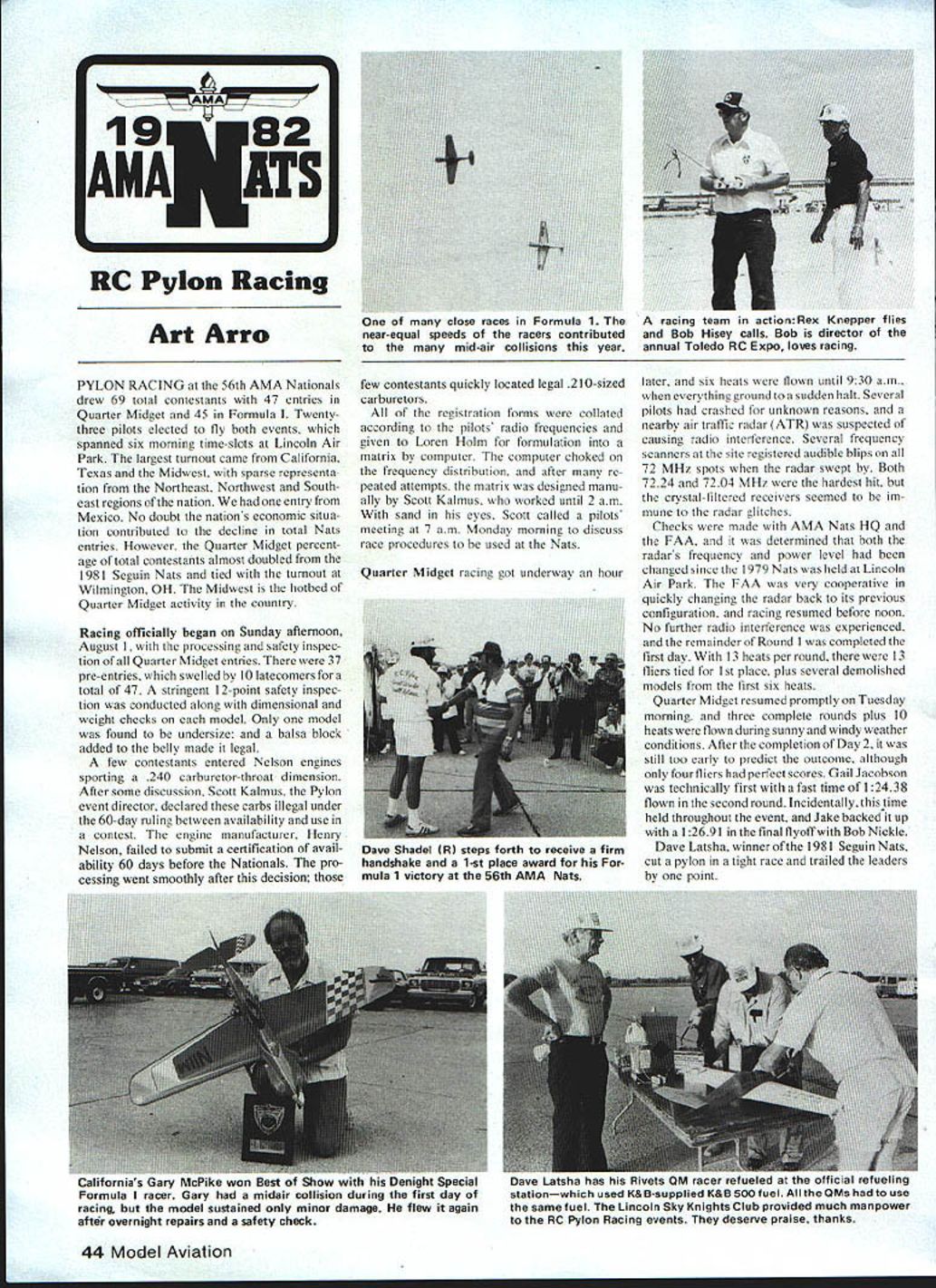
Pylon racing at the 56th AMA Nationals drew 69 total contestants with 47 entries in Quarter Midget and 45 in Formula I. Twenty-three pilots elected to fly both events, which spanned six morning time-slots at Lincoln Air Park. The largest turnouts came from California, Texas and the Midwest, with sparse representation from the Northeast, Northwest and Southeast regions. There was one entry from Mexico. The nation's economic situation likely contributed to the decline in total Nats entries, but the Quarter Midget percentage of total contestants almost doubled from the 1981 Seguin Nats and matched the turnout at Wilmington, OH. The Midwest remains the hotbed of Quarter Midget activity.
Quarter Midget
Racing officially began Sunday afternoon, August 1, with processing and safety inspection of all Quarter Midget entries. There were 37 pre-entries plus 10 latecomers for a total of 47. A stringent 12-point safety inspection was conducted along with dimensional and weight checks on each model. Only one model was found to be undersize; a balsa block added to the belly made it legal.
A few contestants had Nelson engines fitted with a .240 carburetor throat. After discussion, Scott Kalmus, the pylon event director, declared these carbs illegal under the 60-day availability ruling: the engine manufacturer, Henry Nelson, had failed to submit certification of availability 60 days before the Nationals. The affected contestants quickly located legal .210 carburetors and processing continued.
Registration forms were collated by pilots' radio frequencies and given to Loren Holm for matrix formulation by computer. The computer choked on the frequency distribution; after repeated attempts, Scott Kalmus manually designed the matrix and worked until 2 a.m. He then called a pilots' meeting at 7 a.m. Monday to discuss race procedures.
Quarter Midget racing began an hour later. Six heats were flown until 9:30 a.m., when several pilots experienced unexplained crashes. A nearby air traffic radar (ATR) was suspected of causing radio interference. Frequency scanners at the site registered audible blips on all 72 MHz channels when the radar swept by; 72.24 and 72.04 MHz were hardest hit. Crystal-filtered receivers seemed immune. Checks with AMA Nats HQ and the FAA determined the radar's frequency and power had changed since the 1979 Nats. The FAA cooperatively changed the radar back to its previous configuration and racing resumed before noon. No further radio interference was experienced, and the remainder of Round 1 was completed that day. With 13 heats per round, 13 fliers were tied for 1st place after the first day, plus several damaged models from the early heats.
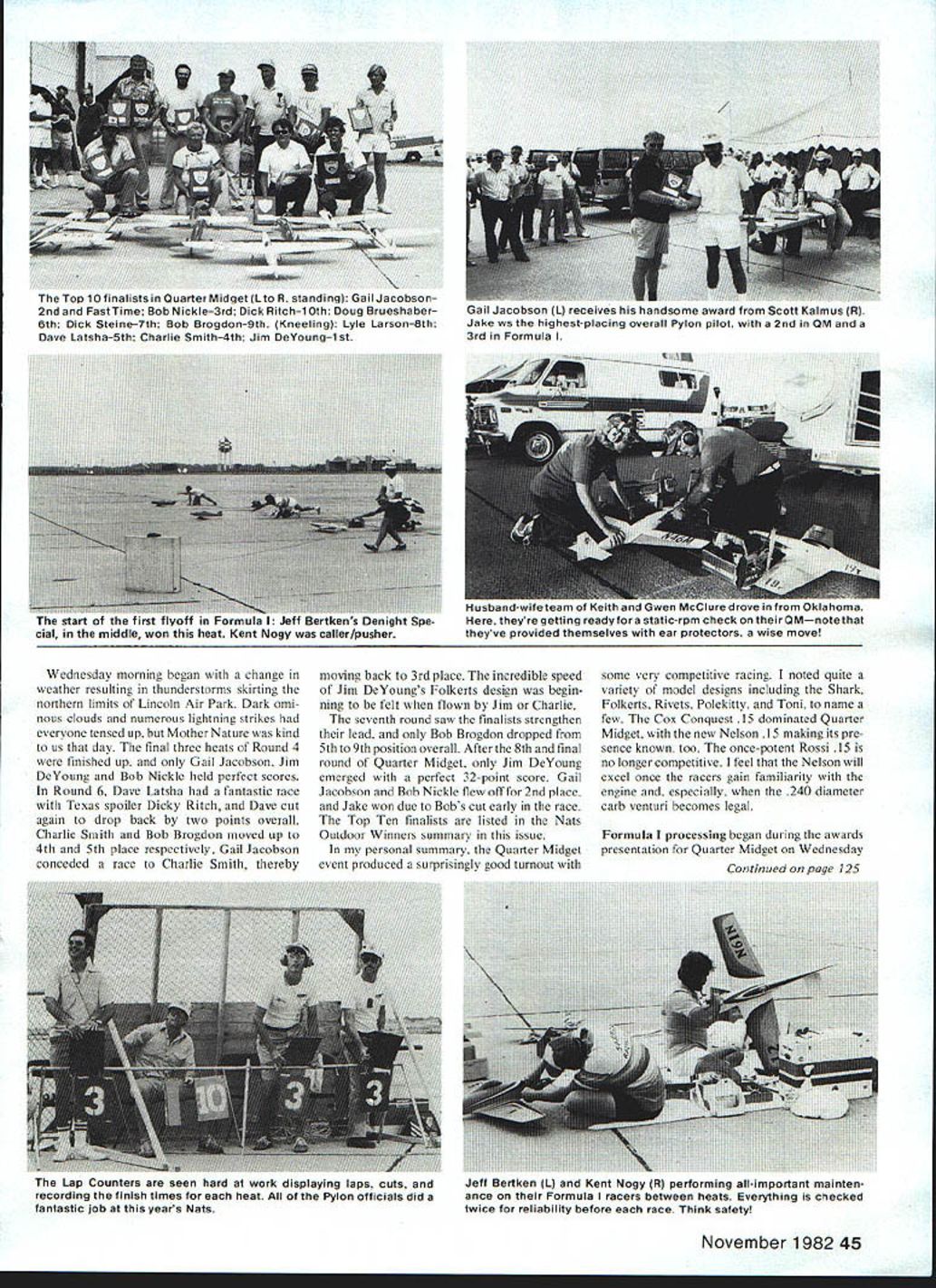
Quarter Midget resumed Tuesday morning. Three complete rounds plus 10 heats were flown in sunny, windy conditions. After Day 2 only four fliers had perfect scores. Gail Jacobson (often called "Jake") posted a fast time of 1:24.38 in Round 2, which stood throughout the event; Jake backed it up with a 1:26.91 in the final flyoff with Bob Nickle. Dave Latsha, winner of the 1981 Seguin Nats, cut a pylon in a tight race and trailed the leaders by one point.
Wednesday brought thunderstorms skirting the northern limits of Lincoln Air Park. Despite dark clouds and lightning, the final three heats of Round 4 finished. Gail Jacobson, Jim DeYoung and Bob Nickle held perfect scores at that point. In Round 6 Jim DeYoung had a fantastic race; Texas spoiler Dicky Ritch cut and dropped two points overall. Charlie Smith and Bob Brogdon moved up to 4th and 5th respectively. Gail Jacobson conceded a race to Charlie Smith and moved to 3rd. The speed of Jim DeYoung's Folkerts design was becoming apparent.
The seventh round saw the finalists strengthen their leads; only Bob Brogdon dropped from 5th to 9th overall. After the 8th and final round of Quarter Midget, only Jim DeYoung emerged with a perfect 32-point score. Gail Jacobson and Bob Nickle flew off for 2nd place; Gail won due to Bob's cut early in the race.
Quarter Midget summary: turnout was strong and competition was tight. A variety of model designs were noted — Shark, Folkerts, Rivets, Poketty, and Toni among them. The Cox Conquest .15 dominated Quarter Midget, with the new Nelson .15 making its presence known; the once-potent Rossi .15 is no longer competitive.
Formula I
Formula I processing began during the Quarter Midget awards on Wednesday afternoon. Dimensional and safety checks were performed on all Formula I models. Handicap judging was done and models were segregated into groups; the top groups were rejudged and a Best of Show model was selected. (In Formula I the order of takeoff is determined by handicap position; Best of Show takes off first.) The AMA rule book specifies scale fidelity, workmanship and appearance for judging, but scale fidelity has been de-emphasized and handicapping has become a beauty contest. Formula I models tend to be the best-finished in all of RC. At Lincoln, Gary McPike won Best of Show with his Denight Special.
The Formula I pilots' meeting was held Thursday morning during a rain squall. Intermittent rain and humidity held times in the mid-to-high 1:10s. Rusty Van Baren set a fast time of 1:15.51 that stood until Round 6. Dave Shadel had a "no-start" in Round 3 with his radio turned off. Midair collisions began early — Gary McPike and Bob Brogdon tangled; Bob's Polecat was totaled while Gary landed with minor damage. Three rounds and 10 heats were flown on the first day of Formula I.
Day 2 began in misty low overcast with an increasing tailwind. Scott Kalmus reversed the course and racing resumed. Round 4 was completed but Rusty Van Baren suffered a spectacular crash due to radio problems. John McDermott and Gary Hover were the only pilots with perfect scores at that point, trailed by five others with one point down.
Round 5 saw a collision between Gary Hover and Ron Schorr while turning the scatter pylon; Duane Pisciotta moved into the No. 1 position. Gary dropped to 6th and Ron to 7th. Bob Onori and Doug Brueshaber trailed Duane by one point each. In Round 6 Doug took a third and dropped to 10th overall. Dave Shadel advanced to 4th and Eric Ristrum bettered the fast time with a 1:15.24.
The final day was overcast and warm. Dave Shadel moved into first place after Round 7, sharing the top spot with John McDermott, Phil Bussell, Bob Onori and Duane Pisciotta. In Round 8 Duane mid-aired with Gail Jacobson and zeroed out; Jake suffered superficial damage to his Polecat but won the heat and locked into 4th overall. Virtually every heat produced upsets and the Top Ten remained wide open.
Round 9 was similar: Duane Pisciotta benefited when three planes in his heat failed to start and he took a free win. Doug Brueshaber was one of the non-starters and dropped to 6th. John McDermott's zero in Round 9 moved him from a tie for 1st down to 11th. After Round 9, three flyoffs were required to settle positions 1 through 8, with 3rd already secured by Gail Jacobson.
Flyoff results:
- Flyoff for 6th–8th: Jeff Bentken won with 1:16.17; Dave Laynor was second; Bill Preis was third (saved a lean-running engine).
- Flyoff for 4th–5th: Norm Johnson beat Phil Bussell with a blistering 1:15.13 — the fastest Pylon time of the Nationals (not recognized as an official event-best since it was set during heat racing).
- Flyoff for 1st–2nd: Dave Shadel beat Bob Onori with a 1:16.85. Both bettered their best times during the flyoff.
Formula I summary: Dave Shadel took the gold, Bob Onori second, and Gail Jacobson third. Norm Johnson was 4th and Phil Bussell 5th. Jeff Bentken, Dave Laynor and Bill Preis filled 6th–8th. The event saw many mid-air collisions and equipment failures; the famed Samurai Racing Team placed members in 1st, 6th and 9th despite many losses.
Engines, Models and Equipment
- Quarter Midget: Cox Conquest .15 dominated; Nelson .15 gaining ground; Rossi .15 declining.
- Formula I: Toni, Polecat and Denight Special were the most common designs. The Supertigre X-40 was the most popular engine; the K&B 6.5 also performed well when prepared by experienced tuners. Many Formula I engines were modified, and there was active discussion about top engine customizers.
- Fuel and refueling: The refueling station used K&B-supplied K&B 500 fuel; all OMs were required to use the same fuel.
- Support: The Lincoln Sky Knights Club provided manpower, repairs and safety checks.
Incidents and Issues
- Carburetor legality: Nelson .240 carbs were disallowed under the 60-day availability rule; contestants switched to .210 carbs.
- Radio interference: Air traffic radar caused interference on 72 MHz during early Quarter Midget heats; the FAA adjusted the radar and racing resumed.
- Mid-air collisions: Numerous mid-airs in Formula I contributed to many destroyed models and shuffled standings.
- Weather: Thunderstorms, rain squalls, misty overcast and shifting winds affected times and forced course reversals.
- Equipment failures and pilot errors (e.g., radios left off) influenced results.
Results (not exhaustive)
Quarter Midget
- Jim DeYoung (winner — perfect 32 points)
- Gail Jacobson
- Bob Nickle
Formula I
- Dave Shadel
- Bob Onori
- Gail Jacobson
- Norm Johnson
- Phil Bussell
- Jeff Bentken
- Dave Laynor
- Bill Preis
Conclusion
The 1982 Nationals were a success for RC Pylon Racing despite radar interference, numerous mid-airs, and drastic weather changes. Pylon officials, led by Scott Kalmus and his crew, handled heat, rain, high humidity and all the screaming engines superbly. Over 220 heats were flown in both events with few relays required. Pylon race winners combine the best equipment, flying ability and callers — with a little help from Lady Luck — and the 56th AMA Nationals were no exception.
Transcribed from original scans by AI. Minor OCR errors may remain.

