
1982 AMA Nats: RC Scale
Bob and Dolly Wischer
NATS contestant participation in RC Scale steadily diminished from 83 in 1980, to 36 in 1981, and to a low of 29 in this year's competition. Precision Scale suffered the greatest reduction, with only two entries. There were 14 entrants in Sport Scale Expert, 6 in Sport Scale Sportsman, and 7 in Giant Scale. Compensating for the low quantity was the usual increase in quality, in both static scoring and flight, which has been the most noticeable feature of continuous upgrading in recent years.
Sport Scale Expert
Hal Parenti won Sport Scale Expert with his Grumman Bearcat, repeating a near-win from Wilmington, OH two years earlier (where his Bearcat had been within one point of first). The model had the highest static score in its class and was of sufficient quality that it could have been entered in Precision Scale. It is a close copy of John Gury's restoration of the Bearcat used in Warbird exhibitions. Hal improved the model by making a new engine cowl with a more accurate shape to help boost his static score. A quarter-turn fastener permits the cowl top to be removed for easy access to the Super Tigre .60 engine compartment. Finish is K&B Superpoxy, flattened for realism.
Because the prototype is a fast airplane, Hal used reduced throttle settings except between maneuvers and during his landing gear retraction demonstration (done at very low altitude, directly in front of the judges, to show sequence of gear and door operations). There was a definite time lag between the two gear legs. Flight was fast enough to be unaffected by turbulence. Noticeably absent from his schedule was the spectacular low-level split-S that had been his trademark and which caused a damaging accident to his Zero at Seguin in 1981 (when he left his elevator dual-rate control in Low).
The second-place Sport Scale Expert model was a North American YAT-28E by Fred Hulen, which recorded the highest single flight score of the meet (95.7). Ed Izzo had the second-highest flight score with his Focke-Wulf FW 190 D-9 (modified Pica kit, OS .80 engine), though Ed’s third flight suffered cylinder-head damage when a glow plug blew out. Skip Mast’s new four-engine Lockheed HC-130B Hercules (foam and fiberglass construction, 102-in. span) placed third in Sport Scale Expert and won Best Military; it featured operating landing gear, cargo door, Fowler flaps, custom mufflers, and a Fuller-O’Brien epoxy finish with satin hardener.
Sport Scale Sportsman
Jack Fortney won Sport Scale Sportsman with a scratch-built Stearman-Boeing N2S-3 (Navy PT-17). It was Jack's first Nats entry, though the model was seven years old. It is now flown with an OS .40 four-stroke, which proved to have adequate power even in windy conditions to carry the 50-in. span, 5-lb Stearman through all aerobatics. His landing gear with operating oleos was tested on several gusty landings. Built from Nick Ziroli's plans, the Stearman received the highest Sportsman static score; that score might have been higher with more ribs at scale locations in the wings and with some dihedral in the upper wing.
Second place in Sportsman was won by Dale Alvin with a Vought F4U-1D Corsair built from a Top-Flite kit. Dale’s consistent flights (flight scores separated by less than 2 points) illustrated the importance of consistency in placing high.
Giant Scale
Mike Gretz won Giant Scale flying the scratch-built prototype for Sig's new Quarter Scale Cub kit. His 15-lb Cub was powered by a Fox .78 glow-plug engine and was kept partially throttled throughout flights except when full power was needed for aerobatics. Mike’s loops were especially realistic, entering and finishing at the same altitude with little loss of speed at the top. The model used Coverall and Sig dope finishes and a cowl and dummy engine made from Mike's molds (now Sig kit parts). Mike had the highest flight scores in Giant Scale.
Other notable Giant Scale entries:
- Leonard McCoy’s Giant Dornier Do-23G (105-in. span, 26 lb., twin OS .60s) placed second in Giant Scale, just 0.2 points ahead of Dean Copeland’s CAP 21.
- Dean Copeland’s Quadra-powered, 16-lb CAP 21 featured a visible smoke system and airshow-style maneuvers; it finished third in Giant Scale and received the Flight Achievement Award.
- Jack Aycock’s Nieuport 28 (80-in. span, 16 lb.) had the highest static score of the meet (including Sport Scale) but finished fifth due to flight problems.
- Joe Solko’s Laser 200 (Mallory Models kit, Quadra engine) finished fourth, modeled after Leo Loudenslager’s World Champion aerobatic plane and equipped with an effective pulse smoke system.
- Bud Atkinson’s scratch-built Beechcraft T-34B (21 lb., 1.5 cu. in. Moki engine) suffered glitches on its third flight but landed safely to cheers.
- Dale Cordes used Repla-Tech International scale drawings and an Ohio Superstar kit to build a Giant Scale Zlin Z-50L, finished to duplicate the plane flown by Muller and Pena in the 1980 World Championship Aerobatics.
Precision Scale
Bob Wischer won Precision Scale for the fifth time with his time-worn Piel Beryl in a tightly contested competition with Cliff Tacie’s new Spezio Tu-HoIer. The Beryl had the high static score; the Tu-Holer had the high flight score. A better three-view drawing in an otherwise excellent documentation for Cliff’s Spezio could have provided the static points needed to win. His flights were among the best ever seen in Precision Scale. This was a great improvement over the Spezio’s marginal performance at the 5,000-ft altitude of Reno Stead Airport during the recent Scale World Championships, where overheating and oxygen starvation limited the model’s potential. At Lincoln, it flew in the true-prototype manner of a home-built lightplane.
This was the first Nats to use FAI rules for Precision Scale, wherein contests can be won or lost on takeoff and landing scores. A perfect “10” takeoff, with a K-factor of 10, provides 100 points from each of the three judges (300 points). Similarly, a perfect spot landing in the circle can yield 270 points. These scoring weights caused scores to swing drastically, and the outcome was in doubt until the last flights were made under windy Sunday conditions.
Documentation and Judging
Whenever possible, the scale documentation offered to static judges was examined. In Sport Scale, some static scores were low because documentation was poor or completely absent. Models that were well-finished and flew respectably had no chance to place highly if documentation was lacking — even models of well-known civil types that should be easy to document would not place without proper paperwork. The greatest current difference between Sport Scale and Precision Scale lies in the documentation required.
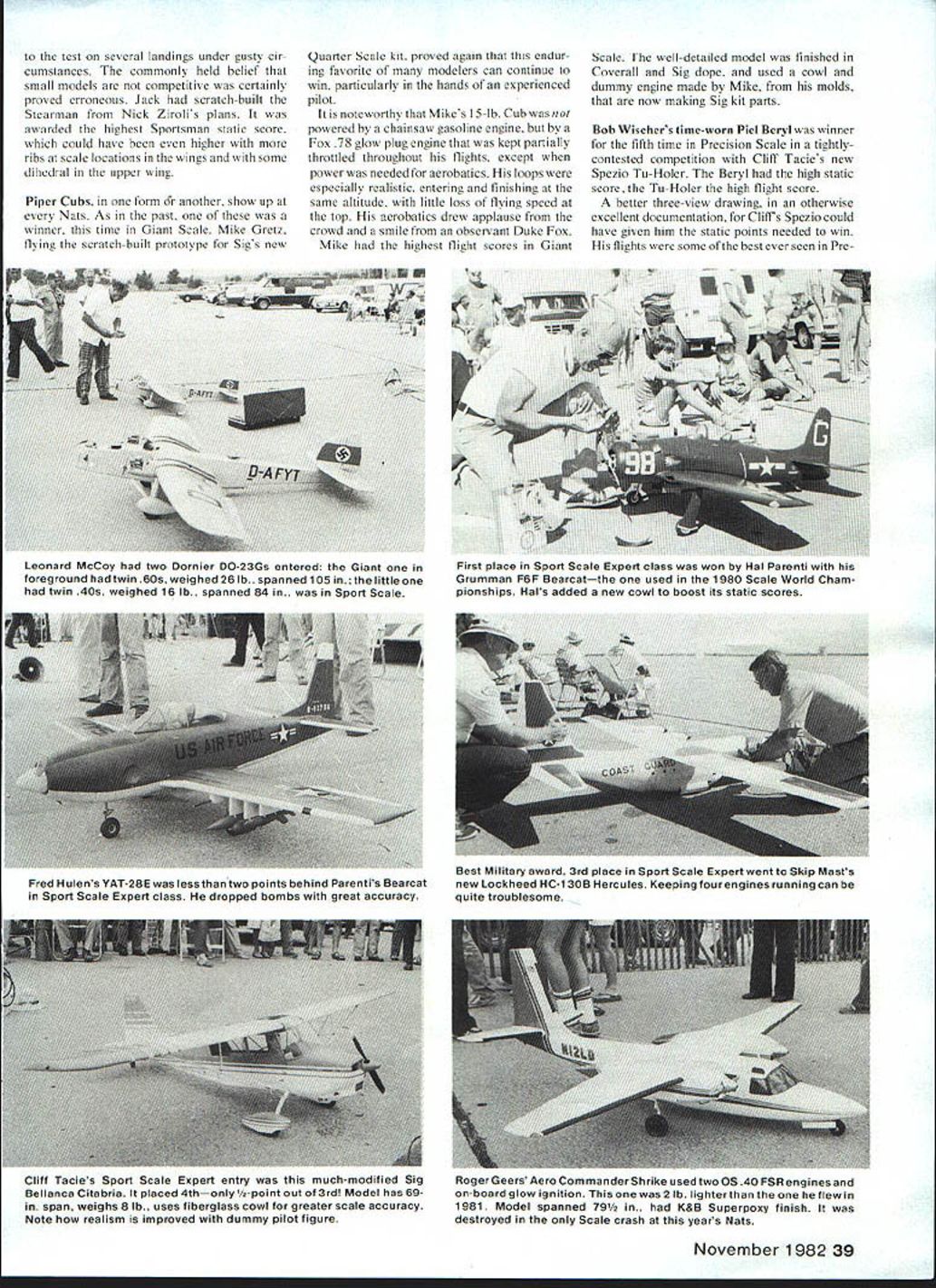
Credit must be given to Scale Event Director Bob Underwood for a well-run meet. Everyone who wanted to fly was given four rounds with four sets of judges to reduce the possibility of inequalities.
Notable Models, Features, and Incidents
- Cliff Tacie also placed fourth in Sport Scale with a heavily modified Sig Citabria. On his last flight he lost nearly all allotted time because of a disconnected throttle linkage; after quick repairs he completed the flight with 30 seconds to spare, demonstrating perseverance.
- Leonard McCoy entered two Scale events with a pair of Dornier Do-23G models (one in Sportsman, one in Giant). The smaller had an 84-in. span, weighed 16 lb., and used twin OS .40 engines. The Giant Dornier was his second or third of the type; he planned a lightweight fourth for a 1983 FAI team attempt.
- Dean Copeland also entered Sport Scale Expert with a Bryon Originals Beechcraft T-34C-1 prototype (Moroccan Air Force colors, OS .60 Gold Head). It was equipped with flaps, retracts, and bombs and finished fifth in that class.
- Roger Geers’ Aero Commander Shrike (new replacement model, 14 lb., twin OS .40 FSRs with on-board glow ignition) was one of four multi-engined models; its predecessor had been demolished after a stall at the top of a loop the prior year — this was the only serious Scale accident at Lincoln.
- Two ducted-fan models competed: an A-4F Skyhawk II (Violett semi-kit) by Art Arro in Expert, and a MiG-15 (Bryon Originals kit) by Jewel Ness in Sportsman. Jewel’s early flights were handicapped by lean engine runs but improved later to place third.
- Several contestants used flight options to drop objects: Hal Parenti’s Bearcat dropped its external fuel tank into the landing circle; Leonard McCoy’s Dornier dropped bombs and parachutes (one parachute hit his own van and dropped through an open window); Fred Hulen’s YAT-28 and Dean Copeland’s T-34C also dropped bombs.
Weather and Field Conditions
Weather at Lincoln was near perfect on Saturday (quite hot, gentle breeze down the runway). Sunday was considerably cooler and windy (again down the runway), with gusts strong enough to move lighter models backward after landing; occasional gusts spoiled many landings.
Organization and Acknowledgments
The Lincoln Sky Knights (host club), the Omahawks, and clubs from Beatrice, Grand Island, and Hastings all contributed to the success of the Nats events — RC Scale included. The site was superb with relocated flight lines; there was a very fine state park campsite nearby and reportedly good dormitory accommodations. Entry fees were still considered a bit high by some. Overall, the meet was well organized and enjoyable thanks to the officials and host-club volunteers.
Transcribed from original scans by AI. Minor OCR errors may remain.

