
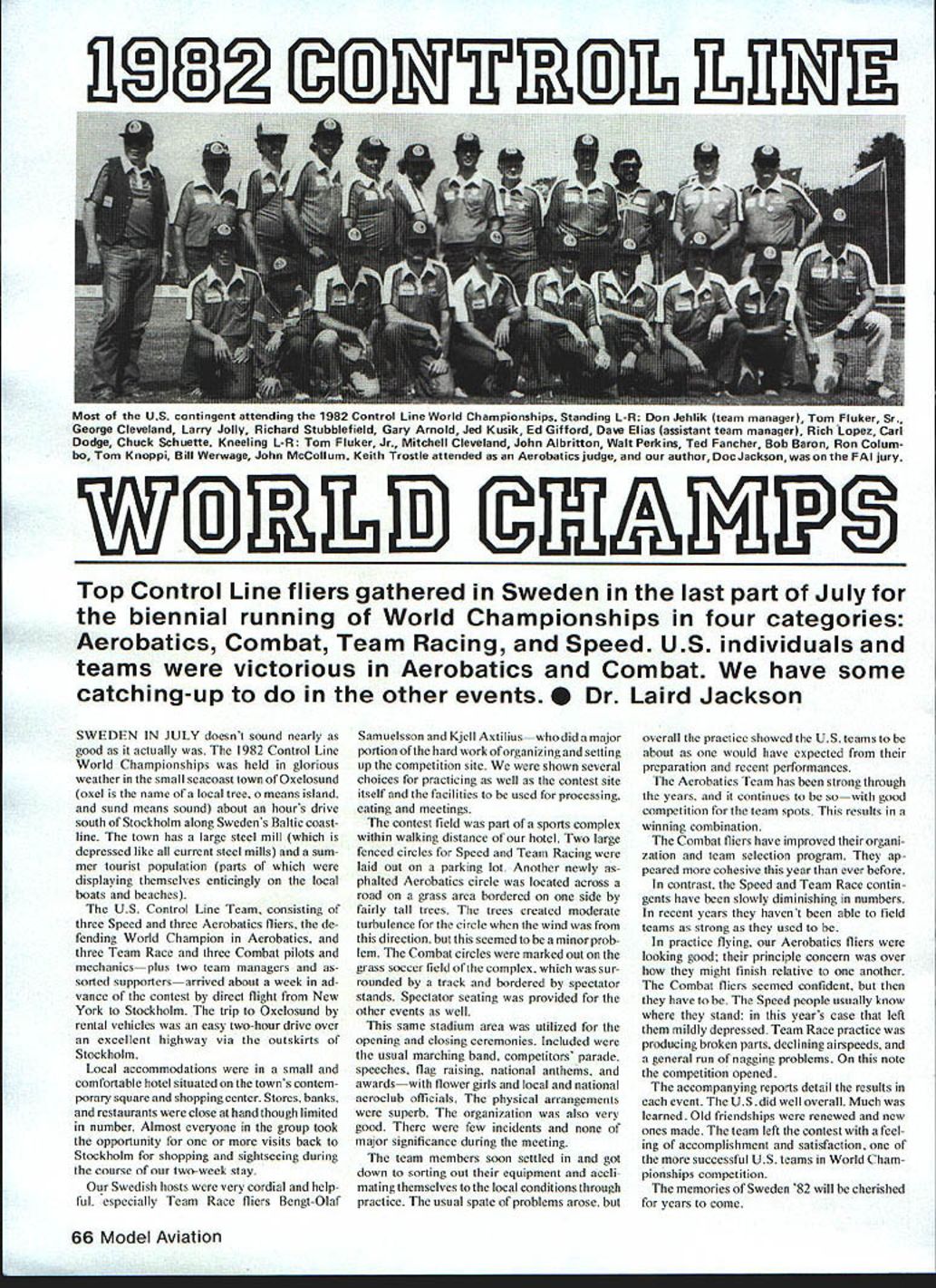
1982 Control Line World Champs
Top Control Line fliers gathered in Sweden in the last part of July for the biennial running of World Championships in four categories: Aerobatics, Combat, Team Racing, and Speed. U.S. individuals and teams were victorious in Aerobatics and Combat. We have some catching-up to do in the other events. — Dr. Laird Jackson
Sweden in July doesn't sound nearly as good as it actually was. The 1982 Control Line World Championships was held in glorious weather in the small seacoast town of Oxelösund (oxel is the name of a local tree, o means island, and sund means sound), about an hour's drive south of Stockholm along Sweden's Baltic coastline. The town has a large steel mill (which is depressed like all current steel mills) and a summer tourist population (parts of which were displaying themselves enticingly on the local boats and beaches).
The U.S. Control Line Team, consisting of three Speed and three Aerobatics fliers, the defending World Champion in Aerobatics, and three Team Race and three Combat pilots and mechanics — plus two team managers and assorted supporters — arrived about a week in advance of the contest by direct flight from New York to Stockholm. The trip to Oxelösund by rental vehicles was an easy two-hour drive over an excellent highway via the outskirts of Stockholm.
Local accommodations were in a small and comfortable hotel situated on the town's contemporary square and shopping center. Stores, banks, and restaurants were close at hand though limited in number. Almost everyone in the group took the opportunity for one or more visits back to Stockholm for shopping and sightseeing during the course of our two-week stay.
Our Swedish hosts were very cordial and helpful, especially Team Race fliers Bengt-Olof Samuelsson and Kjell Axtelius — who did a major portion of the hard work of organizing and setting up the competition site. We were shown several choices for practicing as well as the contest site itself and the facilities to be used for processing, eating, and meetings.
The contest field was part of a sports complex within walking distance of our hotel. Two large fenced circles for Speed and Team Racing were laid out on a parking lot. Another newly asphalted Aerobatics circle was located across a road on a grass area bordered on one side by fairly tall trees. The trees created moderate turbulence for the circle when the wind was from this direction, but this seemed to be a minor problem. The Combat circles were marked out on the grass soccer field of the complex, which was surrounded by a track and bordered by spectator stands. Spectator seating was provided for the other events as well.
This same stadium area was utilized for the opening and closing ceremonies. Included were the usual marching band, competitors' parade, speeches, flag raising, national anthems, and awards — with flower girls and local and national aeroclub officials. The physical arrangements were superb. The organization was also very good. There were few incidents and none of major significance during the meeting.
The team members soon settled in and got down to sorting out their equipment and acclimating themselves to the local conditions through practice. The usual spate of problems arose, but overall the practice showed the U.S. teams to be about as one would have expected from their preparation and recent performances.
The Aerobatics Team has been strong through the years, and it continues to be so — with good competition for the team spots. This results in a winning combination.
The Combat fliers have improved their organization and team selection program. They appeared more cohesive this year than ever before.
In contrast, the Speed and Team Race contingents have been slowly diminishing in numbers. In recent years they haven't been able to field teams as strong as they used to be.
In practice flying, our Aerobatics fliers were looking good; their principal concern was over how they might finish relative to one another. The Combat fliers seemed confident, but then they have to be. The Speed people usually know where they stand; in this year's case that left them mildly depressed. Team Race practice was producing broken parts, declining airspeeds, and a general run of nagging problems.
On this note the competition opened. The accompanying reports detail the results in each event. The U.S. did well overall. Much was learned. Old friendships were renewed and new ones made. The team left the contest with a feeling of accomplishment and satisfaction, one of the more successful U.S. teams in World Championships competition.
The memories of Sweden '82 will be cherished for years to come.
CL Aerobatics World Championships
Aerobatics (F2B), or just plain good old Stunt, has always been a U.S. stronghold. At each WC since at least 1966 we have won the Team World Championship, and the individual title fell to Bill Werwage in 1970 as the first in an unbroken string of U.S. Individual World Champions.
It hasn't always been easy. If things seem to be going too well, one of our team members fiddles with the needle-valve too long so as to run out of fuel in the clover-leaf, or forgets how to count to three while doing inside loops—or something equally brilliant. Spices up the proceedings, you know.
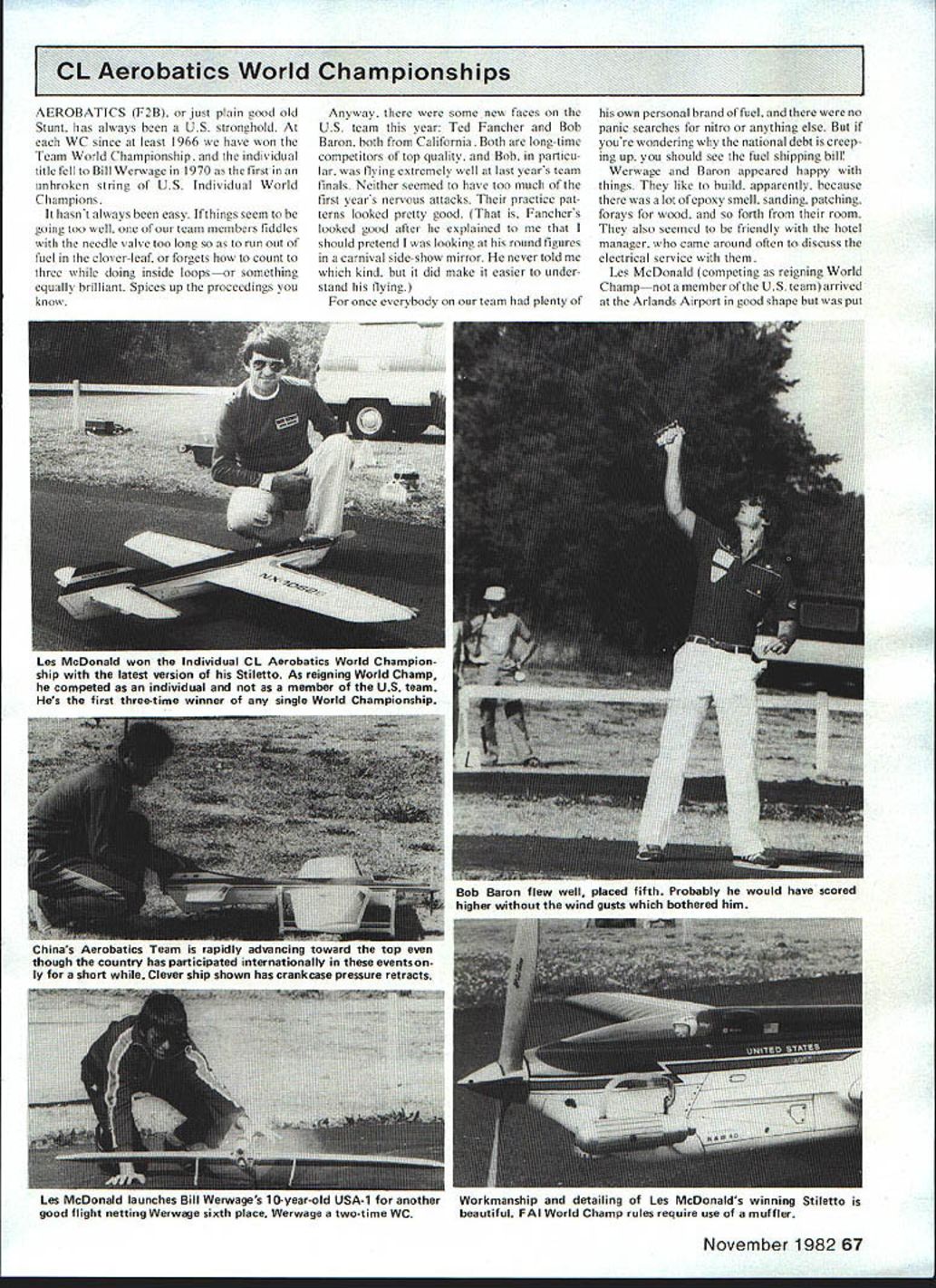
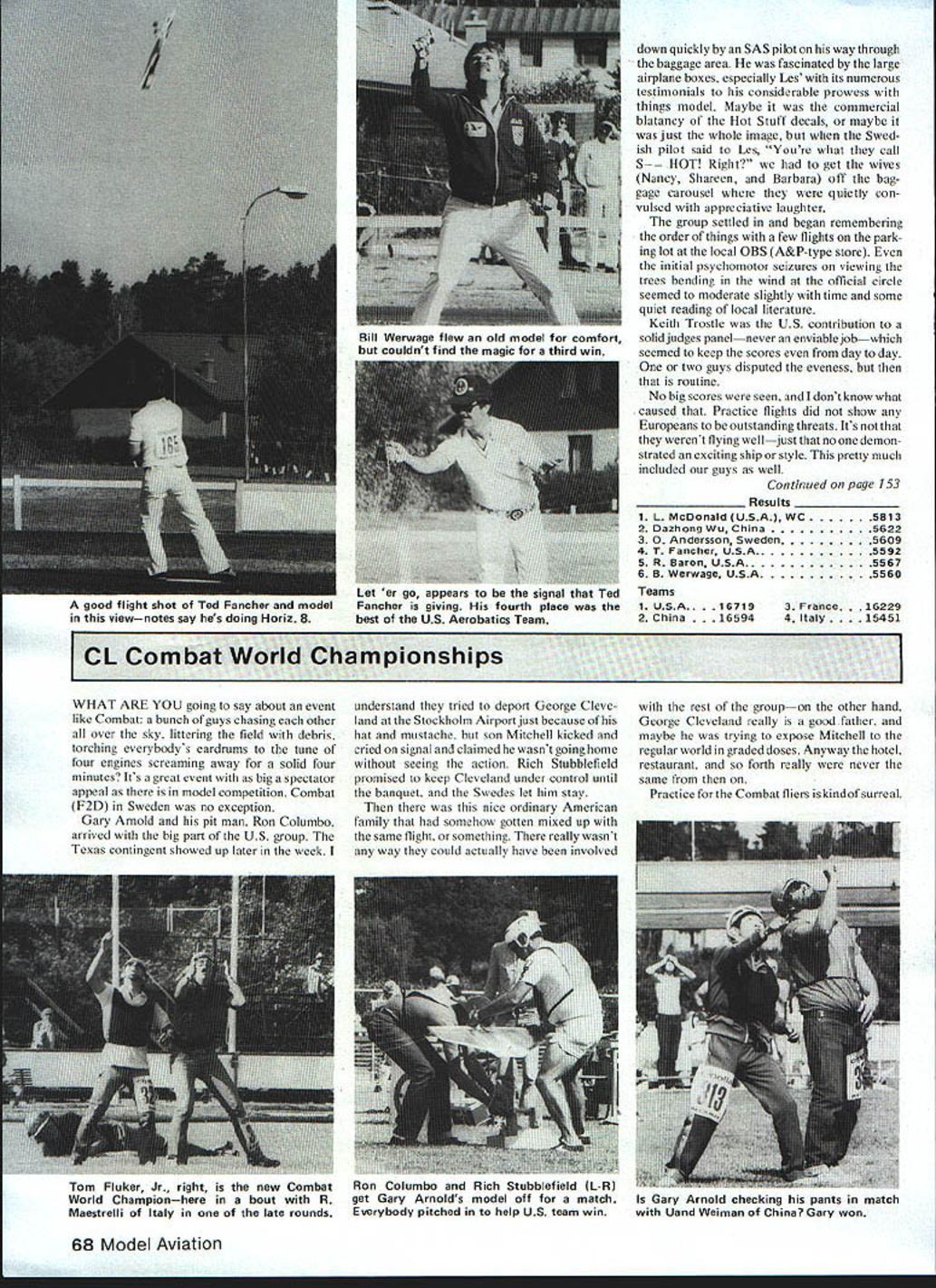
There were some new faces on the U.S. team this year: Ted Fancher and Bob Baron, both from California. Both are long-time competitors of top quality, and Bob, in particular, was flying extremely well at last year's team finals. Neither seemed to have too much of the first-year nervous attacks. Their practice patterns looked pretty good. (That is, Fancher's looked good after he explained to me that I should pretend I was looking at his round figures in a carnival side-show mirror. He never told me which kind, but it did make it easier to understand his flying.)
For once everybody on our team had plenty of his own personal brand of fuel, and there were no panic searches for nitro or anything else. But if you're wondering why the national debt is creeping up, you should see the fuel shipping bill!
Werwage and Baron appeared happy with things. They like to build, apparently, because there was a lot of epoxy smell, sanding, patching, forays for wood, and so forth from their room. They also seemed to be friendly with the hotel manager, who came around often to discuss the electrical service with them.
Les McDonald (competing as reigning World champ — not a member of the U.S. team) arrived at Arlanda Airport in good shape but was put down quickly by an SAS pilot on his way through the baggage area. He was fascinated by the large airplane boxes, especially Les' with its numerous testimonials to his considerable prowess with model things. Maybe it was the commercial blatancy of the Hot Stuff decals, or maybe it was just the whole image, but when the Swedish pilot said to Les, "You're what they call S-HOT! Right?" we had to get the wives (Nancy, Shareen, and Barbara) off the baggage carousel where they were quietly convulsed with appreciative laughter.
The group settled in and began remembering the order of things with a few flights on the parking lot at the local OBS (A&P-type store). Even the initial psychomotor seizures on viewing the trees bending in the wind at the official circle seemed to moderate slightly with time and some quiet reading of local literature.
Keith Trostle was the U.S. contribution to a solid judges panel — never an enviable job — which seemed to keep the scores even from day to day. One or two guys disputed the evenness, but then that is routine.
No big scores were seen, and I don't know what caused that. Practice flights did not show any Europeans to be outstanding threats. It's not that they weren't flying well — just that no one demonstrated an exciting ship or style. This pretty much included our guys as well.
McDonald received the Snoopy Award for first, and he became the first repeat champion since Bill Werwage in 1972; the first Control Line World Champion in any category to successfully defend his title under the new rule allowing individual entry (when Bill Werwage repeated, he was not competing as reigning champion); and the first competitor to win three World Championships in any single category (Tom Koster of Denmark has won each Free Flight World Championships category once). Congratulations to Les!
The U.S. team was mildly displeased at not winning more individual top places, but they won a solid Team World Championship. To be sure, the Chinese pushed them harder than ever before, but that simply added some spice to the cake. Bill Werwage went into temporary retirement between the field awards ceremony and beer service at the banquet, but his humor was undimmed by it all.
Ted Fancher seemed genuinely pleased to accept the team trophy at the banquet. He was the most gracious and deserving fourth-place winner I can remember in recent championships. They all did a good job.
CL Combat World Championships
What are you going to say about an event like Combat: a bunch of guys chasing each other all over the sky, littering the field with debris, torching everybody's eardrums to the tune of four engines screaming away for a solid four minutes? It's a great event with as big a spectator appeal as there is in model competition. Combat (F2D) in Sweden was no exception.
Gary Arnold and his pit man, Ron Columbo, arrived with the big part of the U.S. group. The Texas contingent showed up later in the week. I understand they tried to deport George Cleveland at the Stockholm Airport just because of his hat and moustache, but son Mitchell kicked and cried on signal and claimed he wasn't going home without seeing the action. Rich Stubblefield promised to keep Cleveland under control until the banquet, and the Swedes let him stay.
Then there was this nice ordinary American family that had somehow gotten mixed up with the same flight, or something. There really wasn't any way they could actually have been involved with the rest of the group — on the other hand, George Cleveland really is a good father, and maybe he was trying to expose Mitchell to the regular world in graded doses. Anyway the hotel, restaurant, and so forth really were never the same from then on.
Practice for the Combat fliers is kind of surreal. They did a lot of 1/4A flying, got engines set, and sharpened reflexes—I guess. They got used to the air and each other. The U.S. team had good fliers in Tom Fluker, Jr. (dad pits), Rich Stubblefield (George Cleveland pits), and Gary Arnold. Fluker and Stubblefield used Fox engines with ample nitro, while Arnold was using Admasi-tuned Supertigers. All of their engines sounded good, but not superior to the Rossi engines which most of the Europeans used. An occasional person, like Fred Meijer of Holland, used the new Nelson, and these engines did sound impressive.
Combat ships sort of separated out into two basic types: large foamies with various covering and spar schemes; and somewhat smaller (except the Soviets) framework ships covered with Mylar. Most people (again except the Soviets) used bladder pressure tanks of some sort, either tubing or pacifier.
You can run two ships per bout, so the practice is to get both running and be ready to launch the second model as soon as the first is down and you have switched the streamer over. Everybody wears helmets (except the spectators), so theoretically it is safe. There were two flyaways with cut lines. One was Fred Meijer. His ship came down full bore through one of the trees bordering the Speed circle and struck the ground less than two meters from a spectator. Not anybody's fault, but grounds for thought. The second was a German ship which ran on forever while gently looping and climbing into the afternoon sky until the engine quieted while it was a speck. Then the darn thing had a transition that would make a Free Flighter drool—after which it soared on a thermal for quite a while before disappearing over a hill on the skyline. It was found floating in the bay, undamaged, a little later.
The first rounds of Combat were fairly uneventful except that they showed the American weakness for getting too much streamer on the first pass. Maybe this is reflex from the kill in Fast Combat, but when you take the whole streamer in FAI you just get 100 points like any other cut. Then you have a long four minutes to hide, because you have nothing left to go after while your opponent, who is faster now without his streamer, can nibble away at you at 100 points a nibble.
Stubblefield fell to this in the first bout, but bounced back in the losers' round. Arnold and Fluker survived, and then Tommy Fluker drew one of the extra bouts to narrow the field to 32 pilots. All were in the final field then.
Fluker and Arnold then won their matches in the 16-bout round, while Stubblefield fell by the wayside—partly due to streamer overeating, plus a false assumption that his opponent would crash his uncontrollable ship. Didn't happen and he lost.
In the round of eight bouts, Gary also succumbed to this appetite problem. It was a good match. All of the Americans flew well, but many of the other fliers were also very quick and used good equipment with tactics that were sometimes surprising to our fliers. Only Tom Fluker was left in the quarter-finals.
Fluker drew Titov, one of the two fast Russians. The bout was good, with each getting two cuts before a line tangle caused both of them to go into the ground. The battle stopped at the line tangle.
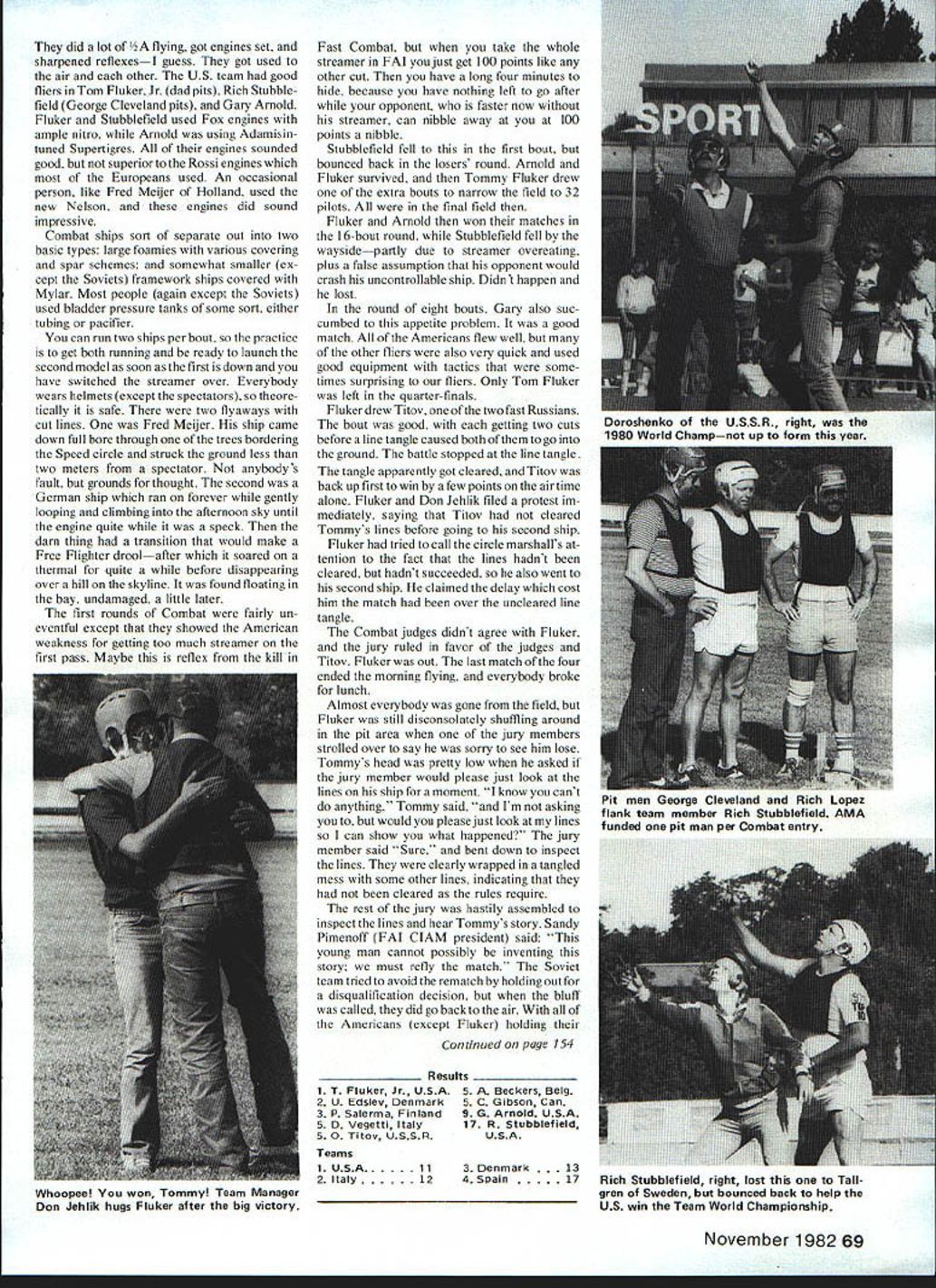
The tangle apparently got cleared, and Titov was back up first to win by a few points on the air time alone. Fluker and Don Jehlik filed a protest immediately, saying that Titov had not cleared Tommy's lines before going to his second ship. Fluker had tried to call the circle marshal's attention to the fact that the lines hadn't been cleared, but hadn't succeeded, so he also went to his second ship. He claimed the delay which cost him the match had been over the uncleared line tangle.
The Combat judges didn't agree with Fluker, and the jury ruled in favor of the judges and Titov. Fluker was out. The last match of the four ended the morning flying, and everybody broke for lunch.
Almost everybody was gone from the field, but Fluker was still disconsolately shuffling around in the pit area when one of the jury members strolled over to say he was sorry to see him lose. Tommy's head was pretty low when he asked if the jury member would please just look at the lines on his ship for a moment. "I know you can't do anything," Tommy said, "and I'm not asking you to, but would you please just look at my lines so I can show you what happened?" The jury member said "Sure," and bent down to inspect the lines. They were clearly wrapped in a tangled mess with some other lines, indicating that they had not been cleared as the rules require.
The rest of the jury was hastily assembled to inspect the lines and hear Tommy's story. Sandy Pimenoff (FAI CIAM president) said: "This young man cannot possibly be inventing this story; we must rectify the match." The Soviet team tried to avoid the rematch by holding out for a disqualification decision, but when the bluff was called, they did go back to the air. With all of the Americans (except Fluker) holding their breath, Tommy went up for the rematch. He lost when a prop on his ship broke, cutting the engine and dropping his ship into the ground. Titov recovered to win the bout and went on to win the event.
Results
- T. Fluker, Jr., U.S.A.
- U. Edslev, Denmark
- P. Salermo, Finland
- D. Veggetti, Italy
- A. Beckers, Belgium
- C. Gibson, Canada
- G. Arnold, U.S.A.
- R. Stubblefield, U.S.A.
Teams
- 1. U.S.A. — 11
- 2. Italy — 12
- 3. Denmark — 13
- 4. Spain — 17
CL Speed World Championships
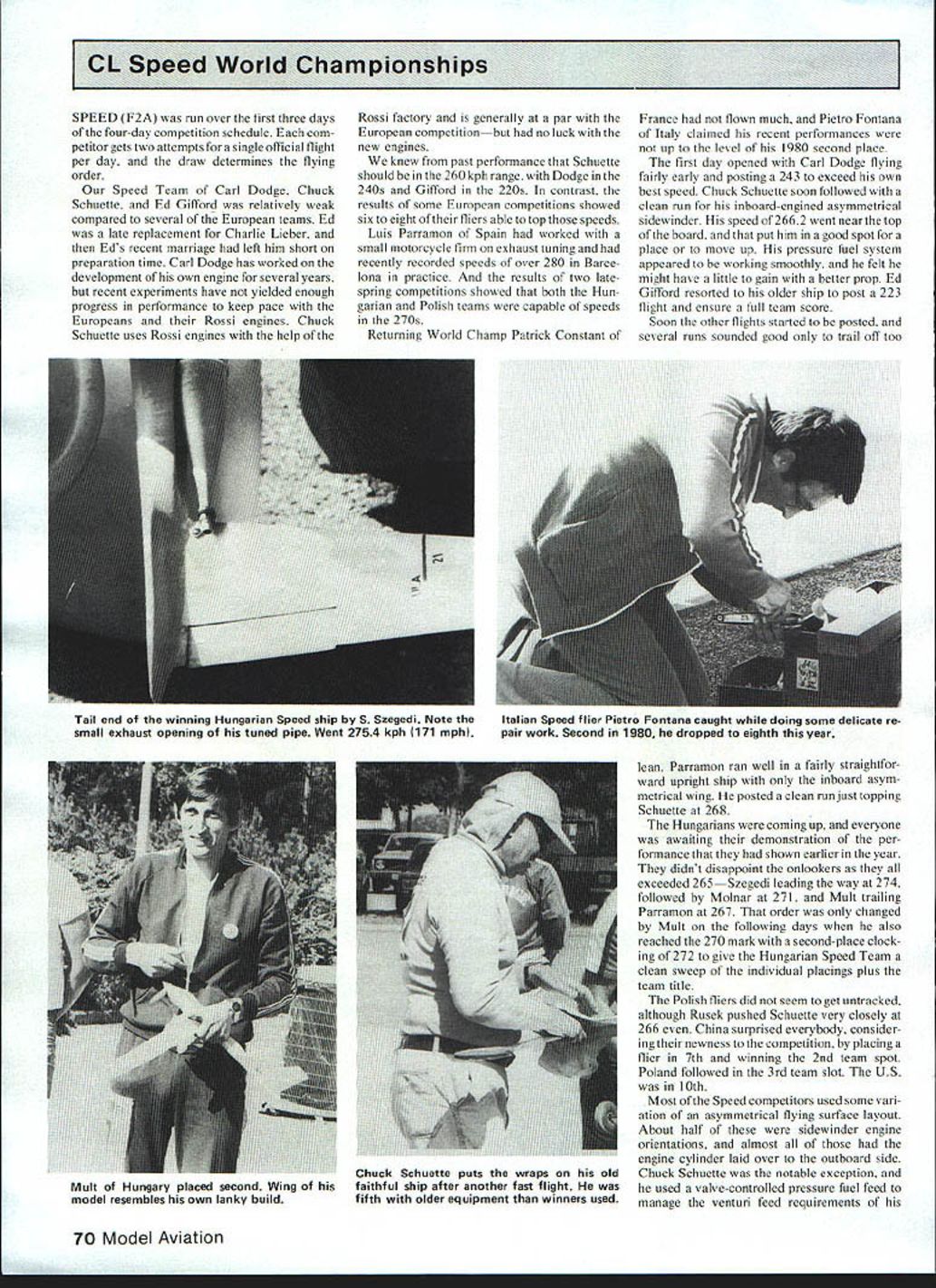
Speed (F2A) was run over the first three days of the four-day competition schedule. Each competitor gets two attempts for a single official flight per day, and the draw determines the flying order.
Our Speed Team of Carl Dodge, Chuck Schuette, and Ed Gifford was relatively weak compared to several of the European teams. Ed was a late replacement for Charlie Lieber, and then Ed's recent marriage had left him short on preparation time. Carl Dodge has worked on the development of his own engine for several years, but recent experiments have not yielded enough progress in performance to keep pace with the Europeans and their Rossi engines. Chuck Schuette uses Rossi engines with the help of the Rossi factory and is generally at a par with the European competition — but had no luck with the new engines.
We knew from past performance that Schuette should be in the 260 kph range, with Dodge in the 240s and Gifford in the 220s. In contrast, the results of some European competitions showed six to eight of their fliers able to top those speeds.
Luis Parramon of Spain had worked with a small motorcycle firm on exhaust tuning and had recently recorded speeds of over 280 in Barcelona in practice. And the results of two late-spring competitions showed that both the Hungarian and Polish teams were capable of speeds in the 270s.
Returning World Champ Patrick Constant of France had not flown much, and Pietro Fontana of Italy claimed his recent performances were not up to the level of his 1980 second place.
The first day opened with Carl Dodge flying fairly early and posting a 243 to exceed his own best speed. Chuck Schuette soon followed with a clean run for his inboard-engined asymmetrical sidewinder. His speed of 266.2 went near the top of the board, and that put him in a good spot for a place or to move up. His pressure fuel system appeared to be working smoothly, and he felt he might have a little to gain with a better prop. Ed Gifford resorted to his older ship to post a 223 flight and ensure a full team score.
Soon the other flights started to be posted, and several runs sounded good only to trail off too clean. Parramon ran well in a fairly straightforward upright ship with only the inboard asymmetrical wing. He posted a clean run just topping Schuette at 268.
The Hungarians were coming up, and everyone was awaiting their demonstration of the performance that they had shown earlier in the year. They didn't disappoint the onlookers as they all exceeded 265 — Szegedi leading the way at 274, followed by Molnar at 271, and Mult trailing Parramon at 267. That order was only changed by Mult on the following days when he also reached the 270 mark with a second-place clocking of 272 to give the Hungarian Speed Team a clean sweep of the individual placings plus the team title.
The Polish fliers did not seem to get untracked, although Rusek pushed Schuette very closely at 266 even. China surprised everybody, considering their newness to the competition, by placing a flier in 7th and winning the 2nd team spot. Poland followed in the 3rd team slot. The U.S. was in 10th.
Most of the Speed competitors used some variation of an asymmetrical flying surface layout. About half of these were sidewinder engine orientations, and almost all of those had the engine cylinder laid over to the outboard side. Chuck Schuette was the notable exception, and he used a valve-controlled pressure fuel feed to manage the venturi feed requirements of his engine. The others almost all used centrifugal fuel switches either made by Emil Rumpel or of the same type. Some, especially the Italians, used suction of the uniflow type.
There tended to be an emphasis on large ram-air induction area for the carburetor and relatively small exhaust exit area from the tuned exhaust pipe. Variations in pipe shape were seen, but other than departing from the constant-diameter center sections seen previously, there was no obvious pattern.
The Hungarians appeared to be the only team able to extract competitive performance from the newer Rossi engine. They had received about two dozen piston/liner sets from Fontana last fall, and apparently they had successfully learned the operation of the engine. When asked if the secret to success was to obtain a new-model Rossi engine, Szegedi, the winner, replied: "If you don't know how to play the violin, buying a new one won't help." And that is the name of that tune, gang.
Results
- S. Szegedi, Hungary — 275.4 kph
- J. Mult, Hungary — 272.3 kph
- J. Molnar, Hungary — 271.9 kph
- L. Parramon, Spain — 268.8 kph
- C. Schuette, U.S.A. — 266.2 kph
- C. Dodge, U.S.A. — 247.2 kph
- E. Gifford, U.S.A. — 233.8 kph
Teams
- 1. Hungary — 819.6
- 2. China — 782.5
- 3. Poland — 767.3
- 10. U.S.A. — 737.2
CL Team Racing World Championships
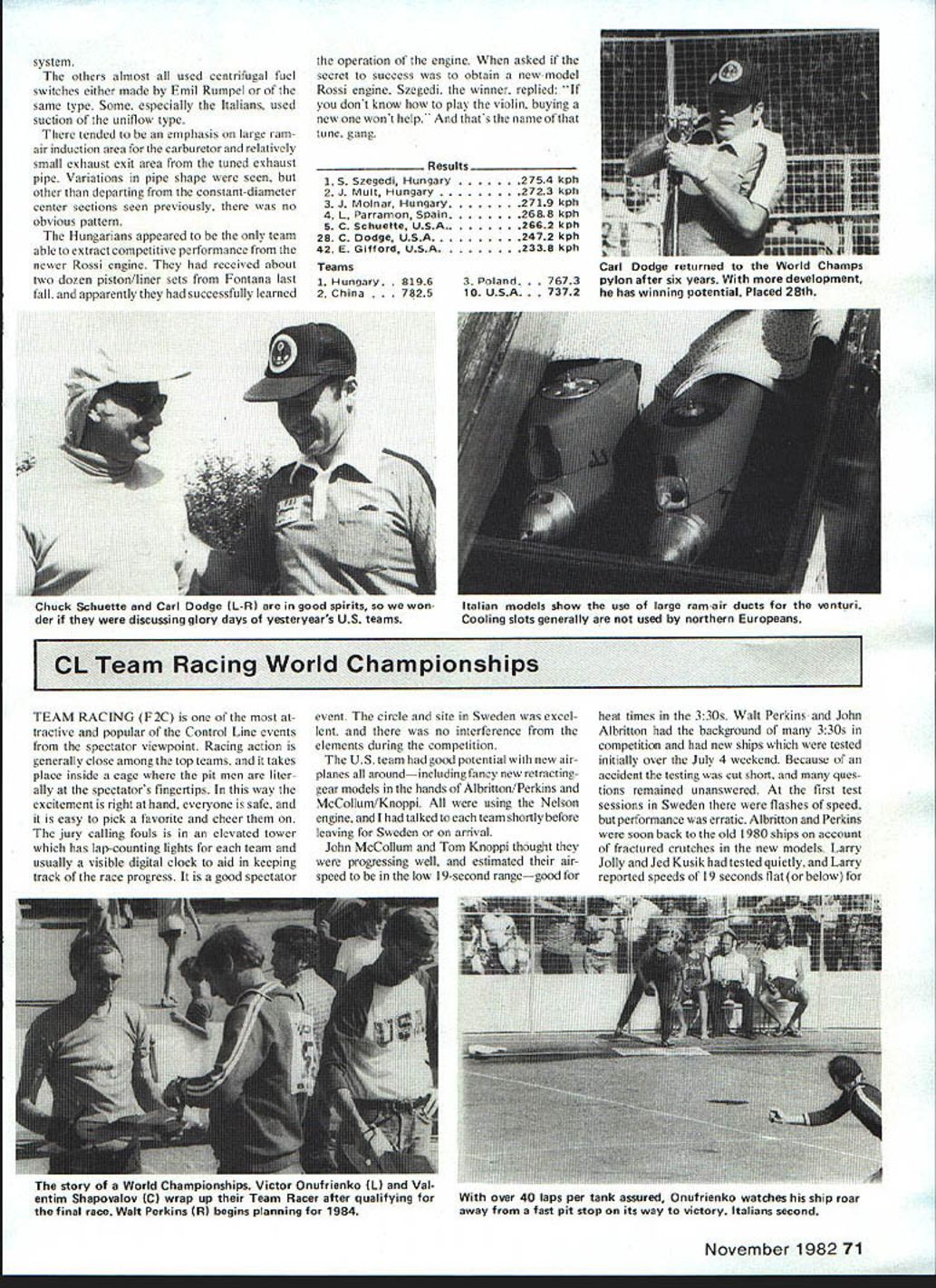
Team Racing (F2C) is one of the most attractive and popular of the Control Line events from the spectator viewpoint. Racing action is generally close among the top teams, and it takes place inside a cage where the pit men are literally at the spectator's fingertips. In this way the excitement is right at hand, everyone is safe, and it is easy to pick a favorite and cheer them on. The jury calling fouls is in an elevated tower which has lap-counting lights for each team and usually a visible digital clock to aid in keeping track of the race progress. It is a good spectator event. The circle and site in Sweden was excellent, and there was no interference from the elements during the competition.
The U.S. team had good potential with new airplanes all around—including fancy new retracting-gear models in the hands of Albritton/Perkins and McCollum/Knoppi. All were using the Nelson engine, and I had talked to each team shortly before leaving for Sweden on arrival.
John McCollum and Tom Knoppi thought they were progressing well, and estimated their airspeed to be in the low 19-second range—good for heat times in the 3:30s. Walt Perkins and John Albritton had the background of many 3:30s in competition and had new ships which were tested initially over the July 4 weekend. Because of an accident the testing was cut short, and many questions remained unanswered. At the first test sessions in Sweden there were flashes of speed, but performance was erratic. Albritton and Perkins were soon back to the old 1980 ships on account of fractured crutches in the new models. Larry Jolly and Jed Kusik had tested quietly, and Larry reported speeds of 19 seconds flat (or below) for the kilometer—and with good range.
Being your basic cynic I had to see the Jolly/Kusik performance for myself. Lo and behold, when I first watched their practice, the speed was there! I got times of 18.8 to 19.2 with a strong sounding engine, good starting and a strong surge out of the pit. The Achilles heel seemed to be the range. They were counting 33 to 35 laps per tank, but the engine actually was cutting at 31 to 33 laps—with the extra two laps occurring while gliding into the pit. In a race, two laps can disappear magically, and sometimes three or four will go away with the rigors of traffic. So I was worried that their setting would not hold up to a race.
Albritton/Perkins finally got their old #12 ship rolling at about 19.2 with a fairly happy sound. That certainly didn't give them any advantage over other teams.
McCollum/Knoppi were in constant trouble with their equipment. They finally abandoned the retracts and newer valves, but were still having troubles.
This wasn't an auspicious way to approach race day. However, no other team except the Soviets appeared to be in any better position.
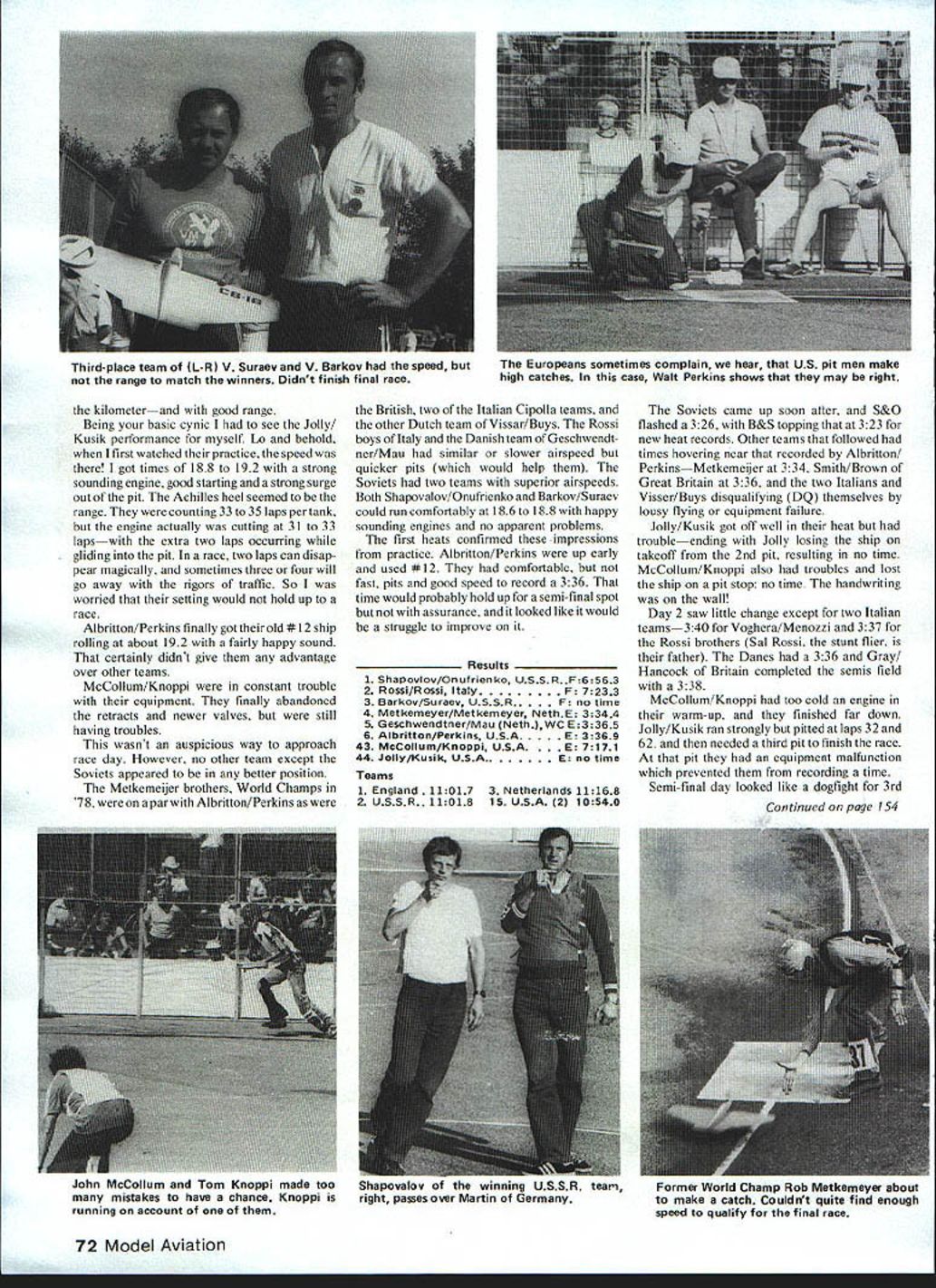
The Metkemeyer brothers, World Champs in '78, were on a par with Albritton/Perkins as were the British, two of the Italian Cipolla teams, and the other Dutch team of Visser/Buys. The Rossi boys of Italy and the Danish team of Geschwendtner/Mau had similar or slower airspeed but quicker pits (which would help them). The Soviets had two teams with superior airspeeds. Both Shapovalov/Onufrienko and Barkov/Surav could run comfortably at 18.6 to 18.8 with happy sounding engines and no apparent problems.
The first heats confirmed these impressions from practice. Albritton/Perkins were up early and used #12. They had comfortable, but not fast, pits and good speed to record a 3:36. That time would probably hold up for a semi-final spot but not with assurance, and it looked like it would be a struggle to improve on it.
The Soviets came up soon after, and Shapovalov & Onufrienko flashed a 3:26, with Barkov & Surav topping that at 3:23 for new heat records. Other teams that followed had times hovering near that recorded by Albritton/Perkins—Metkemeyer/Metkemeyer at 3:34, Smith/Brown of Great Britain at 3:36, and the two Italians and Visser/Buys disqualifying (DQ) themselves by lousy flying or equipment failure.
Jolly/Kusik got off well in their heat but had trouble—ending with Jolly losing the ship on takeoff from the 2nd pit, resulting in no time. McCollum/Knoppi also had troubles and lost the ship on a pit stop: no time. The handwriting was on the wall.
Day 2 saw little change except for two Italian teams—3:40 for Voghera/Menozzi and 3:37 for the Rossi brothers (Sal Rossi, the stunt flier, is their father). The Danes had a 3:36 and Gray/Hancock of Britain completed the semis field with a 3:38.
McCollum/Knoppi had too cold an engine in their warm-up, and they finished far down. Jolly/Kusik ran strongly but pitted at laps 32 and 62, and then needed a third pit to finish the race. At that pit they had an equipment malfunction which prevented them from recording a time.
Semi-final day looked like a dogfight for 3rd place. Albritton/Perkins had done a 3:35 in their first semi, so they were just trailing Suraev, while the Rossis had DQ'd.
Albritton/Perkins went up in the same heat with the Rossis, and for once Perkins' strategy let him down. Since Albritton is shorter than most pilots they decided to call the first pit early to avoid traffic problems — and came in a wee bit too early on lap 31. They ran strongly and appeared to be ahead of the Rossis at least in airspeed, but ran out of fuel before the end and had to glide almost 2 laps. Rossi finished in 3:32 for the second final slot, and Albritton/Perkins glided across in 3:39 to miss.
The final went off in the afternoon with most people wondering which Soviet team would top the other. No one except the Rossi brothers really believed the Rossis had a chance. Each team took its 10-minute warm-up except Onufrienko, who was having troubles in the pit warm-up. With a flurry of excitement, Shapovalov/Onufrienko hurriedly swapped the engine into the other ship and quickly gave it a brief run-up. On to the circle with just time for one quick tank of fuel and a cold-sounding setting.
Then it was time to start the countdown for the race. Onufrienko apparently knew which adjustments to make, because when the flag fell he was off as strongly as the rest. Barkov/Suraev appeared to have a little speed advantage, with Shapovalov/Onufrienko and Rossi/Rossi about even. Onufrienko had picked an upwind pit position to stay well clear of the others in the stops. Barkov and then Rossi came in on lap 35 or so and were off quickly. But Shapovalov just kept rolling with Onufrienko counting laps closely on the sideline. They let the tank run out to check the range and came in on lap 46 with an airspeed of 18.86 in traffic!
Onufrienko coolly opened the needle a touch to ensure no burn-down and motored off into the Swedish air for an assured victory. They stopped the race, gaining time on the other two, and everything would have been routine except that Barkov stumbled while landing at the last pit stop; the ship rolled into Suraev's leg, breaking the prop. They retired while in 2nd and let the Rossi brothers take 2nd to the cheers of their supporters.
Shapovalov and Onufrienko finished in an astonishing 6:56.3 for a new record and the comeback of the year. Can you believe that Henry Nelson and I finished ahead of them in Poland?
Results
- Shapovalov/Onufrienko, U.S.S.R. — F: 6:56.3
- Rossi/Rossi, Italy — F: 7:23.3
- Barkov/Surav, U.S.S.R. — F: no time
- Metkemeyer/Metkemeyer, Netherlands — E: 3:34.4
- Geschwendtner/Mau, Netherlands — W.C.E.: 3:36.5
- Albritton/Perkins, U.S.A. — E: 3:36.9
- McCollum/Knoppi, U.S.A. — E: 7:17.1
- Jolly/Kusik, U.S.A. — E: no time
Teams
- 1. England — 11:01.7
- 2. U.S.S.R. — 11:01.8
- 3. Netherlands — 11:16.8
- 15. U.S.A. — 10:54.0
Transcribed from original scans by AI. Minor OCR errors may remain.

