
1982 U.S. FF CHAMPS
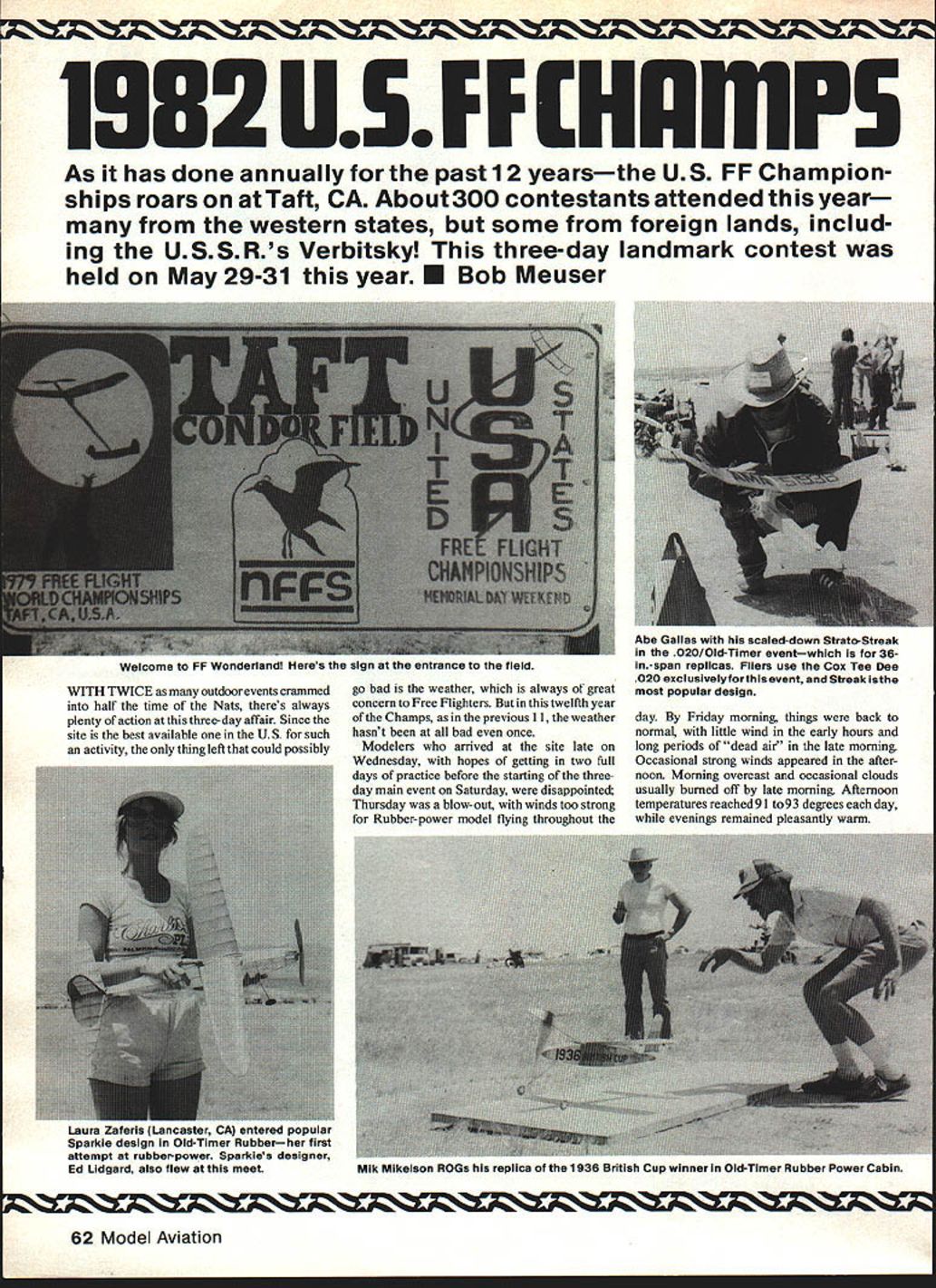
As it has for the past 12 years, the U.S. Free‑Flight Championships roared into Taft, CA. The three‑day landmark contest was held May 29–31 and drew about 300 contestants, mostly from the Western States plus a scattering of out‑of‑state and foreign flyers — including the U.S.S.R.'s Eugene Verbitsky.
Weather and site conditions
Thursday practice was lost to a blow‑out; winds were too strong for rubber‑power flying. By Friday morning conditions returned to near normal: light winds early, long periods of “dead air” late morning, and occasional strong afternoon winds. Morning overcast and patchy clouds usually burned off by late morning. Afternoon temperatures reached 91–93°F; evenings were pleasantly warm. Dust devils periodically marched through the parking area, damaging tents and shelters.
Competitors and visitors
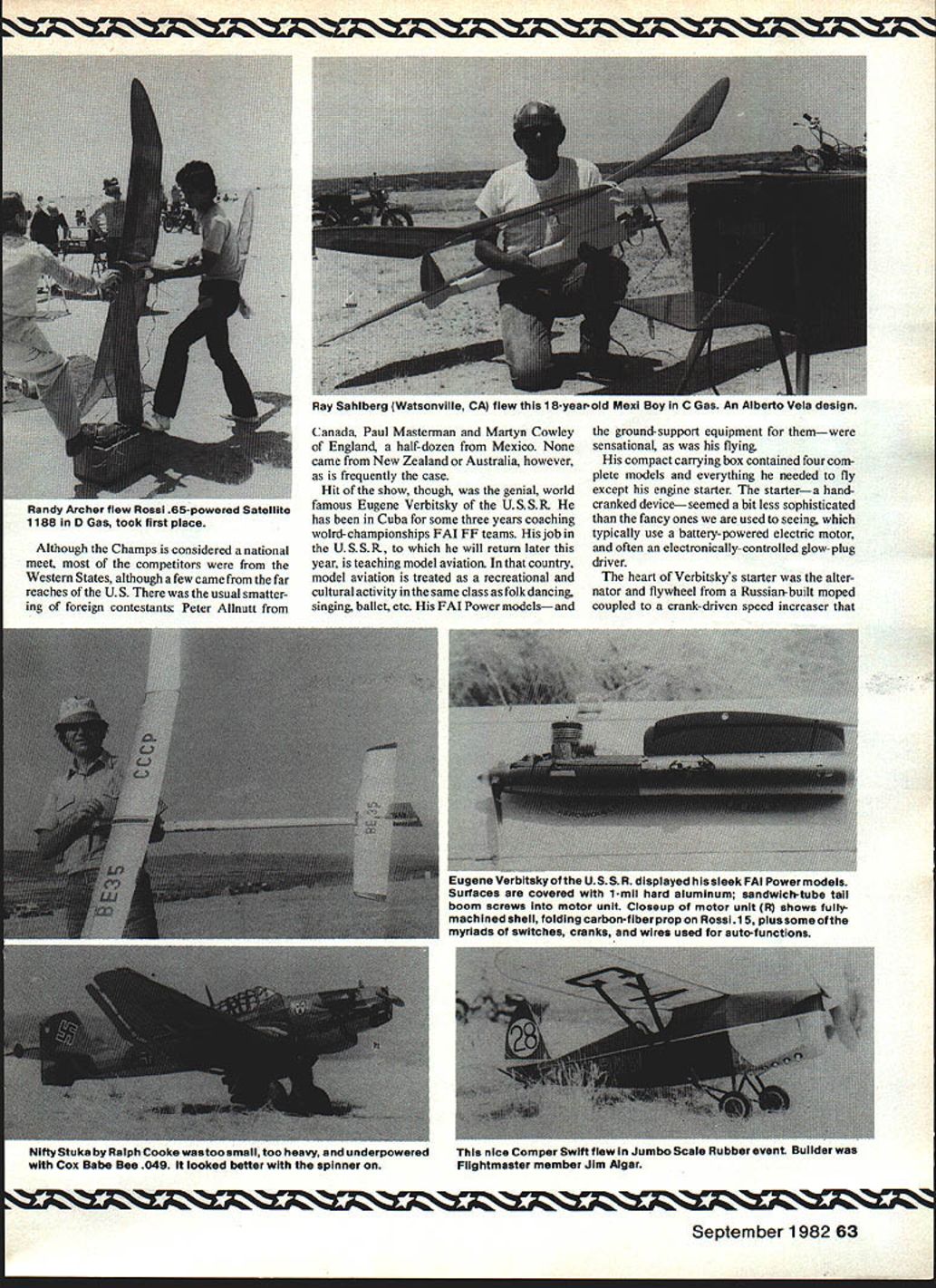
Most competitors were from the Western States. Notable foreign and out‑of‑state attendees included:
- Peter Allnutt (Canada)
- Paul Masterman (England)
- Martyn Cowley (England)
- About half a dozen entrants from Mexico
No contestants came from New Zealand or Australia this year.
The hit of the show was the genial, world‑famous Eugene Verbitsky of the U.S.S.R., who has been in Cuba coaching world‑championship FAI free‑flight teams and will return later in the year to teach model aviation. In the U.S.S.R. model aviation is treated as a cultural recreational activity on par with folk dancing or ballet.
Verbitsky’s models and equipment
Verbitsky’s gear was notable for compactness and clever engineering:
- A single carrying box held four complete FAI power models and all ground support equipment except his engine starter.
- His starter was a hand‑cranked unit built around an alternator/flywheel from a Russian moped coupled to a crank‑driven speed increaser. A miniature ammeter indicated glow‑plug condition and cranking speed.
- Model construction included fully machined forward fuselage sections with many small levers and springs to operate auto‑sequence functions; tail assembly screwed into that forward section.
- Wings and stabilizers were covered with one‑mil hard aluminum for strength, stiffness, and low weight.
- Flight sequence: models climbed almost straight up, made a quarter to half aileron roll, then, a second or two after motor cutoff, a trailing‑edge change produced a quarter outside loop into glide attitude while the stabilizer popped into glide trim — a “bunt” maneuver not commonly seen in the U.S.
Verbitsky judged the conditions at Taft to be difficult for picking “good air.”
Event highlights
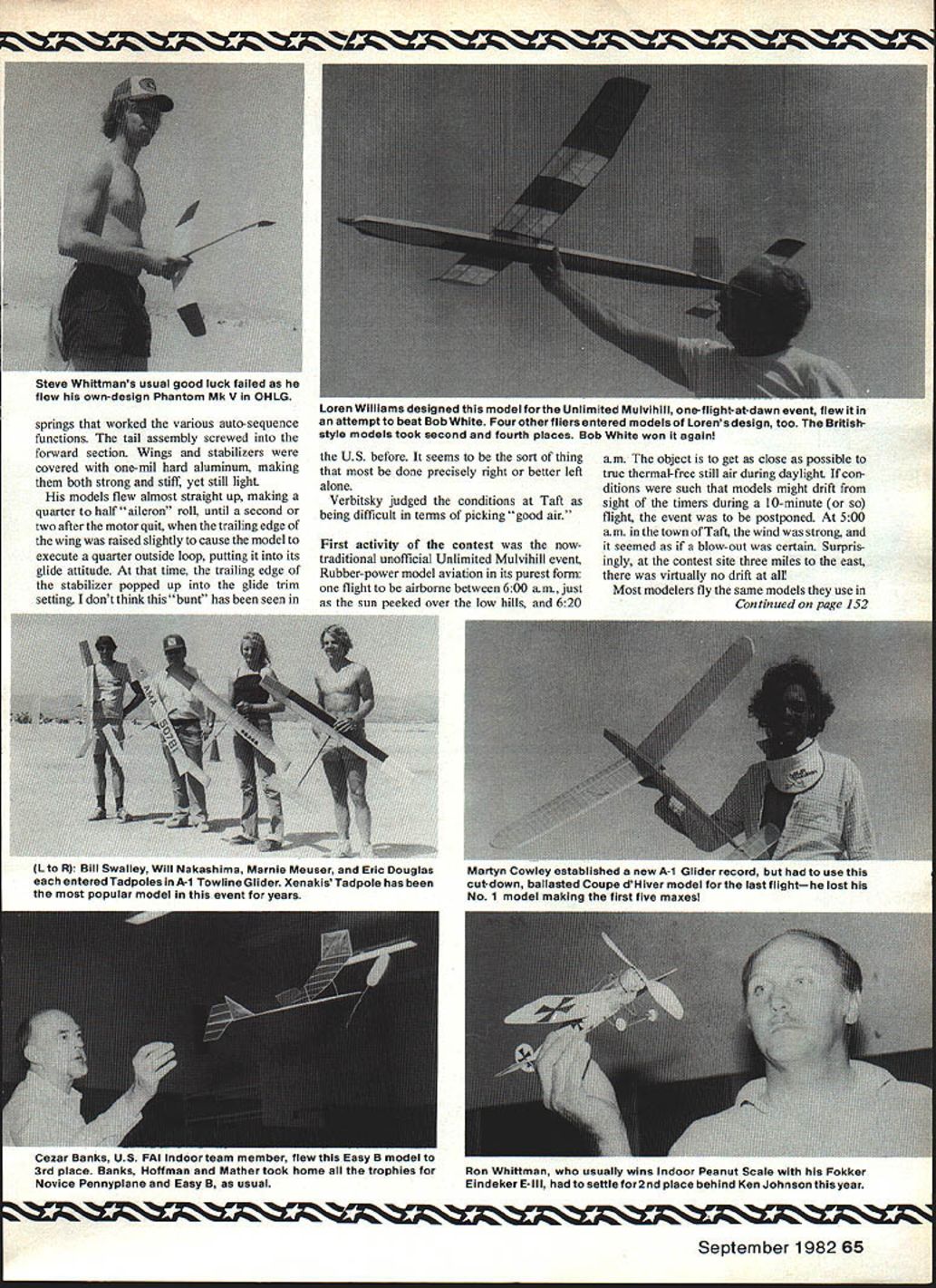
#### Unlimited Mulvihill (unofficial) The now‑traditional unofficial Unlimited Mulvihill event requires launching between 6:00 and 6:20 a.m. to seek near still (thermal‑free) daylight air. Although the event is unofficial (results do not appear in official standings), it draws attention.
- Bob White — long a specialist in still‑air Mulvihill models — won his fifth consecutive Unlimited Mulvihill. His twin‑fin model climbed to perhaps 500 ft and landed after 10:49 within 50 yards of the launch point, earning him the Oakland Cloud Dusters Perpetual Trophy for another year.
Note: As getting second place in this grueling event is an accomplishment in itself, second‑place trophies will be awarded for this event in the future.
#### Regular Mulvihill Bud Romash won the regular Mulvihill after a hard fight. Known for designs evolving from Bilgri influence toward higher aspect‑ratio wings and T‑tails, Bud suffered several wing failures and made repairs during the contest. His final winning flight was made with a combination of parts not previously test‑flown. On one retrieval he briefly chased a model on foot, then mounted a motorcycle; the model suddenly reappeared and he caught it.
#### A/2 Towline Glider Wind increased after the fourth round and caused problems. Martyn Cowley (England) was caught with his tow hook set for calmer conditions and had a difficult recovery, recorded as an “attempt” after circling dozens of times and running downwind about a quarter‑mile. Most competitors used the Russian circle‑tow/zoom‑launch technique; George Xenakis used straight towing and stayed competitive until the flyoff schedule was moved to 6 a.m. because of high winds. Ten modelers recorded the required seven maxes and entered flyoffs; Bob Isaacson won after one flyoff round with a 3:10 early flight while others waited for thermals.
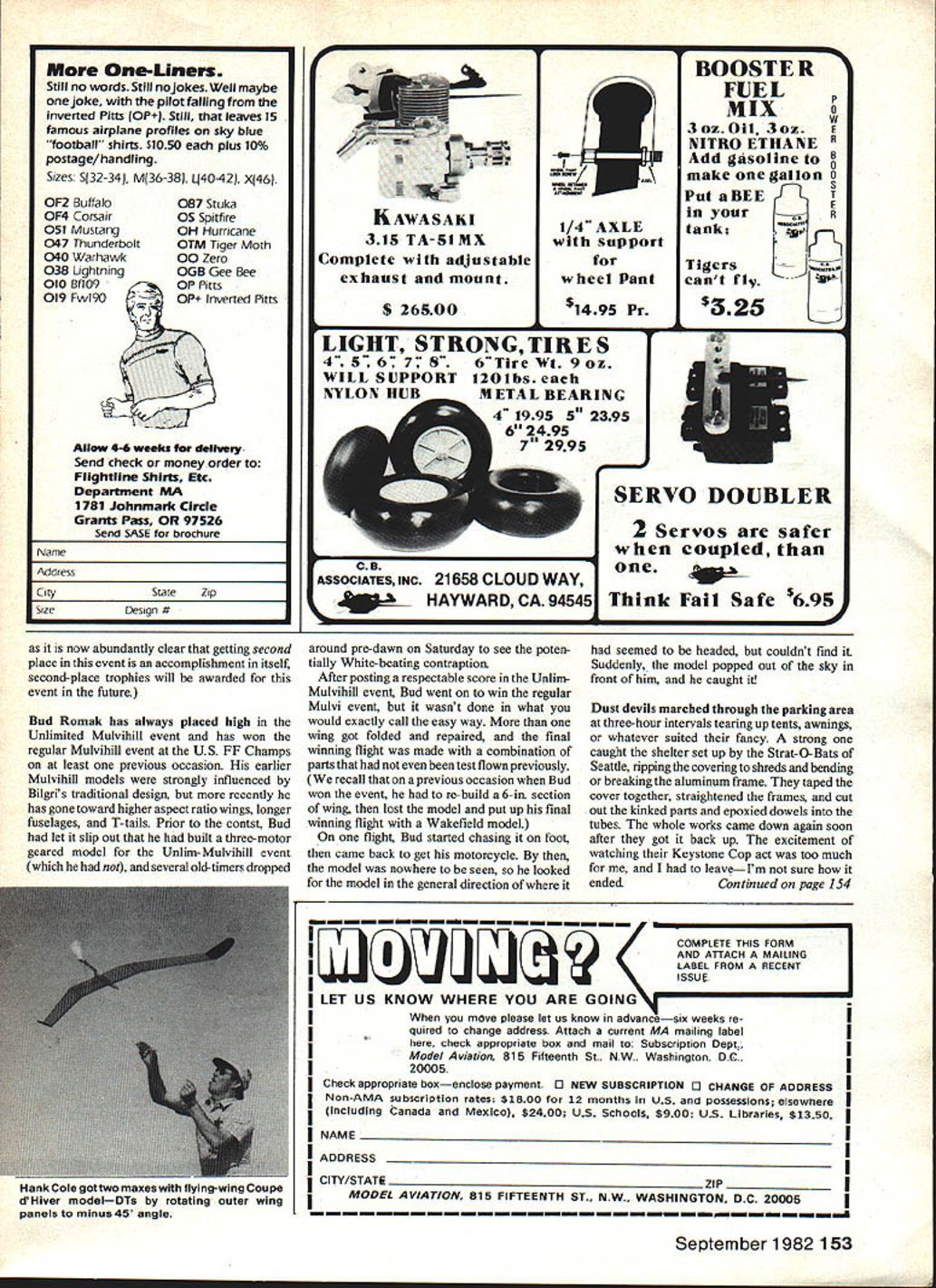
#### Wakefield Rubber Hank Cole was sidelined early when another model’s prop clipped off his model’s tail. He spent the next two days tweaking his flying‑wing Coupe d’Hiver — shifting CG, adjusting surfaces and thrust line — and noted that solving such challenges is a major part of the fun. His wing posted several maxes and DTed more or less properly from a strong thermal.
#### C‑Gas Doug Galbreath won C‑Gas with six maxes. On what would have been an additional record flight, his model struck power lines, shorted, and erupted in flames, burning the model. Modelers quickly extinguished the resulting grass fire, but a separate larger grass fire started nearby at about the same time, raising concerns that modelers might be blamed.
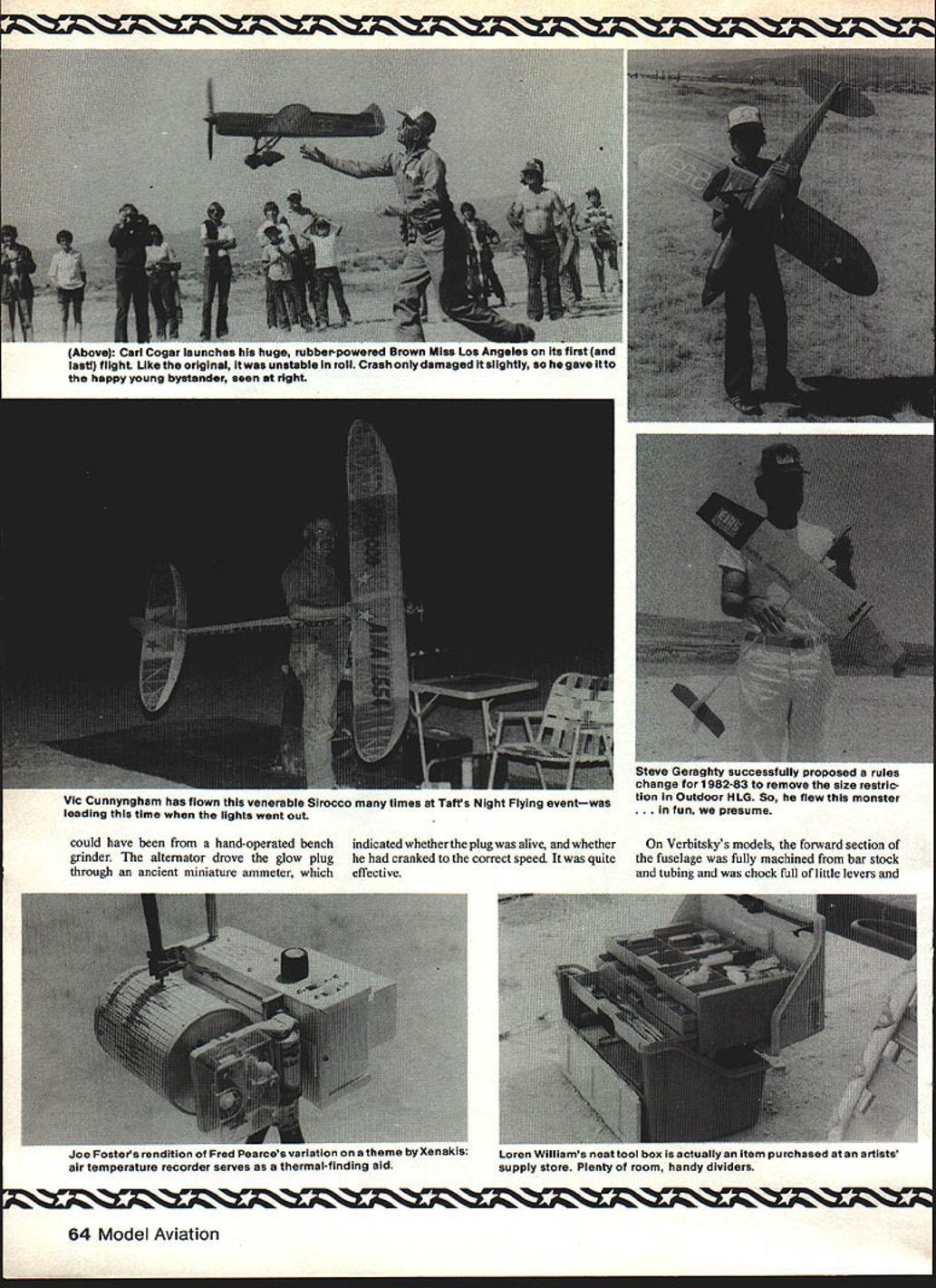
#### Outdoor Hand‑Launch Glider (HLG) Rules were relaxed this year by removing needless wing‑area restrictions. Larger throws and larger wings were allowed; if a competitor can throw a glider with more than 100 sq. in., that’s fine, and smaller junior entries are not disqualified by arbitrary minimums.
- Steve Geraghty brought a playful Double Driftwood (double dimensions, four times the wing area); with a 3‑ft span and 80 g weight it was not poised for high thermals.
- Mike McKeever won HLG with 11 straight maxes, breaking Bill Blanchard’s eight‑year record.
#### Old‑Timer classes and Texaco The eleven Old‑Timer events (covering many vintage Rubber and Gas classes) were well attended; those competitors tended to cluster on the east edge of the field. The Texaco event and its huge gas models were a standout. Fuel allowance is proportional to model weight; engines run until fuel exhaustion, typically 3–5 minutes, producing long, impressive flights.
Incidents and anecdotes
- Dust devils damaged shelters and awnings. The Strat‑O‑Bats of Seattle suffered repeated collapses of a shelter that they jury‑rigged back together.
- Ralph Prey’s large 1,100‑sq‑in. model landed near a road by the Kitty Litter factory and was picked up by a truck driver entering the plant. Although the driver insisted on returning the model personally, it ended up being driven toward Milpitas before Ralph could intercept it.
- The C‑Gas fire and the nearby larger grass fire raised concerns about future liability at Taft.
Trophies and etiquette
The author expressed irritation at trophy winners who do not show to collect their awards, depriving others of the moment of recognition. A first‑place trophy presentation can be a memorable event for a competitor; not collecting lesser‑place trophies is regarded as poor manners.
Closing
Despite recurring routines and the same faces returning year after year, nearly all of the almost 300 participants indicated they’ll be back next year — to do it all over again, and maybe a little better.
Transcribed from original scans by AI. Minor OCR errors may remain.

