
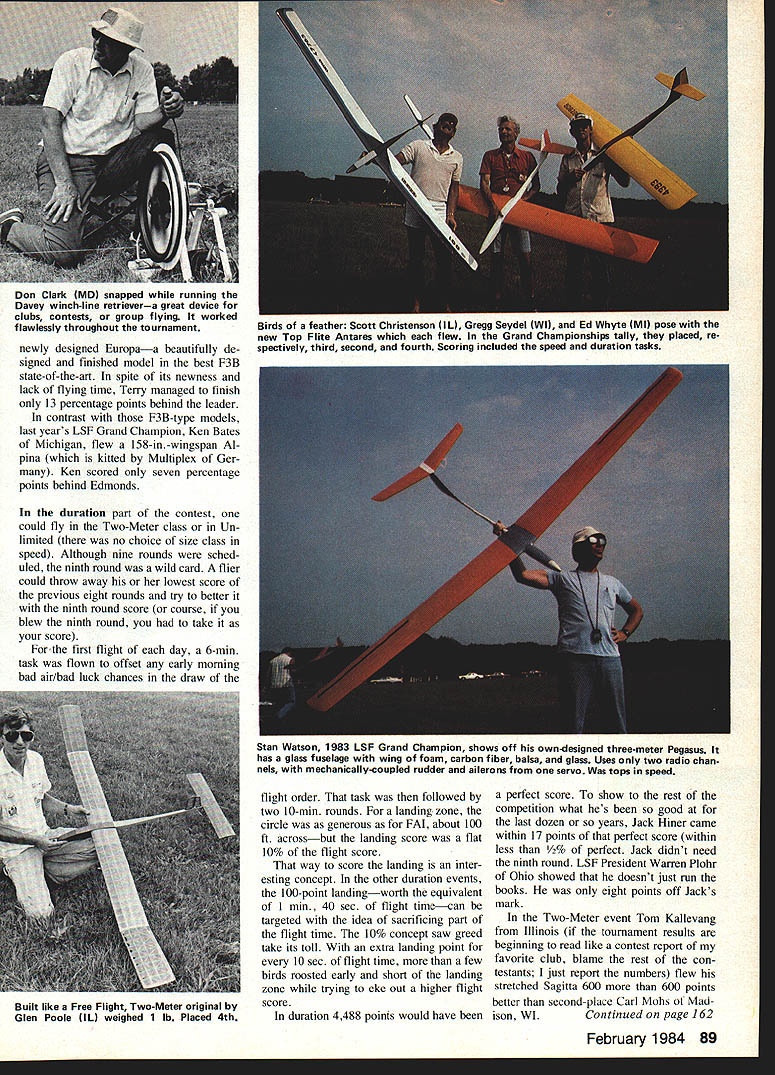
1983 LSF TOURNAMENT
It was a homecoming social affair as much as it was a contest, and it was excellent in both respects. Stan Watson was the 1983 Grand Champion, placing first in speed and fifth in duration, the latter with an interesting twist on scoring the landing. — Dan Pruss
History
The longest-running annual sailplane contest is the tournament sponsored by the League of Silent Flight (LSF). Starting in 1970, the first event had nearly the complete LSF membership show up. Membership was small then and concentrated in California, where the contest was held.
From the beginning, under the leadership of Le Gray, the annual event included a "performance" task in addition to thermal duration. Tasks of distance, speed, or a combination were typically on the schedule. An interesting side note: the original sailplane rules proposals submitted to the AMA RC Contest Board in 1970 came from LSF and included duration, distance, and speed tasks. The Italian aero club adapted those ideas and forwarded modified tasks to FAI/CIAM in Paris, an evolution that helped lead to F3B.
Early tournaments did not rigidly follow the original rule proposals; organizers designed tasks based on attendance and terrain while keeping a performance task on the schedule. Scale was another event always scheduled to foster the then-new Soaring class.
Those early years developed skills in precision duration, precision landings, and the controversial 2- and 3-minute precision tasks. The latter, with a scoring curve that gave zero if you were 30 seconds either side of perfect, sorted competitors quickly. The tournaments remained in California through 1976, but demand for regionals around the country led to a change in 1977.
From 1977 onward, regionals were held across the country (ten in 1977, twelve in 1978), with top finishers qualifying for a single national tournament in odd years. The single contests were often scheduled centrally in the Midwest. The 1983 event, as in 1981, was held in Illinois at the Joliet Park District Airport with the cooperation of the Joliet Park Board.
1983 Gathering and Attendance
The 1983 tournament had a strong homecoming flavor—many members who hadn't seen each other since the early days returned. With representatives from 17 states plus Canada, the meet combined social reunion and serious competition.
Notable attendees and represented states:
- New York: Dick Pike (discussed resurrecting the Elmira/Harris Hill event)
- Texas: Jim Simpson
- Former LSF secretary (1974–1977): John Nielsen
- Florida: Walt Good
- Maryland: Don Clark
- California: Larry Jolly
- New York: Bill Meleske
- Other states represented: Indiana, Michigan, Pennsylvania, Illinois, Arkansas, New Jersey, Virginia, Tennessee, Wisconsin, Ohio, Iowa, Missouri
- Scott Christensen (LSF001), one of the four founders of the tournament
Format and Schedule
- Duration: five days total.
- First two days: FAI-style speed (14 rounds across two days).
- Last three days: duration (nine rounds scheduled; ninth round was a wild card).
- Entrants could enter speed, duration, or both. To compete for Grand Championship, entrants had to fly the same plane in both tasks.
- Scale was offered as a separate entry.
- Speed flights were flown in groups of four. Winches were left in position and, after the last flier in a group completed a run, each stayed on the line for another run to double the number of attempts for the same working time.
- Duration format:
- For the first flight each day: a 6-minute task to offset early-morning conditions.
- This was followed by two 10-minute rounds.
- Landing zone: roughly a 100 ft. circle (FAI-sized), but landing score was flat 10% of the flight score.
- The ninth round was a wild card: a flier could throw away the lowest score of the previous eight rounds and replace it with the ninth round score; but if the ninth round was bad, it had to be taken.
Speed (FAI style)
- Fourteen rounds were flown over two days.
- Top competitors battled closely. On the 10th flight, Larry Jolly destroyed his newly designed Cheetah and switched to his backup Meteor.
- Stan Watson (IL) posted the best time of the meet: 21.8 seconds, and took first in speed.
- Terry Edmonds (IA) flew a newly designed Europa and finished well despite limited flying time.
- Ken Bates (MI), last year’s LSF Grand Champion, flew a 158‑in. Alpina and finished strongly.
Duration
- Nine rounds scheduled; the ninth was the wild card (see Format).
- Perfect duration score (Eight counted rounds): 4,488 points.
- Landings were scored as 10% of flight score. This encouraged riskier decisions: with an extra landing point for every 10 seconds of flight, some fliers chose to land early to secure landing points, sometimes costing flight time.
Notable duration performances:
- Jack Hiner (IL) scored 4,471 — within 17 points of perfect.
- LSF President Warren Plohr (OH) scored 4,463 — eight points behind Hiner.
- In Two-Meter (class D) Tom Kallevang (IL) dominated, scoring more than 600 points ahead of second place.
RESULTS
Grand Championship
- 1. Stan Watson (IL) — 1963 points
- 2. Gregg Seydel (WI) — 1618
- 3. Scott Christensen (IL) — 1483
Duration — Eight rounds (Perfect score: 4488)
Note: Ninth round was a wild card; a throwaway is indicated with *
Unlimited Class C
- 1. Jack Hiner (IL) — 4471
- 2. Warren Plohr (OH) — 4463
- 3. Dale Harber (IN) — 4370
- 4. Larry Jolly (CA) — 4363
- 5. Stan Watson (IL) — 4306
Two‑Meter Class D
- 1. Tom Kallevang (IL) — 4131
- 2. Carl Mohs (WI) — 3464
- 3. Dale Folkening (IL) — 3408
- 4. Glen Poole (IL) — 3357
- 5. Charles Mohs (WI) — 3296
Junior Age Class
- 1. Ed Dumas Jr (TN) — 3917
Sid Axelrod Memorial Award
- Jim McIntyre
Sport Scale
- 1. Ed Whyte (MI) — 1953
- 2. Gene Shelkey (PA) — 1950
- 3. Ron Stanfield (AR) — 1870
- 4. Jim Johnston (MI) — 1840
- 5. Ken Bates (MI) — 1780
FAI Speed — 14 Rounds (Perfect score: 14000)
- 1. Stan Watson (IL) — 12446
- 2. Larry Jolly (CA) — 12203
- 3. Terry Edmonds (IA) — 10892
- 4. Ken Bates (MI) — 10114
- 5. Gregg Seydel (WI) — 9674
Best Team
- 1. Watson / Bates / Shaw — 5107
- 2. Jolly / Olsen / Simpson — 4695
- 3. Seydel / Whyte / Christensen — 4441
- 4. Feather / Hill — 1837
- 5. Posthuma / Vanderplow — 1665
Best Level (LSF Points)
- 1. Scott Christensen — 1032 LSF Points
- 2. Dale Folkening — 494 LSF Points
- 3. Ted Davey — 314 LSF Points
Grand Championship Sailplane (most-used or top-placing sailplanes)
- 1. Pegasus 3M
- 2. Antares 3
- 3. Antares 4
- 4. Antares 2M
- 5. Legionnaire 2M
NOTES, ACKNOWLEDGMENTS, AND MISCELLANY
- Scale turnout was excellent: of 11 entries, nine models flew. Ed Whyte (MI), the AMA Nationals winner, took first in Sport Scale, narrowly beating Gene Shelkey (PA) by three‑tenths of a point.
- The 1983 Grand Champion was Stan Watson flying his well‑tested Pegasus 3‑meter—first in speed and fifth in duration.
- Teams were not restricted by club; on-the-field teams formed before the first flight. The winning team (Watson/Bates/Shaw) totaled 5,107 points.
- Tournament management and support:
- Warren Plohr (LSF president) and Gene Shelkey (NSS president) led organization over the five-day event.
- Ted Davey provided mechanical retrievers; Don Goughnour provided winches.
- Batteries used throughout the event were DieHard brand.
- Helen Olsen (MO) and Barb Robinson (MI) were back flying.
- Special thanks to Eric White, airport manager at Joliet, for his cooperation.
- Level V announcements: Mike Regan (CA) and Bob Robinson (MI) were awarded Level V; John Humphreys (MI) was added after the tournament, bringing the total to 31 Level V awardees.
- Sid Axelrod Memorial Award: given to Jim McIntyre of SOAR for 10 years of untiring efforts as winchmaster.
One last note: the new mailing address for level vouchers is:
- LSF, Box 647, Mundelein, IL 60060
If your current LSF contact address is different, please update it to ensure quicker processing and fewer misdirected vouchers.
Good lift!
Transcribed from original scans by AI. Minor OCR errors may remain.

