
1983 U.S. FF Championships
By Bob Meuser
Hot! Dusty! Frustrating! A total of 295 contestants wore themselves and their models out during the 1983 three-day session of the annual U.S. Free Flight Championships in Taft, CA.
My overall impression of the contest may seem very curious to you. Sure, there was a lot of activity in Old-Timer and AMA Gas events, but I'm not involved in those events, being (in general) a rubber and glider freak.
For the most part, the Gas events involved the gang that usually flies these events, and they did their usual thing—and had a whale of a good time at it. My feeling is that you've got to be there to really appreciate the activity—and I don't think that one of my punctilious writeups would be of any great interest to a modeler who wasn't actually involved in the meet. So, I don't really have much to report about them.
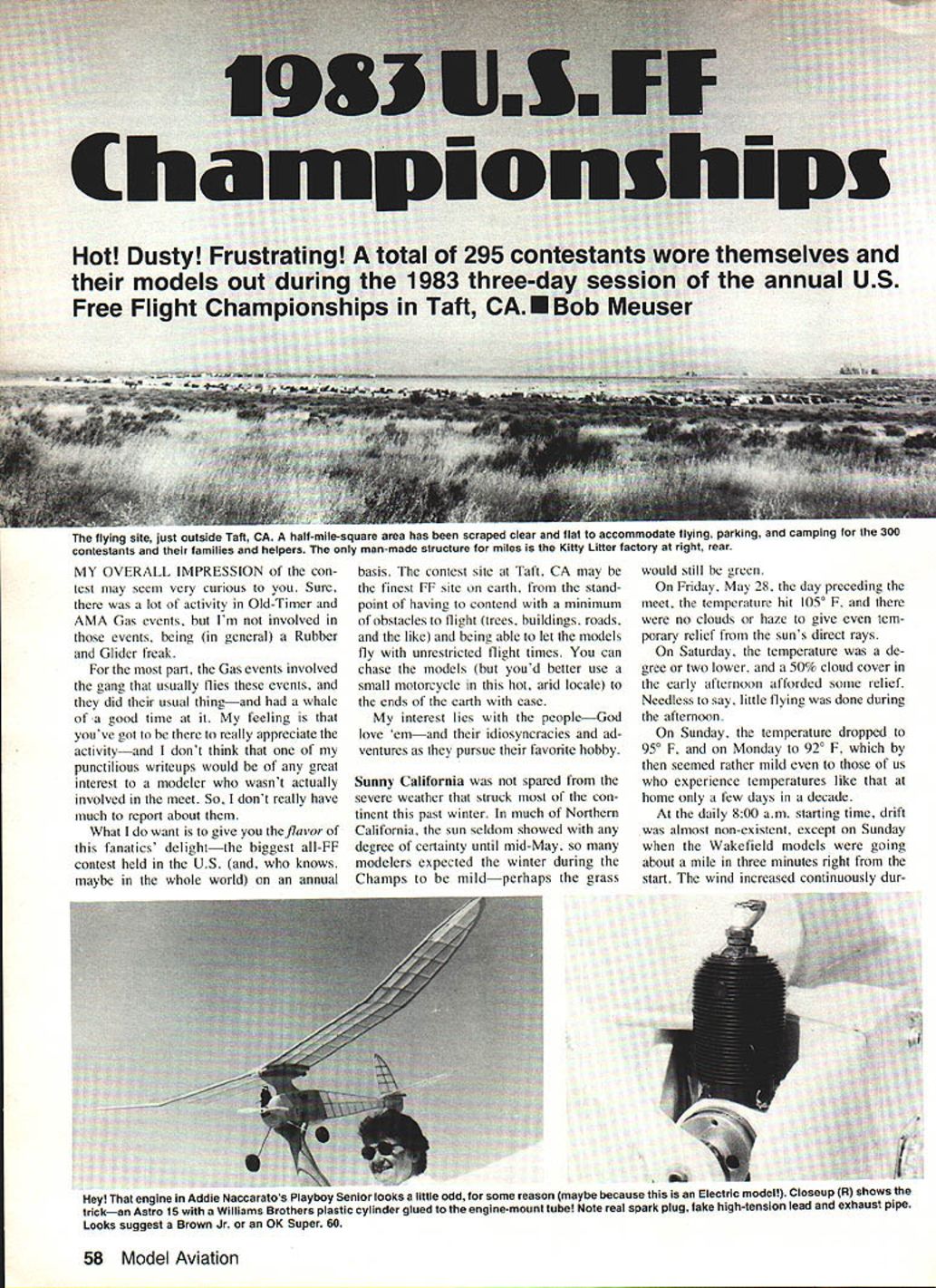
What I do want is to give you the flavor of this fanatics' delight—the biggest all-FF contest held in the U.S. (and, who knows, maybe in the whole world) on an annual basis. The contest site at Taft, CA may be the finest FF site on earth, from the standpoint of having to contend with a minimum of obstacles to flight (trees, buildings, roads, and the like) and being able to let the models fly with unrestricted flight times. You can chase the models (but you'd better use a small motorcycle in this hot, arid locale) to the ends of the earth with ease.
My interest lies with the people—God love 'em—and their idiosyncrasies and adventures as they pursue their favorite hobby.
Sunny California was not spared from the severe weather that struck most of the continent this past winter. In much of Northern California, the sun seldom showed with any degree of certainty until mid-May, so many modelers expected the weather during the Champs to be mild—perhaps the grass would still be green.
On Friday, May 28, the day preceding the meet, the temperature hit 105°F, and there were no clouds or haze to give even temporary relief from the sun's direct rays.
On Saturday, the temperature was a degree or two lower, and a 50% cloud cover in the early afternoon afforded some relief. Needless to say, little flying was done during the afternoon.
On Sunday, the temperature dropped to 95°F, and on Monday to 92°F, which by then seemed rather mild even to those of us who experience temperatures like that at home only a few days in a decade.
At the daily 8:00 a.m. starting time, drift was almost non-existent, except on Sunday when the Wakefield models were going about a mile in three minutes right from the start. The wind increased continuously during the day—occasional dead spells late morning—strong, steady blow during the afternoon.
Participation this year was high: 295 entries compared with an all-time high of 305. Seven women entered. The vast majority of contestants were from California—258. Washington was second with 5. Thirteen states were represented. Canada 4. England 2. Australia 1. The usual strong representation from Mexico didn't send.
I'll give you a glimpse of the madness. First, I'd better describe what the Taft contest site really is like. It's out in the middle of nowhere, on a flat, arid plain. An area about one-half mile square has been graded smooth and flat for the camping and flying. Contestants establish campsites along the edge of this area. I'd guess that there is a 1,500 ft. frontage of campsites, by the time everyone gets here. Although the contest doesn't begin until Saturday, by mid-Thursday, nearly all of the frontage-lot claims have already been staked. Latecomers pitch their shelters a row behind, or they go "sharesies" with the guys already there. However, it doesn't seem to be a big problem; those who want to get together in their efforts do, in fact, somehow get together.
I can tell you about some of the goofy things that took place within a frontage of about 30 ft., and I'd have been lucky to have caught a third of them. Multiply by 50 or 100 to get the total picture.
There was this one fellow, a noted Wakefield flier, who had become somewhat disgusted at his previous haphazard organizational method for preparing for a contest. So, he took an additional day off from work, laboriously wrote a list of the things he would need for the meet, and then packed the car according to the list. After the car was packed he thought to himself: "Wow, this organizing routine really pays off. The car's half empty!" The next day he discovered that he had forgotten to put "Wakefield models" on the list.
Next, there was the tall, bearded, cigar-eating FAI Power flier from the environs of Detroit. Pooped from the flying and the heat, he laid down for a nap on a six-buck plastic-and-aluminum chaise lounge. Two hours later he awoke, staggered out to his rented car, and found it eager for his departure with the left-front door still open and the engine still running!
Also present was this disgustingly well-organized young, but experienced, lad from England. His model was well-tuned, the rubber motor was wound to within a tenth of a percent of self-destruction, as planned, and the appropriate instant for launching had been properly selected. Nothing to do but light the fuse, record the max, and retrieve the model. No harm, nothing to it—simply routine. But there was a minor flaw in the planning: instead of lighting the fuse, the bloke lit the bloody wing!
And then there was the lad who pestered everyone in sight as to the potential causes for his motorcycle acting as if it were out of gas, when he knew for certain that the tank was full. Water in the gas? Clogged fuel lines? Float level thrown off by a recent crash? Poorly maintained battery gone sour? When the fuel lines were disconnected and nothing came out; it was a sure sign that they were clogged. However, putting a half-gallon of gas in the tank fixed everything.
There was also the photographer—completely intent on getting The Photo of the Century of Lillian Andrade catching Manny's Mulvihill model in midair after a mile-and-a-half chase, framing it perfectly, and then discovering that it is extremely difficult, at best, to get 39 exposures on a 36-exposure roll.
Competition Activity
I guess that I will start my reportage of the actual competition flying by looking at the "normal" events first. (Yes—by implication, I'll get to the "abnormal" events later.) Where to start? I'll play favorites and go to Glider and Rubber, first.
A-1 Towline Glider
Martyn Cowley broke the record he set in the A-1 Towline Glider event at last year's Champs with a total of 40:48 (2-min. maxes) and was followed by Mike McKeever and Rod Persons. Martyn's model had a full-house circle-tow zoom-launch capability (seldom seen on A-1's), which he employed to perfection. Steve Zink topped the Juniors' list.
A-2 Towline Glider
Jim Bradley of the 1983 U.S. Free Flight team won the A-2 Towline Glider event, followed by former Team Manager Dick Myers and Jose Dona. For his efforts, Jim was awarded the Tom Hutchinson Memorial Trophy. Tom was a friend of many Southern California fliers, and is well-known for his accomplishments in many phases of Free Flight. Towline Glider was one of his favorite events, and his designs have stood the test of World Championship competition. His wife, Rosemary, his mother, and his sister were on hand for the presentation.
Outdoor Rubber
- Regular Mulvihill: Bob White won the regular Mulvihill, with Cameron Booth taking the Junior Trophy.
- P-30 (30-in., plastic-prop, rubber-power): Clarence Mather won, with Channing Booth topping the Juniors.
- Coupe D'Hiver: Richard Rourke won.
Bob White sort of made up for his loss in the Unlimited Mulvihill event (we'll tell you more about that later) by winning the regular Mulvihill.
Wakefield
To merely report that the Wakefield event was won by Les DeWitt would be a gross understatement, for Les did it with style! He arrived at Taft a full two weeks before the Champs. Unable to secure accommodations in town, he, his pet cockatoo, and his long, black Cadillac Fleetwood camped out at the flying field the whole time. This afforded Les the opportunity to try every imaginable variation on the parameters of his polyhedral model and to get almost instant feedback of the effect. He started out by putting the CG back so far the model would do an outside loop once it got its nose down, then coached it forward until he got the sort of behavior he wanted. Next in line were variations of rudder and stab areas, stab airfoil torque-sensing control device, and the full-span flap travel-limits. That's right, flaps—and the travel limits of each of the four sections were independently adjustable! But then, in mid-afternoon each day, when it became too hot and windy, Les, the cockatoo, and the long, black Cadillac would retire from the field. Les' performances really proved the old adage that "Practice makes perfect."
Hand-Launched Glider (Outdoor)
We expected to see the Stoy "boys" do better in Outdoor Hand-Launch Glider, but that wasn't to be. The event was won by Martyn Cowley, former Editor of Aeromodeller magazine, with a near-record performance of ten 2-min. "maxes," plus 80 sec. Martyn used a model built just a few days earlier, which employed a unique fuse-operated pop-up-wing dethermalizer. Martyn was followed by Tulsa Glue-Dobbers Trophy winner Jim Lucken and Kevin Anderson. David Terzian won the Junior event.
FAI Power
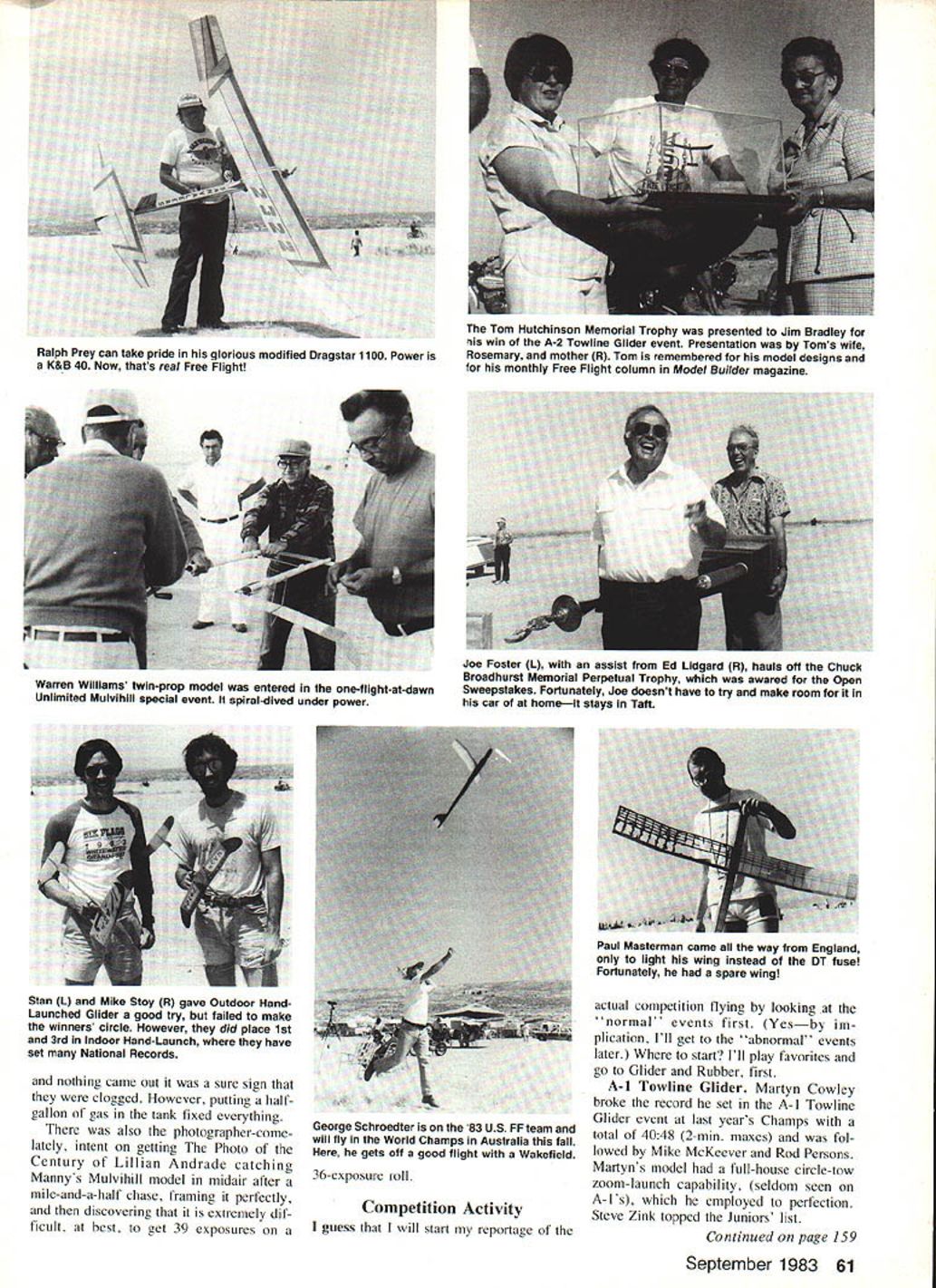
In addition to its primary role, the U.S. FF Champs afforded the opportunity for a final get-together for the team which will represent the United States at the forthcoming World Championships to be held in Australia this fall. The FAI-Power lads were not about to allow such an opportunity to slip past without adding a touch of class: the fliers who were not on the U.S. team organized themselves into pseudo-teams "representing" other countries.
- The "Russian" team, consisting of Doug Galbreath, Ken Olivernisky, and Ron Morganofskovich, won handily over the U.S. team.
- The Italian team was disqualified for having more than one model in the air at the same time.
- Rob Anderson of the U.S. Team won the event, with Marty Thompson taking second and Al Bissonnette third after a five-man flyoff.
For the U.S. team, winning was not the important thing—practicing together, as a team, was. The U.S. team is ready!
AMA Gas
These events were sort of dominated by Doug Galbreath, who won two of the five daytime events, Classes C and D. In addition to winning Class C, Doug set the high time for the meet, which won for him the Ocie Randall award and established a new national record for the event. Doug did it all with his NFFS Model of the Year Award-winning model, the 757 Summerwind, hauled aloft by an OS Max engine.
Other winners in the AMA Gas events included:
- Half-A Junior: Mike Keller
- Half-A Sr./Open: Bob Sunberg
- A Gas Junior: Paul Funk
- A Gas Sr./Open: Peter Sahlberg
- B Gas: Dave Wineland
Outdoor Flying Scale
Participation in these events was good, but not as good as it could be, considering that Southern California is the largest hotbed of Free-Flight Scale activity in the country.
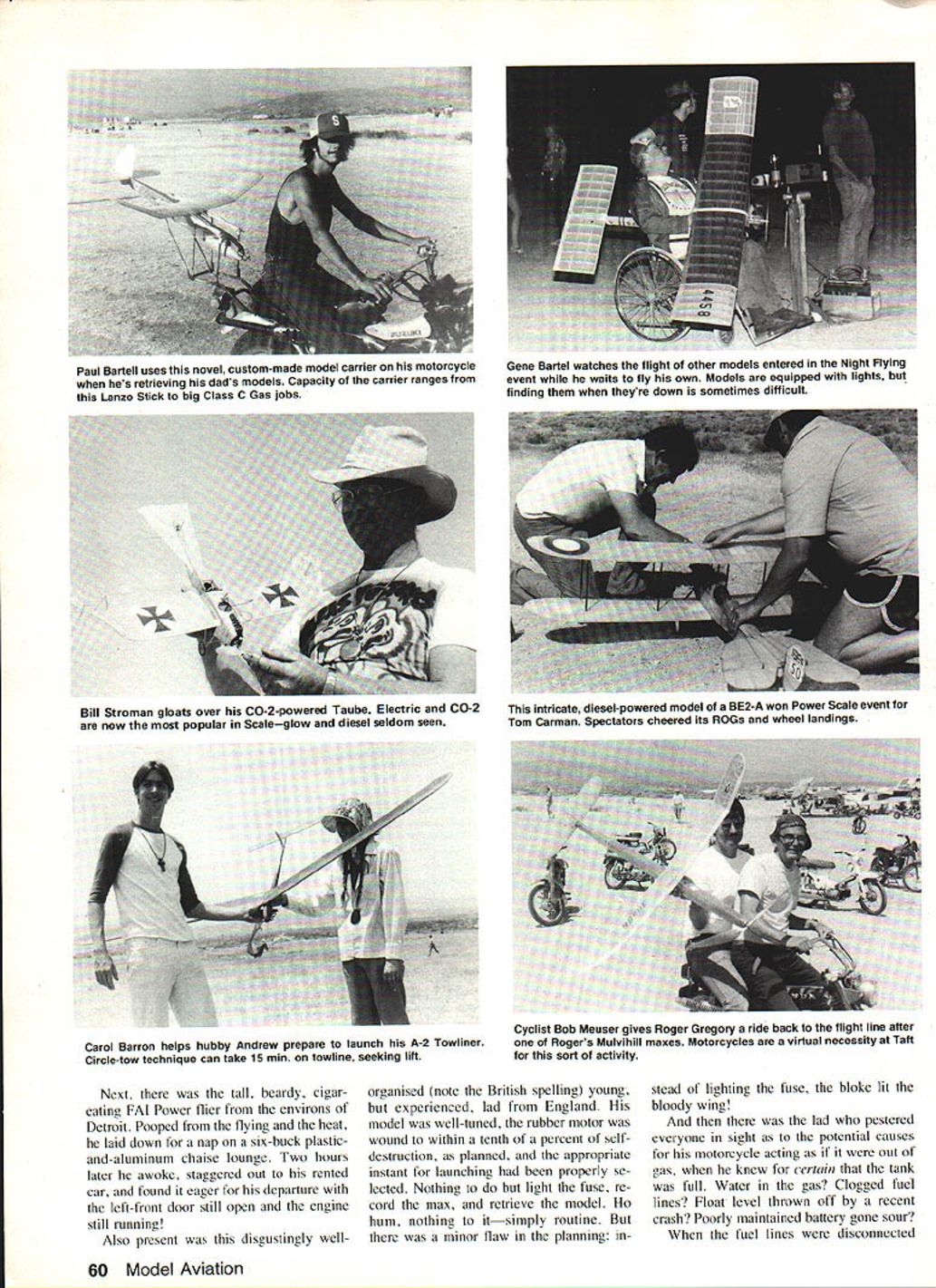
- Power (Outdoor): Tom Carman won with a huge ED Diesel-powered BE2-A biplane. His launch and two-point landing drew applause from the crowd. Roy Mayes, last year's winner, and his electric-powered Dormoy Bathtub had to settle for second place.
- Outdoor Peanut Scale: Farrell Papic
- Rubber Scale: Von Whitlock
- Jumbo Scale rubber-power (Ray Berrens trophy): Bill McConachie, flying his Curie Wott
Now, it's time for the "abnormal" events. They earn this pejorative title merely because they have some peculiarity in rules, model specifications, or flight schedule which takes them out of the ordinary. (Or just because I feel like it!)
Unlimited Mulvihill
This event, usually the first event of the contest albeit an unofficial one, was held on Sunday this year, rather than on Saturday as in the past. The contest is for traditional Mulvihill rubber-power models, and is flown within a 20-min. time-window starting at dawn.
Bob White's five-year winning streak was broken: turbulent air made his delicately-trimmed model stall, putting him in third place. "Mik" Mikkelson won with a flight of 10:29, followed by Joe Foster who flew 9:13. Mik's win was the result of an effort by a team headed by Loren Williams. Their models were designed especially for the event and are incredibly light: 57 to 64 grams without rubber, with prop-plus-noseblock assemblies weighing only 11 to 13 grams. But, except for Mik, all were done in by the same turbulence that ruined White's flight. Despite the rather poor conditions, exactly one-third of the field topped 7 minutes!
Timekeepers were pooled and assigned at random by the Event Director, with the provision that the contestant could reject the assignment and get another. It seemed that such a system could be a nightmare at dawn, but it worked. Spectator interest for the event was high, and there was no shortage of timers, although it would have been a comfort if some of them had volunteered their efforts a bit earlier. Youngest timers were the Terzians: Chris, 10, and David, 12. Young and not so experienced, perhaps, but they have eyes like eagles—which is about what it takes to see a model against the mountainside background in the poor light just after dawn.
Electric Power
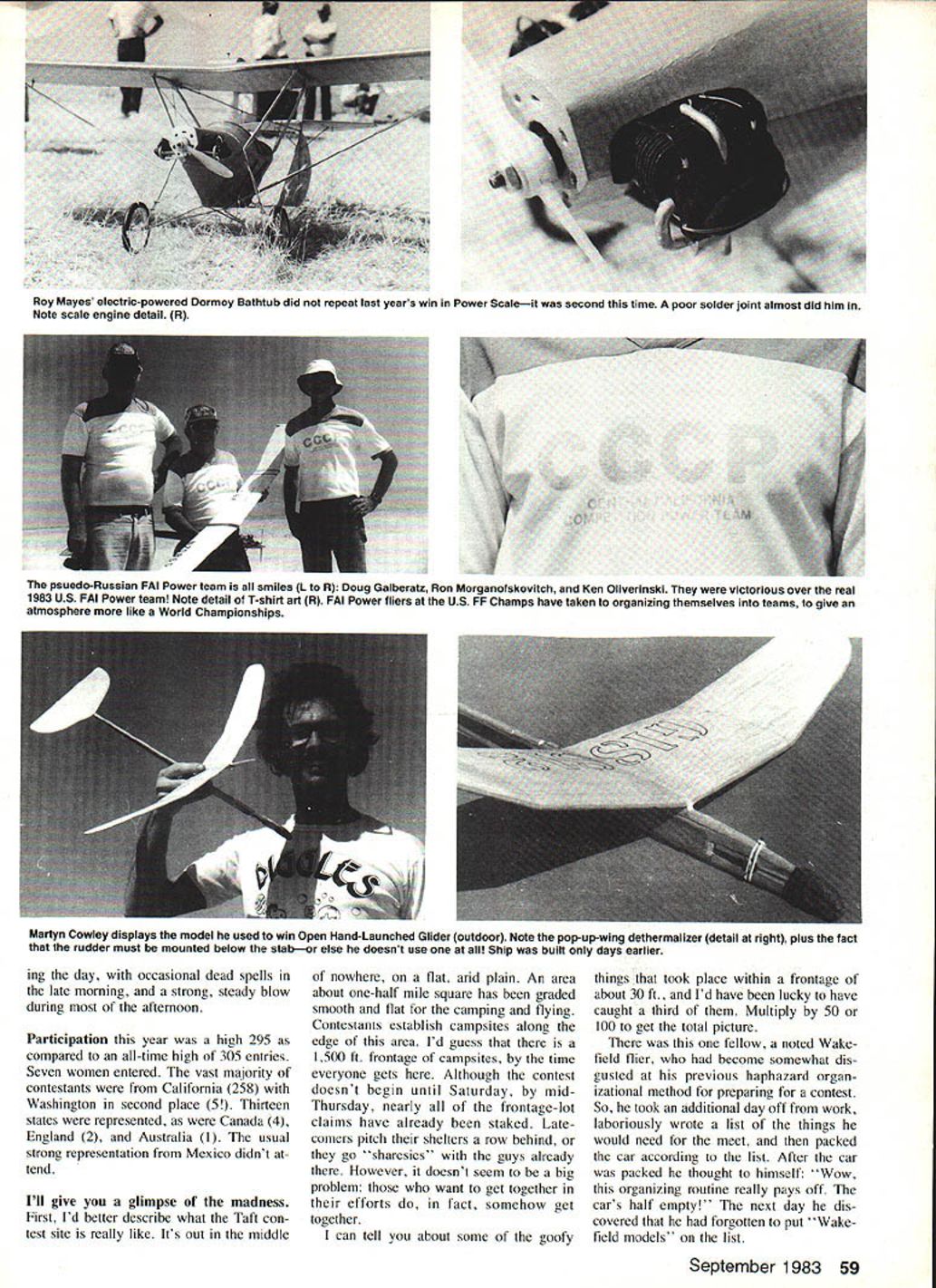
Although this is a "regular, rule-book" event, electric propulsion for Free Flight competition has never really quite gotten off the ground, somewhat disappointingly, so we were pleased to see a good turnout for the event, only recently added to the Champs menu. Jim McDermoth won flying a conventional pylon model of about 3-ft. span, powered by what appeared to be an Astro 020. Jim was followed by Addie Naccarato and Barnaby Wainfan. Addie flew an Old-Timer, a Playboy Senior powered by a direct-drive Astro 15 buried under a Williams Bros. cylinder that made it look for all the world like an Arden. Power was provided by a dozen 1,200 mAh sub-C Ni-Cds. Wainfan used a novel flying wing model.
Night Flying
Night Flying certainly speaks worlds about the dedication (and the mentality) of all true Free Flight devotees. Despite the small participation, Night Flying is always a thrill. The time-honored device for marking the flight path of the big, gas-engine models was a haywire concoction of batteries, wires, and light bulbs that often was shaken loose a few seconds after the launch. However, the advent of chemical glow-lights put an end to that; they're infinitely more reliable, worse luck!
There is usually very little wind in the early part of the night, and models seldom drift more than a half-mile during a five-min. "max" flight. But this year, the wind was relatively strong, with models drifting about two miles in their allotted five minutes. A good fraction of the models entered were lost during the event and not found until the next day. Tom Carman lost his on his first flight, which was a max. Forrest Staires won the event with a three-flight total of 11:10.
Old Timer
The 020 Replica event was first with 30-in. Strato Streaks, but there is nothing new about that. Clif Silva and Bill Cohen both did their flying from wheelchairs. Cohen won the Texaco event, flown under the old fuel-allotment rules, with a flight of 21:14.
Beyond that, here are some of the winners of the Old-Timer events:
- Rubber Stick: Gene Bartel
- Rubber Cabin: Carl Cogar
- 020 Replica: Dick Lyons
- A Pylon: Rudy Calvo
- A Cabin: Bruce Chandler
- B Pylon: Ken Kullman
- B Cabin: Bruce Chandler
- C Pylon: Leon Nadolski
- C Cabin: Bob Olsen
- Half-A Texaco: Carl Taylor
- Texaco: Bill Cohen
- 30-Second Antique: Bob Dittmer
Payload
It is a shame that this event isn't a more popular one, and it is difficult to see why it is not; only five entered. Tom Carman lost his model to a strong thermal that kept it going up even after it dethermalized on his first flight. The winner was 65-year-old John Drobshoff with a three-flight total of 6:44.
Nostalgia Gas
Nostalgia Gas events have shown a slow but steady increase in popularity and are now an official part of the Champs program. These events are for designs that appeared in the Forties and Fifties and are powered by early-design glow engines.
- Half-A Nostalgia Gas: Bill Valentine (total score 38:18)
- Combined A-B: Jack Moreland
- Combined C-D: Al Heinrich
Indoor
Just in case you thought I'd forgotten about them (how could I?), here are the Indoor results. They are neither "normal" nor "abnormal"—they're just "Indoor".
Peanut Scale
Peanut Scale was won by Ken Johnson flying a 1911 Cessna. He also entered a Clerget, which topped the static judging. A top flight time of 68 sec. was posted by Dick Baxter's LE7.
Novice Pennyplane
This inappropriately-named event was won by Earl Hoffman, who employed a novel flying technique. Ordinarily, fliers must back off on power so that their models don't climb above the light fixtures, which makes a hangup almost certain; just tickling the bottoms of the lights is OK. The motor stick on Earl's model bends a lot with a fully-wound motor, causing a nose-down flight attitude. So Earl's model bounces along with the prop hitting the floor for about two minutes until the motor relaxed and the motor stick straightened out to the point where the model would fly normally. The Easy-B event was won handily by Clarence Mather who is always in the top three.
Hand-Launched Glider (Indoor)
Inasmuch as Taft is the Mecca of Free Flight competition, a pilgrimage at least once during the lifetime of a true believer is mandatory. Stan Stoy Jr. decided it was high time he got around to it, and celebrated the occasion by winning the Indoor Hand-Launched Glider event with an incredible two-flight total of 69.7 sec. Ron Wittman took second place with 63.8 sec., followed by last year's winner Mike Stoy (61.8), with Ron's son Steve, now a Senior, in fourth (60.0). Top Juniors were Steve Zink, Ken Keegan, and Jeff Wittman. Ron's daughter is beginning to show an interest in Free Flight, so it seems as if we'll be seeing a lot of the Wittman tribe for some years to come.
Trophies and awards:
- Team Trophy: The Orbiters' team — Don Bartick, Clarence Mather, Bill Booth, Jr.
- Open Sweepstakes: Joe Foster (followed by Eugene Bartel and Andrew Barron)
- Junior Sweepstakes: Steve Zink
- High-Time trophy: Doug Galbreath (for his performance in C Gas)
This isn't the end—merely the conclusion of my report. There is no end. Free Flight is forever!
Transcribed from original scans by AI. Minor OCR errors may remain.

