
1984 Aerobatic World Championships
EIGHT HOURS in a noisy, chilly cargo plane. Three days of battling through low clouds and rain to get to the practice site, and another three struggling to get from there to the contest. By then, the glory of being one of the select few was starting to sound like sarcasm.
But once on the airfield, friends from past contests flocked around to offer warm greetings and a flood of questions. While all this was deep in the unfamiliar countryside of southeastern Hungary, the 12th biennial World Aerobatics Championships (August 12–27, 1984) was full of sights and sounds reminiscent of past championships.
Arrival and site
The edges of the field at Bekescsaba (Bek-esh-CHA-ba) were trimmed with pretty red and blue banners. The main hangar was almost covered with huge emblems of the national sports association (one of which included a crossed sledgehammer and submachine gun, for reasons that remained a mystery). Along one side of the field were many concession stands selling Pepsi (for about 11c, thanks to a heavily controlled economy), delicious sausages, cool beer, and a wide variety of souvenirs.
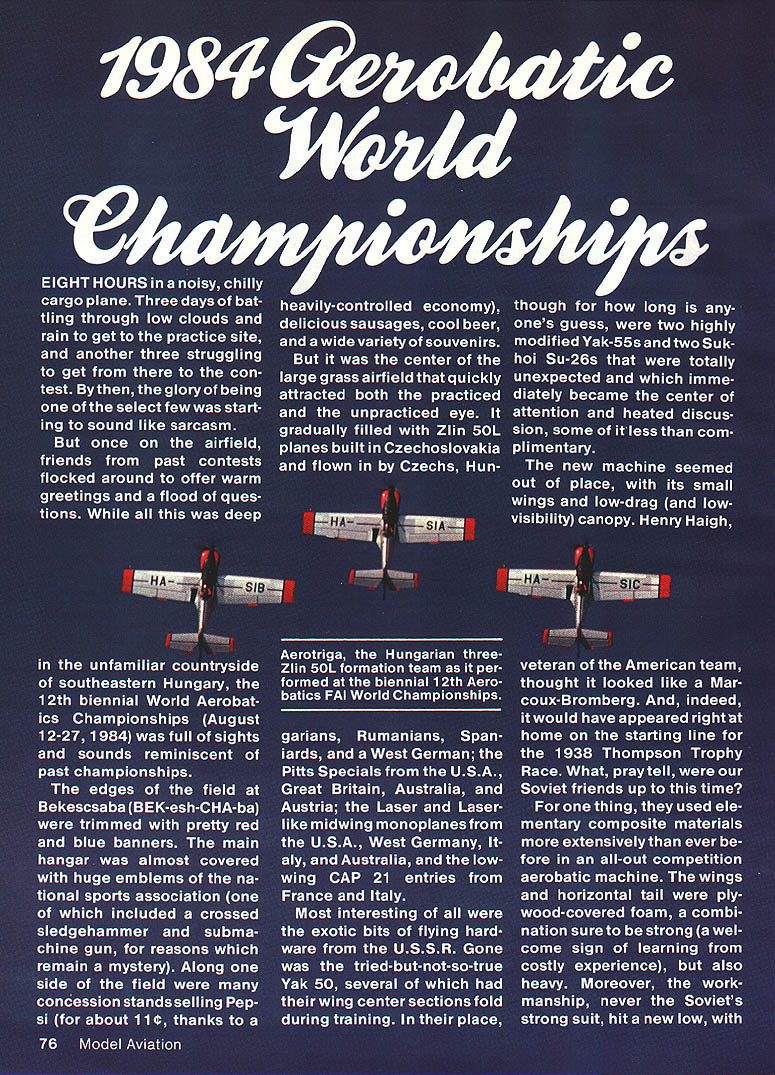
The center of the large grass airfield quickly attracted both the practiced and the unpracticed eye, gradually filling with aircraft from many countries.
Aircraft and teams
Types of airplanes present
- Zlin 50L planes (Czechoslovakia)
- Pitts Specials (U.S.A., Great Britain, Australia, Austria)
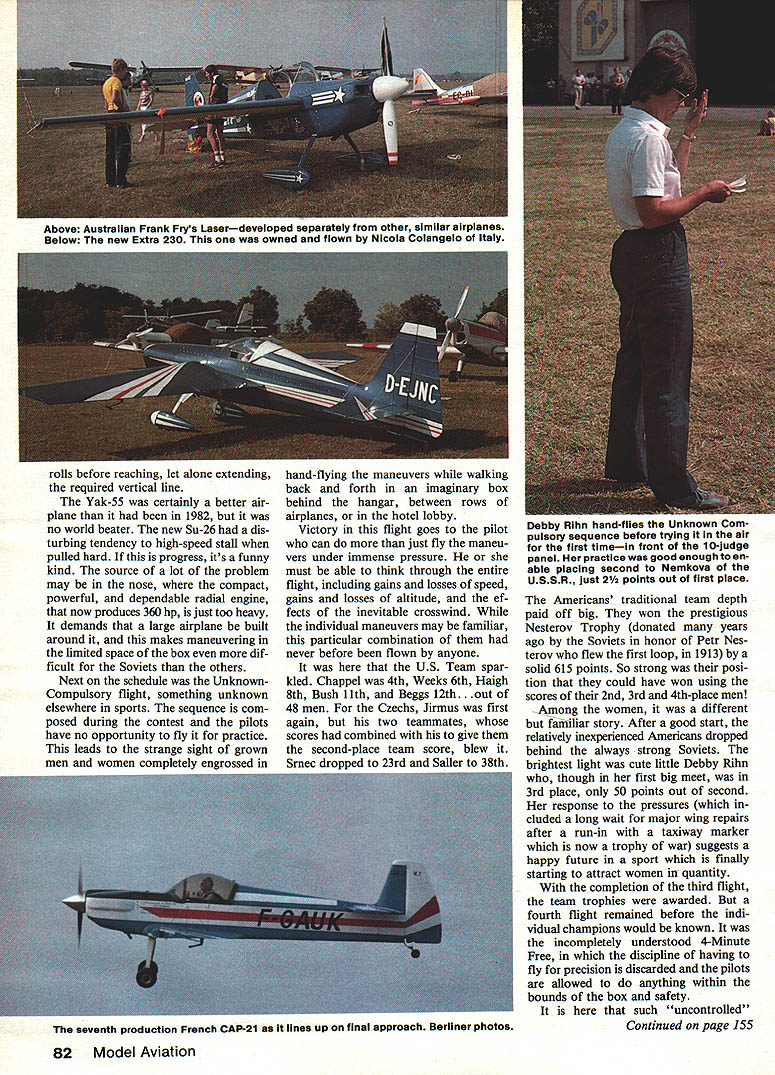
- Laser and Laser-like midwing monoplanes (U.S.A., West Germany, Italy, Australia)
- CAP 21 low-wing entries (France, Italy)
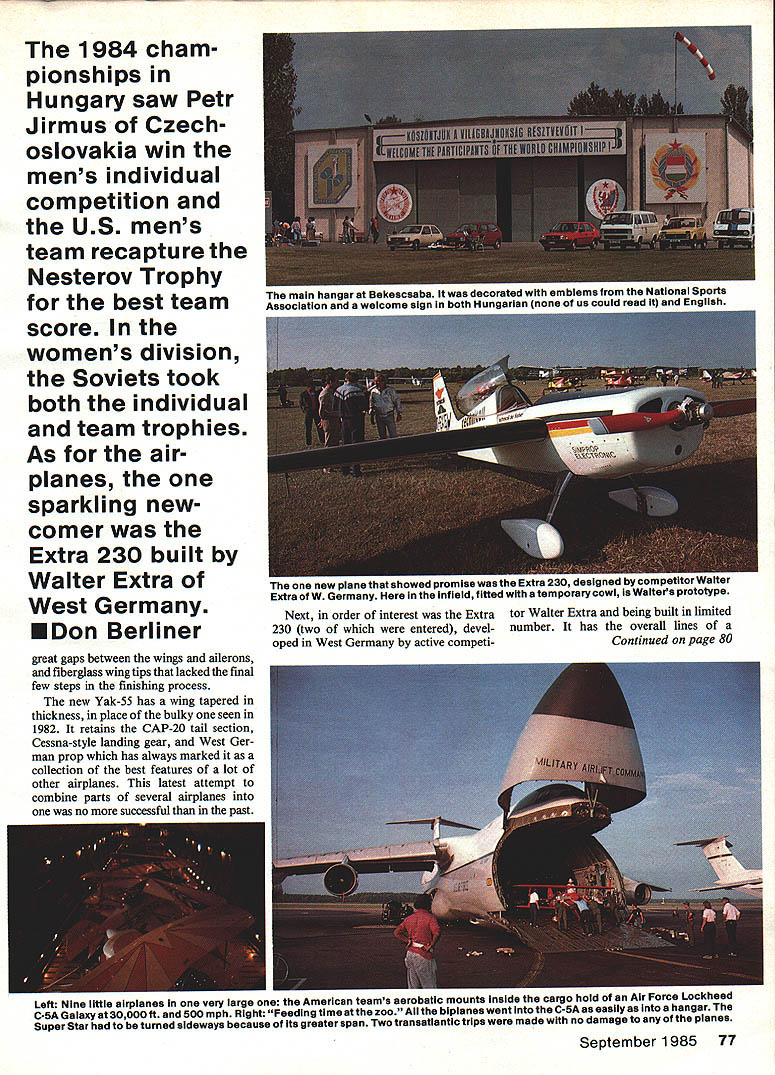
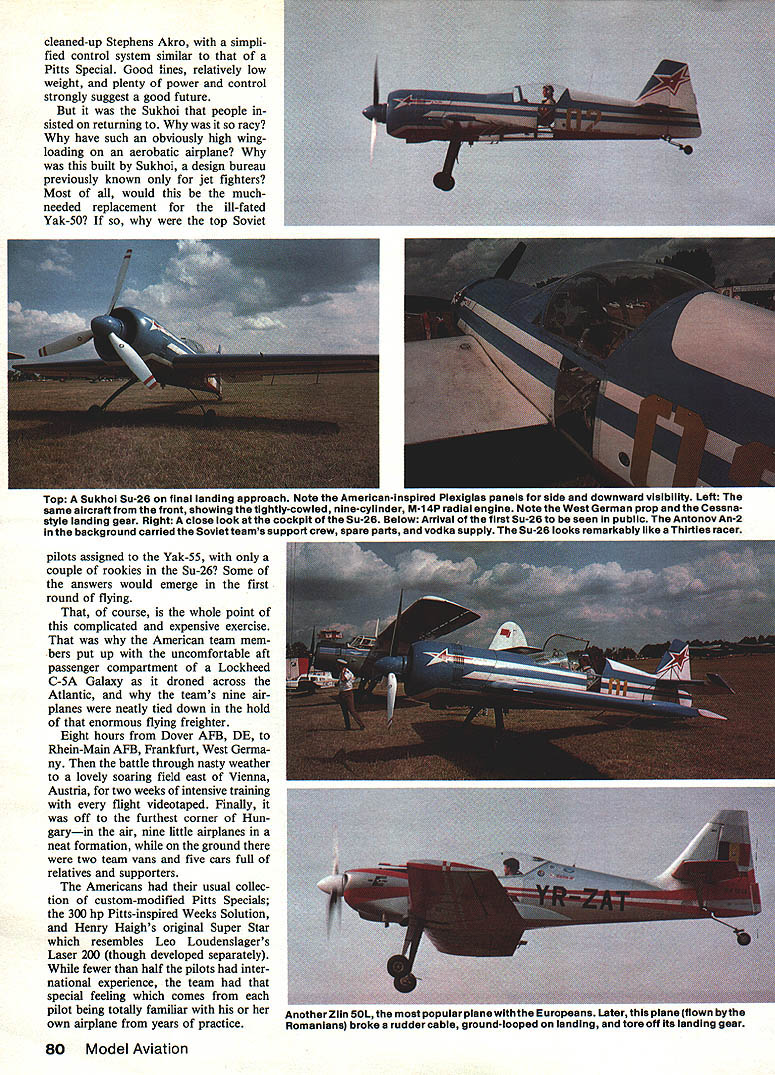
- Exotic Soviet entries: modified Yak-55s and Sukhoi Su-26s
Most interesting were the Soviet machines. The tried-but-not-so-true Yak-50 was gone (several had suffered wing-center failures during training). In its place were two highly modified Yak-55s and two Sukhoi Su-26s, which immediately became the center of attention and heated discussion.
Observations about the Soviet airplanes:
- Greater use of composite materials than before: wings and horizontal tails were plywood-covered foam — strong but heavy.
- Workmanship was uneven, with gaps between wings and ailerons and unfinished fiberglass wingtips.
- The new Yak-55 had a tapered-thickness wing (an improvement over 1982), retained a CAP-20 tail section, Cessna-style landing gear, and a West German prop — essentially a collection of parts from several designs.
- The Su-26 was a racy, high-wing-loading design from the Sukhoi bureau (better known for jet fighters), seen by some as a needed replacement for the Yak-50. It showed a disturbing tendency to high-speed stall when pulled hard; its compact radial engine (about 360 hp) made for a heavy nose and required a larger airframe.
Other notable new types included the Extra 230 (two entered), developed by competitor Walter Extra in West Germany. It combined good lines, relatively low weight, plenty of power, and a simplified control system — promising despite a projected price near $75,000.
American team and preparation
American team members endured the uncomfortable aft passenger compartment of a Lockheed C-5A Galaxy as it droned across the Atlantic. The team's nine airplanes were tied down in the hold of the enormous freighter. After eight hours (Dover AFB to Rhein-Main AFB, Frankfurt) the team battled nasty weather to a soaring field east of Vienna, Austria, for two weeks of intensive training; flights were videotaped.
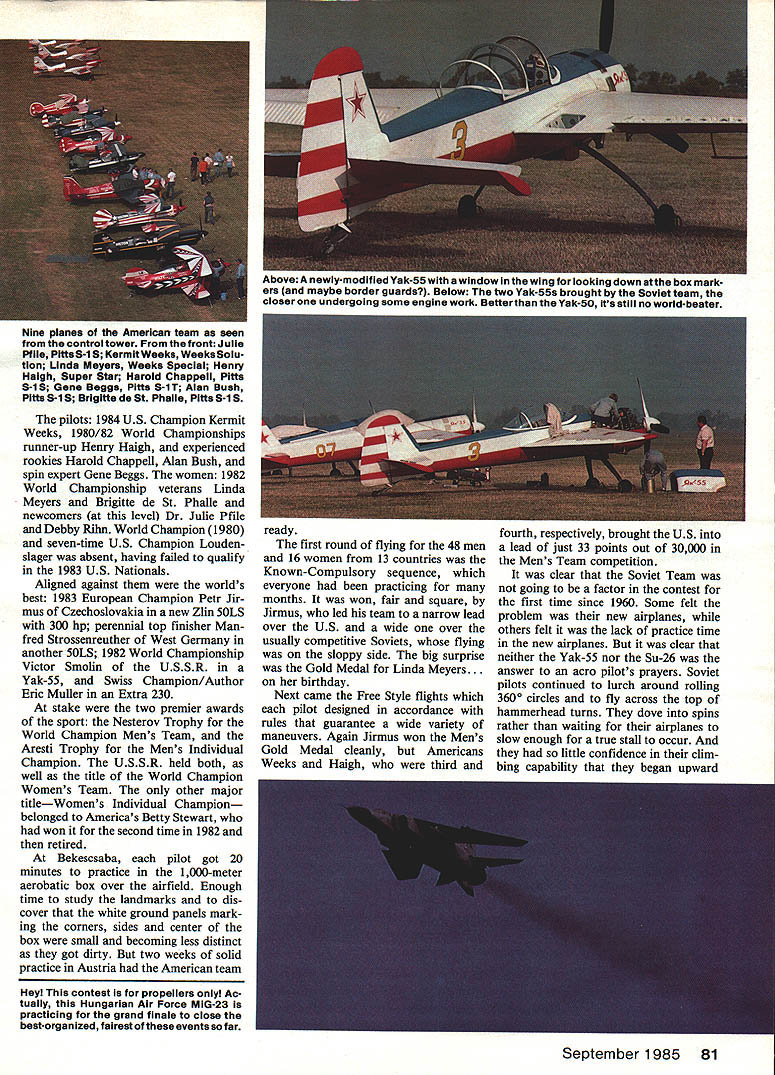
Finally, the team flew to Hungary. On the field were nine little airplanes, two team vans, and five cars full of relatives and supporters. The Americans had a collection of custom-modified Pitts Specials (300 hp), the Pitts-inspired Weeks Solution, and Henry Haigh's original Super Star (which resembles Leo Loudenslager's Laser 200, though developed separately). The team's strength came from pilots being totally familiar with their own airplanes after years of practice.
American pilots:
- Kermit Weeks — 1984 U.S. Champion
- Henry Haigh — 1980/82 World Championships runner-up
- Harold Chappell — experienced rookie
- Alan Bush — experienced rookie
- Gene Beggs — spin expert
American women competitors:
- Linda Meyers — 1982 World Championship veteran
- Brigitte de St. Phalle — 1982 veteran
- Dr. Julie Pfile — newcomer
- Debby Rihn — newcomer
Note: Leo Loudenslager (1980 World Champion and seven-time U.S. Champion) was absent, having failed to qualify at the 1983 U.S. Nationals.
Key international competitors
- Petr Jirmus (Czechoslovakia) — 1983 European Champion; new Zlin 50L-5, 300 hp
- Manfred Strossenreuther (West Germany) — perennial top finisher; Zlin 50L-5
- Victor Smolin (U.S.S.R.) — 1982 World Champion; Yak-55
- Eric Müller (Switzerland) — Extra 230
Competition format and practice
At Bekescsaba each pilot got 20 minutes to practice in the 1,000-meter aerobatic box over the airfield — enough time to study the landmarks and discover that the white ground panels marking the corners, sides, and center of the box were small and became less distinct as they got dirty. Two weeks of solid practice in Austria had the American team ready.
Rounds flown:
- Known-Compulsory — sequences everyone had been practicing for months.
- Free Style — pilots design their own sequence within rules that require a wide variety of maneuvers.
- Unknown-Compulsory — sequence composed during the contest; pilots have no opportunity to practice it before flying. This forces intense mental preparation and walking-through of the box and maneuvers.
- 4-Minute Free — pilots have 4 minutes to fly anything within box and safety limits; emphasis is on spectacle and maximum performance (lomcevak variations, torque rolls, etc.).
Competition highlights and results
Known-Compulsory
- Men: Petr Jirmus won the Known-Compulsory, leading his team to a narrow lead over the U.S. and a wide lead over the Soviets, whose flying appeared sloppy.
- Women: The big surprise in this round was a Gold Medal for Linda Meyers.
Free Style
- Men: Petr Jirmus again won the Men's Free Style clearly. Americans Kermit Weeks and Henry Haigh placed third and fourth in the Free Style, bringing the U.S. into a narrow lead (about 33 points out of roughly 30,000) in the Men's Team competition.
Unknown-Compulsory
- The U.S. team performed exceptionally well under the pressure of the Unknown-Compulsory. Individual American placings among 48 men: Harold Chappell 4th, Kermit Weeks 6th, Henry Haigh 8th, Alan Bush 11th, Gene Beggs 12th.
- For the Czechs, Jirmus was first again, but teammates Srnec and Saller dropped to 23rd and 38th respectively, costing the team.
- Team result: The U.S. won the prestigious Nesterov Trophy (World Champion Men's Team) by a solid 615 points. Their depth was such that they could have won using the scores of their 2nd, 3rd, and 4th-place men.
Women's competition
- The relatively inexperienced American women dropped behind the strong Soviet women's team. Debby Rihn, in her first major meet, held 3rd place overall at one point and finished with an overall Bronze Medal despite wing repairs after striking a taxiway marker during practice.
- Linda Meyers finished sixth overall; Dr. Julie Pfile finished ninth.
- Final Women's Champion: Khalide Makaganova (U.S.S.R.). The U.S.S.R. retained a strong presence in the women's events.
4-Minute Free and final individual standings
- The 4-Minute Free emphasizes maximum, often uncontrolled, maneuvers. Kermit Weeks was the favorite (and 1982 Gold Medallist) with his powerful Weeks Solution; his opening torque roll — seven full rolls straight up and four more while sliding down backwards — set the tone for the winning 4-Minute flight.
- Petr Jirmus flew more cautiously in the 4-Minute to protect his lead, finished third in that flight, and held on to first place overall.
- Victor Smolin (defending champion) had a lackluster defense, placing ninth in the 4-Minute and fifth overall for the contest.
Final men's individual results (top):
- Petr Jirmus — Aresti Trophy (Men's Individual Champion) — won by more than 300 points out of ~16,000
- Manfred Strossenreuther — second place
- Kermit Weeks — third place
- Henry Haigh — fourth place
Women:
- Champion: Khalide Makaganova (U.S.S.R.)
- Debby Rihn — Bronze (3rd)
- Linda Meyers — 6th
- Dr. Julie Pfile — 9th
Aircraft performance and rankings
- The top two placings were Zlin 50L-5s; among the top 10 were two Yak-55s, two Pitts Specials, three mid-wing monoplanes, and the Weeks Solution — three biplanes and seven monoplanes.
- Zlin was the big favorite among European teams; 22 pilots flew Zlins. In Eastern Europe and some Western countries without a strong homebuilt movement, the Zlin dominated. Elsewhere in the West, homebuilt-based designs like the Pitts and mid-wing monoplanes were more common.
- Of new types, the Extra 230 looked most promising. The improved Yak-55 and the Su-26 did not impress as world-beaters; rumored plans to boost the Su-26 to 420 hp seemed questionable given handling concerns.
Judging, fairness, and the future of the sport
World Championship aerobatics had come a long way since the politically charged 1980 meet, which was so dominated and manipulated by Soviet officials that results bore little relation to flying. The introduction of the Bauer System — a computer analysis of each judge's scoring consistency — pretty well eliminates national-bias cheating and points things back in the right direction. The contest operation at Bekescsaba was as fair and as efficient as anyone had yet seen.
Looking ahead:
- The next World Championships were scheduled for August 1–17, 1986, at Cranfield, England, with excellent facilities (6,000-foot hard-surface runways, large hangars, and dormitories on the field).
- Aerobatic airplane design will likely see much more use of composite materials (high strength-to-weight ratio), permitting new configurations beyond the traditional strut-braced biplanes and cantilever monoplanes.
- Despite technological progress, the predominance of the pilot over the airplane should remain. It will still take hundreds of hours of practice in a top-notch machine to reach the Aresti and Nesterov trophies.
The World Championships began in 1960 and have since produced performances that earlier aviators might have thought impossible.
Transcribed from original scans by AI. Minor OCR errors may remain.

