
1986 Nats: CL Combat
Charlie Johnson
CL Combat
Site and conditions
Combat was flown Saturday morning at the Nationals. Other Combat events were flown during the week, but the heart and soul of the competition occurred during a three-hour period on Saturday. It was extremely hot during Combat Week, and many memories from the event may have been seared by the heat; this report therefore highlights the high points rather than giving a strict chronological account.
The event site was within a block of the Nats AMA headquarters and offered nice grass with lots of room for official flying and testing. There was no rain, barely any wind, and very high temperature and humidity. Official highs were in the 90s, but on-site air temperature reached as high as 108°F in the shade over grass. The heat wore out engines, affected engine runs, and shortened tempers. The conditions encouraged many to just “get it over with,” rather than fully enjoy the Nationals. Each winner received a trophy and an “I survived Lake Charles” T-shirt.
Slow Combat
Slow Combat was largely as expected, with the Fox .36 engine dominant and a few Supertigres and a new Cipolla .36 appearing. Don Cranfill was the star of the show with excellent flying, as were Michael Willcox, Marvin Denny, and many others. Michael Willcox chose to fly with the Open contestants after his big win at the Northwest’s Bladder Grabber earlier in the month; his outstanding performance made many Open contestants wish he’d stayed with the younger fliers.
More good airplanes are being flown by more people than before. Marvin Denny’s all-wood model with wing flaps was very impressive, as was Cranfill’s wood model with a foam leading edge. Willcox’s all-foam models weren’t quite as impressive as the others, but Cranfill still managed to beat Michael Willcox when it counted. The soft-cell fuel pod seems to have lost some of its appeal, though a few contestants still used them.
As you look through the official Nats results, keep in mind that total entries were down in every Combat event. All events were flown double-elimination, which made winning especially tough; total entry a decade earlier had been higher.
Junior and Senior ranks
With John Stubblefield flying for the U.S. team at the Hungarian World Champs and Michael Willcox flying in Open, the door opened for new talent in the Junior and Senior ranks. Andy Miner did well in Junior, and his older brother Cary did well in Senior. Their stiffest competition came from Team Olson (Abbie in Junior and Aimee in Senior). The Miner brothers prevailed in the head-to-head battles; both Juniors and Seniors flew well and showed good sportsmanship.
FAI Combat
FAI day turned out to be the longest — from the tentative pilots’ meeting at 7:30 a.m. until the event ended at 7:00 p.m. Having 14 entrants made the event feel like it needed major editing. Event management had promised to finish by a little after noon, but things dragged into the late afternoon.
As Slow Combat appeared to be in Cranfill’s pocket, he faded toward the end and let Pat Willcox and Howard Rush sneak by. Don said the heat really affected him late in the day, and a 99% effort wasn’t enough against Pat Willcox. Cox .15 engines seemed to suffer from the heat more than Nelson .15s, although Nelsons had their share of sour runs. Pitmen were careful not to flood engines because high heat and direct sunlight kept engines low on boil if they hadn’t been run.
Howard Rush used superior technology and a lot of carbon fiber. The howling Nelson proved to be top-speed king. FAI pilots and others are thinking about building battering-ram models under the new 1.6-oz minimum FAI rule. Howard is planning an even-more-rigid engine-mount structure so that he gets more power. There were only a couple of flyaways, which is low for FAI where a large pilots’ circle increases the chance of control-line breaks from tangles.
Half-A Combat
Half-A Combat has been an official event since 1985 (after many years as an unofficial event) and has suffered decreased entries both years. Some FAI pilots and pit crews were too tired to make the Wednesday finals. The event was flown fairly casually, with only a couple of kills during the first two rounds.
Things tightened up around round three. Larry Driskill, winner of the previous two Nats 1/2A events and trying for a third, suffered a series of fuel-bladder failures that took him out of contention. He let Pat Willcox use his model — and Pat wound up winning the event, so Driskill’s model won three years in a row. Pat had to fly against Michael in the final; this time the outcome went in Pat’s favor, unlike their Slow Combat semifinal match where Michael prevailed.
AMA Precision Scale
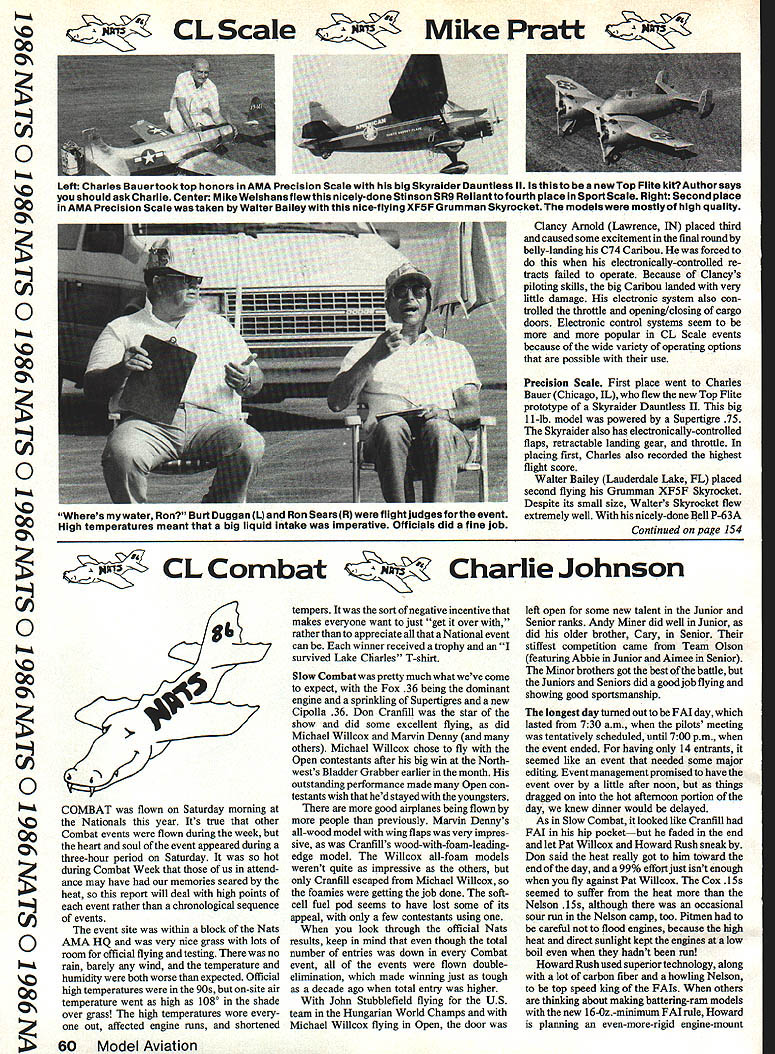
- First place: Charles Bauer, Chicago, IL — flew a new Top Flite prototype Skyraider Dauntless II, an 11-lb. model powered by a Supertigre .75. The Skyraider featured electronically controlled flaps, retractable landing gear, and throttle. Charles also recorded the highest flight score.
- Second place: Walter Bailey, Lauderdale Lakes, FL — flew a Grumman XF5F Skyrocket. Despite its small size, the Skyrocket flew extremely well.
- Other notable entries: A nicely done Bell P-63A was present and judged favorably. Wayne Foster flew his Competition Corner model and continued to add variety and interest to the event; his designs, along with those from Driskill, fly very nicely.
Nats CL Combat (Fast Combat)
Format and aircraft
Fast Combat, like Slow, was dominated by the Fox .36 engine with occasional Supertigres and one Cipolla .36. Foam is now the material of choice for quick construction, whether all-foam or foam leading edge with wood aft, as seen in McFadden’s models. Marvin Denny used an all-wood model to good advantage, placing well.
Event Director Gary Arnold ran three rounds of Fast Combat on Friday and saved the rest for Saturday morning. That decision proved wise and set the stage for exciting Saturday flyoffs.
Finals and results
The three rounds on Friday were a welcome relief compared to the other days; only about a half-dozen fliers were eliminated before Saturday’s competition began. The finals made up for much of the week’s agony — spirits were higher and nearly every match was a good one.
Marvin Denny was six wins and one loss after seven rounds and seemed poised to win. Tom Fluker was also six wins/one loss after seven rounds. Marvin then flew Pat Willcox (who was five wins/one loss) and lost, making Marvin six/two. Fluker and Willcox then flew off, with Fluker winning and becoming National Combat Champion with a 7–1 record. Both Marvin Denny and Pat Willcox finished 6–2 and flew off for second and third; Pat Willcox prevailed to place second.
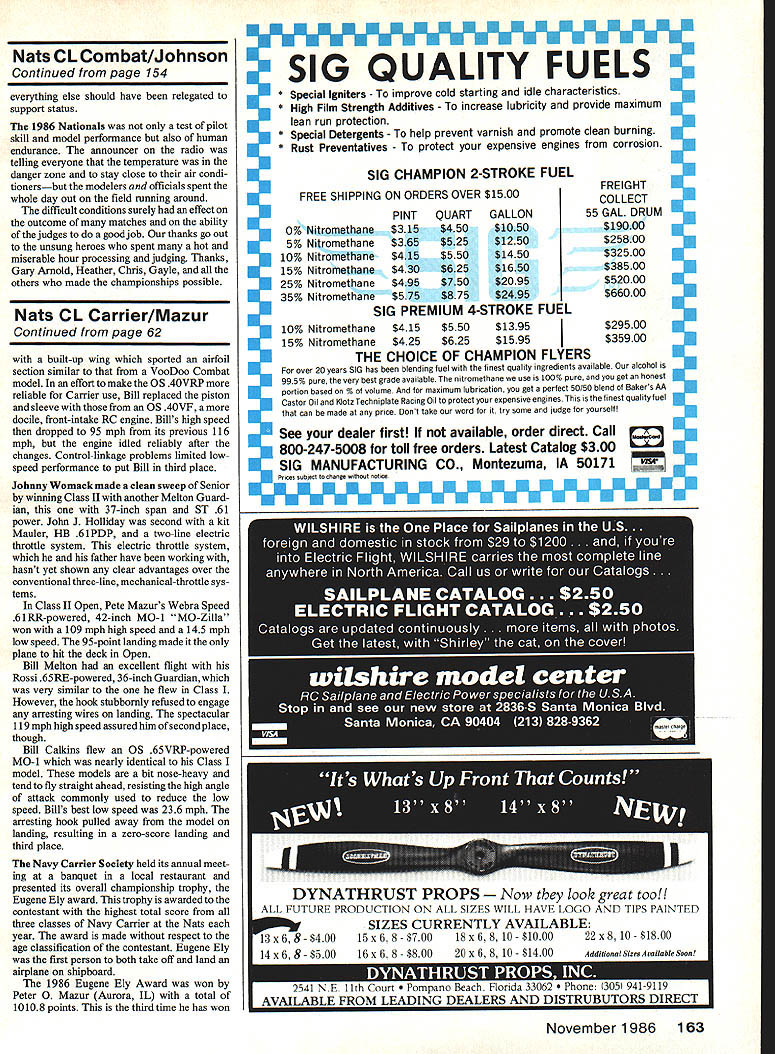
The final hours featured fast, furious action, drama, and suspense. Many felt Fast Combat was the "Top Gun" event and that other events were in supporting roles.
Conditions, judging, and thanks
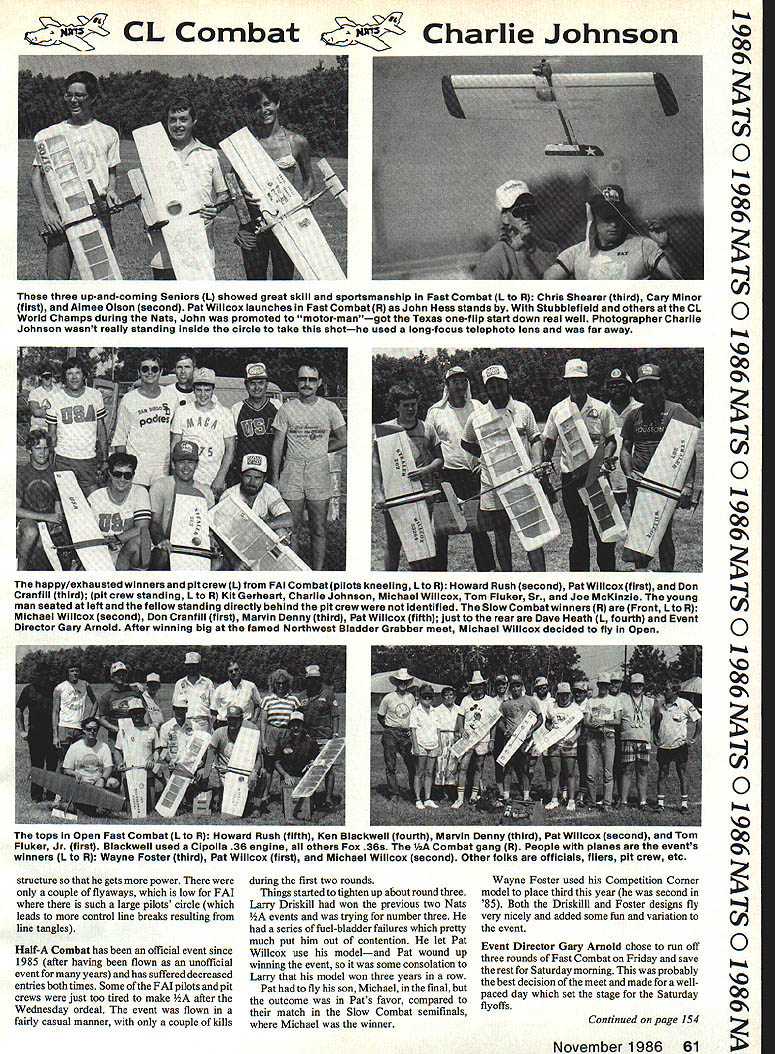
The 1986 Nationals were as much a test of human endurance as of pilot skill and model performance. Announcers warned that temperatures were in the danger zone and to stay close to air conditioners, yet most modelers and officials spent the whole day out on the field.
The difficult conditions affected match outcomes and the judges’ ability to do their jobs. Many unsung heroes spent hot, miserable hours processing and judging. Thanks go to Gary Arnold, Heather, Chris, Gayle, and all the others who made the championships possible.
Transcribed from original scans by AI. Minor OCR errors may remain.

