
1986 Nats: CL Aerobatics
By Lou Dudka
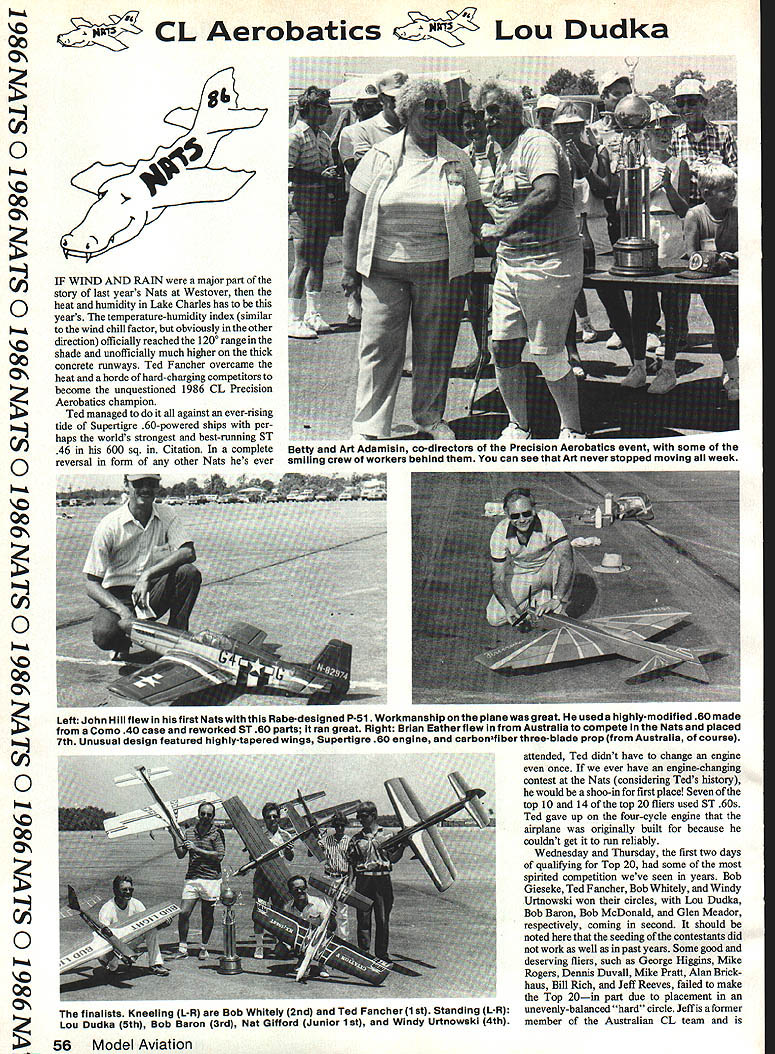
If wind and rain were a major part of the story of last year's Nats at Westover, then the heat and humidity in Lake Charles have to be this year's. The temperature-humidity index (similar to the wind-chill factor, but obviously in the other direction) officially reached the 120° range in the shade and unofficially much higher on the thick concrete runways. Ted Fancher overcame the heat and a horde of hard-charging competitors to become the unquestioned 1986 CL Precision Aerobatics champion.
Ted managed to do it all against an ever-rising tide of Supertigre .60-powered ships, with perhaps the world's strongest and best-running Supertigre .46 in his 600 sq. in. Citation. In a complete reversal of form from any other Nats he's ever attended, Ted didn't have to change an engine once. If we ever have an engine-changing contest at the Nats (considering Ted's history), he would be a shoo-in for first place! Seven of the top 10 and 14 of the top 20 fliers used Supertigre .60s. Ted gave up on the four-cycle engine the airplane was originally built for because he couldn't get it to run reliably.
Wednesday and Thursday, the first two days of qualifying for Top 20, had some of the most spirited competition we've seen in years. Bob Gieseke, Ted Fancher, Bob Whitely, and Windy Urtnowski won their circles, with Lou Dudka, Bob Baron, Bob McDonald, and Glen Meador, respectively, coming in second. It should be noted here that the seeding of the contestants did not work as well as in past years. Some good, deserving fliers, such as George Higgins, Mike Rogers, Dennis Duvall, Mike Pratt, Alan Brickhaus, Bill Rich, and Jeff Reeves, failed to make the Top 20 — in part due to placement in an unevenly balanced "hard" circle. Jeff is a former member of the Australian CL team.
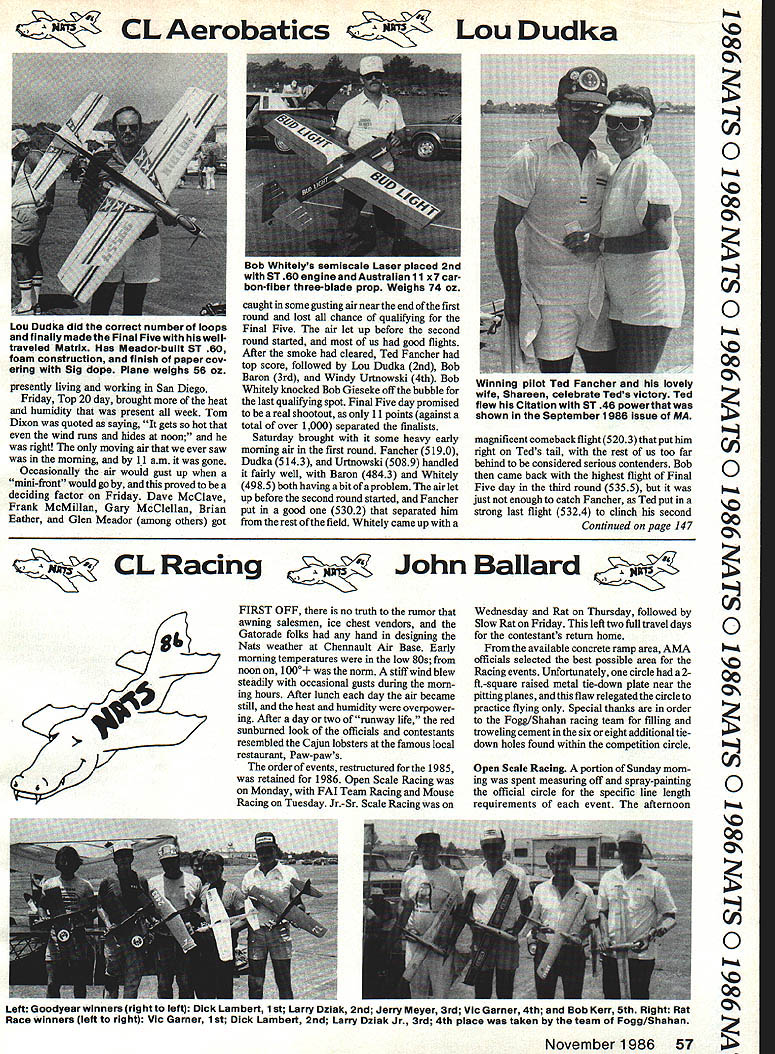
Friday — Top 20 day — brought the heat and humidity present all week. Tom Dixon was quoted saying, "It gets hot — the wind runs, and by noon the right-moving air is gone; the worst I've ever seen by 11 a.m." Occasionally the air would gust up a mini-front which proved the deciding factor Friday. Dave McClave, Frank McMillan, Gary McClellan, Brian Eather, Glen Meador, among others, got caught in some gusting air near the end of the first round and lost their chance at qualifying. The air let up before the second round started and we saw good flights. After the smoke cleared, Ted Fancher had the top score followed by Lou Dudka (2nd), Bob Baron (3rd), and Windy Urtnowski (4th). Bob Whitely knocked Bob Gieseke off the bubble, the last qualifying spot. Final Five day promised a real shootout — 11 points out of a total over 1,000 separated the finalists.
Saturday brought some heavy early morning air. In the first round Fancher scored 5,190, Dudka 5,143, and Urtnowski 5,089 — all handled fairly well. Baron had 4,843 and Whitely 4,985, both having a bit of a problem. The air let up before the second round started. Fancher put up a good 5,302, separating him from the rest of the field. Whitely came up with a magnificent comeback flight, 5,203, putting him right on Ted's tail; the rest were too far behind to be considered serious contenders. Bob came back with the highest flight of Final Five day, third round, 5,355 — just enough to catch Fancher. Ted put in a strong last flight, 5,324, to clinch second.
There is no additional body text of the "1986 Nats: CL Aerobatics" article on this scanned page beyond photo captions and images. The remainder of the Aerobatics article continues on a different page; this page contains photos/captions and the start of the separate "CL Racing" article.
Whitely's plane was initially designed by fellow West Coaster Gild Adkisson, and Bob had added his own modifications. It was an unusual semiscale version of a Bud Light Laser weighing 74 oz. with an enormous fuselage and 740 sq. in. wing area. Power was a Supertigre .60 with an Australian Bolly 11 1/4 x 7 three-blade carbon-fiber prop that was cut down to 11 in.
Bob Baron finished third, and his flying looked much better than it did at Westover and at last year's FAI Team Finals.
Windy Urtnowski flew his Louisiana Lightning to a fourth-place spot. The gorgeous workmanship, combined with the prettiest rudder I've seen in years, made this plane one of the most attractive ones at the Nats.
Lou Dudka (5th) managed to do the correct number of inside and outside loops in all of his official flights. He combined this newfound ability to count along with some good flying to qualify his year-old Matrix in the Final Five for the first time.
Bob Gieseke took last year's 60 Nother to a 6th-place finish. He seemed to be flying better. Had it not been for the extremely tough level of competition, he probably would have been a finalist.
Continued from page 147
Brian Eather (7th) came all the way from Australia and chose to compete at the Nats instead of the World Championships. Believe it or not, he was also the Rookie of the Year, since this was his first Nats! He showed that he is a world-class flier and a gentleman. He was well-liked by all, and we hope to see him again.
Glen Meador flew his last year's Eagle to an 8th-place finish. He posted the highest qualifying round score of anyone on his second flight on Thursday.
Bob McDonald flew a .60-powered ship for the first time and looked better than ever on his way to a 9th-place finish. You have to see his plane in person to appreciate all the technology in it.
Tom Dixon rounded out the Top 10 with a .61 in last year's ship. Tom is now importing the Menco into the U.S. His engine sounded good, and it may prove to be an alternative to the Supertigre .60.
The rest of the Top 20 qualifiers (11th through 20th) were:
- Frank McMillan
- Frank Williams
- Don Melanson
- Don McClave
- Gary McClellan
- Jim Armour
- Dave Cook
- Bruce Olsen
- Gunnar "Ski" Dombrowski
- Jack Sheeks
A most special thank you to Big Art and Betty Adamisin who served as event directors in their farewell Nats, at least as administrators. Over the years they and their family have competed and contributed more than most of us can remember. A contest's success could hinge on whether or not the Adamisins would show up — as seven of them! With nine grandchildren (at last count) we hope to see a lot more of them for many years to come. Thanks!
Big Art once again did a super job of choosing and training the judges, along with Head Judge Bill Zimmer. In the last three major contests that I've flown (two Nats and the FAI Team Finals), I've had nothing but praise for the quality of the judging. The judges may have outdone themselves on my first flight of Top 20 day. Out of five judges, four gave me exactly the same score, and one was on the high side by only one point. It took me a while to figure out my score sheets, as I thought the tabulators had put down my average instead of the individual totals in the bottom column. We only had two judges per circle during the first two days of competition instead of the usual three, because Big Art had a tough time convincing qualified people to come out. What we lacked in quantity was surely made up in quality.
The Precision Aerobatics Model Pilots Assn. (PAMPA) banquet was held on Saturday night, at which time awards were presented. Notable awards and honors included:
- Gunnar "Ski" Dombrowski — Concours d'Elegance Award for the prettiest airplane (vote by all the pilots) for his year-old Lacemaker.
- Gunnar "Ski" Dombrowski and Gene Martine — special PAMPA awards for being the only two people in Nats history to get 20 appearance points since the new scoring system was adopted (Gene Martine couldn't attend).
- Ken "Sleepy" Dawson — Pachyderm Award for bad memory during official flights. Unlike Dudka and Fancher of recent years (they tried to rewrite the pattern to include extra maneuvers), Sleepy left out not one but two during one official flight!
- Nat Gifford — Junior champion for the third year in a row, edging out three other fliers. There were no Senior entrants.
- Old-Timer Stunt: Jack Sheeks (1st); C.M. Shearer (2nd); Jim Craig (3rd); Bill Zimmer (4th); Bob Hazel (5th).
Cheryl Higgins did a marvelous job as chief tabulator and in running the scorers' table. She also planned and organized the PAMPA banquet practically single-handedly (while husband George tried to take all the accolades).
I would like to close with a thank you to all those who worked so hard to make this a most enjoyable Nats for the contestants. Most of us really don't understand just how important these people are. Without them, there literally couldn't be a contest.
See you all next year in Lincoln, Nebraska.
Transcribed from original scans by AI. Minor OCR errors may remain.

