
1986 Nats: CL Navy Carrier
HOT and humid every day. The weather at the Nats produced a characteristic pattern of 10 mph winds until about 11:00 a.m., followed by calm the rest of the day. The CL Carrier contestants generally delayed their flights until the wind dropped and nearly ideal wind conditions for all classes prevailed. This "sandbagging" might have been a problem at a busier contest, but not at this year's Lake Charles Nats, where the entry was disappointingly low.
Profile entrant summary
- 13 contestants presented Profile models, including four Seniors.
- Class I had six contestants; Class II had eight.
- Two Seniors entered Class I and three entered Class II.
Profile Open
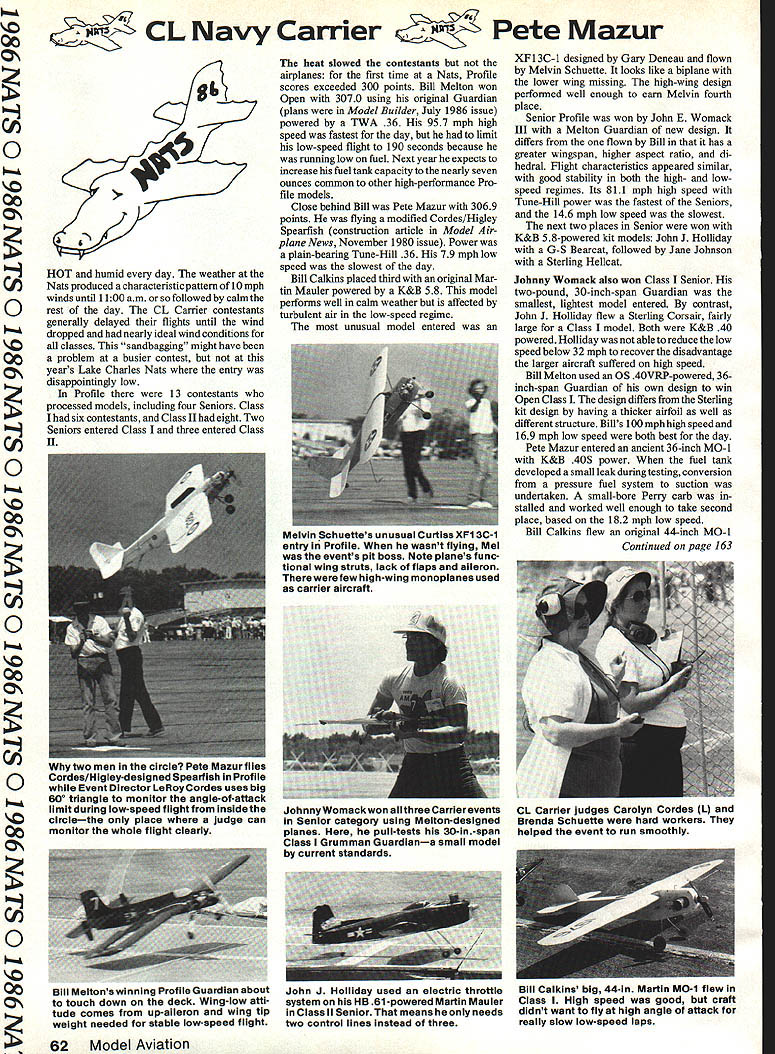
For the first time at a Nats, Profile scores exceeded 300 points. Bill Melton won Open with 307.0 using his original Guardian plans (plans in Model Builder, July 1986) powered by a TWA .36. His 95.7 mph high speed was fastest for the day, but he had to limit his low-speed flight to 190 seconds because he was running low on fuel. He expects to increase tank capacity next year to the nearly seven ounces common to other high-performance Profile models.
Close behind Bill was Pete Mazur with 306.9 points. He flew a modified Cordes/Higley Spearfish (construction article in Model Airplane News, November 1980) powered by a plain-bearing Tune-Hill .36. His 79 mph low speed was the slowest of the day.
Bill Calkins placed third with an original Martin Mauler powered by a K&B .58. This model performs well in calm weather but is affected by turbulence in the low-speed regime.
The most unusual model entered was an XF13C-1 designed by Gary Deneau and flown by Melvin Schuette. It looks like a biplane with the lower wing missing. The high-wing design performed well enough to earn Melvin fourth place.
Senior Profile
Senior Profile was won by John E. Womack III with a Melton Guardian of new design. It differs from the one flown by Bill in that it has a greater wingspan, higher aspect ratio, and dihedral. Flight characteristics appeared similar, with good stability in both the high- and low-speed regimes. His 81.1 mph high speed was the fastest of the Seniors, and his 14.6 mph low speed was the slowest.
The next two Senior places were won with K&B .58-powered kit models: John J. Holliday with a G-S Bearcat, followed by Jane Johnson with a Sterling Hellcat.
Class I Senior and Class I Open
Johnny Womack won Class I Senior with a two-pound, 30-inch-span Guardian—the smallest, lightest model entered. By contrast, John J. Holliday flew a Sterling Corsair, a fairly large Class I model. Both were K&B .40 powered. Holliday was able to reduce the low speed below 32 mph to offset the disadvantage larger aircraft suffered at high speed.
Bill Melton also won an Open Class with a 36-inch-span Guardian of his own design powered by an OS .40VRP. His design differs from the Sterling kit design, having a thicker airfoil and different structure. Bill's 100 mph high speed and 16.9 mph low speed were both best for the day.
Pete Mazur entered an older 36-inch MO-1 with K&B .40S power. When the fuel tank developed a small leak during testing, the model was converted to a pressure fuel system. A small-bore Perry carb was installed and worked well enough to take second place, based on the 18.2 mph low speed.
Bill Calkins flew an original 44-inch MO-1.
Nats CL Carrier / Mazur
Class II Open
In Class II Open, Pete Mazur won with his Wreba Speed .61RR-powered, 42-inch MO-1 "MO-Zilla," recording a 109 mph high speed and a 14.5 mph low speed. The 95-point landing made it the only plane to hit the deck in Open.
Bill Melton had an excellent flight with his Rossi .65RE-powered, 36-inch Guardian, very similar to the one he flew in Class I. However, the hook stubbornly refused to engage on several wire trips on landing. The spectacular 119 mph high speed assured him of second place despite the landing troubles.
Bill Calkins flew an OS .65VRP-powered MO-1 nearly identical to his Class I model. These models are a bit nose-heavy and tend to fly straight ahead, resisting the high angle-of-attack commonly used to reduce the low speed. Bill's best low speed was 23.6 mph. The arresting hook pulled away from the model on landing, resulting in a zero-score landing and third place.
Navy Carrier Society banquet and awards
The Navy Carrier Society held its annual meeting at a banquet in a local restaurant and presented the group's top awards. The Eugene Ely Award is presented to the contestant with the highest total score from all three classes of Navy Carrier at the Nats each year, regardless of class specification. Pete O. Mazur (Aurora, Ill.) scored 1010.8 points and was the first person last year to both take off and land an airplane on shipboard; this is the third time he has won the trophy.
The Navy Carrier Society was organized after the 1977 Nats using, as a foundation, the Society's newsletter begun by Ted Kraver. Pete Mazur has been the Society's president since that time. LeRoy Cordes, this year's Nats Carrier Event Director, is the Society's secretary-treasurer and is also the newsletter editor and publisher. John Castiglioni, the 1985 Nats Carrier Event Director, is vice-president of the Navy Carrier Society.
At the banquet, thanks were given to the 1986 Nats Carrier event officials for an excellent job of running the events:
- Event Director: LeRoy Cordes
- Carolyn Cordes and Brenda Schuette: took care of all operations on the flight line
- Melvin Schuette and Bert Allair: ran in the pits
Well done!
Transcribed from original scans by AI. Minor OCR errors may remain.

