
1986 Nats: RC Aerobatics
Ron Van Putte
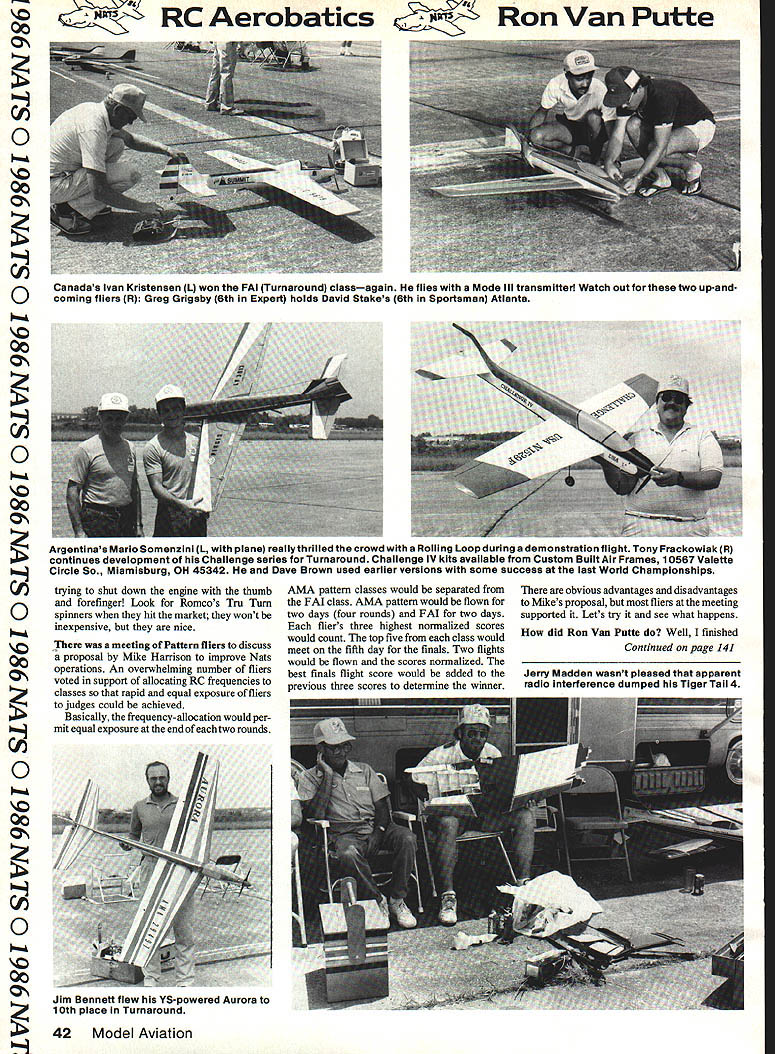
EXCLUDE THEM! The results of the 1986 Nats FAI Pattern event demonstrated once again that the United States needs tighter control of persons entering the country across its northern border. Ivan Kristensen from Ontario, Canada won the FAI Pattern event for the third time in the last four years — and the other time he was second to Chip Hyde at the 1984 Reno Nats. Very impressive flying.
Site and schedule
The Nats returned once again to the old runway that used to be Chennault AFB near Lake Charles, LA. Previously, the Nats were held at this same site in 1974, 1975, and 1978. It may well be the last time a Nats can be held there, since the Boeing Co. is going to establish an aircraft rework facility at the field and will be using the old bomber runway that makes the site so popular to modelers.
Everything started earlier than usual at this Nats. Transmitter processing was held on Friday, July 25, and competition started the next day at 7:00 a.m. At most previous Nats, transmitter processing has been on Sunday and competition began on Monday. The two-day shift in schedule was a noticeable change from past years.
Entrants and classes
Pattern attracted 123 contestants:
- 52 in Sportsman
- 16 in Advanced
- 16 in Expert
- 8 in Master
- 31 in FAI
The quality of flying appeared to be better than at other Nats I can remember. Like most Nats, the high-placing fliers were very good, but the unusual thing was to see that the fliers in the bottom half of the placings weren't so bad, either.
Sportsman
Steve Carruthers led the event from beginning to end and won by a comfortable margin. The remaining top-five Sportsman competitors bounced up and down in the standings as expected. Mike Watts was third; William Haskell was fourth and never out of the top five — that's unusual.
Advanced
Rick Byrd led and won convincingly. Rick was high junior, too. The next three finishers — William Jones, David Snow, and Brent Bourgeois — remained in the top five during the entire event.
Expert
Expert winner Hank Cooper had to contend with tough competition. Charles Lewis was second and Don Vail third; Vail also lost an airplane during the third round. Hank's PCM radio went into its fail-safe mode just after he completed three axial rolls and the airplane crashed. A borrowed radio from Bob McLain was used to finish the last two rounds, though nothing unusual happened.
Master
Paul Verger tried to duplicate the feats of Carruthers and Byrd, leading the class from start to finish. Pete Callas overcame engine problems that plagued him during the first two rounds, transplanted a trusty engine, and overtook Paul to win the event. Bryan Henderson was third; Russ Nakamura fourth; Harold Roberts fifth — also never out of the top five.
FAI
FAI event results were interesting. Ivan Kristensen won, Chip Hyde was second, Tony Frackowiak third, Steve Helms fourth, and Dave Brown fifth. Helms and Brown hovered around fourth, fifth and sixth during the event. Frackowiak was not in the top five until the fifth round.
Scoring was based on adding the three best flight scores out of five official flights; scores were normalized based on difficulty. Dividing each contestant's score in front of a particular set of judges by the highest score given out by that set of judges, then multiplying the result by 1,000, the order of finish would have been exactly the same, according to Chief Tabulator Mike Laumer.
Runway layout and wind
The big north–south runway was used to good advantage. Three Pattern sites were set up on the runway, with two flight lines at each of the end (north and south) sites and one flight line at the middle site. Separation between sites was at least 2,000 feet so that there was no overlapping of one site from an adjacent site. Since flying was done from 7:00 a.m. to 1:00 p.m., the pilots and judges were on the east side of the runway to keep the sun at the fliers' backs.
Fliers who planned well expected prevailing winds from the south, taking off from right to left while rolling maneuvers would be from left to right. After diligent practice for the expected wind conditions, these fliers discovered that the wind blew from the northwest for all four days — so much for good planning! Those of us who like to do rolling maneuvers from right to left were happy — especially me, since I hadn't practiced for the other wind direction.
Weather and conditions
It was hot at Lake Charles. Those of us from the Gulf Coast are used to hot July days, but it was warmer even to us. You can imagine how bad it must have been for some of the Northern fliers who had never experienced four solid days of Southern heat — especially during the South's worst recorded heat wave. Shade was at a premium, and wind was welcome.
Complaints: flight line operation and judging
The only universal complaints I heard concerned flight line operation and the judges. Fifteen judges remained at the same flight lines while 123 fliers moved from flight line to flight line. This meant that it was impossible for a flier to establish a "permanent" base from which to operate. It was too much trouble to put up a tent in the morning, only to take it down again and move before noon. The judges should have moved while the fliers remained at a line.
Everyone complains about judges; the 1986 Nats was no exception. There appeared to be one "easy" set of judges, three "average" sets, and one set that looked "hard." On closer examination, one judge in the "hard" set was scoring far below the other two judges. His scores were two to three points under the scores of the other two judges on more than half of the maneuvers. The result was that few fliers used the score they earned on that line, and a lot of people's time was wasted. I understand that several prominent fliers told him they were not delighted by his performance.
Tabulation and demonstrations
One of the really bright spots in this year's Nats was the tabulation of scores. Mike Laumer developed a system which featured an optical card reader. Judges blackened a spot on the score sheet corresponding to the score for each maneuver. The cards were read by the card reader and the results were available quickly.
At the end of each round the standings for each class were posted on the outside of the tabulation trailer, located at the northeast corner of the site. It was a popular place. This was also the site at which the awards were made shortly after the last flights were flown.
In the meantime, several demonstration flights were flown for a team of reporters from the National Geographic Society. Bill Thomas, Chip Hyde, and Tony Plehanek drew applause for their efforts; however, Argentinean Mario Somenzini brought down the house with his show. You may have seen a Rolling Circle — but have you ever seen a Rolling Loop? Yes, Mario really did one, and the low point of the loop was barely 10 feet off the ground!
New products
A couple of new products made their appearance at the Nats.
- Flite Lite wheels by Dave Brown: With the emphasis on reducing the weight of airplanes in the Turnaround (FAI) event, Dave Brown's new Flite Lite wheels were a big hit. The wheels have a rubbery-sponge feel and are very light. The problem some competing designs have with keeping the tire on the hub appears to have been solved by Dave's new design. The best news is that the prices are very competitive.
- Romco lightweight aluminum spinner: Owner Bob Oxenberger wouldn't tell me how he manages to machine the outside and inside of the spinner simultaneously, but the end result is a very lightweight spinner. One feature I liked was the way the retaining bolt matched the contour of the nose of the spinner. No more cuts to the fingers when trying to shut down the engine with the thumb and forefinger! Look for Romco's Tru Turn spinners when they hit the market; they won't be inexpensive, but they are nice.
Proposal to improve Nats operations
There was a meeting of Pattern fliers to discuss a proposal by Mike Harrison to improve Nats operations. An overwhelming number of fliers voted in support of allocating RC frequencies to classes so that rapid and equal exposure of fliers to judges could be achieved.
Basically, the frequency allocation would permit equal exposure at the end of each two rounds.
Under the proposal:
- AMA pattern classes would be separated from the FAI class.
- AMA pattern would be flown for two days (four rounds) and FAI for two days.
- Each flier's three highest normalized scores would count.
- The top five from each class would compete on the fifth day for the finals. Two flights would be flown and the scores normalized. The best finals flight score would be added to the previous three scores to determine the winner.
There are obvious advantages and disadvantages to Mike's proposal, but most fliers at the meeting supported it. Let's try it and see what happens.
How I did
How did Ron Van Putte do? I finished twelfth in Expert, but I was way ahead of last year. This year I had an airplane after the first round, thanks to my Futaba PCM. Why didn't I do better? That's easy to explain: the judges (except for one notable exception) gave me what I deserved rather than what I wanted. The truth is, overall I flew just about as well as I can, and I can't ask for more.
Many people worked hard to put together an enjoyable Nats for the rest of us, and they all deserve a pat on the back. No one deserves more credit than John Embry, the RC Pattern Category Director. Thanks, John... thanks, everyone.
Transcribed from original scans by AI. Minor OCR errors may remain.

