
1986 Nats: RC Pylon Racing
By Bill Hager
WELCOME to Lake Charles, LA, site of the 1986 AMA Nationals. I have managed to make it to the Nats each year that it has been held at Lake Charles, and while it can be a little on the warm side, each of the previous Nats has been a great success.
This year was no exception. Our Event Director was Wayne Yeager, along with his wife, Karen. These two make quite a team, and along with all of the other workers who stuck it out through all of the heat, they did a fantastic job. Thanks, gang! Those who didn't attend missed a great week of racing.
FAI Pylon
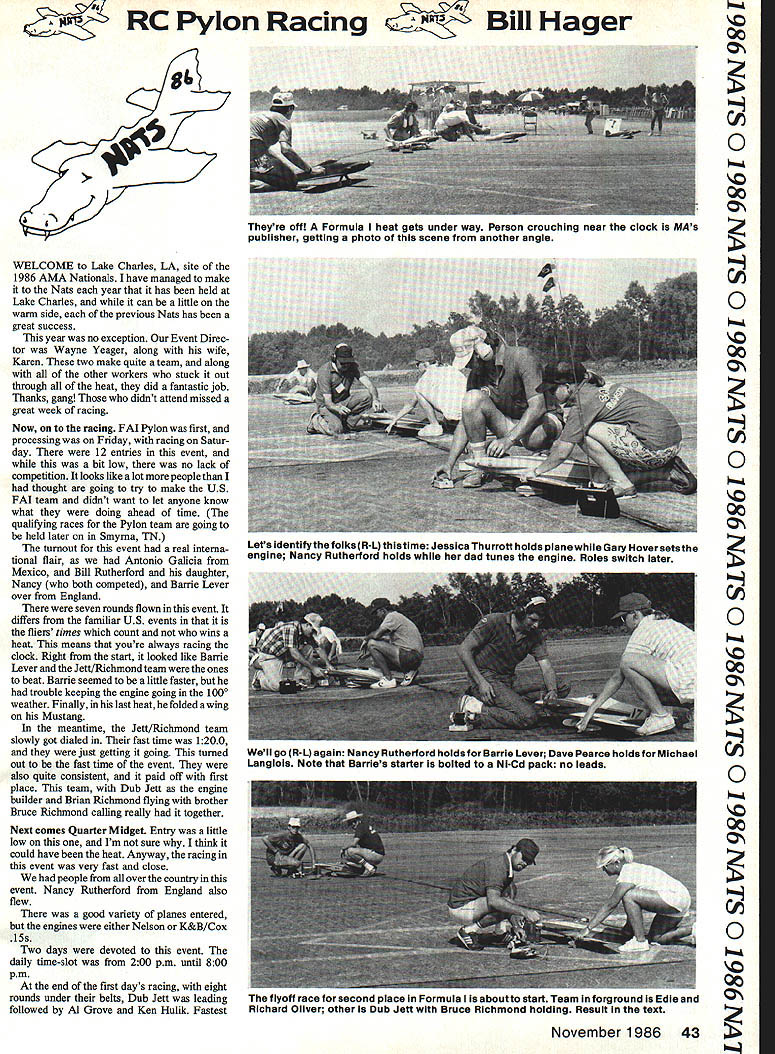
FAI Pylon was first. Processing was on Friday, with racing on Saturday. There were 12 entries in this event; while a bit low, there was no lack of competition. It looks like a lot more people than I had thought are going to try to make the U.S. FAI team and didn't want to let anyone know what they were doing ahead of time. (The qualifying races for the Pylon team are going to be held later in Smyrna, TN.)
The turnout for this event had a real international flair. Competitors included Antonio Galicia (Mexico), Bill Rutherford and his daughter Nancy, and Barrie Lever (England).
Seven rounds were flown in this event. Unlike familiar U.S. events, FAI Pylon is scored by fliers' times rather than heat wins—you're always racing the clock. Right from the start, Barrie Lever and the Jett/Richmond team looked like the ones to beat. Barrie seemed a little faster, but he had trouble keeping the engine going in the 100° weather and, in his last heat, folded a wing on his Mustang.
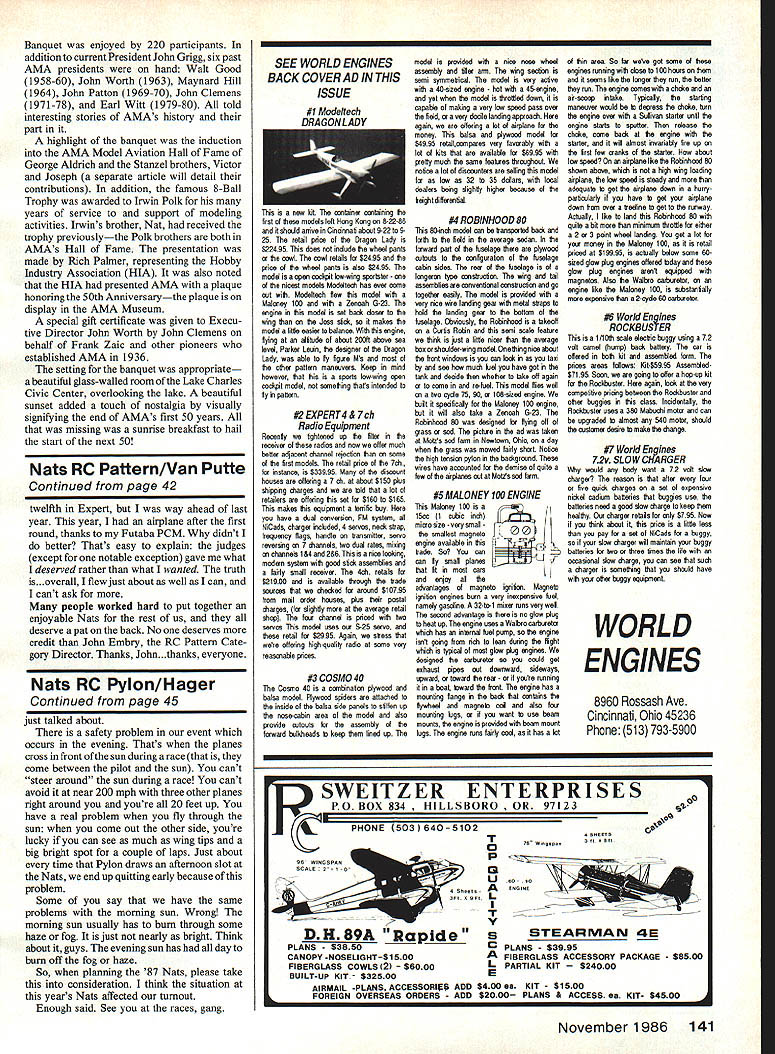
Meanwhile, the Jett/Richmond team slowly got dialed in. Their fast time was 1:20.0, and that turned out to be the fastest time of the event. They were also quite consistent, which paid off with first place. The team—Dub Jett as engine builder, Brian Richmond flying with brother Bruce Richmond calling—really had it together.
Quarter Midget
Entry was a little low for Quarter Midget; the heat may have been a factor. The racing, however, was very fast and close. Competitors came from all over the country, and Nancy Rutherford also flew in this event.
There was a good variety of planes entered, with engines primarily Nelson or K&B/Cox .15s.
Two days were devoted to this event, with daily time slots from 2:00 p.m. until 8:00 p.m.
After the first day's eight rounds, the leaders were:
- 1st: Dub Jett — fastest time 1:20.23
- 2nd: Al Grove — fast time 1:22.03
- 3rd: Ken Hulik — fast time 1:21.71
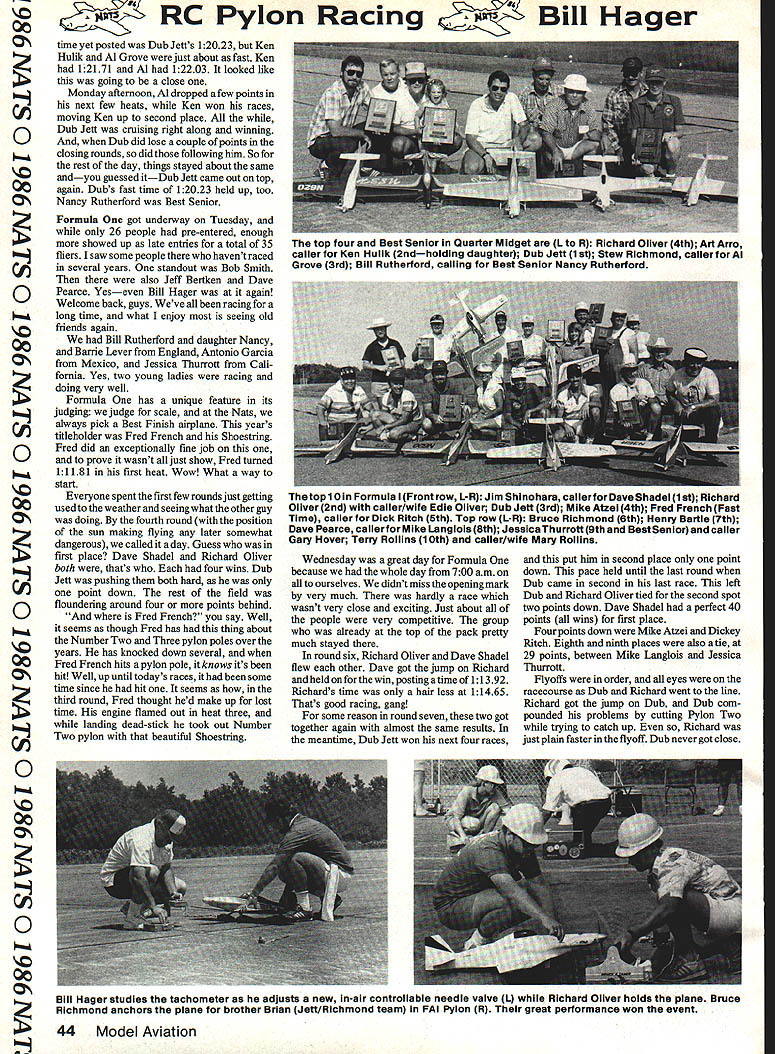
It looked like it would be close. On Monday afternoon Al dropped a few points in the next heats while Ken won races and moved up to second place. Dub Jett continued winning and, despite losing a couple of points in the closing rounds, stayed on top. Results held, and Dub Jett won with his 1:20.23 holding up as the fastest time.
Senior Formula One
Senior Formula got underway Tuesday. Twenty-six people pre-entered; enough showed up late that entries totaled 35 fliers. We saw people who haven't raced in several years — standout Bob Smith, Jeff Bertken, Dave Pearce, and even Bill Hager again. Welcome back, guys! It's always good to see old friends. Also competing were Bill Rutherford and daughter Nancy; Barrie Lever (England); Antonio Galicia (Mexico); and Jessica Thurrott (California) — yes, two young ladies racing and doing very well.
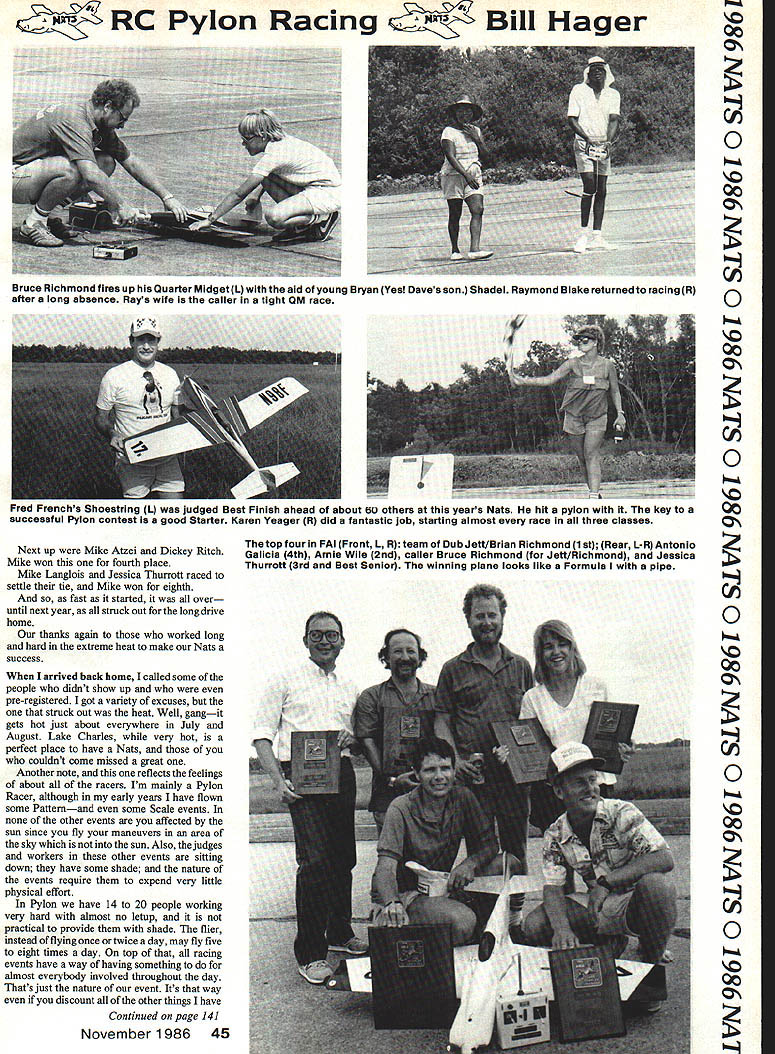
Formula One has a unique feature: it's judged by scale, and the Nats always pick Best Finished Airplane. This year's titleholder, Fred French (Shoestring), did an exceptionally fine job and proved it wasn't just show. Fred turned 1:11.81 in his first heat — wow!
Everyone spent the first few rounds getting used to the weather and seeing what others were doing. In the fourth round, the position of the sun made flying later somewhat dangerous and we called the day.
By that point, Dave Shadel and Richard Oliver were tied for first place, each with four wins. Dub Jett was pushing them hard, only one point back. The rest of the field trailed by four or more points.
Wednesday was a great day for Formula One; we had the entire day from 7:00 a.m. on. There was hardly a race that wasn't very close and exciting. The top pack mostly stayed at the top.
In round six, Richard Oliver and Dave Shadel flew each other. Dave got the jump and held on for the win with a time of 1:13.92; Richard posted 1:14.65. In round seven they matched up again with almost the same results. Dub Jett won his next four races, putting him in second place, one point down. That pace held until the last round when Dub came in second in his final race, leaving Dub and Richard Oliver tied for second, two points down from Dave Shadel. Dave finished with a perfect 40 points (all wins).
Four points down were Mike Atzel and Dickey Ritch. Eighth and ninth places were a tie at 29 points between Mike Langlois and Jessica Thurrott.
Flyoffs were required:
- Richard Oliver vs. Dub Jett: Richard won; Dub cut Pylon Two while trying to catch up and never got close.
- Mike Atzel vs. Dickey Ritch: Mike won for fourth place.
- Mike Langlois vs. Jessica Thurrott: Mike won for eighth place.
And so, as fast as it started, it was all over—until next year, as everyone struck out for the long drive home.
Safety, Scheduling, and Heat Concerns
Our thanks again to those who worked long and hard in the extreme heat to make our Nats a success.
I called some of the people who didn't show up even though they were pre-registered. I got a variety of excuses, but the one that stuck out was the heat. It gets hot just about everywhere in July and August. Lake Charles, while very hot, is a perfect place to have a Nats, and those who couldn't come missed a great one.
A note reflecting the feelings of many racers: Pylon racing is especially demanding on workers and judges. In other events (Pattern, Scale), judges and workers sit in the shade and expend very little physical effort. In Pylon we have 14 to 20 people working very hard with almost no letup; many competitors fly five to eight heats a day. The nature of racing events keeps most people busy throughout the day.
There is also a safety problem in our event which occurs in the evening: planes cross directly in front of the sun during a race (i.e., they come between the pilot and the sun). You can't "steer around" the sun during a race at near 200 mph with three other planes right around you at about 20 feet up. When you fly through the sun, you may come out the other side able to see only wing tips and a big bright spot for a couple of laps. Just about every time Pylon draws an afternoon slot at the Nats, we end up quitting early because of this problem.
Some say we have the same problems with the morning sun. Wrong — the morning sun usually has to burn through haze or fog and is not nearly as bright. The evening sun has had all day to burn off haze.
So, when planning the 1987 Nats, please take this into consideration. I think the situation at this year's Nats affected turnout.
Enough said. See you at the races, gang.
Transcribed from original scans by AI. Minor OCR errors may remain.

