
1986 Nats: RC Soaring
In Memory of Dan Pruss
Skip Miller
His good humor, the small wrinkles on his face, and the childlike expressions when he described the latest sailplane gizmo — these are the memories many of us have of Dan Pruss. A man who always displayed a class of his own: self-developed, self-assured, yet somehow making you feel comfortable, grounded, and connected.
Dan waged some of the toughest battles I know, and I would not say he lost. I am proud to have called him a friend. Good ones go away, and maybe we appreciate their efforts and contributions more after they are gone. Dan always set the example and the standards others should compare to. He attained the highest respect in the fellowship of aeromodeling worldwide through hard work, sincerity of effort, and foremost integrity. I have known no man with more character and grace. His friendly style and courageous spirit were paramount. I will always remember Dan — a man I always looked up to.
---
Event summary
The 1986 Soaring Nats were held on a grassy farm field belonging to McNeese State University just outside Lake Charles, LA. Conditions were extremely hot and humid — day temperatures approached record highs. Despite the heat, flying conditions were excellent over the four days: a fairly constant west breeze generally in the 10–12 mph range, with mornings often fairly liftless and the daytime offering normal periods of good lift and big sink. In general, conditions improved as the day wore on.
---
Field and safety
- The contest field was tight for safety: most landing approaches were low over car canopies and several planes landed on or in cars. Fortunately, there were no personal injuries.
- Winch lines could be stretched to 750 feet.
- About 80 feet behind the winches stood a solid row of tall trees. This required locating two landing circles down toward the turnarounds, leaving the winches roughly a 100-yard walk (sometimes a sprint) from the circles.
- The trees did catch a few planes but often produced a slope-type lift as the breeze deflected up over them; some pilots used this lift for several minutes.
---
Organization and operations
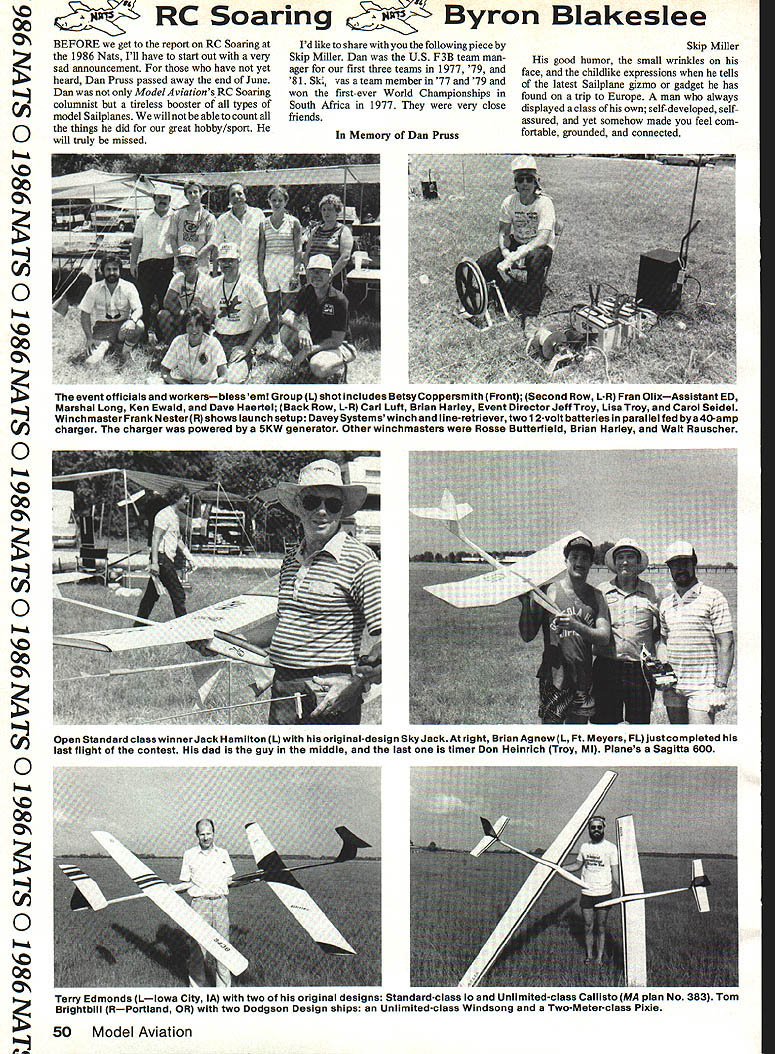
- Event Director: Jeff Troy (with crew mainly from the Valley Forge Signal Seekers). Assistant Event Director: Fran Olix. Flight Line Director: Tom Kozel. The winchmasters, scorekeepers, and impound crew received high praise for professional work.
- Pre-contest directive from Jeff: "The contest is not being run for the egos of the contestants."
- Fliers were organized into 15 flight groups by radio frequency, with 12–13 contestants per group. A daily draw determined which group would fly first.
- Operational flow: a "Ready" and "Standby" funnel system kept things moving. Tom Kozel made winch assignments; once hooked up and cleared by the winchmaster, launches proceeded promptly. The PA system was used effectively.
- Equipment: Four Davey Systems winches and retrievers were used. These V-belt-drive winches differ in torque/speed from direct-drive starter-motor winches; retrievers worked well and helped maintain contest pace.
- Procedures emphasized punctuality: fliers had to be ready when their transmitter was released from impound, and each flight used a different timer within a class to speed operations and give contestants a chance to meet many people.
- Scoring and timing:
- Duration task: Seven-Minute International.
- Points per flight: 420 for perfect duration plus a 100-point bonus for landing in a 25-meter-diameter circle, giving a maximum of 520 points per flight.
- Two flights per day for four days = 8 flights; maximum possible in one class = 4,160 points.
- Scorekeeping: timers reported times and whether the landing was in or out of the circle; no score sheets were handed out to contestants.
---
Entries and participants
- Open entries: 63 Unlimited, 66 Standard, and 61 Two-Meter — 190 entries in total. Many contestants entered two or all three classes; eliminating multiple entries left 82 individual Open fliers.
- Seniors (ages 15–19): five Unlimited, five Standard, and six Two-Meter entries (seven actual fliers).
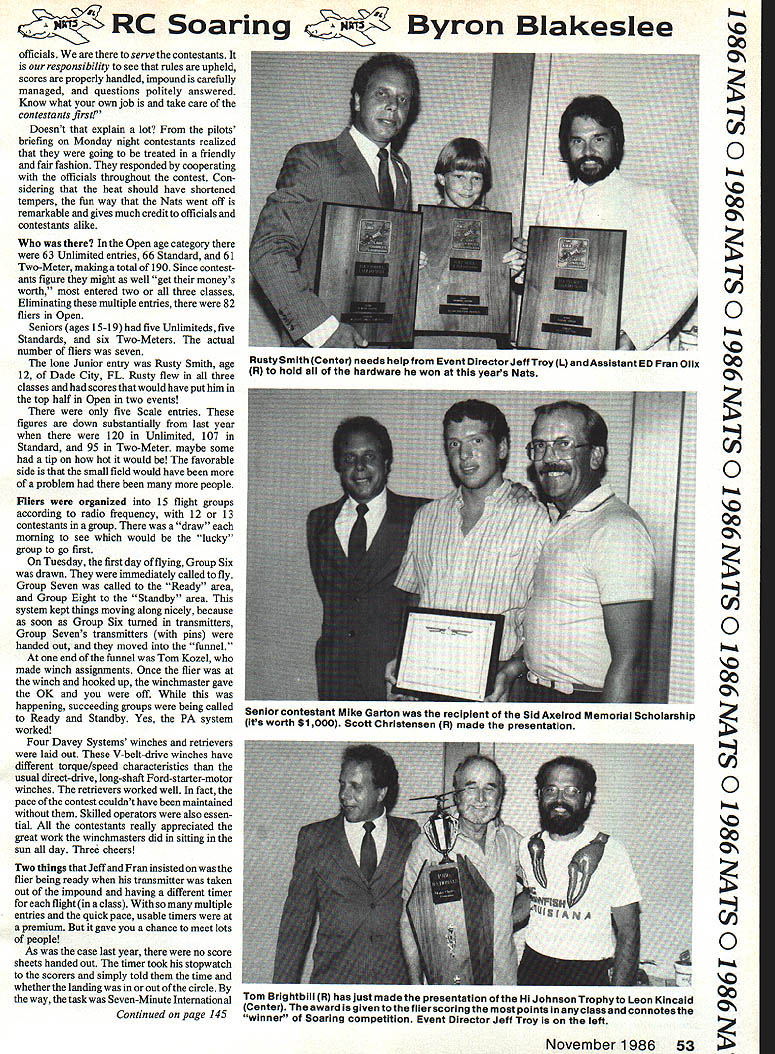
- Junior: one entry — Rusty Smith, age 12, of Dade City, FL. Rusty flew all three classes and posted scores that would have placed him in the top half of Open in two events.
- Scale: only five entries (substantially down from the previous year).
- General contestant feedback on the event included: "Best Nats I've attended," "Well-run," "Very professional," and "Excellent crew."
---
Results and notable performances
- Open Unlimited (and Hi Johnson Award for highest score in any class): Leon Kincaid — 4,150 points.
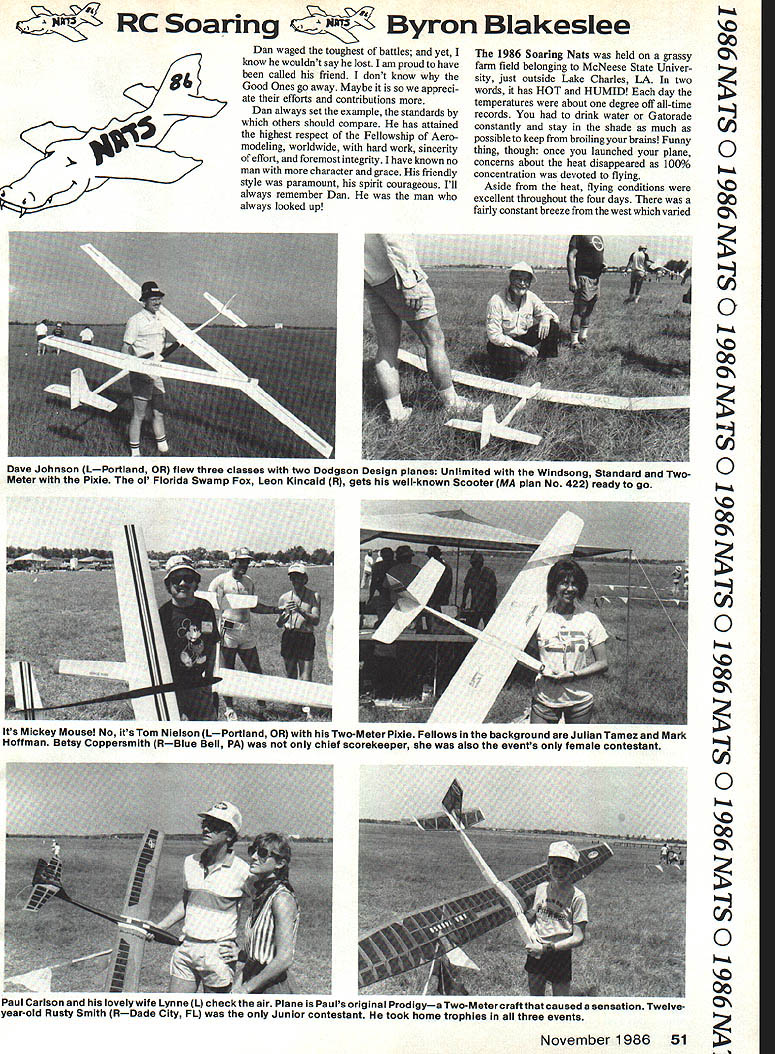
- Open Standard: Jack Hamilton.
- Open Two-Meter: Paul Carlson.
- Close finish: Tom Brightbill scored 4,149 in Unlimited — only one point behind Leon.
- Paul Carlson (Urbana, IL) — remarkable performance across classes using a single Two-Meter plane (his original-design Prodigy):
- Won Two-Meter by 162 points over Brian Agnew.
- Was leading Standard going into the last flight but dropped time on the last Standard flight, allowing Jack Hamilton to win Standard by 28 points (Brian Agnew third, Al Scidmore and Terry Edmonds following).
- Finished third in Unlimited behind Leon Kincaid and Tom Brightbill.
- Paul won the Lee Renaud Memorial Trophy for highest total points across all three classes with 12,190 points.
- Top totals:
- Paul Carlson: 12,190
- Terry Edmonds: 11,508 (last year's winner)
- Brian Agnew: 11,496
- Tom Brightbill: 11,458
- Note: Brian Agnew also flew the same Two-Meter ship (a Sagitta 600) in all three classes, showing a small ship can compete with larger ones.
- Other placements: Bob Wilkosz was fourth in Unlimited; Terry Edmonds finished tenth in Unlimited and Brian Agnew fourteenth.
- Sid Axelrod $1,000 scholarship (for all-around performance, design skill, and knowledge): Mike Norton of Iowa (Senior Unlimited and Standard, third in Two-Meter). Last year's Axelrod winner Alex Bereczky finished second in Senior Unlimited and second in Two-Meter. Jorge Guzman of Mexico City won Senior Two-Meter and was second in Senior Standard.
---
Scale
- Scale was flown midday Thursday (better timing than previous years when Scale ran on Saturday after the banquet).
- Only five entries; the two favorites suffered mishaps:
- Ed Whyte's 1/5-scale Schweizer TG-3 flipped on its nose during ROG takeoff (right wing caught in grass).
- Connie Jones' 1/4-scale Jantar (from a Wainchen kit) landed wing-first on its first flight and was damaged beyond further competition.
- Results:
- 1st: Jack Hamilton — Graupner-kit Cirrus (first flown in 1973; used for LSF Level IV requirements)
- 2nd: Don Mulligan — ASW-17
- 3rd: Bob Cartwright — Slingsby T.49B Capstan
---
Sailplanes and equipment notes
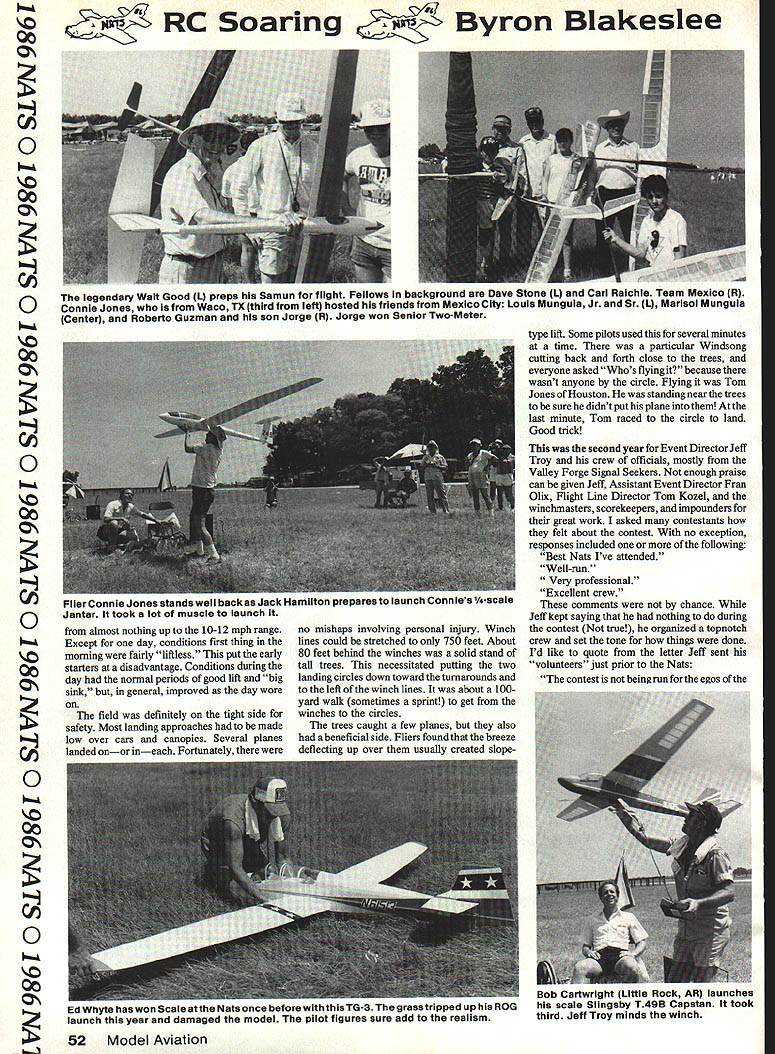
- Aileron-equipped ships continue to gain popularity; roughly one-third of planes at the Nats had ailerons. In the benign conditions at this event, polyhedral (straight-wing) planes remained competitive and won top places in each class.
- Paul Carlson's Two-Meter Prodigy (Off the Ground Models):
- Bend-wing Two-Meter design, all-wood kit with high-tech features.
- Uses a Selig S4061-096-84 airfoil and carbon-fiber-reinforced spars.
- Two-Meter II kit price: $69.95.
- Expected to be popular among serious contest fliers.
- Leon Kincaid's Scooter designs are simple and straightforward but display exceptional craftsmanship and attention to detail.
- Terry Edmonds' Two-Meter ship: glass fuselage with foam wings covered in balsa and MonoKote; excellent workmanship and lightweight construction. Contact for fiberglass fuselages and foam cores: Jerry Slates, 2026 Spring Lake Dr., Martinez, CA 94553; telephone 415-689-0766.
---
Awards banquet and closing
- Friday night Awards Banquet: well organized and MC'ed by Jeff Troy; over 100 attendees. Sufficient door prizes ensured many received something.
- Trophies (plaques) were awarded down to tenth place in all three Open classes, plus awards in Scale, Seniors, and Junior classes.
- The Hi Johnson Trophy presentation (perpetual trophy on display at AMA HQ) was a highlight; Leon Kincaid received a standing ovation along with Tom Brightbill.
- The Nats blends serious sports competition at the top level with camaraderie, fun, and the usual mixture of the strange and wonderful for those not in contention.
— Dan Blakeslee
Transcribed from original scans by AI. Minor OCR errors may remain.

