
1988 SAM CHAMPS
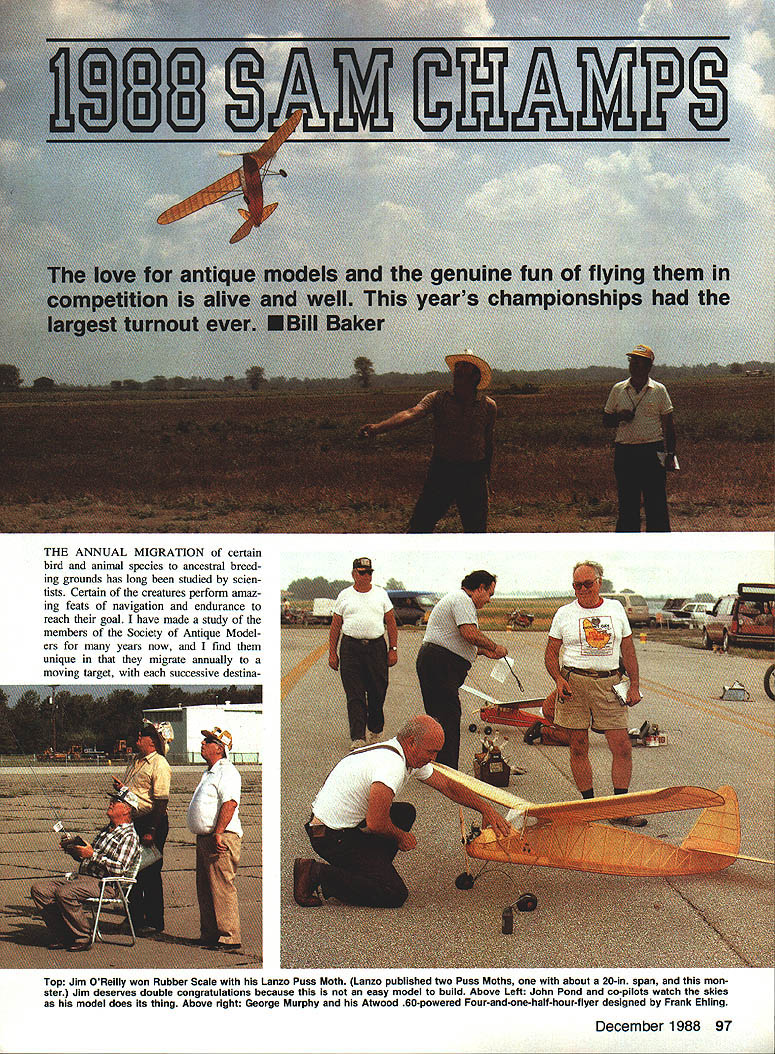
The love for antique models and the genuine fun of flying them in competition is alive and well. This year's championships had the largest turnout ever. — Bill Baker
The annual migration of certain bird and animal species to ancestral breeding grounds has long been studied by scientists. Certain creatures perform amazing feats of navigation and endurance to reach their goal. I have made a study of the members of the Society of Antique Modelers for many years now, and I find them unique in that they migrate annually to a moving target, with each successive destination.
This year the SAM members came—from border to border and coast to coast—to where the Wabash River, spanned by the Red Skelton Bridge, separates Indiana and Illinois. That is how it happened that the headquarters, meals, lodging, etc., were found primarily in Vincennes, IN, while the flying was at the Mid-America Center near Lawrenceville, IL.
In my studies of this group, I have found their annual assemblies to be not so much for reproductive purposes (with certain notable individual exceptions) as to rejoice together in their love of pre-World War II model airplane designs and engines—to fly, to talk, to be together, to remember, and to plan to do it again. Many are flying their own designs, which is remarkable considering that the designs must be pre-1942 to be eligible.
Notable attendees
- Chester Lanzo flew an original design in the contest and placed in one of the RC events. He had the satisfaction of seeing George Perryman win two Free-Flight events with Lanzo designs, and he could hardly fail to notice the popularity of the bomber design in RC events.
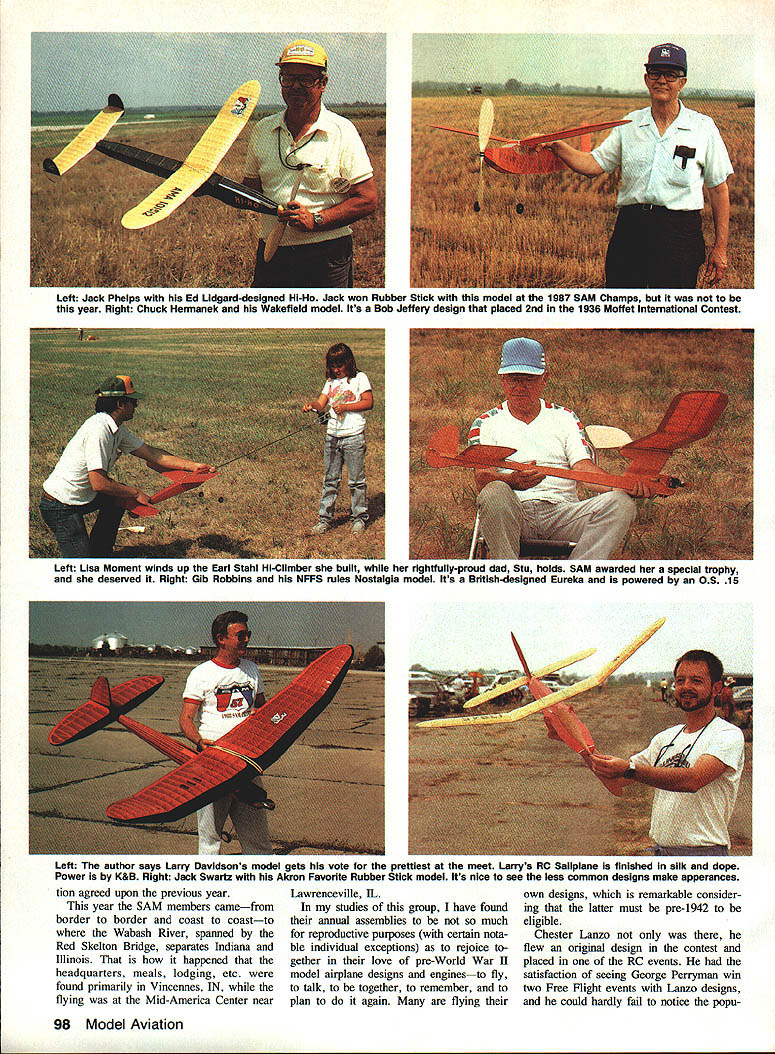
- Sal Taibi flew his own designs and watched them flown by others.
- Joe Konefes flew a Buzzard Bombshell powered by a Brown Jr., just like the one he used to win Class C at the 1940 Nationals.
- Joe Wagner, who created many models for Veco to kit in the 1950s, was there flying for fun and sending aloft the likes of his prototype Veco Dakota biplane.
- Ed Wallenhorst came from California, flying a Roberts Stick model he designed in 1940.
- Jim Noonan, Joe Hervat, Mike Granieri, Joe Elgin—if you've read Zaic's yearbook enough, you know the names.
Other SAM fliers gladly tell you why they built a particular model: "My dad built one of these with me." ... "My big brother designed this." ... "There was one in the hobby shop window, but I never could afford it when I was young." ... "I just think it is pretty." ... "I built one when I was a kid, and it was the first model I ever got to fly." ... "This design wins ..."
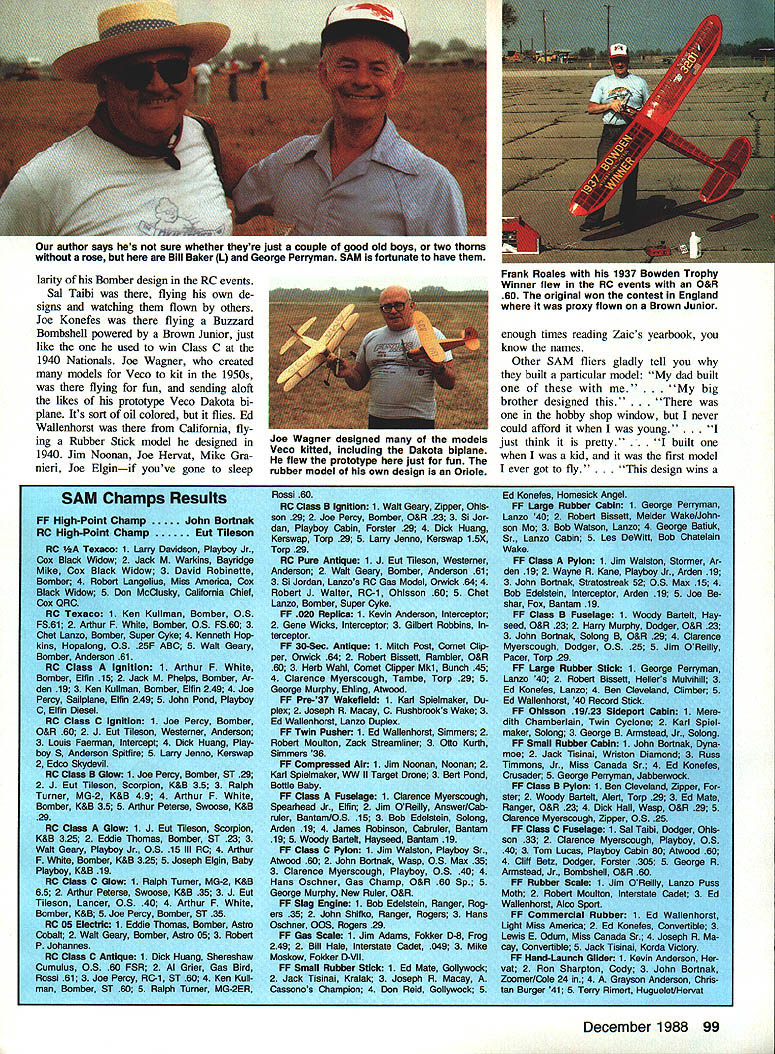
SAM Champs Results
- FF High-Point Champ: John Bortnak
- RC High-Point Champ: Eut Tileson
Events and the Game
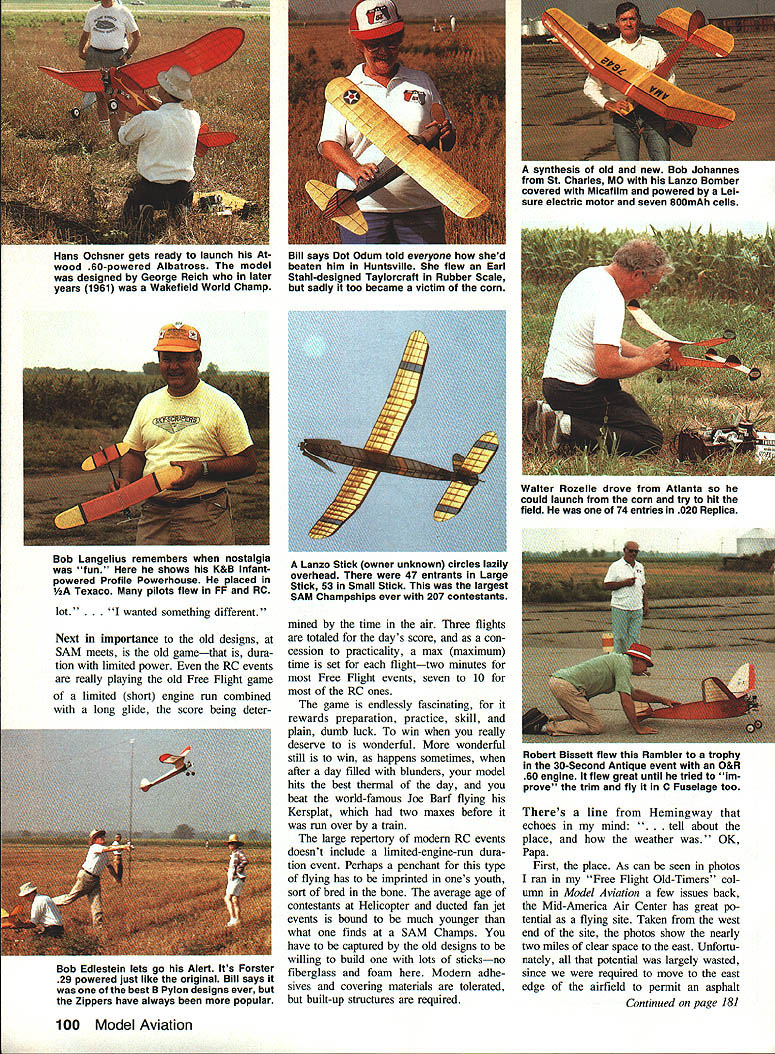
Next in importance to the old designs at SAM meets is the old game—that is, duration with limited power. Even the RC events are really playing the old Free Flight game of a limited (short) engine run combined with a long glide; the score is determined by the time in the air. Three flights are totaled for the day's score, and as a concession to practicality a max (maximum) time is set for each flight—two minutes for most Free Flight events, seven to ten for most of the RC ones.
The game is endlessly fascinating, for it rewards preparation, practice, skill, and plain, dumb luck. To win when you really deserve to is wonderful. More wonderful still is to win, as happens sometimes, when after a day filled with blunders, your model hits the best thermal of the day, and you beat the world-famous Joe Braf flying his Kersplat, which had two maxes before it was run over by a train.
The large repertory of modern RC events doesn't include a limited-engine-run duration event. Perhaps a penchant for this type of flying has to be imprinted in one's youth, sort of bred in the bone. The average age of contestants at helicopter and ducted-fan jet events is bound to be much younger than what one finds at a SAM Champs. You have to be captivated by the old designs to be willing to build one with lots of sticks—no fiberglass and foam here. Modern adhesives and covering materials are tolerated, but built-up structures are required.
I will venture an opinion about the Nostalgia events I saw flown in Tuesday's relatively good weather. The performance of most competitive models, I believe, equals that of most current AMA Free Flight models. That is too bad, as it becomes just another power race. It took five flights to separate first and second in Class A, and three maxes would only get you into fifth. I think most fliers would prefer these events to be somewhat lower in performance. I do love to see the Zeeks and Hogans go up, and see the Korda Powerhouses crash just like they did in the days of my youth.
When I wrote the story of the 1986 SAM Champs I was not taken by the Wakefield event, but this year what I enjoyed most was the Thirty-Second Antique event. A recent rules change removed certain pylon designs from the event and gave it back to the designs it was intended for: Comet Clippers, Taibi Powerhouses, Ramblers, and—my favorite this year—George Murphy's huge Frank Ehling design called Four-and-a-Half-Hour Flier. (Gee, Frank, you had at least four-and-a-half hours to think of a name for it!) The engines used in the event are the great old thumpers like the Brown Jr., the Ohlsson .60, the Atwood, or, especially in the Powerhouses, the Forster .99. I saw the big (8-ft. span) Ehling design fly for two full minutes after a less-than-ideal engine run got it up only about 75 ft., and that was worth driving a long way to see.
This year the Thirty-Second Antique was flown with an actual engine run maximum of only 25 seconds, as an adjustment to the short two-minute max—which was itself an adjustment to the limited space downwind. The engine runs of other Free Flight events were also adjusted to suit the short max. Since this isn't possible in the Rubber events, they are flown to current Mulvihill rules, with a minute added to the length of the max in each successive flight (after the first three) until there are no ties left.
George Perryman had told me he wouldn't be attending the SAM Champs, as he was going to the AMA Nationals and couldn't fit in both contests. When I learned of the cancellation of the Free Flight events at the Nationals due to the loss of the scheduled site, I called George. He thought I was putting him on. I kept urging him to come to the SAM Champs, and he said, "Bill, I would love to, but I can't go to both." I said, "I keep telling you, there ain't gonna be both." Stunned silence, then, "You're serious!" So he came, and quite a number of other later entries also came, which was lucky for us. It helped to make this the largest SAM Champs ever, with 207 contestants, about two-thirds of whom, I estimate, were Free Flight. Perryman won the Rubber Stick and Rubber Cabin events, and each win cost him a model lost in the corn.
Site and Weather
First, the place. As can be seen in photos I ran in my "Free Flight Old-Timers" column in Model Aviation a few issues back, the Mid-America Air Center has great potential as a flying site. Taken from the west end of the complex, the photos show the nearly two miles of clear space to the east. Unfortunately, all that potential was largely wasted, since we were required to move to the east edge of the airfield to permit an asphalt crew to resurface a runway—work that had originally been scheduled for the week after the meet. I thought this showed poor judgment on the part of the airport management, especially considering the substantial economic impact the SAM Champs must have had on the community.
The other stumbling block and disappointment was the corn—lots of corn. No one ever seems to grow a little corn, do they? We could console ourselves that some of the crop was not over three or four feet high—but some of it was, and not a few models were lost in it. The corn was as unexpected as the asphalt crew, and, again, was doubly distressing because we'd rescheduled the Champs in order to avoid it. When we'd learned that the farmers were planning to plant potatoes instead of their usual corn crop this year, we decided to schedule our meet for July when the potatoes would be harvested, rather than earlier in the summer (when the corn would be short). Well, we did and they didn't—so much for trust!
Beset though they were by these problems and limitations, the contest administration, and their wives, worked hard and well. They coped, adapted, remained cheerful, and through their hard work made it possible for the rest of us to play.
Collecto (MECA)
Monday was a practice day. I went to the MECA (Model Engine Collectors Association) Collecto at the Executive Inn, but many others spent the day at the field. At the Collecto, we could hear thunder from scattered storms in the area. Fortunately, for the most part the storms missed the field, and contestants were able to get in some test flying.
The Collecto is an independent affair not affiliated with SAM, but many people are members of both, and it is a traditional part of SAM Champs. They are full of the serendipity and interest you'd expect at a flea market or swap shop, and they're a lot of fun. I sold some engines I no longer wanted, and gave away all the back issues of the Olde Free Flight Flyer left in the universe. It's amazing what people will buy—old engines, parts of old engines, old kites, magazines, plans, and books. I even saw some old, and very used, Control Line models. I took a lunch break with Ed Koehles, and just as I was about finished Joe Konefes showed up. He had three engines to sell. I took them back to the Collecto with me while Joe had lunch with his brother, and I sold two of them before he finished his lunch.
Weather through the week
Tuesday was cloudy, with light winds and temperatures in the 75 to 80-degree range. Wednesday, it rained—a lot. The rain would stop, the wind would come from another direction, the Free Flight crowd would have to move to try to get more space downwind, and then it would rain again. It did stop long enough for Danny Shields to get his Twin Pusher Mass Launch off around noon as scheduled, and then by two in the afternoon the rain was over and the flying activity became intense.
So packed was the schedule that contestants who'd entered several events frequently were forced to boil their choice down to just one, agonizing over which they wanted to fly the most. I'm sure this had a great effect on the results of the Nostalgia events (which were not a part of the SAM Champs but a separate contest run by the NFFS), as many contestants who'd intended to fly in both contests ended up running out of time and having to choose.
Thursday was warm and sunny with light winds. Friday was even better—an ideal day for flying. During the whole week, only about half a day was spoiled by the weather. As a bonus, Wednesday's rains chased off the severe heat wave that had gripped the area for weeks.
Scale and International Competitors
Adding Scale to the other four events proved to be a good move. The first few days, though, we wondered if we had a Scale team, because they were off visiting old friends and partying (actually, we were jealous). One thing I'll say: thanks to their large-sized model boxes, it was easy to find the team in the airport proper. Rumor has it, however, that Aeroflot is planning to lend Perez and Byron a container from a 747 so they can pack at home.
They had their own personal engines, however, and had access to just about any building material. The Soviet team had been training at the site for about five weeks, and it was obvious that they weren't just sport flying during that period. The meet was very exciting, but close as the Americans were, it was no cigar. The Soviets were so accommodating that they even put down new sod on about a third of the grass circle because they didn't think it would be up to our standards. While we all have our sights on the Soviets, we shouldn't forget about the many other excellent fliers from around the world. It'll be a real shootout in 1990.
One memorable moment: brakes on, then a roar, and the next thing you knew his An-28 was backing around the circle! The Scale competitors knew what to expect, but for the rest of us spectators it was a real treat. We were all happy to see Vladimir retain his title, which he'll hold for another two years.
RC Competition and Rules
This was the first SAM Champs after what amounted to a civil war (waged with votes) over some of the RC rules. As the outcome, certain engines were eliminated, and the required wing loading (weight in relation to size) was increased. These changes were made, I understand, to try to limit performance. While the changes are far from universally popular, I observed that the models still climb very high, glide a long time, and thermal well. I further observed that there were fewer flyoffs to break ties than in 1986, and that Eut Tileson still wins.
Eut was RC high-point champion this year, which I thought interesting, since I have heard it said that many of the rules proposals were submitted by people who wanted to stop being beat by him. Obviously, it didn't work. Breaking Eut's winning streak was not to be.
Another observation: the average RC Old-Timer contestant does not really understand thermals or thermaling. Competent RC sailplane fliers should stand up very well against them, since the sailplaners' method is to core the thermal—climbing rapidly as they drift downwind—and then run off the upwind lobes of down trim to catch the next thermal. What so many RC folks do is try to hover in one place over the ground, using up trim for minimum sink. The Perryman Falcons (swallows), by the way, are not thermaling, but they eat bugs that are.
Administration and Future Plans
During the annual migratory gatherings of this strange tribe, certain rituals are performed to produce bonding, including, of course, those involving food—the Bean Feed and the Victory Banquet. In addition to the usual meals, where certain traditions are maintained, there is the annual business meeting, where the tribal elders announce the next meeting place, give a financial report, and the like.
This year's business meeting was a very informative one. We learned that the membership is growing, the treasury is increasing, and there are plans in the offing to distribute a book featuring an initial listing of all the SAM-approved models along with drawings of the sources. Also being planned is the creation of a new officer position, that of librarian, who will have a full set of magazines and other reference materials and be able to respond to members' requests for information.
Bob Larsh will head a committee to review all new designs submitted. If you have knowledge of a pre-1942 design that has never been published, Bob is the man to send the data to at: 45 South Whitcomb, Indianapolis, IN 46241.
Finally, we learned that the 1989 meeting will be on the west coast, in 1990 we go to the east coast, and then, I assume, back to the Central States region in 1991. The proposed 1989 site is Reno, NV, but there's been some opposition due to Reno's loose sand which makes retrieval by motorbike nearly impossible. To stay current on such things, you'll need to join SAM and get the newsletter, SAM Speaks. The cost is $10 per calendar year, which should be sent to Bob Dodson, 209 Summerside Lane, Encinitas, CA 92024. As a member, you also get to vote in the next big family races over rules changes, which will be in about four years.
Youth and Outlook
The SAM Society has all the advantages and disadvantages of any democracy. What endures is the basic love of the old designs, and the love of the game. One has to wonder, though, how long it can continue. While the membership and the treasury grow, so does the average age, but of course there are some young people. There are Stu and Lisa Moment, Kevin Anderson, and Jack Swartz, flying Free Flight, and there are RC competitors like Frank Roales, who flew a 1937 Bowden International Petrol Winner at this year's champs—and doesn't even have gray hair! His model gets my vote for the most interesting specimen at the meet.
Frank is from Vincennes and a member of SAM 57, the host club for the meet. He researched and built this 99-in.-span monster (see page 49 of the 1938 Frank Zaic Yearbook) and knows some of the interesting history of the design. He used a somewhat over-the-hill Ohlsson .60 for the contest, but on weekends he sport-flies the ship with a glow-powered .19, which is a clue to the aerodynamic efficiency of the old design.
So there is hope. Younger people can be attracted to designs that have seen some weather, and motivated to learn some of the early skills. I hope SAM and the SAM Champs will continue to thrive. I think we will. Some new people will come in from the Free Flight ranks, seeking refuge from the high-tech, high-pressure competition in the AMA and FAI events. Many more crossovers, I think, will come from the RC sailplane fliers, who are already hooked on thermals, and from the RC sport fliers as they get interested in designs with character and personality.
After all, people who were born in later decades do become interested in 1938 cars. I feel sure that the antique models will always attract a certain amount of interest, just as we still see archers and muzzle-loaders shooting at targets which today are easier to hit with modern devices.
Maybe instead of bitter rules disputes, we should just be grateful for having enough people willing to compromise on rules, so that there are entrants enough to play the game. Grateful to be able to hear the bark of the Super Clyke, to see the spiral climb, the flawless transition, the floating glide. Grateful to never be able to get enough, let alone too much, of it all. And grateful to share our passion for older aircraft with like-minded people who understand.
Transcribed from original scans by AI. Minor OCR errors may remain.

