
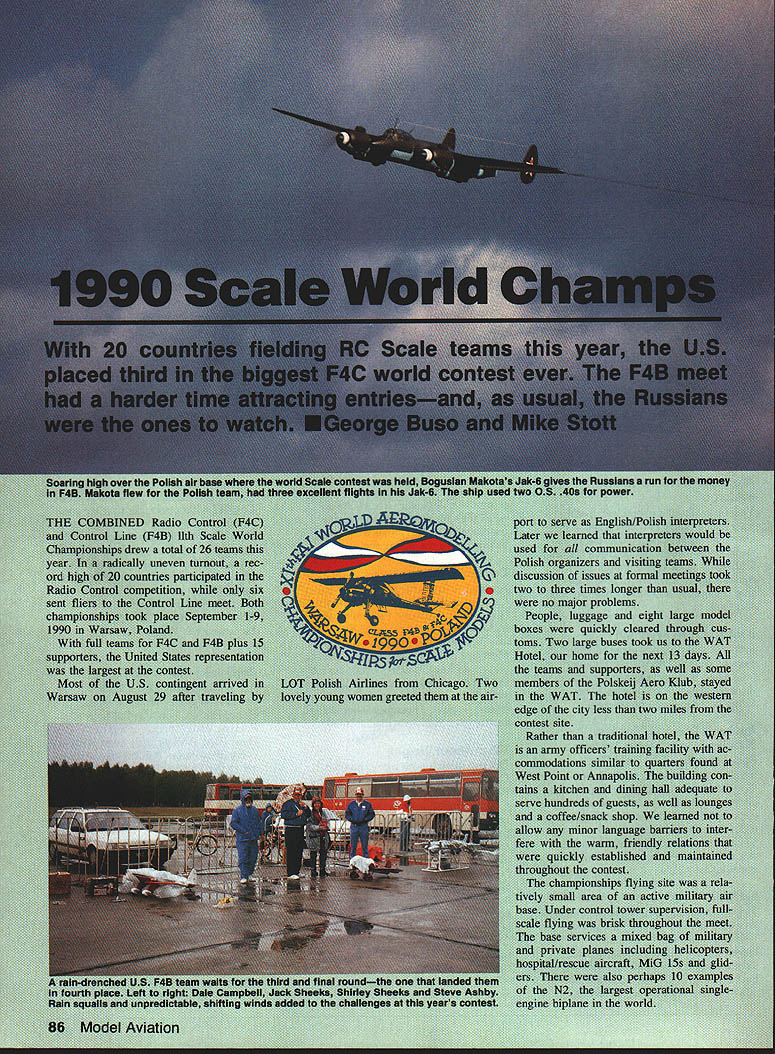
1990 Scale World Champs
By George Buso and Mike Stott
Overview
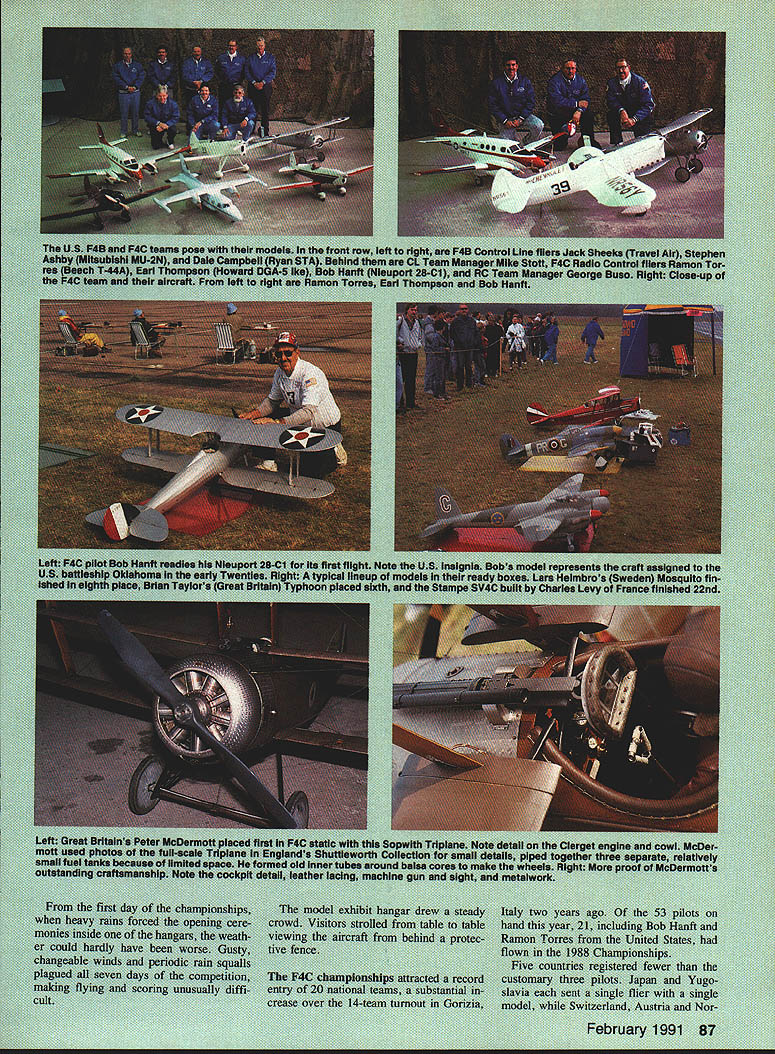
The combined Radio Control (F4C) and Control Line (F4B) 11th Scale World Championships drew a total of 26 teams this year. A record high of 20 countries participated in the Radio Control competition (F4C), while only six sent fliers to the Control Line meet (F4B). Both championships took place September 1–9, 1990 in Warsaw, Poland.
With full teams for F4C and F4B plus 15 supporters, the United States representation was the largest at the contest.
Travel and accommodations
Most of the U.S. contingent arrived in Warsaw on August 29 after traveling by LOT Polish Airlines from Chicago. Two interpreters greeted them at the airport to assist with English/Polish communication. Interpreters were used for all communication between the Polish organizers and visiting teams; formal meetings therefore took two to three times longer than usual, but there were no major problems.
People, luggage and eight large model boxes were quickly cleared through customs. Two large buses took the group to the WAT Hotel, the accommodation for the next 13 days. All teams and supporters, as well as some members of the Polish Aero Klub, stayed in the WAT. The hotel is on the western edge of the city, less than two miles from the contest site.
The WAT is an army officers’ training facility with accommodations similar to those at West Point or Annapolis. The building contains a kitchen and dining hall adequate to serve hundreds of guests, as well as lounges and a coffee/snack shop. Warm, friendly relations were quickly established and maintained throughout the contest despite minor language barriers.
Flying site and weather
The championships flying site was a relatively small area at an active military air base. Under control-tower supervision, full-scale flying was brisk throughout the meet. The base serviced a mixed bag of military and private planes, including helicopters, hospital/rescue aircraft, MiG-15s and gliders. There were also perhaps ten examples of the An-2, the largest operational single-engine biplane in the world.
From the first day, when heavy rains forced the opening ceremonies inside one of the hangars, the weather could hardly have been worse. Gusty, changeable winds and periodic rain squalls plagued all seven days of the competition, making flying and scoring unusually difficult.
The model exhibit hangar drew a steady crowd. Visitors strolled from table to table viewing the aircraft from behind a protective fence.
F4C — Radio Control Championship
Entries and competitors
The F4C championships attracted a record entry of 20 national teams, a substantial increase over the 14-team turnout in Gorizia, Italy in 1988. Of the 53 pilots on hand this year, 21 had flown in the 1988 Championships; among them were Bob Hanft and Ray (Ramon) Torres from the United States.
Five countries registered fewer than the customary three pilots:
- Japan and Yugoslavia each sent a single flier with a single model.
- Switzerland, Austria and Norway each fielded two pilots.
These smaller teams competed with determination and were tough to beat.
Seventeen of the 52 models on display had flown in previous championships; world-championship fliers tend to favor proven designs over risky new models. Eight of the models had twin engines; about half were multiwinged, and 23 were biplanes. The largest wing area belonged to the Sopwith triplane flown by Great Britain’s Peter McDermott. That model placed first in static judging and received a 20% flight bonus.
Three jets were registered; each suffered major engine problems, which devastated the final standing of two teams. Spain’s Dan Jorda, flying a scratch-built KFIR-2 (scale 1 in. = 8.5 ft., 37-in. wingspan, 11 servos, O.S. 0.9 two-cycle with Turbox 3 fan), had flameouts on all three flight attempts and couldn’t become airborne in the time remaining. His teammate Jose Pico also experienced engine failure on three attempts and couldn’t post a flight score. Hermann Michelic of Austria managed two takeoffs with his SAAB 1050, but almost immediate power failures each time prevented him from scoring; he did not attempt a third flight.
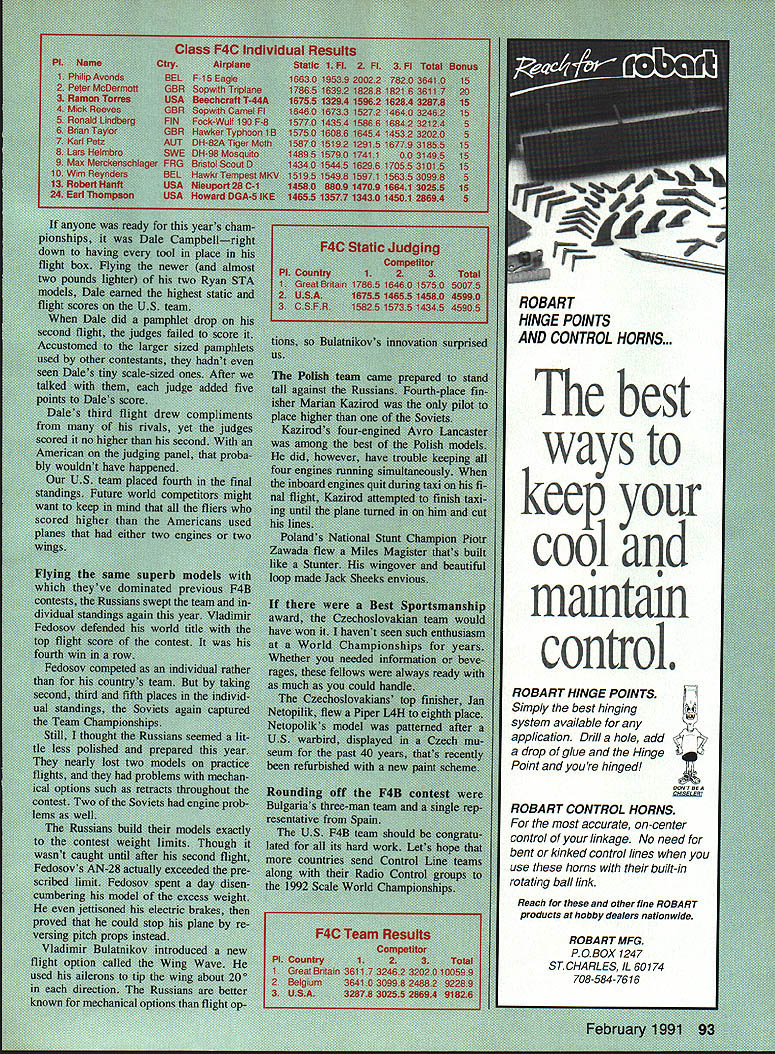
Philip Avonds of Belgium successfully defended his world title with the F-15 Eagle he flew in 1988. Ramon (Ray) Torres’s Beechcraft T-34A moved up from 10th place in 1988 to third in 1990, and Mick Reeves’s Sopwith Camel finished fourth.
Flight and static highlights
Avonds suffered a flameout on his third flight but retained the title on the strength of two exceptionally realistic control demonstrations and a third-place static score. Avonds was the first F4C flier to win the world title twice in a row.
If there were a Worst Luck award, it would have gone to the Spanish team. Jose Pico’s Taube was as exquisite as Jorda’s KFIR-2, but neither flier was able to post a score: Jorda had three flameouts; Pico had engine failure and damage on three attempts. The third Spanish team member, Alfonso Garcia, couldn’t make up for their bad luck.
U.S. F4C team selection and static preparation
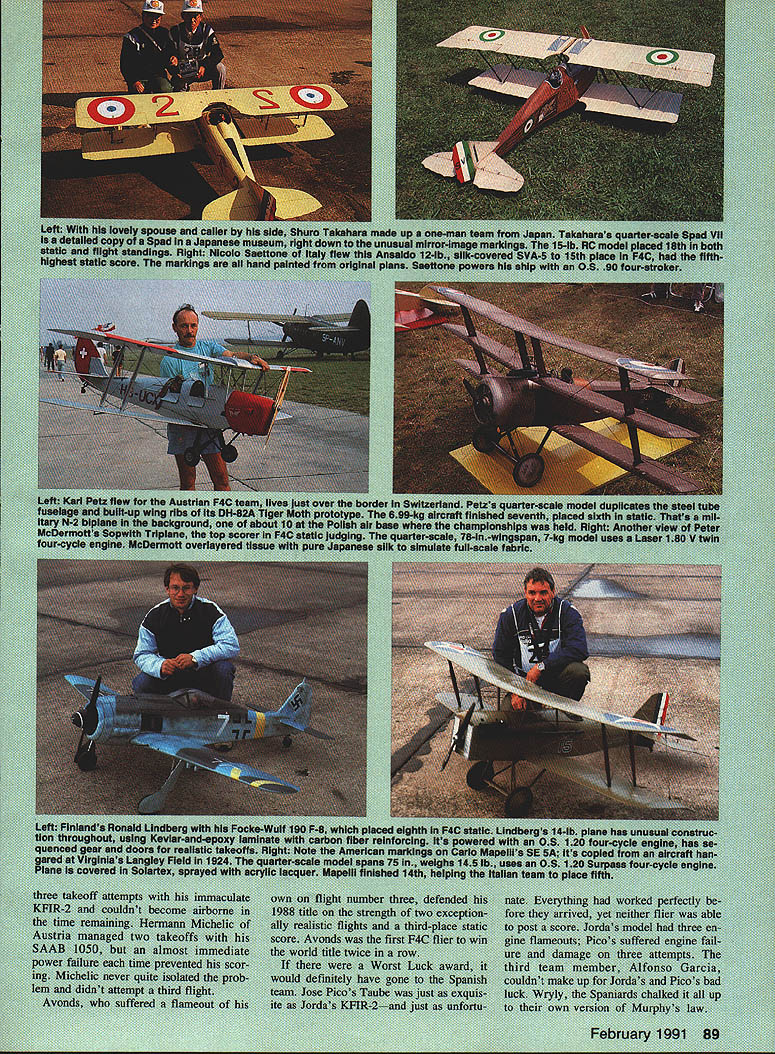
The U.S. F4C and F4B teams were selected in Dayton, OH in August 1989. The static judges at the team selection finals — Darlene Frederick, Vernon Altamirano and Roy Weber — accompanied the teams to Warsaw as supporters. They used their combined experience in role-playing sessions with each team member before static judging began.
Each flier presented his documentation package to the three stand-in judges for analysis. Based on their recommendations, verbal explanations were refined, inessential photos and written material were removed, three-views were improved, and the sequence of some documents was changed. The U.S. models were already outstanding, and the cleaned-up documentation helped the team to a combined second-place static standing (first place in static went to the British).
Peter McDermott’s Sopwith Triplane received the highest static score. Mick Reeves held fourth place and Brian Taylor ranked ninth.
U.S. flying performance
With second place in static, the U.S. team was determined to fly well.
Bob Hanft was first to fly for the Americans. During takeoff one cylinder of his O.S. 1.6 twin engine flamed out. He continued flying his Nieuport 28 low and slow, but gradually lost power and altitude. He called a landing but realized he could not safely return to the runway; he steered the model away from spectators and several large parked buses before it flipped over in the grass. Bob considered the flight a disaster, but the maneuvers scored well and his Nieuport was only slightly damaged.
Ray Torres was up next. Ray hadn’t practiced enough with his Beechcraft twin to feel confident about elevator trim settings. On its first takeoff the model was out of trim and he lost many flight points before stabilizing. Most remaining maneuvers were well executed but the flight earned a mediocre score by his standards.
Earl Thompson, flying a big Howard DGA-5–like model nicknamed the “Ike,” took off superbly until an Enya 1.20 sputtered during an inverted-speed maneuver. He rolled upright and finished the flight but lost many valuable points. Back in the hangar he found and fixed a small kink in the fuel line; whether that was the sole cause was unclear until a subsequent flight.
Meanwhile Philip Avonds earned a phenomenal score with a brilliantly executed set of maneuvers in his F-15. The flight scored a perfect 1,950 points; with the Eagle’s 15% bonus that became 1,953.9 points.
As rounds continued, the British held first place, the Belgians were close behind, and the Americans trailed in sixth. The U.S. team vowed to fly better in round two, and they did: Bob Hanft turned in an excellent flight that moved him up five places on the scoreboard. Ray Torres made a gutsy decision, replacing two maneuvers with more daring ones he had not previously performed. His Descending Circle and Overshoot produced a colorful, action-packed flight with continuous changes in throttle and attitude; the servos “worked their little gears off.”
F4B — Control Line Championship
Turnout and context
The F4B Control Line World Championships attracted only six national teams. The disappointing turnout likely has two causes:
- Control Line’s popularity may be waning compared with Radio Control.
- The Russians’ historical dominance at F4B world contests may discourage potential challengers.
Under a proposed FAI rules change, a World Championships–winning model would be barred from entering a subsequent contest. If adopted, the change should temper the Russians' hold by forcing them to build new models. Such action or similar measures may be necessary if F4B is to continue as a true world event.
U.S. F4B team and static judging
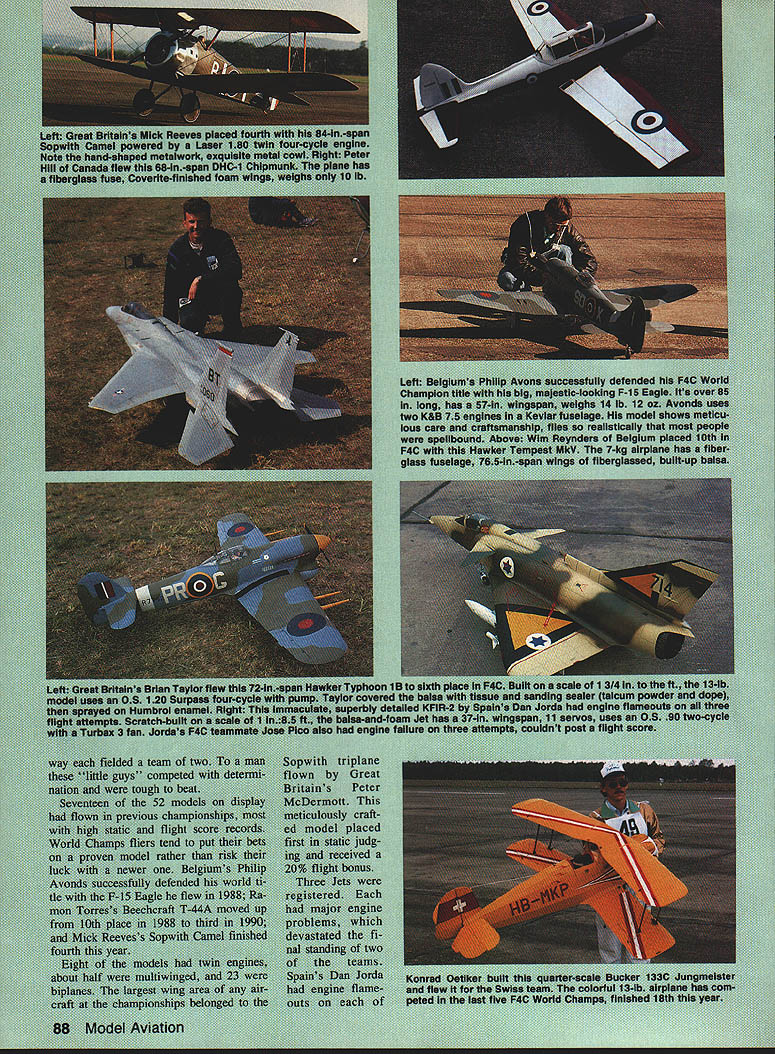
Dale Campbell and Jack Sheeks joined veteran team member Steve Ashby and Team Manager Mike Stott to make up the U.S. F4B contingent. The team arrived in Warsaw several days in advance of the nine-day competition, giving the pilots valuable time to set up and review the schedule.
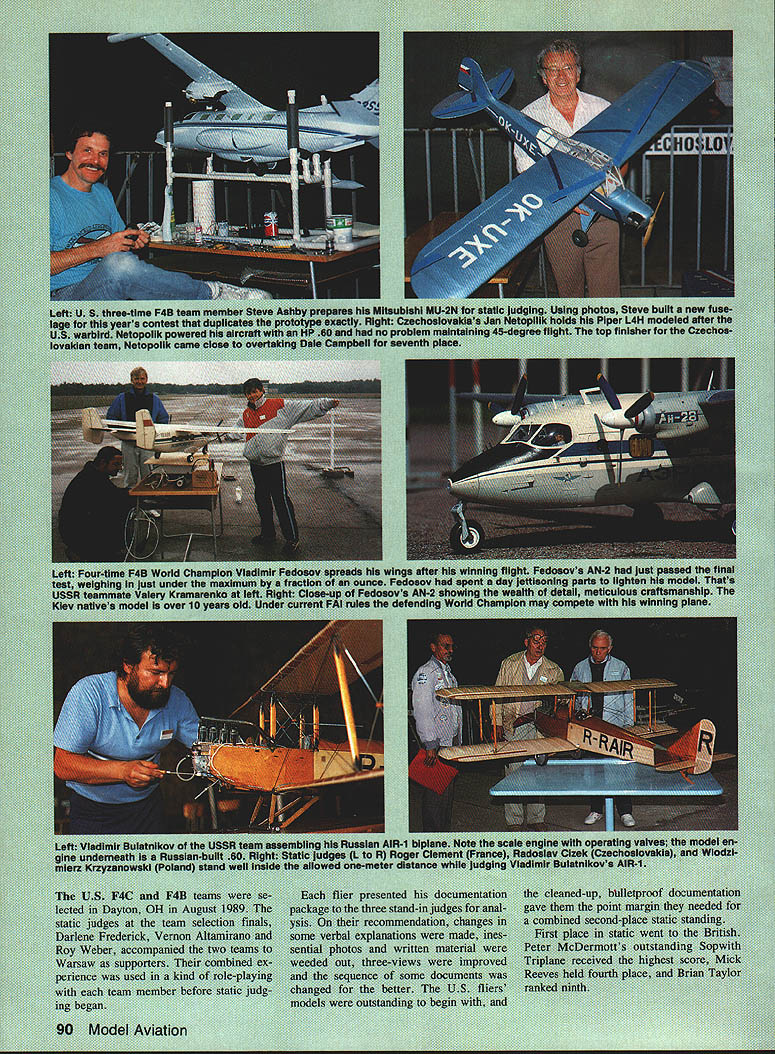
Static judging began Sunday afternoon, September 1, and continued until late Monday afternoon. Although the U.S. team might have benefited from an American representative on the static jury, U.S. flyers scored quite well: Dale Campbell, Steve Ashby and Jack Sheeks placed sixth, seventh and 11th respectively.
When judging craftsmanship, the jury is required to keep a meter’s distance from the airplanes (one meter ≈ 39 inches). Apparently judges either overlooked that rule or didn’t realize a meter is 39 inches, since it was not uncommon to see them bump their heads on the models.
The static jury factored in complexity when judging color and markings, which hurt simpler aircraft like Steve Ashby’s Mitsubishi MU-2. If you plan to duplicate a relatively simple aircraft, consider complexity as a way to pick up extra points.
Flight-line problems and solutions
From the beginning the U.S. team encountered problems on the flight line.
- Jack Sheeks had a persistently sticking throttle in his Mystery Ship. He solved it by installing a different carburetor supplied by Abitair. Later, Jack’s third flight ended in a crash after an excellent start; it was the only crash at the contest.
- Jack was nearly denied full credit for an overshoot maneuver because the head judge, a Russian, initially insisted it wasn’t in the rule book. After pointing out that Russian flyers had been scored for maneuvers not found in the rule book, the judge reconsidered.
- Steve Ashby tried an unfamiliar electrical control system that refused to work. Whenever Steve picked up the transmitter handle, his engine would stall. The team suspected interference. When Steve still hadn’t posted a score by the end of the second round, Dale Campbell volunteered his extra control system. Although only the throttle and flaps could be hooked up (rather than the customary four functions), Steve was able to post a third-round score and save face for the team.
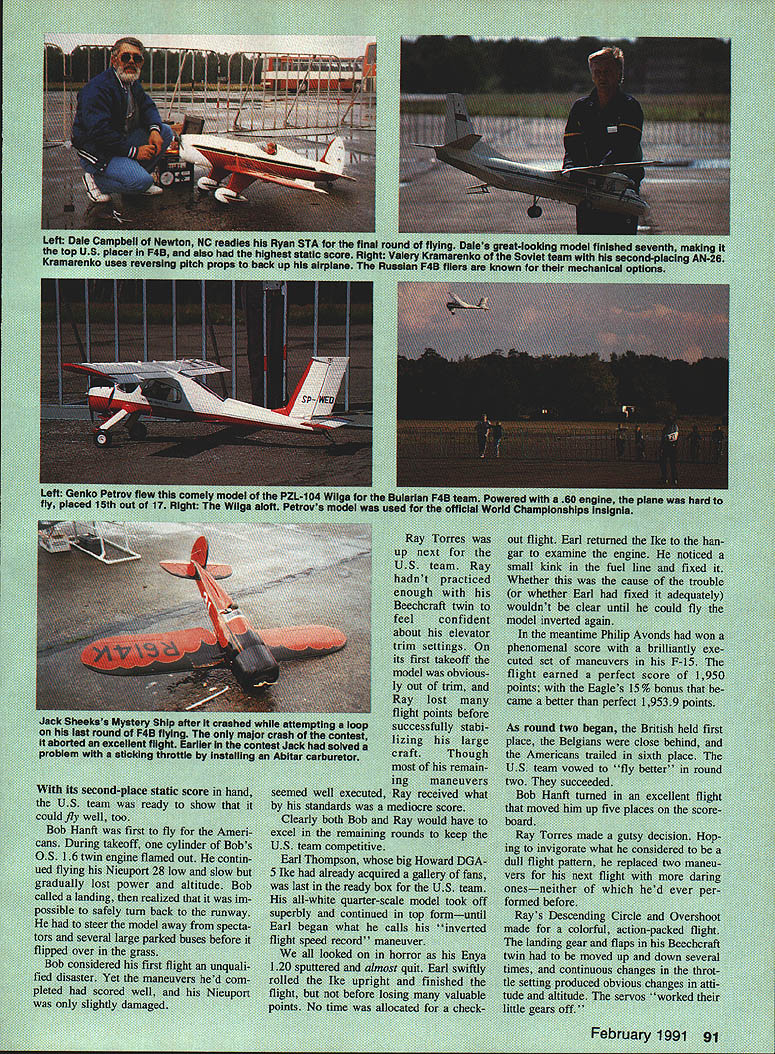
Dale Campbell was exceptionally prepared and flew the newer, nearly two-pound-lighter Ryan STA. He earned the highest static and flight scores on the U.S. team. During his second flight Dale performed a pamphlet drop that the judges initially failed to score because his scale-sized pamphlets were much smaller than those other contestants used. After discussion, each judge added five points to Dale’s score. His third flight drew compliments but was not scored higher than the second; an American on the judging panel likely would have prevented that discrepancy.
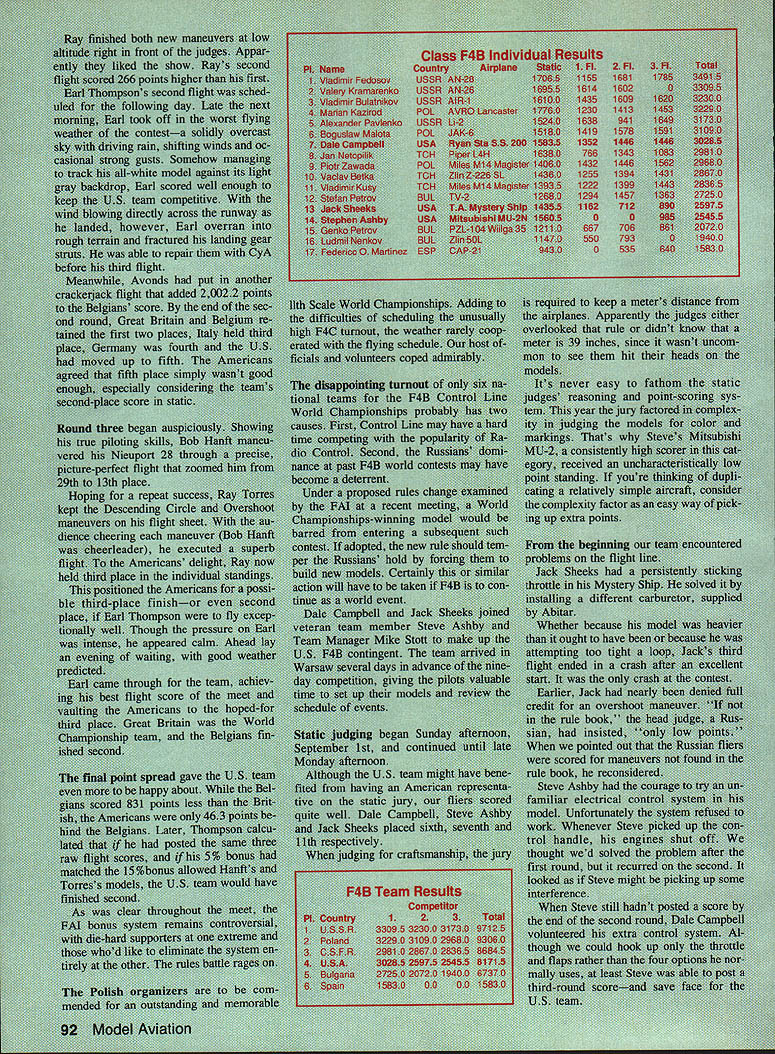
The U.S. team placed fourth in the final standings. Note: all fliers who scored higher than the Americans used planes that either had two engines or two wings.
Winners and notable performances
The Russians again dominated F4B, sweeping the team and individual standings. Vladimir Fedorov defended his world title with the top flight score of the contest — his fourth consecutive win. Fedorov competed as an individual rather than for his country’s team; by taking second, third and fifth in individual standings, the Soviets captured the Team Championship.
Observations on the Russians:
- They build models exactly to the contest weight limits. Fedorov’s AN-28 actually exceeded the prescribed limit after his second flight; he spent a day removing excess weight, even jettisoning electric brakes and proving he could stop by reversing prop pitch instead.
- Vladimir Bulatnikov introduced a new flight option called the Wing Wave, using ailerons to tip the wing about 20° in each direction. The Russians are better known for mechanical options than flight options, so this was a surprise.
- Despite their dominance, the Russians seemed a bit less polished this year: they nearly lost two models on practice flights, had problems with mechanical options such as retracts, and two of the Soviets had engine problems.
Poland came prepared to challenge the Russians. Marian Kazirod finished fourth and was the only pilot to place higher than one of the Soviets. Kazirod’s four-engined Avro Lancaster was among the best Polish models, though he had trouble keeping all four engines running simultaneously; three inboard engines quit during taxi on his final flight, and his model turned in on him and cut his lines.
Poland’s national stunt champion Piotr Zawada flew a Miles Magister built like a stunter; his wingover and beautiful loop impressed many.
The Czechoslovak team was a model of sportsmanship, always ready to help with information or refreshments. Their top finisher, Jan Netopilik, flew a Piper L4H to eighth place; the model was patterned after a U.S. warbird displayed in a Czech museum that had recently been refurbished.
Rounding out the F4B contest were Bulgaria’s three-man team and a single representative from Spain.
Closing thoughts
The U.S. F4B team should be congratulated for its hard work. It is hoped that more countries will send Control Line teams along with their Radio Control groups to the 1992 Scale World Championships to preserve and strengthen F4B as a world event.
Transcribed from original scans by AI. Minor OCR errors may remain.

