
1991 FF World Champs
— Fred Terzian
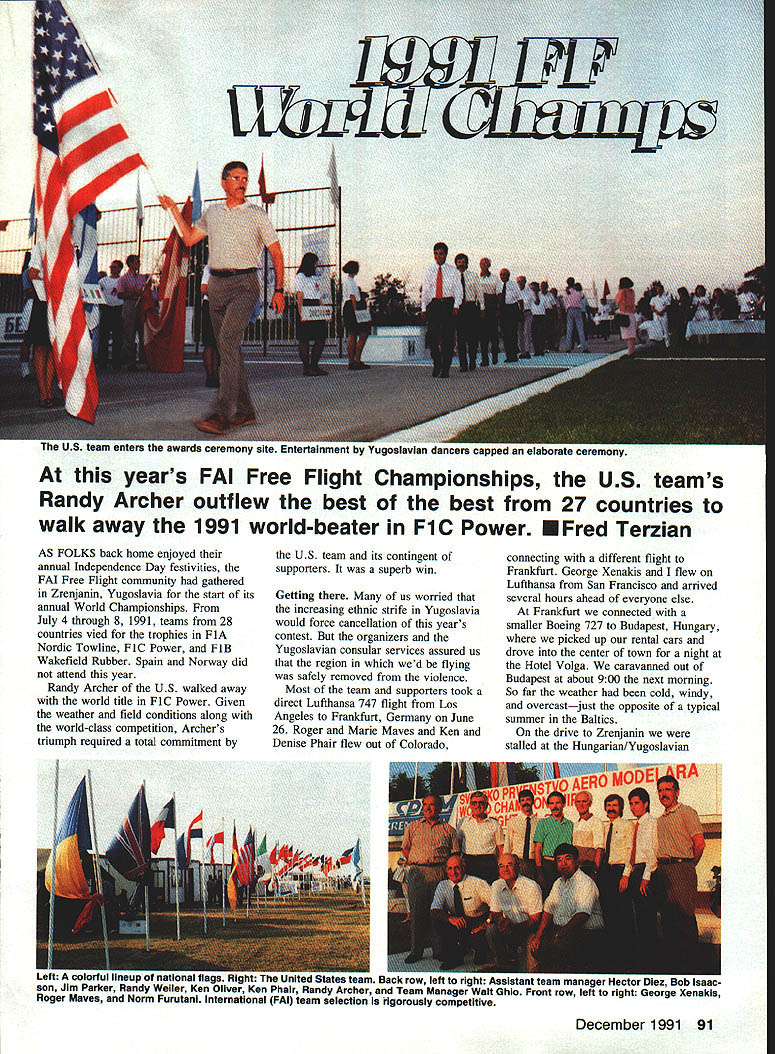
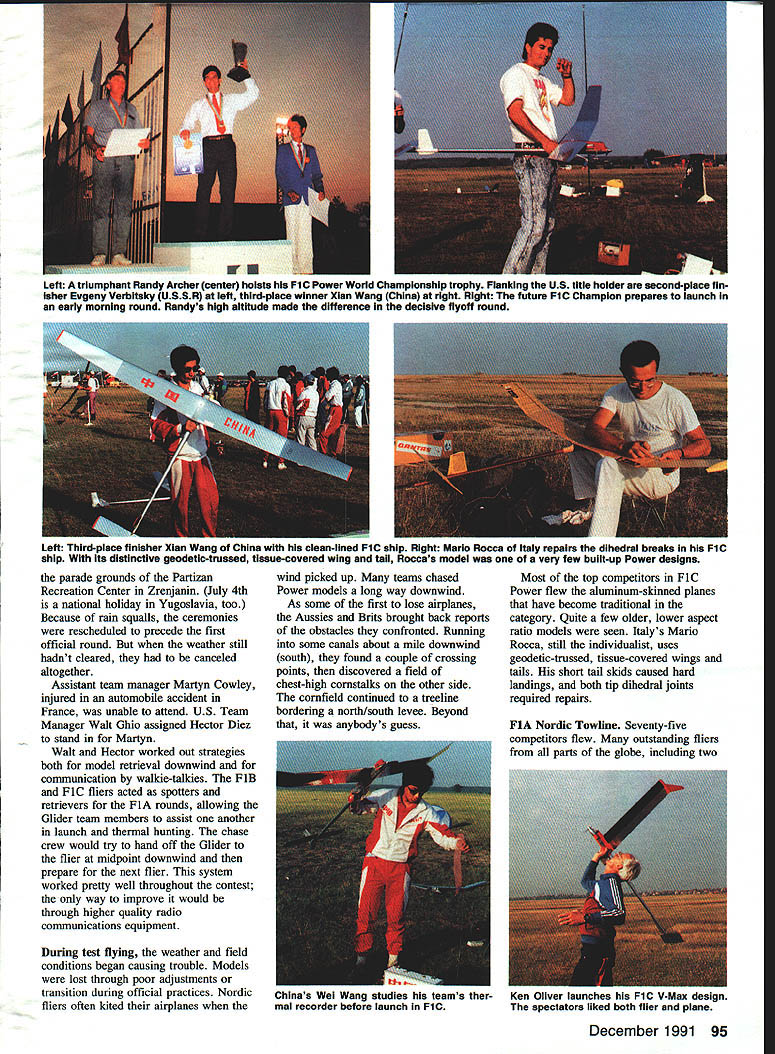
At this year's FAI Free Flight Championships in Zrenjanin, Yugoslavia (July 4–8, 1991), teams from 28 countries vied for trophies in F1A Nordic Towline, F1C Power, and F1B Wakefield Rubber. Randy Archer of the U.S. outflew the world’s best in F1C Power to claim the 1991 world title. Given the weather, field conditions, and world-class competition, Archer’s triumph required total commitment by the U.S. team and its supporters.
Getting there
Most of us took a Lufthansa 747 from Los Angeles to Frankfurt on June 26; others connected via different flights. From Frankfurt we flew a smaller Boeing 727 to Budapest, picked up rental cars, spent a night at the Hotel Volga, and caravanned to Zrenjanin the next morning. The trip to Zrenjanin was delayed at the Hungarian–Yugoslav border by heavy traffic and took about nine hours—three hours longer than planned.
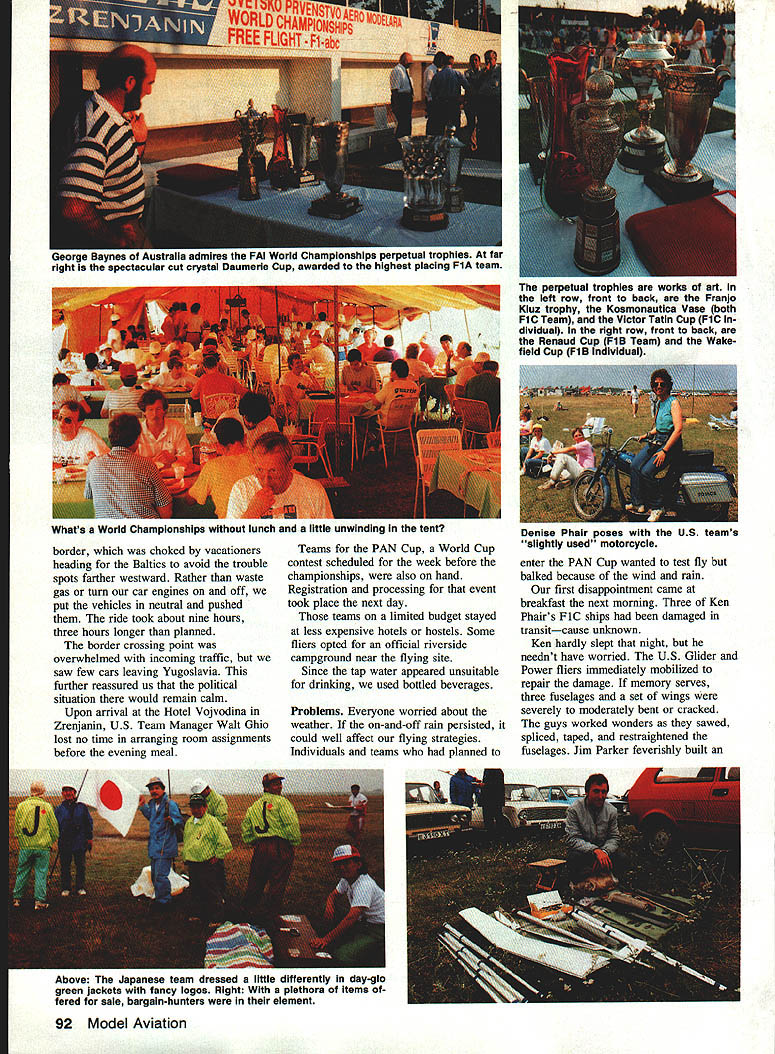
Upon arrival at the Hotel Vojvodina, U.S. Team Manager Walt Ghio quickly arranged room assignments before the evening meal. The PAN Cup (World Cup contest) scheduled the week before the championships had registration and processing the next day. Teams on limited budgets stayed in less expensive hotels and hostels; some fliers camped at the official riverside campground near the flying site. Tap water appeared unsuitable for drinking, so bottled beverages were used.
Problems and repairs
Everyone worried about the weather: unseasonably cold, windy, and rainy conditions persisted and affected flying strategies. The first real disappointment came at breakfast: three of Ken Phair’s F1C ships were damaged in transit. U.S. glider and power fliers mobilized to repair the damage—sawing, splicing, taping, and re-straightening fuselages and wings until the ships flew again.
Several repair anecdotes:
- An alignment jig sat atop Phair’s model box while the crew worked on fuselages.
- Ken Oliver searched for microballoons or baking soda to use as a filler and couldn’t find any locally. My wife had packed surplus Sweet ’n Low packets; we used the granular sweetener as a filler substitute. It was harder to sand but worked as a CYA strengthener.
- Randy Archer supplied carbon/Kevlar sleeves in different diameters to strengthen and align the interiors of Ken’s tail booms.
One wing panel had separated at the juncture of the aluminum skins; the team debated causes but concentrated on repairs and testing.
Perpetual trophies on the line included the Franjo Kluz Trophy and Kosmonautica Vase (both F1C Team), the Victor Tatlin Cup (F1C Individual), the Renaud Cup (F1B Team), and the Wakefield Cup (F1B Individual).
Field conditions
The flying site was a broad, flat plain just outside the town of Aradac. Recent rains made the field green and soft, but low spots with tall grasses hid outcroppings of dirt 12–14 inches high and bumpy as LEGO blocks. These muddy depressions were often full of water and swarmed with insects when the sun came out and the wind died down. It felt like flying in a bog; insect repellent became essential, and chase teams repositioned further downwind.
Only two teams had brought chase bikes or motorcycles. Ken Oliver borrowed a bike via one of the organizers; by the second day the U.S. team had spent about $200 on a borrowed motorcycle. The bike made downwind recovery much easier—especially during F1C Power rounds when flights went far downwind—but shifting gears without a clutch while carrying a plane was tricky on muddy, rough ground.
Retrieval was further complicated by canals, cornfields, levees, and treelines encountered downwind. Some airplanes have been lost forever despite desperate searches by ultralight, motorcycle, or on foot.
Team organization and opening ceremonies
Opening ceremonies were planned for the evening of July 4 on the parade grounds of the Partizan Recreation Center, but repeated rain squalls forced cancellation. Assistant team manager Martyn Cowley, injured in an automobile accident in France, could not attend; Hector Diez stood in for him.
Walt Ghio and Hector Diez worked out retrieval and communication strategies using walkie-talkies. F1B and F1C fliers served as spotters and retrievers during F1A rounds so glider team members could help each other with launches and thermal hunting. The chase crew tried to hand off gliders to the flier at midpoint downwind; the system worked well overall, though better radio communications would have improved it.
F1A Nordic Towline
Seventy-five competitors flew in F1A Nordic Towline. Wind, rain, and slippery field conditions made early rounds tricky, and many outstanding fliers—including two from the U.S.—were eliminated from the flyoffs.
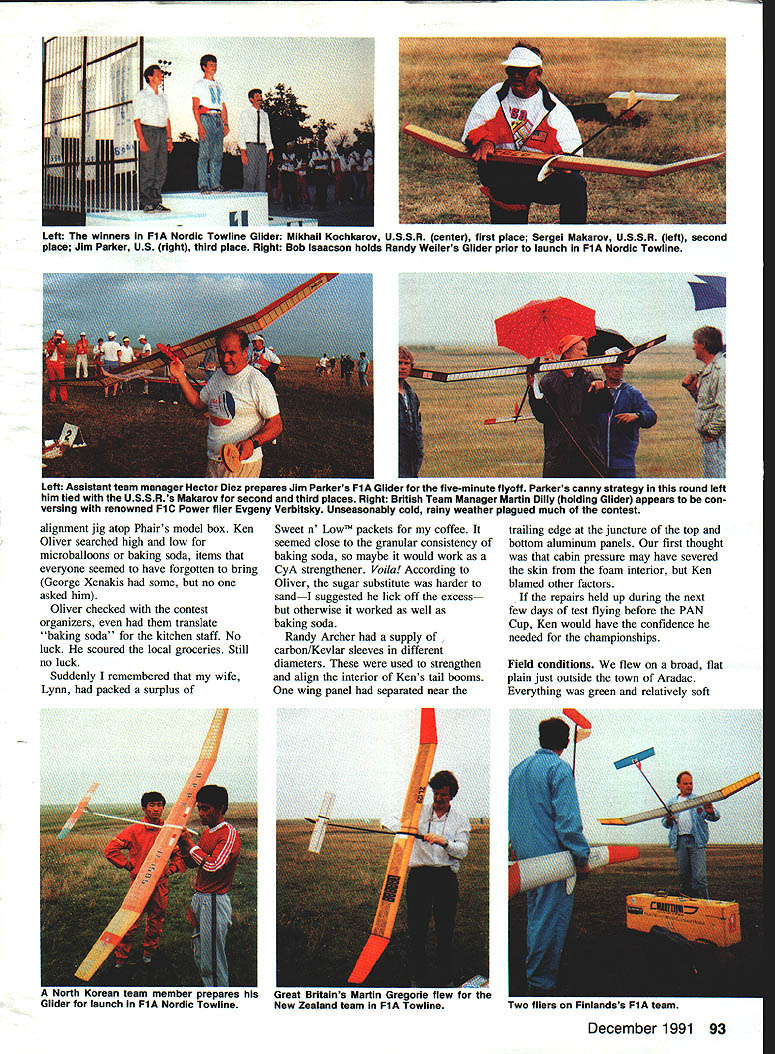
Bob Isaacson (U.S.) struggled in the rain: his glider snaked during the tow and then stalled after launch when rainwater shifted the center of gravity. Although he had perfect scores in the remaining rounds, he missed a max and ultimately the flyoffs due in part to water clinging to his tissue stabilizer. Randy Weiler missed a max by 12 seconds in the third round; more competitors dropped that round than any other.
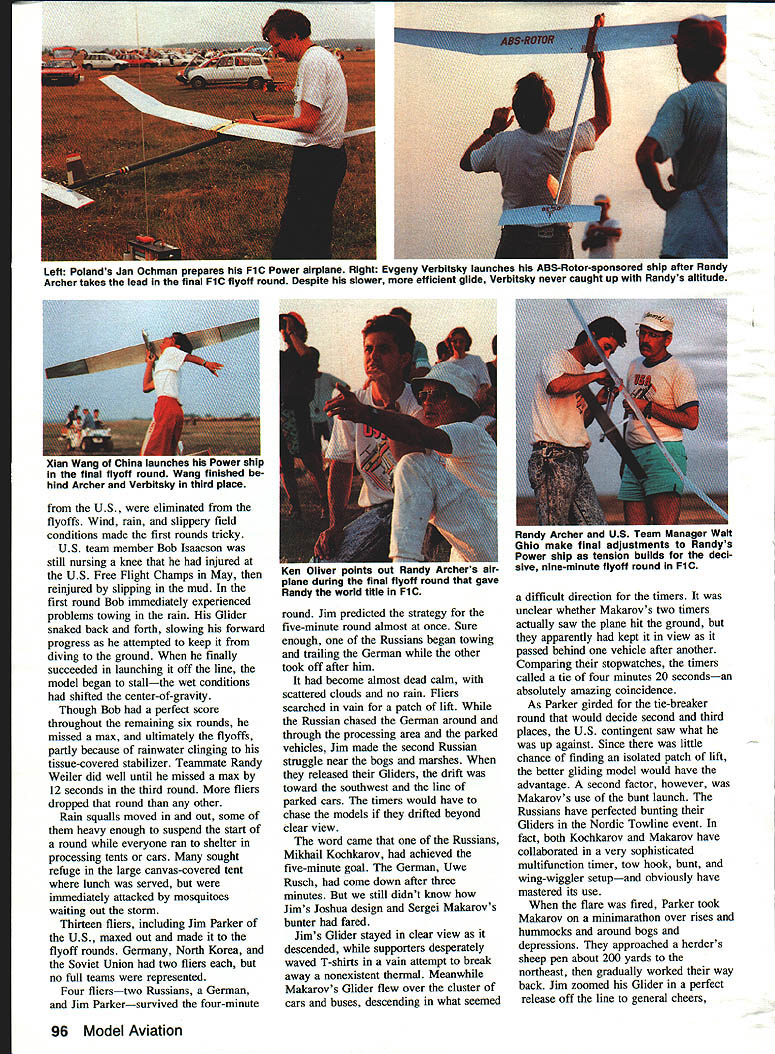
Thirteen fliers, including Jim Parker (U.S.), maxed out and reached the flyoffs. Four fliers—two Russians, a German (Uwe Ruesch), and Jim Parker—survived the four-minute round. In the five-minute round, Mikhail Kochkarov (USSR) achieved five minutes, while Parker and Sergei Makarov tied at four minutes 20 seconds. In the tie-breaker, Jim Parker outmaneuvered Makarov with a superior launch and transition and secured second place; Makarov took third.
F1C Power
Fog cleared early on F1C Power day. Dampness from previous rains forced spotters and chasers to find new routes downwind. The strategy was adjusted so the motorcycle would be midway between the flight line and the crews’ farthest downwind point, easing recovery and radio communications.
Ken Oliver attracted attention with an unusual V-dihedral wing and tiplets. Observers thought his design competitive, but he missed the required four-minute first round by 60 seconds—he'd simply picked bad air. He easily maxed the remaining six flights, though he noted the ship veered like a weathervane in higher winds, perhaps because of the tiplets.
Ken Phair’s repaired ships flew properly by contest time. He moved smoothly through the first three rounds but dropped a potential max by 41 seconds in the fourth—a round in which many top competitors also faltered.
Eighteen contenders made the F1C flyoffs. China and Poland each had full teams; four countries had two fliers. Most pilots used bunters, and many used beepers and transmitters for downwind recovery—becoming essential where tall crops or uneven terrain blocked line-of-sight.
Randy Archer flew consistently and trusted his team to recover his downwind flights, which freed him to concentrate on flying, picking air, and preparing backups. During track-assisted recoveries, Randy used a Jim Walston-designed tracker to locate a hidden plane in corn rows—he was within ten feet before he almost tripped over it.
Flyoffs and the final
The flyoffs were intense. Darkness fell before rounds were completed; officials hoped to finish before the first Wakefield round but had to postpone until after F1B.
The seven-minute round began with seven competitors; the line of top fliers was gradually moved far upwind to help avoid downwind crops and trees and to aid visibility in low light. A disputed timing call occurred during Randy Archer’s nine-minute-winning flight: one official timer had stopped early, but Sandy Pimenoff of the FAI jury reviewed both official watches and ruled in favor of Randy, confirming his nine-minute winner.
In the final contest among Randy Archer, Xian Wang (China), and Evgeny Verbitsky and Valery Strukov (USSR), Randy achieved a near-vertical climb and picture-perfect transition. Verbitsky and Wang both stalled during their climb-to-transition attempts and lost altitude. Randy’s higher altitude and clean transition won the day; his glider touched down at sunset—securing the F1C World Championship.
F1B Wakefield Rubber
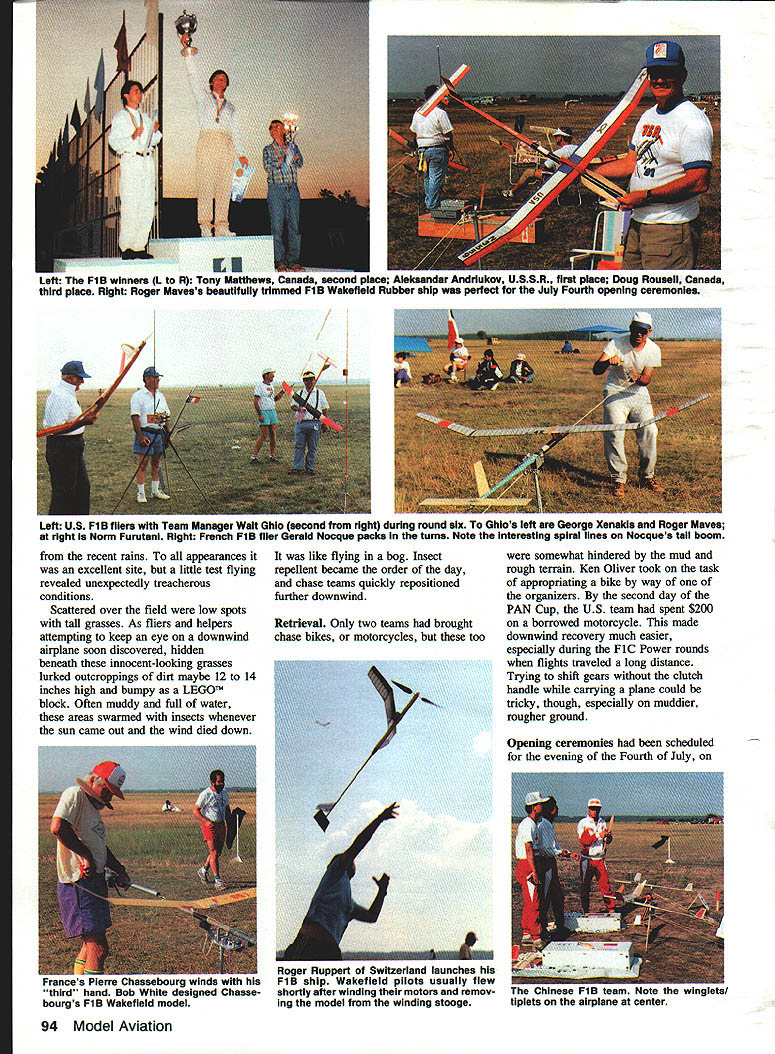
Wakefield events provided a contrast to the loud 2.5cc engine noise of F1C: quiet winding sounds and careful motor handling. European fliers commonly used electric thermal blankets to warm rubber motors; the blanket attaches to the motor tube with Velcro and plugs into a power source.
Thermals were spotty but sometimes produced massive updrafts carrying many Wakefields together. The first round target of 210 seconds proved difficult: 17 of 65 entrants—including George Xenakis—failed to make it. The sixth round featured a large cumulus that produced long maxes for some fliers; others who flew later missed by varying margins.
Seventeen fliers reached the flyoffs. Poland and the USSR had full teams; Canada’s Tom Matthews and Doug Rousell were the only North Americans by name. Twelve survived to the six-minute round. The final came down to Aleksandr Andriukov (USSR) and dark horse Tony Matthews. Andriukov used his intense, vertical-launch style; Matthews used a simpler approach. Matthews touched down only 19 seconds short of Andriukov’s 420-second max, earning admiration and second place; Doug Rousell took third.
Closing ceremony and banquet
The closing ceremony was elaborate: young women carried placards announcing teams’ nationalities in Serbo-Croatian as teams paraded past the reviewing stand. After awarding team and individual perpetual trophies, performers presented Yugoslavian dances. A post-ceremony banquet at a provincial hotel lasted into the early morning of July 9, with traditional toasts and exchanges of shirts, pins, and decals. The U.S. team and supporters were sorry to see it end but glad to begin the trip home.
Observations
- The use of audible beepers and tracking devices is becoming essential to prevent model loss and expensive rebuilding or replacement.
- The Russian bunt concept is a clear advantage in flyoffs when thermals are unlikely—especially in Nordic Towline, where bunt launching provides a decided edge.
- Serious practice and competition flying in all types of weather, including wind and rain, is important so flight characteristics are predictable at World Championships time.
Transcribed from original scans by AI. Minor OCR errors may remain.

