
1991 RC Soaring World Championship
Results and significance
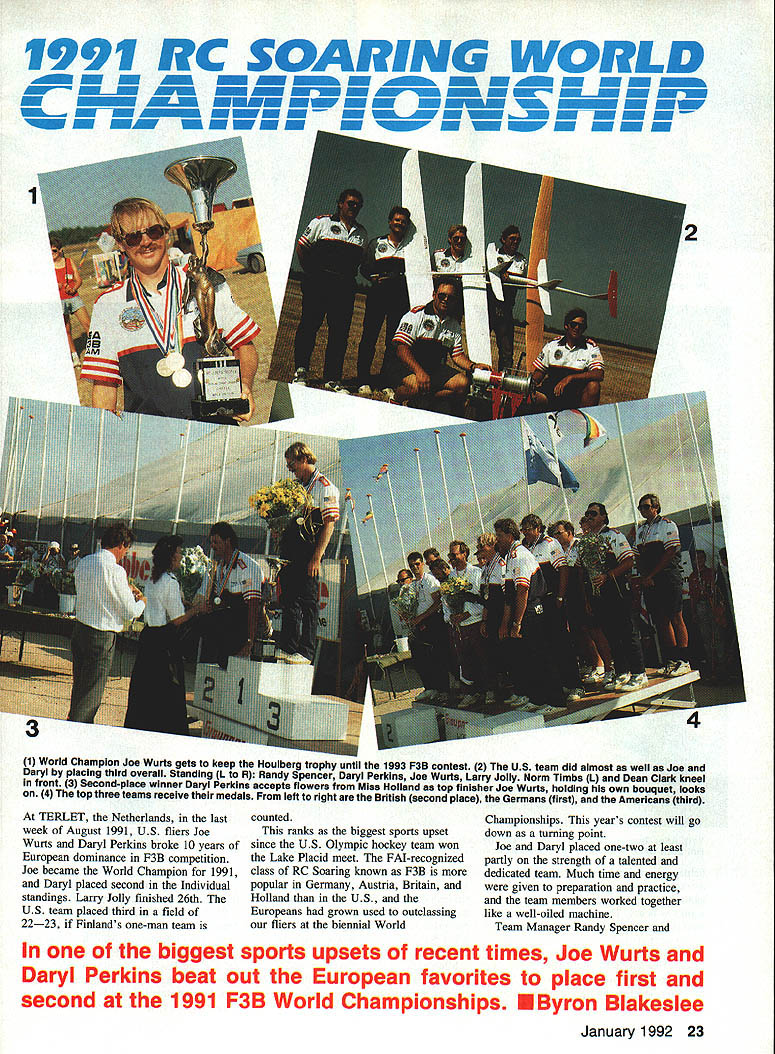
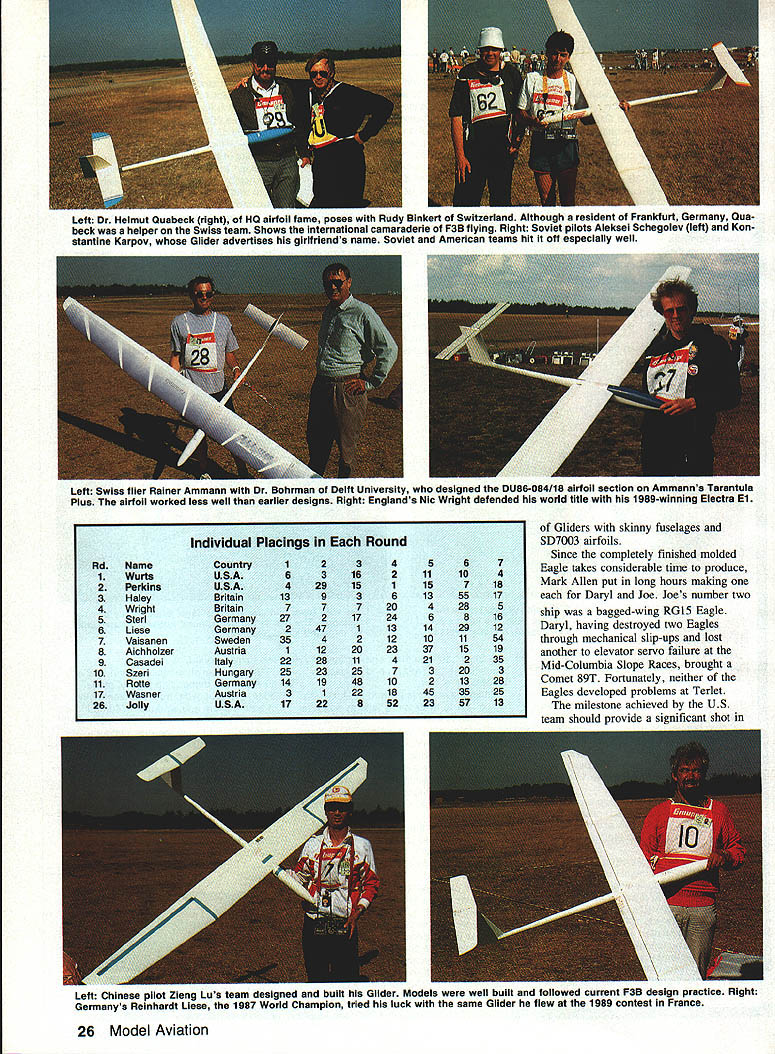
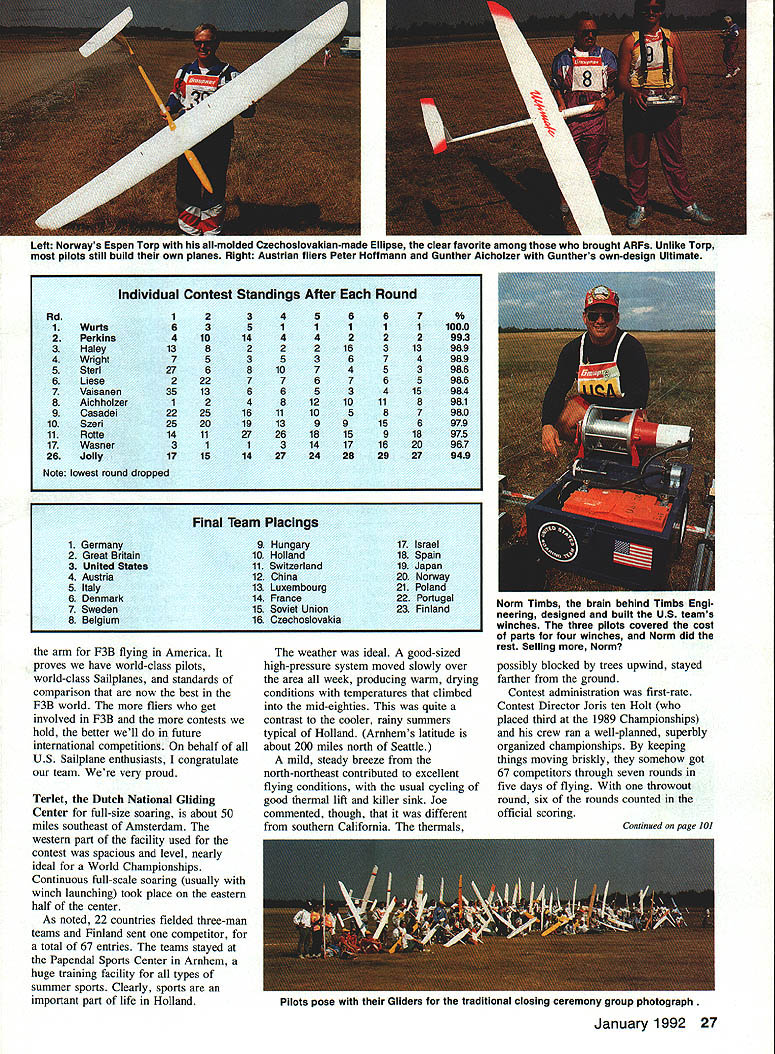
At Terlet, the Netherlands, in the last week of August 1991, U.S. fliers Joe Wurts and Daryl Perkins broke 10 years of European dominance in F3B competition. Joe Wurts became World Champion for 1991 and Daryl Perkins placed second in the individual standings. Larry Jolly finished 26th. The U.S. team placed third among 22 national teams; Finland also sent a one-man entry.
This result was widely regarded as one of the biggest sports upsets since the U.S. Olympic hockey team’s victory at Lake Placid and marked a turning point in F3B, a class previously dominated by Europeans.
Team and equipment
- Team Manager: Randy Spencer.
- Radios: Team used Altronics Vision transmitters.
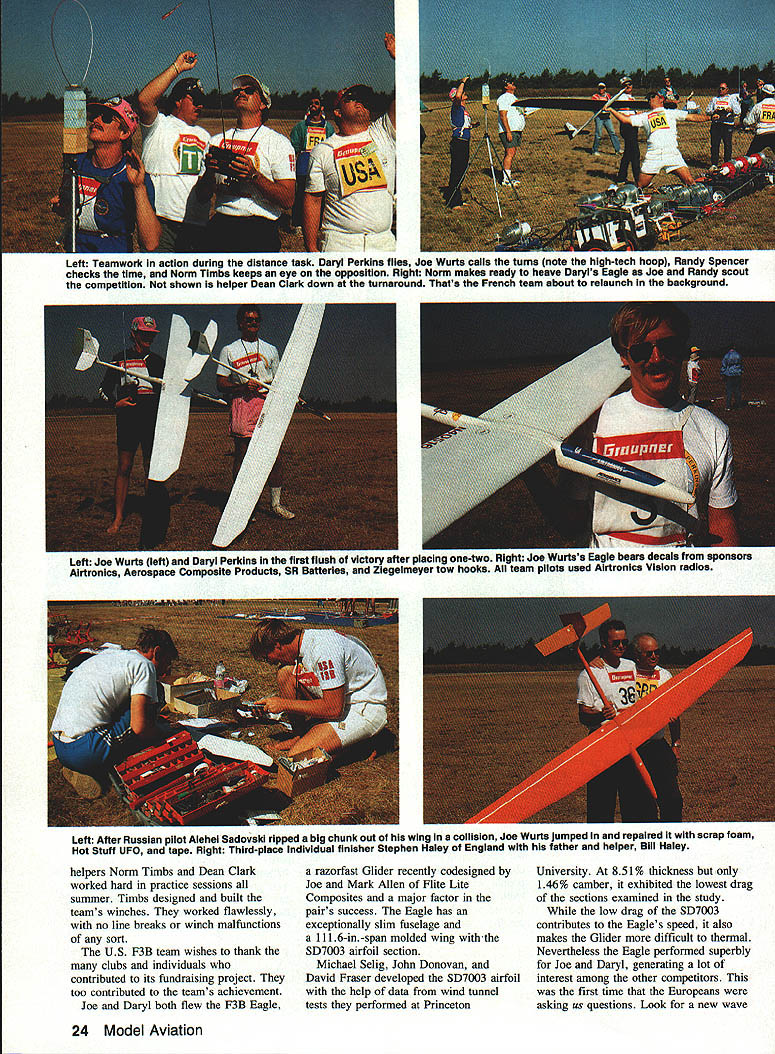
- Primary glider: F3B Eagle — co-designed by Joe Wurts and Mark Allen (Flite Lite Composites). The Eagle features an exceptionally slim fuselage, a molded wing with a 111.6 in span, and the SD7003 airfoil.
- SD7003: developed by Michael Selig, John Donovan and David Fraser with wind-tunnel data from Princeton University. The section (8.51% thickness, 1.46% camber) showed very low drag, contributing to Eagle’s high speed while making thermalling more challenging.
- Backup and construction notes:
- Mark Allen produced Eagles for Joe and Daryl; finished molded Eagles are time-consuming to produce.
- Joe’s second ship was a bagged-wing RG15 Eagle.
- Daryl had brought a Comet 89T as a backup after losing and damaging Eagles earlier; fortunately no Eagles developed problems at Terlet.
- Winches and ground support:
- Winches were designed and built by Norm Timbs; they worked flawlessly with no line breaks or malfunctions.
- Helpers during summer practice included Dean Clark and others.
- Uniforms: Neal Perkins supplied team uniforms.
The team’s preparation, practice and ground support were credited as major factors in the pair’s success.
The contest and venue
- Location: Terlet Dutch National Gliding Center (about 50 miles southeast of Amsterdam), western field used for the contest.
- Entrants: 22 countries fielded three-man teams and Finland sent one competitor; total entries numbered 67.
- Accommodations: Teams stayed at the Papendal Sports Center in Arnhem.
- Weather: A slow-moving high-pressure system produced warm, drying conditions with temperatures into the mid-80s F and a mild, steady north-northeast breeze — generally excellent flying conditions, though thermals behaved differently than in southern California.
- Administration: Contest Director Joris ten Holt and crew ran a well-planned, efficiently organized championships. Seven rounds were flown Tuesday through Sunday, with three to four days of intense practice preceding Monday’s official practice round. One throwout round was allowed; six rounds counted toward final scores.
Championship highlights and narrative
- Joe and Daryl’s combined performance, consistency and teamwork generated significant interest from European competitors.
- Joe Wurts’ statistics (excluding his throwout): averaged 998 points in Duration, 973 in Distance, and 892 in Speed. His throwout round (round three) scored 2,786 points—the highest single-round total in the contest. Joe’s six-round total was 17,254.7 (average 2,875.8).
- Daryl Perkins finished with 17,139.6 points, only 115 points (about two laps) behind Joe.
- The final round speed task (round seven) was flown in reverse order of standings after round six. With closest competitors’ times already posted, Daryl and Joe knew exactly what they needed; Daryl recorded 17.9 s and Joe 17.7 s to clinch first and second places respectively.
- Larry Jolly: dominated U.S. team finals the previous year but suffered bad luck—notably in round four’s speed task (only 485 Speed points after a sink and turn cut) and again in round six—showing how luck and conditions can dramatically affect results.
- Overall: competition level was extremely high and unusually even; many previously lesser-known pilots performed very well.
F3B — How It Works
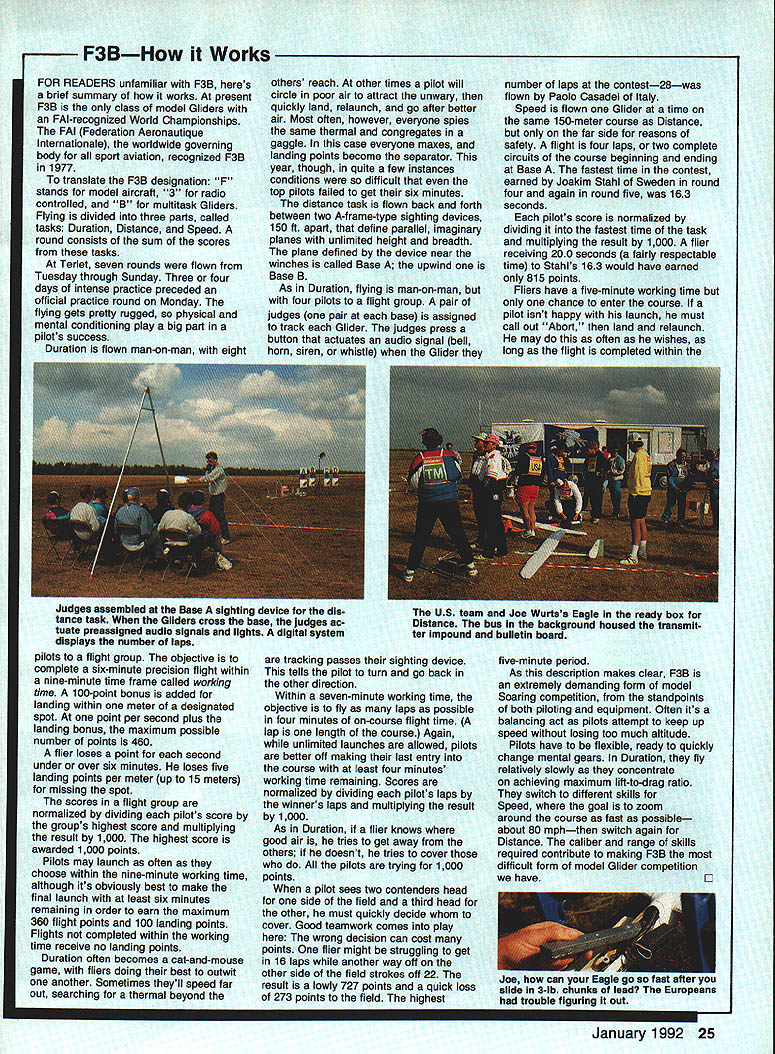
For readers unfamiliar with F3B, here's a summary. F3B is an FAI‑recognized World Championship class (FAI = Fédération Aéronautique Internationale). F3B was recognized in 1977. The designation: F = model aircraft; 3 = radio-controlled; B = multi-task glider.
A round consists of three tasks: Duration, Distance and Speed. Scores from the three tasks are summed for the round. Typically seven rounds are flown over five days, with three to four days of practice beforehand. F3B requires both physical and mental conditioning, and demands a wide range of piloting skills.
Duration
- Format: Man-on-man heats of eight pilots.
- Objective: Maximize time aloft within the prescribed period (often a six-minute goal).
- Tactics: Pilots circle thermals; some may land and relaunch to find better lift. Gaggles form when pilots spot the same thermal. When everyone maxes, landing points separate competitors.
- Scoring: Scores are normalized—each pilot’s raw score divided by the winner’s raw score, then multiplied by 1,000.
- Notes: In very difficult conditions, even top pilots sometimes fail to reach the maximum time.
Distance
- Course: Two sighting devices define parallel planes 150 meters apart (Base A nearer the winches, Base B upwind).
- Format: Man-on-man with four pilots per group. Pairs of judges (one pair at each base) track each glider and trigger audio signals when the glider passes the sighting device to indicate turns.
- Objective: Within a seven-minute working time, pilots aim to fly as many laps as possible in four minutes of on-course time. A lap is one length of the course.
- Launches: Unlimited launches allowed, but final entry into the course is best with at least four minutes of working time remaining.
- Scoring: Each pilot’s laps divided by the winner’s laps, then multiplied by 1,000.
- Strategy: Pilots try to get away from others when they know where good air is; otherwise they cover opponents. Good teamwork and tactical decisions are crucial. Highest laps at the contest: 28 (Paolo Casadei, Italy).
Speed
- Course: Same 150‑meter course as Distance, but only the far side is used for safety.
- Flight: Four laps (two complete circuits beginning and ending at Base A).
- Timing: Each pilot’s score normalized by dividing the fastest time by the pilot’s time and multiplying by 1,000.
- Working time: Five minutes; pilots have only one chance to enter the course (but may call “Abort!” to land and relaunch, as long as the flight finishes within the five-minute window).
- Example: Fastest time in the contest was 16.3 s (Joakim Ståhl, Sweden). A time of 20.0 s would score about 815 points versus the 1,000 for the fastest run.
- Notes: Speed tasks can take several hours overall; variable conditions and launch timing significantly affect results. At Terlet, an experiment requiring pilots to enter the course within one minute of launch was tried to avoid pilots climbing away on a lucky thermal; the experiment worked well.
General notes about F3B
- F3B pilots must be adaptive: Duration requires slow, efficient flying for maximum L/D; Speed requires high-energy flying (around 80 mph); Distance requires mixture of speed and altitude management.
- Aircraft typically weigh about 85–100 oz and have 108–118 in wingspans, Schuemann wing planforms, RG or HQ airfoils, and T-tails. Even with restricted winches, gliders must be robust to withstand high-G launches.
Factors behind the changing competitive balance
Three developments narrowed the equipment gap and raised overall competition:
- Restricted, equal-strength winches: The 15 milliohm motor resistance rule (introduced in 1989) limited winch power and reduced the “winch war,” letting competitors focus on flying and aircraft design.
- Maturation of F3B designs: Successful features became standardized across many designs.
- Availability of competitive molded gliders: Ready-to-fly or kit-molded ships (for example, Ellipse, Eagle) made high performance more accessible.
Facts about the contest
- This was the first F3B World Championships to which the Soviet Union sent a team. Their arrival coincided with the start of the 1991 Moscow coup attempt.
- China sent its second F3B team; Chinese competitors traveled eight days by train and passed through Moscow during the coup.
- For the first time, West and East Germans flew together as a single team; some pilots (e.g., Christoph Sterl) came from the former DDR (East Germany).
- Winches remained in place all day, even during Speed tasks, which eased helpers’ workload.
- Portugal flew German kit gliders that, while not typical F3B designs, performed admirably.
- Switzerland’s Rainer Ammann used the new DU 86‑084/18 airfoil but judged it slower in Speed and less effective in Distance than other sections.
- Notable successful designs influencing current F3B ships: Rolf Decker’s early winners, Reinhardt Liese’s 1987 Epsilon, and Nic Wright’s Electra E1 (1989).
Equipment availability and acknowledgements
- Flite Lite Composites planned to offer the Eagle as:
- A complete out-of-the-mold kit (finish work required) for $675.
- A semi-kit with fuselage and cores for bag-it-yourself wings for $175.
- Only a very limited number of completely finished molded versions would be produced.
- Contact: Mark Allen — 707-792-9174.
- The U.S. F3B team thanks the clubs and individuals who contributed to fundraising and support.
- Additional thanks to Neal Perkins for team uniforms and to Joe and Antoinette Schlosser for hospitality.
Transcribed from original scans by AI. Minor OCR errors may remain.

