



1991 U.S. FREE FLIGHT CHAMPIONSHIPS
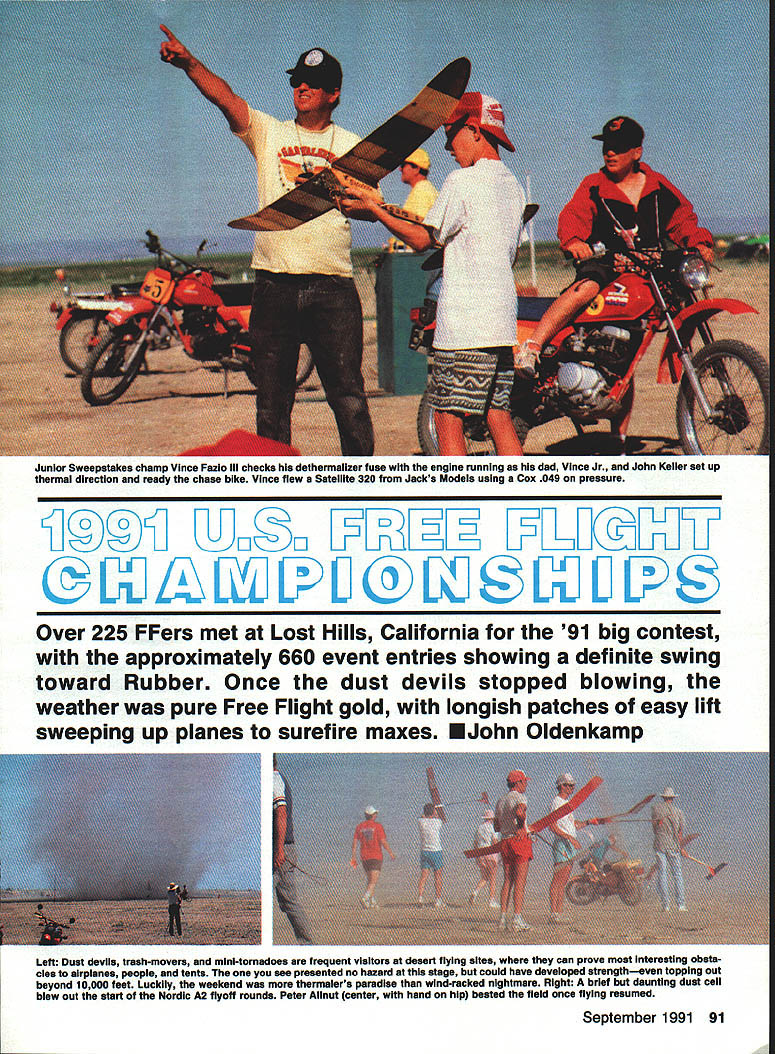
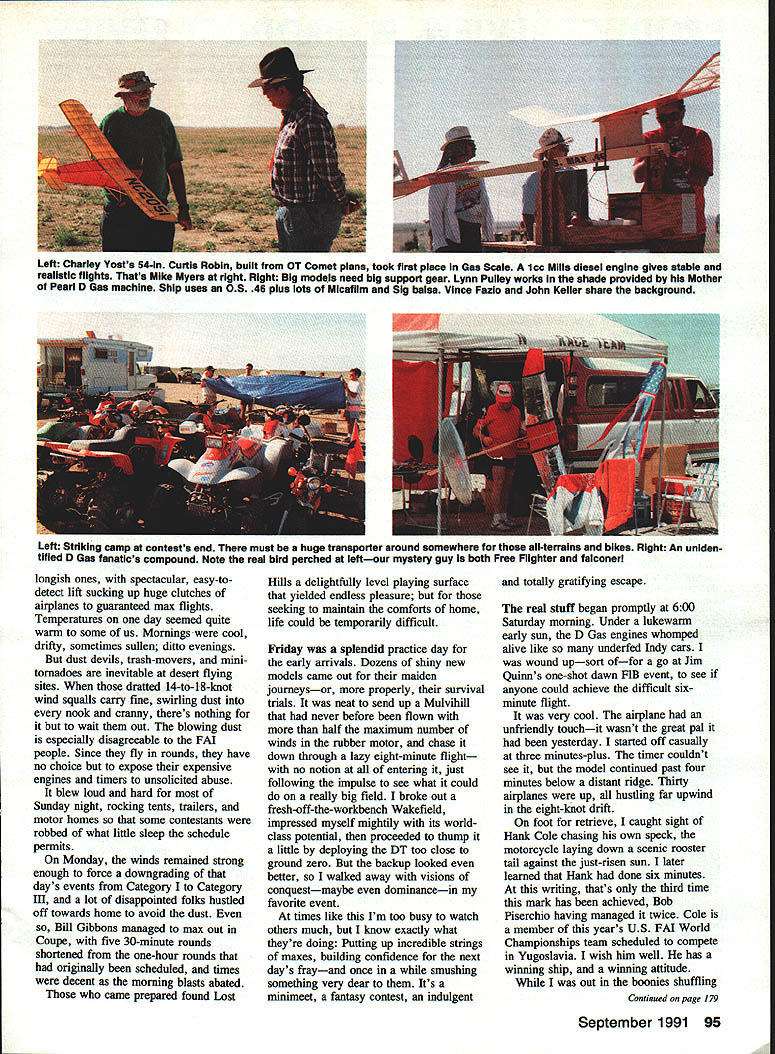
Over 225 free‑flighters met at Lost Hills, California, for the '91 big contest, with approximately 660 event entries showing a definite swing toward rubber-powered events. Once the dust devils stopped blowing, the weather was pure Free Flight gold, with long patches of easy lift sweeping up planes to surefire maxes. — John Oldenkamp
Introduction: Ah, Competition!
Ever since the spindly, fragile beginnings of aeromodeling, our goal has been to remain airborne longer than the other guy—reaping booty from mere trinkets to large pieces of hardware. In Free Flight, duration is the name of the game, together with subtler attempts to outdesign, outbuild, and, in extreme cases, outwit one's opponents.
Competition fuels innovation. Whether cars, boats, horses, airplanes, space vehicles, or even baseball, innovations usually turn up first on the playing field and then find their way into the marketplace. In Free Flight we pursue the max, the perfect score, the loftiest performance imagined in initial sketches. The ultimate success in competition is to top the entry list and the existing record, itself a product of improving the breed.
Back in the 1920s and 1930s, records read in seconds and fractions of seconds; today marks read in long minutes and hours. Despite rulemakers' efforts to limit extremes, the Mulvihill Rubber record (about 99 minutes) still inspires those willing to stake vacation time, money, and sleep to set a new one.
Maybe the real reason we haul several hundred pounds of gear, shelters, airplanes, fuel, rubber, glue, and electronics to a flyspeck in the San Joaquin Valley is simply the urge to go one‑on‑one with the legends of the game.
The Scene at Lost Hills
At the USFFC you can ogle thousands of wonderful airplanes—unique, elegant, powerful for their size. It’s a striver's paradise: not everyone is elite, and many of us are there to learn. We park along a nearly mile‑long launch line, set up camp for the weekend, sniff the air, and get to business. For some it's sport; for others it's cutthroat competition. For everyone it’s capital fun.
This year's contest, the second at the new Lost Hills site, was held May 25–27, 1991.
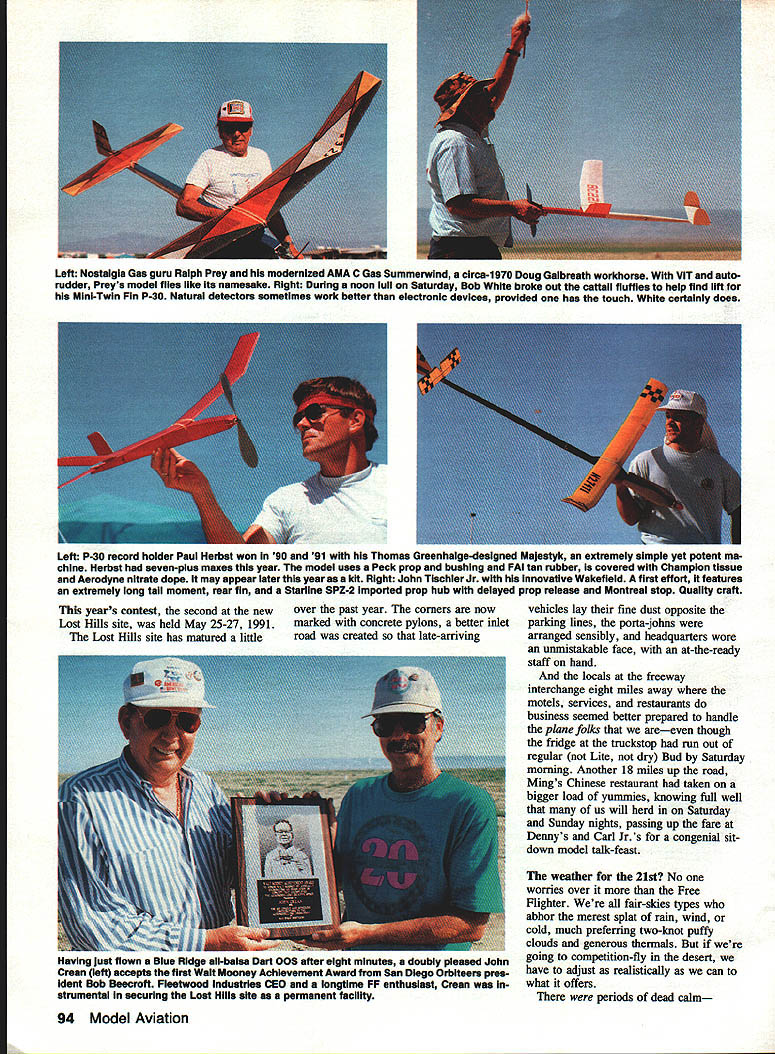
The site has matured since last year. Corners are now marked with concrete pylons, the inlet road was improved, porta‑johns were sensibly arranged, and headquarters wore an unmistakable face with an at‑the‑ready staff. Local motels and restaurants at the freeway interchange eight miles away seemed better prepared for the influx of modelers. Ming's Chinese restaurant, 18 miles up the road, had taken on a heavier load and became a popular Saturday/Sunday evening gathering spot.
Weather and Conditions
Weather is never far from a Free Flighter's mind. We're fair‑skies types who prefer light winds, puffy clouds, and generous thermals. At Lost Hills there were periods of dead calm and, inevitably, dust devils. Once the dust devils subsided, conditions were excellent: long, easy lift patches produced many max flights.
Mornings were cool and sometimes drifty; afternoons warmed into thermally active periods. Dust devils and mini‑tornadoes are a desert inevitability. Fine, swirling dust carried by 14–18 knot squalls forces a wait‑out, and it's especially disagreeable for FAI fliers who must expose engines and timers while flying rounds. Sunday night featured loud winds that rocked tents and trailers and robbed some contestants of sleep. On Monday, winds forced a downgrading of the day's events from Category I to Category III; a number of competitors headed home. Still, some events continued with shortened rounds and decent times.
Those who came prepared found Lost Hills a delightfully level playing surface. For those seeking home‑comforts, life could be temporarily difficult.
Practice and Early Competition
Friday was a splendid practice day. Dozens of new models undertook maiden flights or survival trials. It was neat to fly a Mulvihill with less than half the maximum rubber and chase it through a lazy eight‑minute flight—no entry intended, just the impulse to learn.
The real contest began at 6:00 Saturday morning. Under a lukewarm sun the D Gas engines fired up. Jim Quinn's one‑shot down F/B event drew interest to see if anyone could reach the difficult six‑minute mark. Hank Cole achieved six minutes—only the third time that mark has been hit, Bob Peiserho having managed it twice previously. Cole is a member of the U.S. FAI World Championships team headed to Yugoslavia.
By 7:00 a.m. Ray Faulkner began a quick string of ten five‑minute maxes in D Gas. By nine o'clock he was watching the board to see whether he needed an eleventh to win—phenomenal performance. In the 34½ A class, Bob Sundberg emerged with the win after seven maxes; Terry Thorkildsen took second with six maxes.
Results and Notable Performances
There were many impressive performances across a wide slate of events:
- Martyn Cowley, AMA record holder in A/1 Towline Glider, won that event for the 10th consecutive year.
- Bob Beeckroft had ten maxes in Nostalgia A Gas, flying a to‑the‑plan Lucky Lindy.
- Nordic saw six out of nineteen entrants post perfect scores; Peter Allnut won after surviving the flyoffs.
- Vince Fazio III won Junior Sweepstakes and also recorded Junior High Time; he placed first in 1/2A Gas, Junior Hand‑Launched Glider, and Junior P‑30, and took second in F1J.
- Mulvihill and V2A Nostalgia Gas each produced nine‑max winners (Bruce Augustus and Roger Gregory, respectively).
- Jim Quinn topped a six‑man flyoff to post a perfect score in Wakefield.
- In 1/2A Texaco, Bob Sundberg averaged over 22 minutes per flight to take first place.
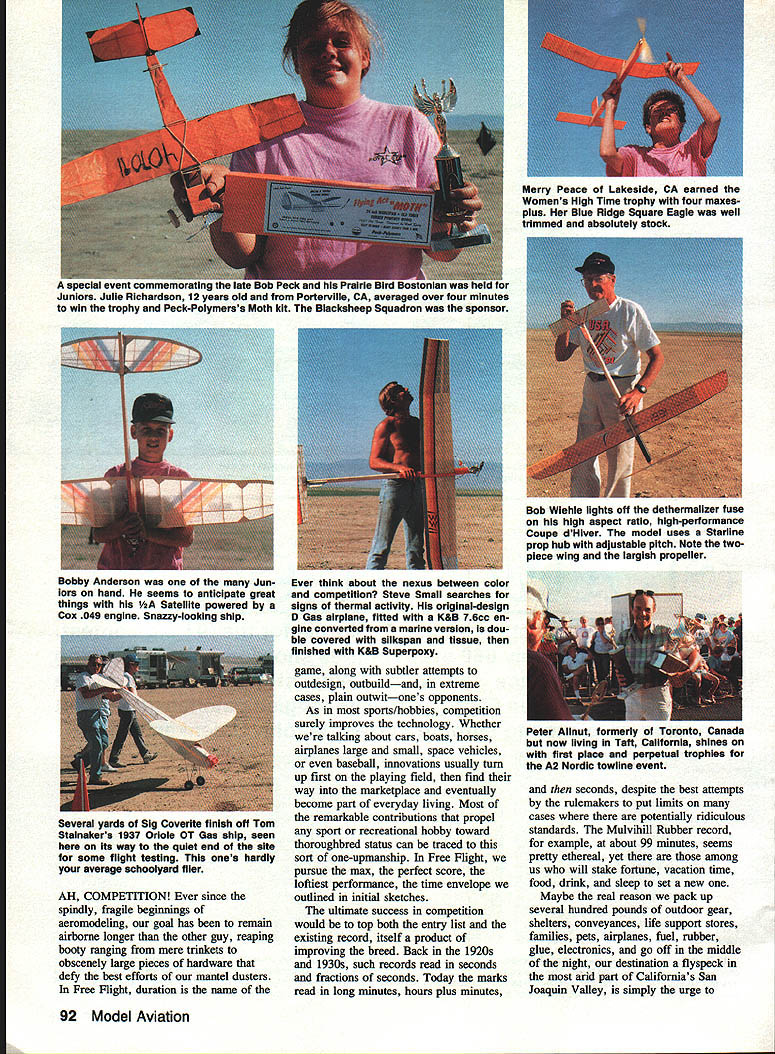
- Merry Peace maxed out through four flights to earn the Women's High Time trophy.
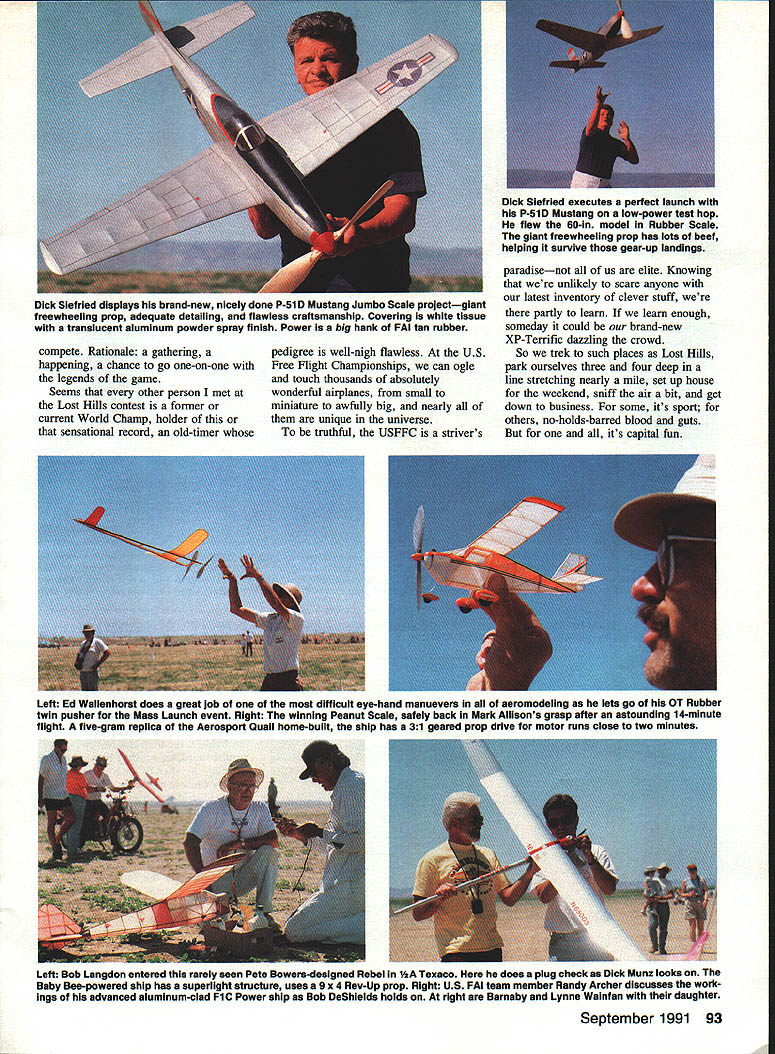
- Mark Allison (Bishop, California) recorded a single Outdoor Peanut flight of 14:39.
Numbers and Trends
My spot‑check of official records showed:
- Registrants: approximately 225–235.
- Event entries: about 660.
- Heavily contested events (approximate entries):
- P‑30: 53 Senior‑Open participants, 6 Juniors.
- Wakefield: 41 fliers.
- A Gas: 36.
- 1/4 A: 34.
- Mulvihill: 29.
- Old‑Timer Cabin and Stick, OHLG, and 1/4 A Texaco: mid‑20s.
Unofficially, gas events outnumbered rubber and glider events, but individual entries in rubber were higher. Comparing the 1991 turnout with the '70s and '80s shows a clear shift toward quieter, rubber‑powered events—upswings in Old‑Timer and P‑30 and a steady Wakefield slate. This may reflect an aging contestant base and growing appeal of rubber‑band events amid environmental concerns. It may also indicate a shift toward kinder, gentler competitive formats.
People and Impressions
Of the many people met at Lost Hills, Bob Wiehle summed up the spirit of Free Flight nicely. At 75 and still flying well, Bob placed fourth in the tough P‑30 class and clocked 6:40 in Dawn Mulvihill. He flew original, beautifully built designs and did his own retrieving. Generous and humorous, Bob even loaned winding tools when another flier's gear went haywire.
Lost Hills has the potential to be a world‑class venue. The U.S. team selection finals for the 1993 World Free Flight Championships were planned to be held there, followed by the world contest itself. However, weather patterns in 1991 and 1992 have been especially cruel; several meets were scrubbed due to wind. Some attribute the recent unpleasantness to drought conditions and unusual weather patterns in central California. Others have proposed relocating to venues such as Brawley. While relocation talk has gained momentum, many argue Lost Hills is bigger, safer, and more benign than alternatives, and that a thorough analysis of long‑term weather data could support rescheduling contests to the most favorable periods.
Contest Management and Conclusion
Contest director Terry Kerger and his crew managed a bright and helpful operation through a demanding program, distributing decisions and awards fairly. The 1991 USFFC offered something for nearly everyone—stats, spirit, sights, and sounds were as rewarding as ever. A new team would take over for 1992, but the menu remained irresistible.
Call your friendly banker today!
Transcribed from original scans by AI. Minor OCR errors may remain.

