
1992 KRC Electric Fly
Mitch Poling
Event overview
SUCCESS: That one word summarizes the 13th KRC Electric Fly. The Keystone RC Club's 1992 meet was held on September 19–20 at the Buc-Le Aerosportsmen flying field in Quakertown, Pennsylvania.
Practice flying was allowed on the afternoon of Friday, September 18. After a few light showers on Friday and Saturday morning, the weather cleared, and there were blue skies and puffy thermal clouds for the rest of the meet. Sunday was especially good, with very light wind and perfect flying weather.
A total of 174 pilots flew more than 300 aircraft — a record number for the meet. Pilots came from 20 states, Canada, England, Germany, and Japan. More than 700 flights were made during the two-day meet. The new KRC pin system worked perfectly; despite the record attendance there was enough flying time for all. Spectators enjoyed some of the most technically advanced electrics in the world.
This was my first visit to the KRC — the longest trip I have ever made to attend an electric meet, all the way from Germany. Dr. Fred Sauerburger was a gracious host. Thank you, Fred!
Practice and arrival
We arrived Friday at the Buc-Le field for practice flying. It was somewhat windy and overcast, but several planes were up and the hobby shop sales area had already been set up.
That evening the Best Western Motor Inn was filled with electric fliers. I found a room with members of SEFLI (Silent Electric Fliers of Long Island) — a jolly group swapping stories and experience over real German beer. Needless to say, work on my AULD plane did not get done that night.
Saturday morning started overcast with a light shower but cleared well before the AULD event. I replaced the gearbox and prop and made another practice flight, but there was still insufficient climb. I left the plane as-is to have time to take photos and gather information about other planes at the field.
Coverage notes
I didn't expect so many pilots and planes. I ended up with more than 300 color photos and 22 pages of notes representing about 70 planes. I obtained specific information on 60 planes but cannot describe them all here; I will highlight a selection of outstanding aircraft and performances.
Events and notable results
AULD (All-Up/Last-Down) and motor-duration
- The AULD event (mass launch) was Saturday at 1:30 p.m.; 15 pilots launched into a no-thermal sky.
- John McCullough won Saturday's AULD with his original design "Oh No." His motor-duration flight exceeded 35 minutes. John won last year as well.
- Russell Pribanic recorded a 34-minute flight and David Baron flew 26 minutes in the duration/motor-duration ranking.
- Robert Shipton flew a stock Airtronics Olympic 650 and finished highly placed in the All-Up/Last-Down event.
- Jerry Smartt and John Mountjoy were notable Excel flyers; Jerry won first place in a later AULD with a time over 47 minutes (Jerry used a Graupner 600 ball-bearing 9.6 V motor with Robbe 5:1 gearbox and a 15" Graupner folding prop; Jomar SM-4 throttle and SR 12S cells).
John McCullough's "Oh No" (design details):
- Span: 76 in; area: 650 sq in; flying weight: 56 oz.
- Batteries: four three-cell Panasonic 1700 packs (24 oz). John reports up to 2100 mAh from these cells.
- Double-timed switching: packs can be configured as four 3-cell packs in parallel (3.6 V, 6.8 Ah) for cruise or two 6-cell packs in parallel (7.2 V, 3.4 Ah) for climb.
- Motor: Leisure geared .05 with Graupner 15x8 folding prop; static draw in cruise ~5 A.
20-Loops
- Best time: 54 seconds — Russ Pribanic (Watt).
- 2nd: David Grife — 55 seconds.
- 3rd: Everett Rebundt — 58 seconds.
- Chris True's Senior Skyvolt placed third in 20-Loops; the Skyvolt (Astro 15) proved very acrobatic.
Russ Pribanic's Watt (20-Loops winner) details:
- Power: 10 Sanyo 1400 SCR cells; geared Astro 15 FAI turning a 12x9 Expert prop.
- Speed control: Astro 205.
- Span: 46 in; wing area: 640 sq in; flying weight: 58 oz.
Scale and Pilots' Choice
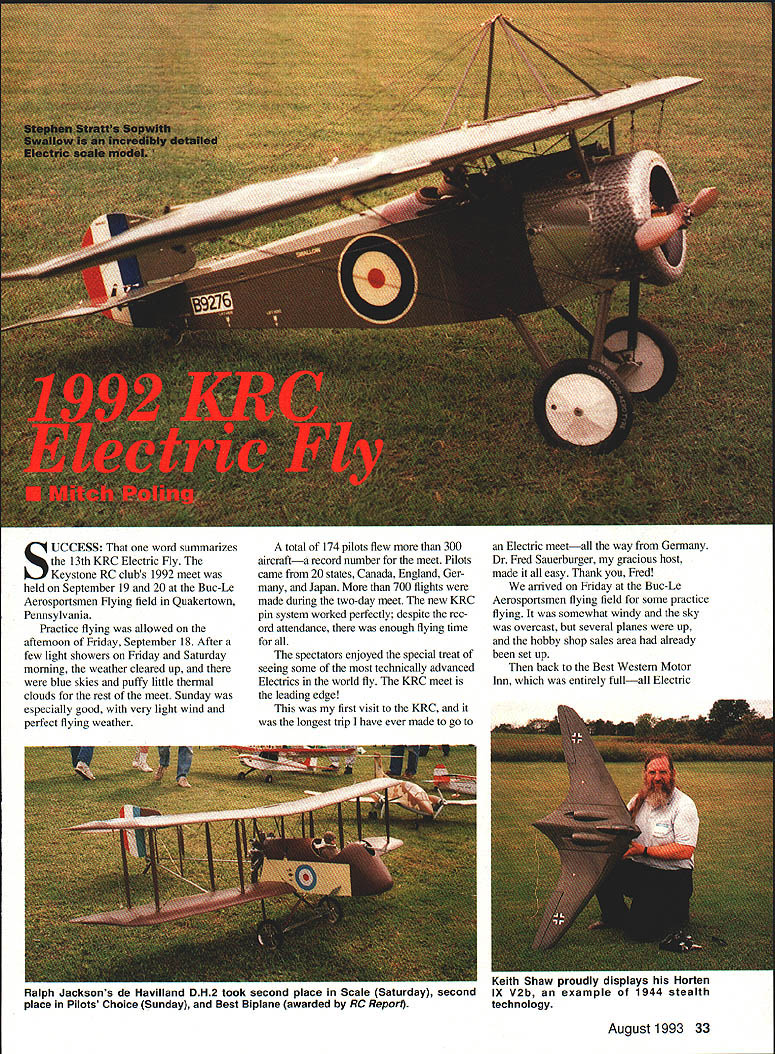
- Scale winner: Steven Stratt — 1/5-scale Sopwith Swallow.
- Span: 60 in; area: 720 sq in; weight: 98 oz.
- Power: 14 SR 1400 Max batteries; geared Astro 25 (2.5:1) turning 12x8 prop.
- Plans available from Airdrome.
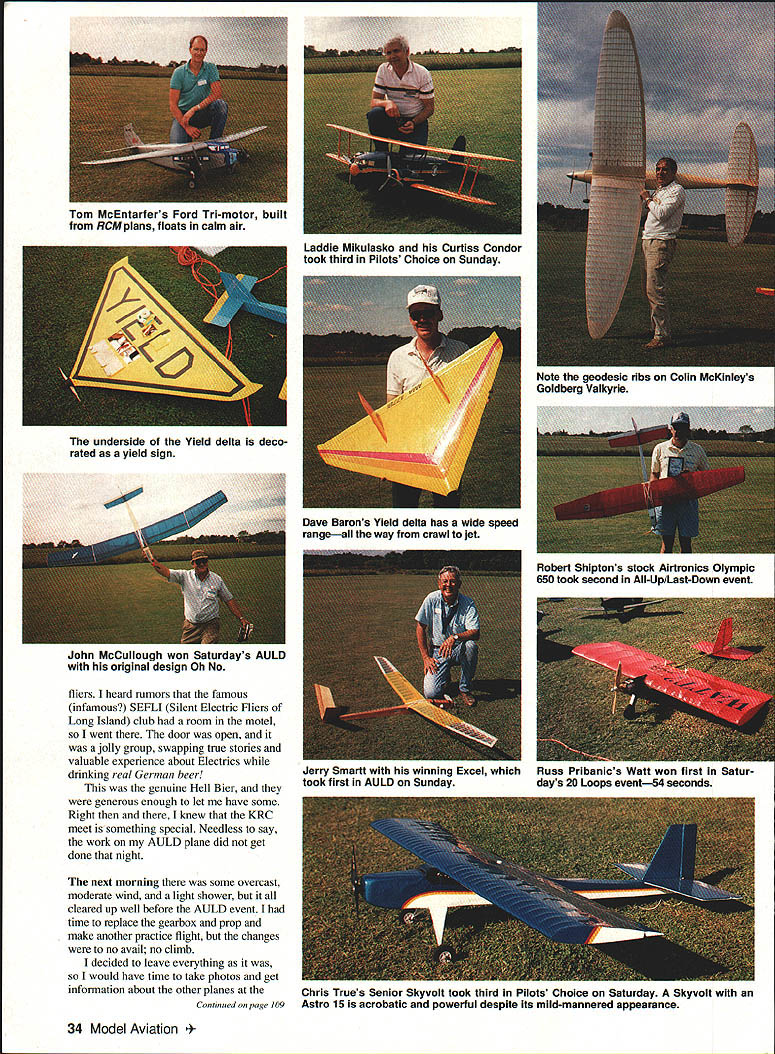
- Scale 2nd: Ralph Jackson — 1/5-scale de Havilland D.H.2 (also Best Biplane and 2nd Pilots' Choice on Sunday).
- Span: 63 in; area: 1,400 sq in; flying weight: 12 lb.
- Power: Astro 60; battery: 28 Sanyo 1800 cells.
- Scale 3rd: Jim Hale — Piper Cub (details not obtained).
Pilots' Choice:
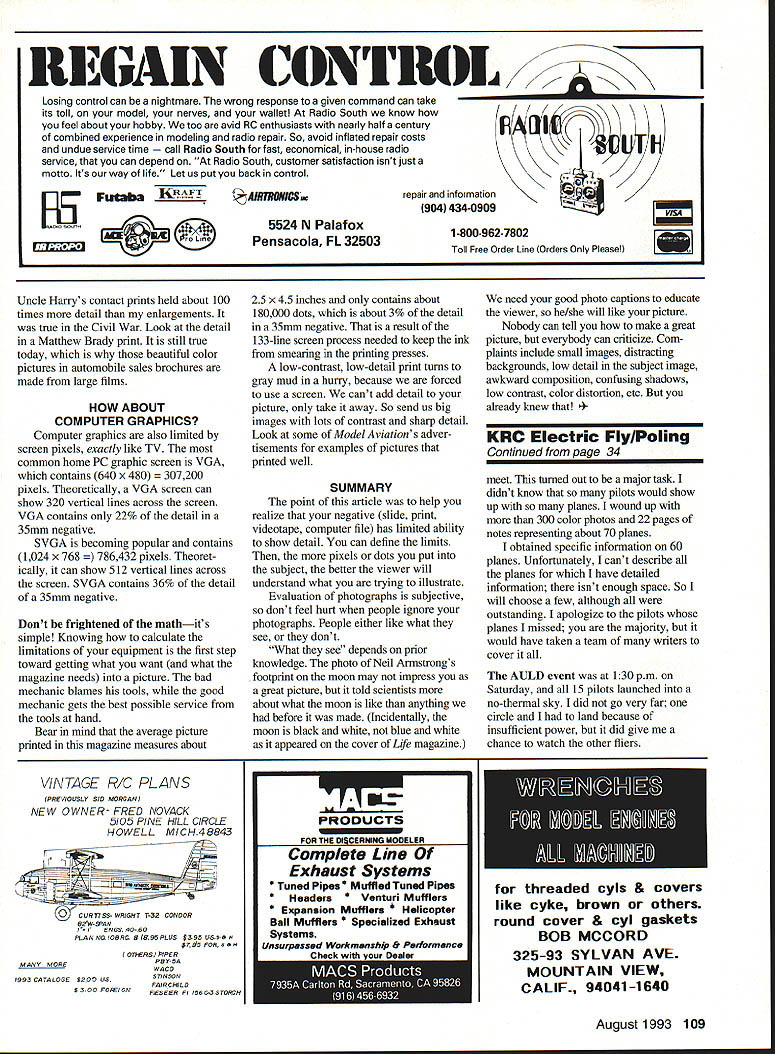
- 1st: Keith Shaw — Horten IX V2b (1/5-scale flying wing).
- Span: 62 in; area: 740 sq in; flying weight: 6 lb.
- Power: two Astro 10 motors; 20 Sanyo 1000 SCR cells; Jomar SM-4 throttle.
- Ducted-fan units: 2.7" diameter 3-blade fans turning ~32,000 rpm; very low-aspect-ratio blades (~1" chord) made from special thermoplastic.
- Keith demonstrated low flybys (~100 mph), steep pull-ups and put on a complete air show both days.
- 2nd: Tom McEntarfer — Ford Tri-Motor (built from RCM plans).
- Span: 74 in; weight: 7 lb; floats in calm air.
- Power: three Leisure LT 50 geared motors turning APC 11x6 props on 21 cells.
- 3rd: Chris True — Senior Skyvolt (very aerobatic with Astro 15 and Sanyo cells).
Other scale/PC notes:
- Ralph Jackson also received Best Biplane from RC Report.
- Colin McKinley: 1st Best Old-Timer (Goldberg Valkyrie).
- Al Yeagle: 2nd Best Old-Timer (Long Cabin).
- Richard De Angelis: 3rd Best Old-Timer (Flying Aces Stick) and awarded first in Pilots' Choice for the Stick.
- Laddie Mikulasko: 3rd Pilots' Choice — Curtiss Condor (American Airlines colors).
- Span: 70 in; area: 900 sq in; weight: 6.5 lb.
- Power: two geared Astro 15s, 10x6 props, 24 Sanyo 1400 cells; Horak speed control.
Speed and aerobatic highlights
- Fastest 30 Rolls: 1st Chris True — 20 seconds; 2nd Dave Baron — 22 seconds.
- Dave Baron's Yield delta: wide speed range, very acrobatic.
- Power: Astro 40; 20 SR 1100 cells; area: 700 sq in; weight: 4 lb; throttle: Astro 205.
- Phil Thayer: Force I delta (Laddie Mikulasko design, Balsa USA kit).
- Power: Astro 25 with Flitec SEC I throttle; 14 Sanyo 1400 SCR cells.
- Span: 36.5 in; area: 611 sq in; weight: 76 oz.
Notable aircraft and builders
- Ralph Jackson — De Havilland D.H.2 (1/5-scale): beautiful, scale-like flight.
- Tom McEntarfer — Ford Tri-Motor: floats and smooth flight.
- Laddie Mikulasko — Curtiss Condor: geodesic ribs observed on underside; realistic flying scale model.
- Cohn McKinley — Goldberg Valkyrie: graceful climber.
- Dave Baron — Delta (Yield): large speed envelope, twin fins, reflex in ailerons, drooped swept tips.
- John McCullough — "Oh No": long-duration original design (see specifications under AULD).
- Russ Pribanic — Olympic II (second in some events) and Watt (20-Loops winner).
- Olympic II: nearly stock with a 2 ft center section added (wing area ~1,100 sq in). Power: 14 Sanyo 1700 cells; geared Astro 15.
- Don Bendorf — 1/4-scale Citabria (Bud Nosen plans; kit available from A&A Industries).
- Power: Astro 60; 32 SR 1400 cells; Jomar SC-6 throttle; APC 16x12 prop @ 5,200 rpm, 25 A. Flying time: 7–8 min. Span: ?; area: 1,550 sq in; weight: 13 lb.
- Steven Stratt — 1/5-scale Sopwith Swallow (Scale winner) — extremely detailed cowl and cockpit.
- Joe Utasi — Lighei Stratos: joined wing with shrouded fan, tandem landing gear; quarter-scale, 700 sq in, 4.5 lb; Marx 300/10 motor on 16 SR 1200 cells; shrouded fan from modified wood props.
- Anthony Fiori — 1/5-scale P-51 Mustang (Pica kit): span 89 in; area 1,356 sq in; weight 20.5 lb.
- Power: Astro 90; 40 Sanyo 1400 SCR cells; 16x12 APC prop @ 6,500 rpm. Custom retracts and working flaps.
- Brad Baylor — Vortex (original sport pattern): Astro 40; 21 Sanyo SCR cells; APC 10x6 prop. Span 64 in; area 704 sq in; weight 6 lb.
- Brian Hunt — Gee Bee Zeta (scale): Astro 60; 28 Sanyo 1200 SCR cells; Jomar SC-5 throttle. Span 84 in; area 1,050 sq in; weight 10 lb.
- Tom Hunt — Pucara (scale Argentine trainer): two geared Astro 05 motors, 11x10 props; twelve 1500 mAh cells. Span 61.5 in; area 600 sq in; weight 6.5 lb.
- Steve Neu / Team USA — SE-XI (F3E World Champs winning design):
- Composite construction (fiberglass, Rohacell, Kevlar, carbon).
- Motor: modified Astro 60 FAI; 27 Sanyo 1000 SCR cells.
- Span 84 in; airfoil: Eppler 205; area 475 sq in; weight 80 oz. Estimated thrust ~160 oz (thrust-to-weight ~2:1).
- Paul Holsten (Ace R/C) — Pondside (Scott Hartman design): Goldfire 550 motor; APC 7x4 prop; seven SR 1100 cells. Span 48 in; area 385 sq in; weight 40 oz. Water/land capability and delightful handling.
Equipment & common gear notes
- Jomar SM-4 and other Jomar throttles were popular at the meet; Joe (Jomar proprietor) designed the SM-4.
- Sanyo cells (various SCR/Max types), Panasonic packs, SR cells, and Astro motors (05, 10, 15, 25, 40, 60, 90) were common.
- Graupner folding props and APC props were widely used.
- Many pilots adapted gearboxes and motor fittings to match motors and props.
Social events
- Saturday night dinner buffet-social drew an estimated 200 people. Raffles and prize drawings were held both days and at the dinner (23 winners in the raffles).
- The SEFLI group held a Midnight Barefoot Hand Launch Glider contest in a motel parking lot; Tom Hunt won after several searches in the dark.
Awards, thanks, and closing
- In addition to the event trophies and contest awards, many door prizes were given throughout both days and at the Saturday night dinner.
- The Buc-Le Aerosportsmen deserve thanks for the use of their fine field.
- Special thanks to the KRC club, John Hickey, George Poos, and all the volunteers who planned and ran the Electric Fly. Their planning begins immediately after each year's meet, and their efforts paid off many times over.
Reserve your place for next year now; expect plenty of "electric elation" in September 1993!
Transcribed from original scans by AI. Minor OCR errors may remain.

