
1992 U.S. Indoor Championships
Avid indoor fliers met in Johnson City, Tennessee for good times and to see whose models flew the longest. — Dave "VTO" Linstrum
Reminiscing and background
As the old-timers of Indoor sit around the pit area after putting in their half-hour flights with gossamer microfilm models or 20-minute flights in EZB, they tell "war stories" about past USICs going back over 10 years. Since Indoor flying has only slowly evolved since the mid‑thirties—when Carl Goldberg and the Chicago Aeronuts set Indoor records—a bit of USIC history is in order. Decade‑long Contest Director Tony Italiano told me this tale (he is now retired from CDing and is flying again).
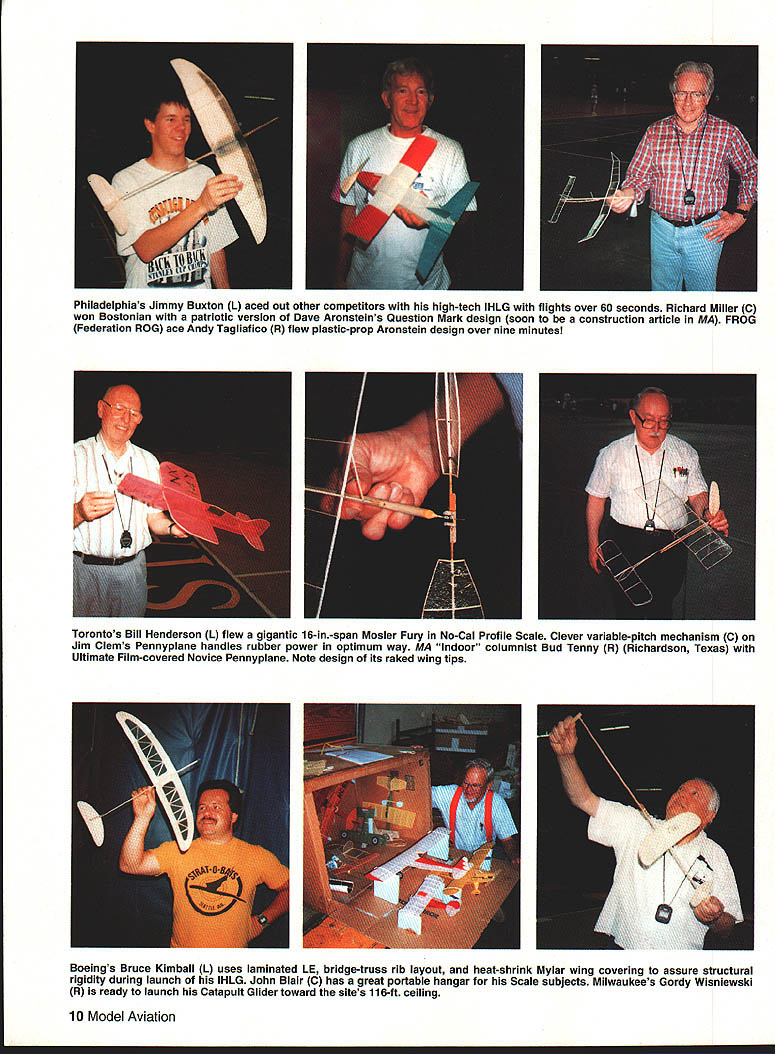
In the beginning there was Indoor Week—a symbiotic and successful combination of the F1D World Championships and the AMA Nationals held in 1980 at West Baden, Indiana. A year later, NFFS President Tony Italiano and Executive Director Hardy Brodersen bemoaned the lack of suitable indoor sites for the AMA Nationals. They proposed that NFFS present an alternative event at a fine site within driving distance of many East Coast fliers. Thus was born the 1982 USIC at West Baden in the 100‑ft. atrium of the Northwood Institute. Sixty‑three fliers enjoyed a site where you could wake up in the morning, look into the atrium from your room, see models fly past your window—and go down to join the fun.
The prime goal was to have national‑caliber competition at a superior site. This proved to be a problem after the 1983 West Baden USIC, as the old building was sold for renovation as a health spa. (It has subsequently deteriorated through nonuse and neglect and is now totally unusable.)
Fortunately, the Michigan State Fair Coliseum (66 ft.) and the Niagara Falls Convention Center (72 ft.) became available in 1984–86 while the search continued for another 100‑ft. site.
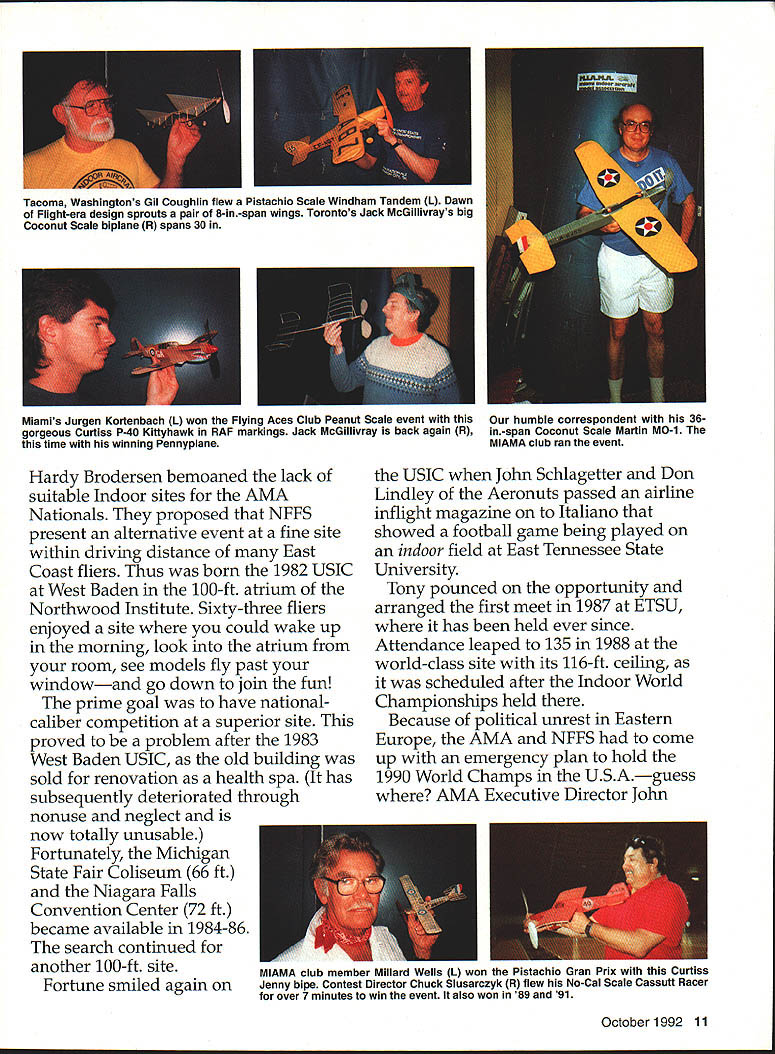
Fortune smiled again on the USIC when John Schlagetter and Don Lindley of the Aeronuts passed an airline inflight magazine to Italiano that showed a football game being played on an indoor field at East Tennessee State University. Tony pounced on the opportunity and arranged the first meet in 1987 at ETSU, where it has been held ever since. Attendance leaped to 135 in 1988 at the world‑class site with its 116‑ft. ceiling, as it was scheduled after the Indoor World Championships held there.
Because of political unrest in Eastern Europe, the AMA and NFFS had to come up with an emergency plan to hold the 1990 World Championships in the U.S.A.—guess where? AMA Executive Director John Worth took the ETSU proposal to the FAI in Paris, where it was accepted. An alternative World Championships site proposal by Bob Stalick for the Kibbie Dome (site of the 1989 AMA Nationals) in Idaho was considered, but the location was too remote for entrants from Europe. So once again the world's largest indoor meet was held at the ETSU Mini‑Dome.
USIC '92
With the Indoor World Championships scheduled to be held in Poland during the summer of 1992, the USIC held June 4–7 proved to be a great testing place for Richard Doig and Larry Loucka of the U.S.A. F1D team (team member Cezar Banks could not attend, as his home is in California). In fact, Doig handily won the F1D event with a two‑flight total of 1 hour 15 minutes!
There were plenty of fliers making history this year under the ETSU dome's 116‑ft. arched roof. While this report is not meant to give complete results (compiled by Melody Doig on her laptop computer, based on scores validated by CD Chuck Slusarczyk), certain phenomenal times are worth noting. Last year's records fell by the wayside as fliers pushed the envelope, wringing every last second of endurance from their fragile craft.
Notable results and top performances
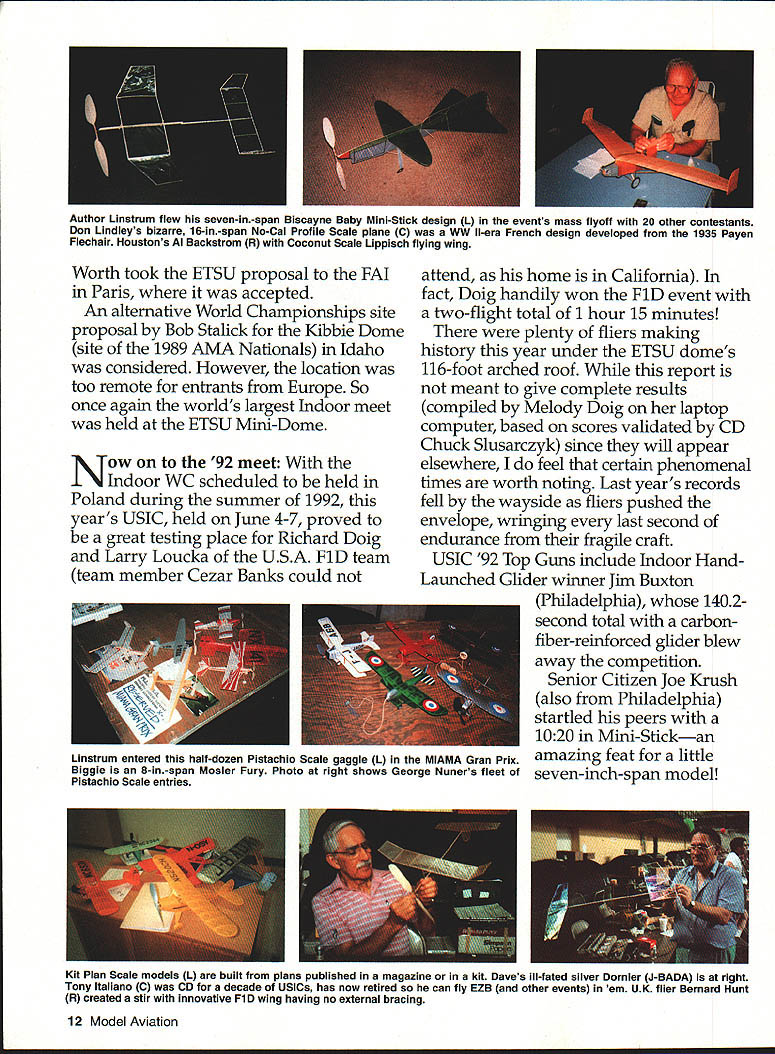
- Indoor Hand‑Launched Glider: Jim Buxton (Philadelphia) — 140.2‑second total with a carbon‑fiber‑reinforced glider.
- Mini‑Stick: Senior citizen Joe Krush (Philadelphia) — 10:20 (amazing for a seven‑inch‑span model).
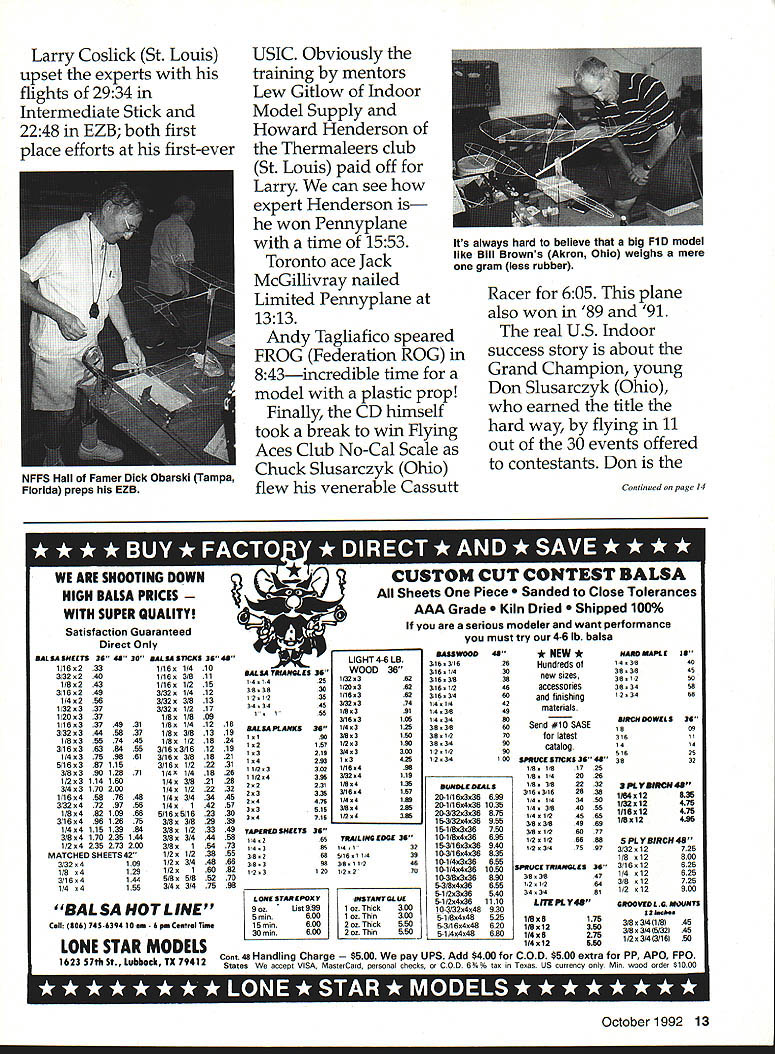
- Intermediate Stick: Larry Coslick (St. Louis) — 29:34 (first place; his first USIC).
- EZB: Larry Coslick (St. Louis) — 22:48 (first place; his first USIC).
- Pennyplane: Howard Henderson (Thermaleers, St. Louis) — 15:53.
- Limited Pennyplane: Jack McGillivray (Toronto) — 13:13.
- FROG (Federation ROG): Andy Tagliafico — 8:43 (incredible time for a model with a plastic prop).
- Flying Aces Club No‑Cal Scale: Chuck Slusarczyk (Ohio) — 6:05, flying his Cassutt Racer (also won in ’89 and ’91).
- F1D: Richard Doig — two‑flight total 1:15:00.
Grand Champion and other events
The real U.S. Indoor success story is Grand Champion Don Slusarczyk (Ohio), who earned the title the hard way by flying in 11 out of the 30 events offered to contestants. Don is the son of the CD, but that gave him no edge—he had to work to earn his first places in Old‑Timer Stick, Autogyro, and Peanut Scale (where he flew an outstanding 1911 Voisin Hydroplane replica). Even his second‑place finish in Intermediate Stick was remarkable—only two seconds short of first with a marvelous time of 29:32. We tip the VTO white sweatband (No VTO white hat indoors!) to Don for his champion performance.
Young Don left the USIC and headed for Miami, where he spent the summer as an intern with Symbiosis, a medical technology corporation run by modelers. Principals Charles Slater and Kevin Smith of Symbiosis are longtime members of the Miami Indoor Aircraft Model Association (MIAMA). They donated handy gripper‑jaw and tiny scissors‑on‑a‑stick devices (great for fishing out blown motors) to USIC; sales of these items generated funds for the 1992 Indoor team.
MIAMA, under the leadership of Doc Martin, ran the Pistachio Grand Prix, Coconut Scale, and Mini‑Stick Mass Launch events at USIC.
- Pistachio Competition (30 models entered): Millard Wells (Florida Keys) won with his WW I Curtiss Jenny in military livery.
- Coconut Scale (mass ROG entries and regular Coconut event): Dave Rees won the mass ROG Coconut with his Zippy Sport (landed last to take first) and also prevailed in the regular Coconut event (17 entries) with his General Aristocrat (flew 2:25).
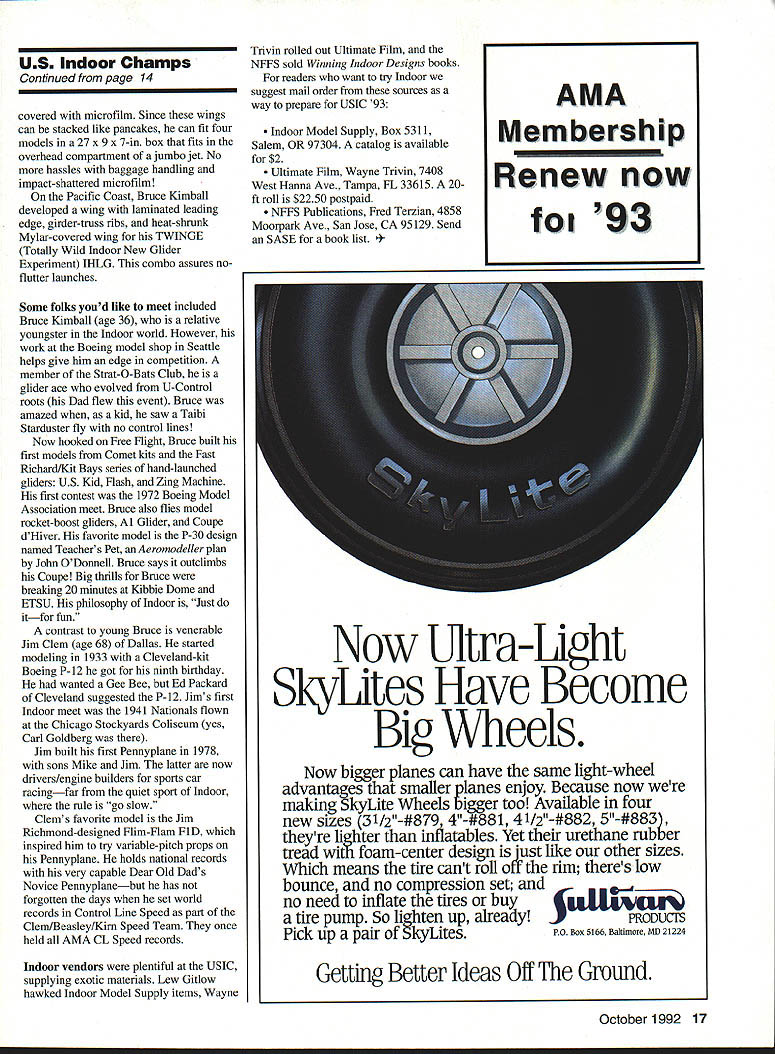
- Mini‑Stick Mass Launch: Stan Chilton (Wichita) won.
Design advances and portability
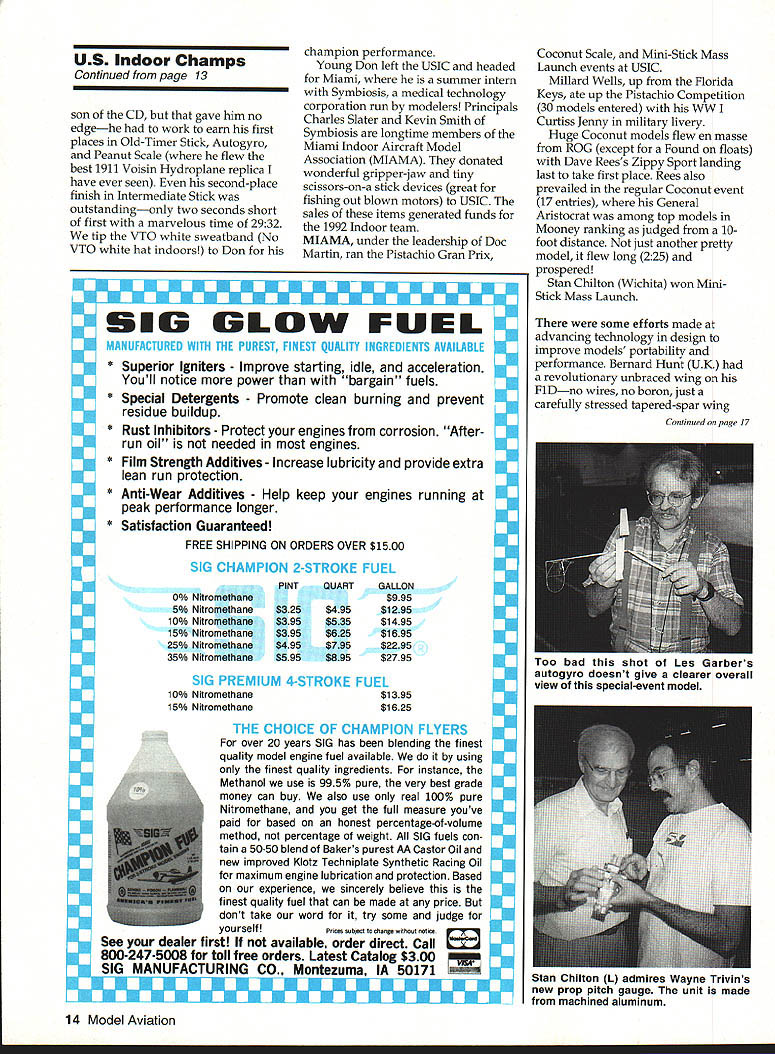
There were efforts to advance technology in design to improve models' portability and performance. Bernard Hunt (U.K.) had a revolutionary unbraced F1D wing—no wires, no boron, just a carefully stressed tapered‑spar wing covered with microfilm. Since these wings can be stacked like pancakes, he can fit four models in a 27 x 9 x 7‑in. box that fits in the overhead compartment of a jumbo jet—no more hassles with baggage handling and impact‑shattered microfilm.
On the Pacific Coast, Bruce Kimball developed a wing with a laminated leading edge, girder‑truss ribs, and heat‑shrunk Mylar covering for his TWINGE (Totally Wild Indoor New Glider Experiment) IHIG. This combination assures no‑flutter launches.
People: profiles and memories
Some folks you'd like to meet included Bruce Kimball (age 36), a relative youngster in the Indoor world. His work at the Boeing model shop in Seattle helps give him an edge in competition. A member of the Strat‑O‑Bats Club, he is a glider ace who evolved from U‑Control roots (his dad flew that event). Bruce was amazed as a kid when he saw a Taibi Starduster fly with no control lines. Hooked on Free Flight, Bruce built his first models from Comet kits and the Fast Richard/Kit Bays series of hand‑launched gliders: U.S. Kid, Flash, and Zing Machine. His first contest was the 1972 Boeing Model Association meet. Bruce also flies rocket‑boost gliders, A1 Glider, and Coupe d'Hiver. His favorite model is the P‑30 design named Teacher's Pet (an Aeromodeller plan by John O'Donnell). Big thrills for Bruce were breaking 20 minutes at Kibbie Dome and ETSU. His philosophy of Indoor is: "Just do it—for fun."
A contrast to Bruce is venerable Jim Clem (age 68) of Dallas. He started modeling in 1933 with a Cleveland kit Boeing P‑12 he got for his ninth birthday. His first Indoor meet was the 1941 Nationals flown at the Chicago Stockyards Coliseum (Carl Goldberg was there). Jim built his first Pennyplane in 1978 with sons Mike and Jim; the sons are now drivers/engine builders for sports car racing. Clem's favorite model is the Jim Richmond‑designed Fim‑Flam F1D, which inspired him to try variable‑pitch props on his Pennyplane. He holds national records with his Dear Old Dad's Novice Pennyplane and once held world records in Control‑Line Speed as part of the Clem/Besaley/Kim Speed Team.
Vendors and resources
Indoor vendors were plentiful at the USIC, supplying exotic materials. Lew Gitlow hawked Indoor Model Supply items, Wayne Trivin offered Ultimate Film, and the NFFS sold Winning Indoor Designs books. For readers who want to try Indoor, mail order from these sources is a way to prepare for USIC '93:
- Indoor Model Supply, Box 5311, Salem, OR 97304. A catalog is available for $2.
- Ultimate Film, Wayne Trivin, 7408 West Hanna Ave., Tampa, FL 33615. A 20‑ft roll is $22.50 postpaid.
- NFFS Publications, Fred Terzian, 4858 Moorpark Ave., San Jose, CA 95129. Send an SASE for a book list.
Transcribed from original scans by AI. Minor OCR errors may remain.

