
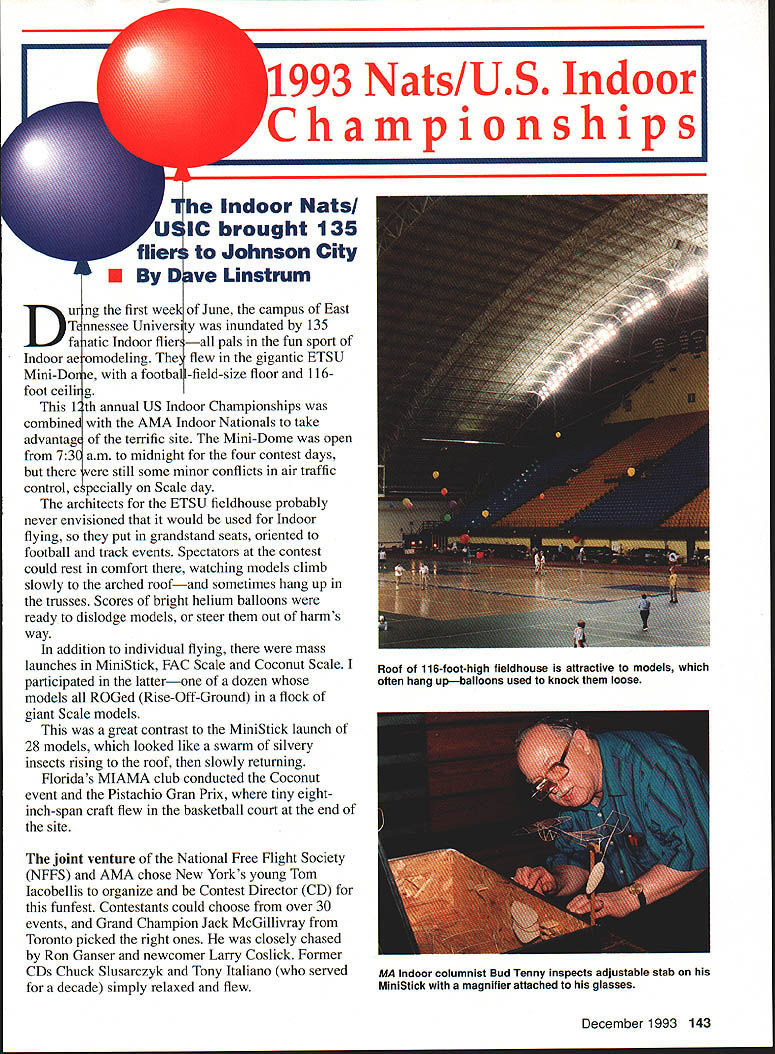
1993 Nats/U.S. Indoor Championships
By Dave Linstrum
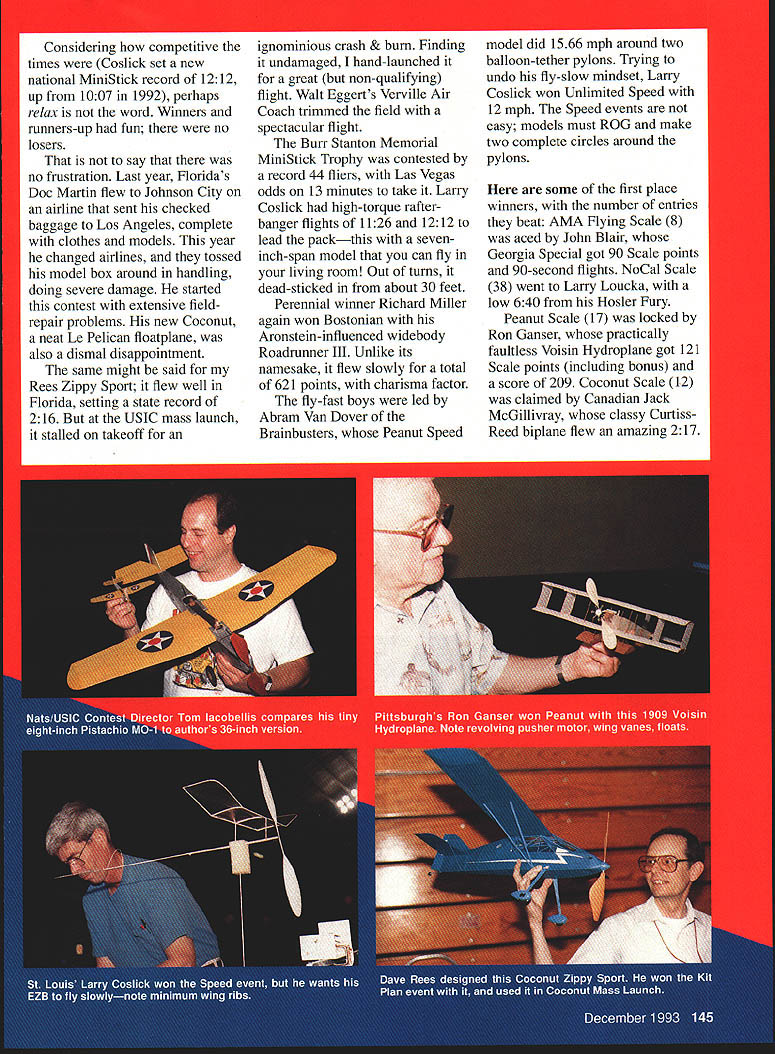
During the first week of June, the campus of East Tennessee State University (ETSU) was inundated by 135 fanatic indoor fliers—all pals in the fun sport of indoor aeromodeling. They flew in the gigantic ETSU Mini-Dome, with a football-field-size floor and a 116-foot ceiling.
This 12th annual U.S. Indoor Championships was combined with the AMA Indoor Nationals to take advantage of the terrific site. The Mini-Dome was open from 7:30 a.m. to midnight for the four contest days, but there were still some minor conflicts in air traffic control, especially on Scale day.
The architects for the ETSU fieldhouse probably never envisioned that it would be used for indoor flying, so they put in grandstand seats oriented to football and track events. Spectators at the contest could rest in comfort there, watching models climb slowly to the arched roof—and sometimes hang up in the trusses. Scores of bright helium balloons were ready to dislodge models, or steer them out of harm's way.
In addition to individual flying, there were mass launches in MiniStick, FAC Scale and Coconut Scale. I participated in the latter—one of a dozen whose models all ROGed (rise-off-ground) in a flock of giant Scale models. This was a great contrast to the MiniStick launch of 28 models, which looked like a swarm of silvery insects rising to the roof, then slowly returning.
Florida's MIAMA club conducted the Coconut event and the Pistachio Grand Prix, where tiny eight-inch-span craft flew in the basketball court at the end of the site.
The joint venture of the National Free Flight Society (NFFS) and AMA chose New York's Tom Jacobellis to organize and be Contest Director (CD) for this funfest. Contestants could choose from over 30 events, and Grand Champion Jack McGillivray from Toronto picked the right ones. He was closely chased by Ron Ganser and newcomer Larry Coslick. Former CDs Chuck Slusarczyk and Tony Italiano (who served for a decade) simply relaxed and flew.
Considering how competitive the times were (Coslick set a new national MiniStick record of 12:12, up from 10:07 in 1992), perhaps "relax" is not the word. Winners and runners-up had fun; there were no losers.
There was some frustration, however. Last year, Florida's Doc Martin flew to Johnson City on an airline that sent his checked baggage to Los Angeles, complete with clothes and models. This year he changed airlines, and they tossed his model box around in handling, doing severe damage. He started this contest with extensive field-repair problems. His new Coconut, a neat Le Pelican floatplane, was also a dismal disappointment.
The same might be said for my Rees Zippy Sport; it flew well in Florida, setting a state record of 2:16. But at the USIC mass launch, it stalled on takeoff for an ignominious crash and burn. Finding it undamaged, I hand-launched it for a great (but non-qualifying) flight. Walt Eggert's Verville Air Coach trimmed the field with a spectacular flight.
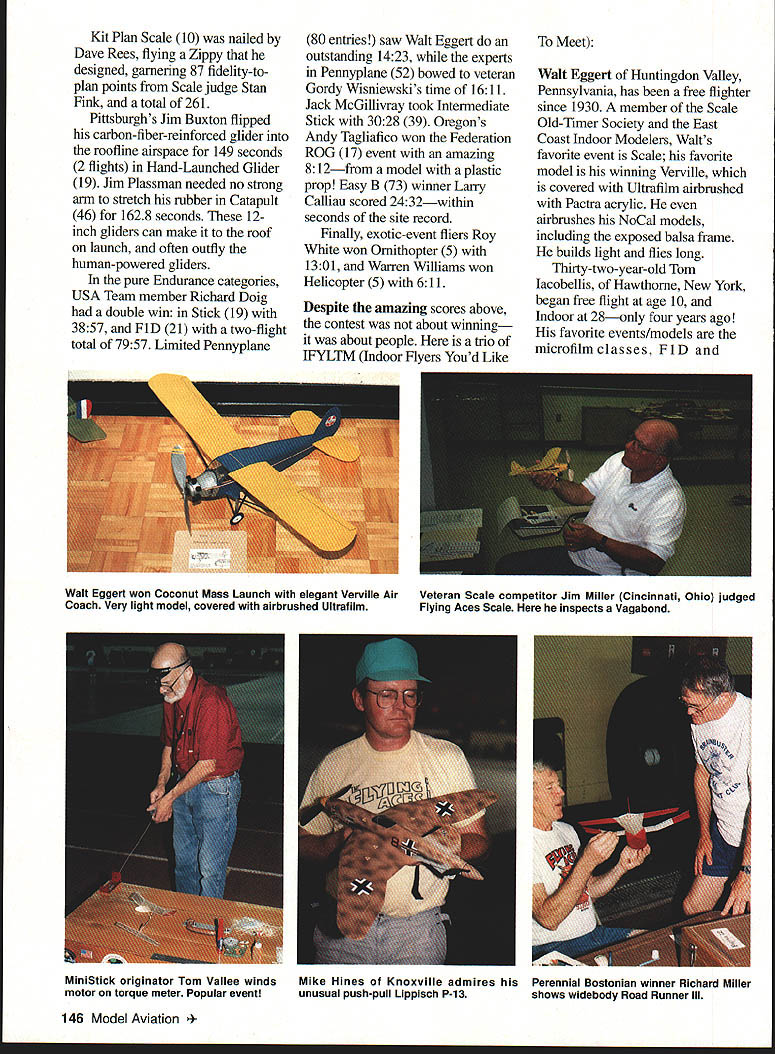
The Burt Stanton Memorial MiniStick Trophy was contested by a record 44 fliers, with Las Vegas odds on 13 minutes to take it. Larry Coslick had high-torque rafter-banger flights of 11:26 and 12:12 to lead the pack—this with a seven-inch-span model that you can fly in your living room! Out of turns, it dead-sticked in from about 30 feet.
Perennial winner Richard Miller again won Bostonian with his Aronstein-influenced widebody Roadrunner III. Unlike its namesake, it flew slowly for a total of 621 points, with charisma factor.
The fly-fast boys were led by Abram Van Dover of the Brainbusters, whose Peanut Speed model did 15.66 mph around two balloon-tether pylons. Trying to undo his fly-slow mindset, Larry Coslick won Unlimited Speed with 12 mph. The Speed events are not easy; models must ROG and make two complete circles around the pylons.
Selected First-Place Winners
- AMA Flying Scale (8 entries): John Blair — Georgia Special, 90 scale points and 90-second flights.
- NoCal Scale (38): Larry Loucka — Hosler Fury, low 6:40 flight.
- Peanut Scale (17): Ron Ganser — Voisin Hydroplane, 121 scale points (including bonus), total score 209.
- Coconut Scale (12): Jack McGillivray (Canada) — Curtiss-Reed biplane, 2:17 flight.
- Kit Plan Scale (10): Dave Rees — Zippy (his design), 87 fidelity-to-plan points, total 261.
- Hand-Launched Glider (19): Jim Buxton (Pittsburgh) — carbon-fiber-reinforced glider, 149 seconds (2 flights).
- Catapult (46): Jim Plassman — 162.8 seconds.
- Stick (19): Richard Doig (USA Team) — 38:57 (winner).
- F1D (21): Richard Doig — two-flight total 79:57.
- Limited Pennyplane (80): Walt Eggert — 14:23.
- Pennyplane, Expert (52): Gordy Wisniewski — 16:11.
- Intermediate Stick (39): Jack McGillivray — 30:28.
- Federation ROG (17): Andy Tagliafico (Oregon) — 8:12 (from a model with a plastic prop).
- Easy B (73): Larry Caillau — 24:32 (within seconds of the site record).
- Ornithopter (5): Roy White — 13:01.
- Helicopter (5): Warren Williams — 6:11.
Despite the amazing scores above, the contest was not about winning—it was about people. Here is a trio of IFYLTM (Indoor Flyers You'd Like To Meet):
To Meet
- Walt Eggert (Huntingdon Valley, Pennsylvania) — A free flighter since 1930, member of the Scale Old-Timers Society and the East Coast Indoor Modelers. Walt's favorite event is Scale; his winning Verville is covered with Ultrafilm airbrushed with Pactra acrylic. He even airbrushes his NoCal models, including exposed balsa frames. He builds light and flies long.
- Tom Jacobellis (Hawthorne, New York), age 32 — Began free flight at age 10 and indoor at 28. His favorite events/models are the microfilm classes, F1D and Intermediate Stick. He enjoyed flying his Pistachio Martin MO-1 (from Model Aviation plans) in the Gran Prix. Tom served as the contest organizer and Contest Director.
- Kris Forward (Asheville, North Carolina), age 13 — Attended his third USIC. He began indoor flying with Limited Pennyplane after a dose of Delta Darts. He started flying at age seven with RC and now flies Phil Hartman's Square Eagle P-30 outdoors. His favorite event is Peanut Scale; his favorite model is Dave Rees' ducted-fan A-10 Warthog.
A number of vendors were present, supplying the tools and materials that this exotic sport demands. Seen on the sidelines were:
- Ed Seay of MAL Texas, with bundles of balsa.
- Tony Italiano, hawking NFFS videos and T-shirts.
- Jim Jones, with prop forms and torque meters.
- Dick Obarski, dispensing incredibly light Polymicro film.
- Stan Fink, pushing Domeduster News.
Johnson City showed a grand brand of Southern hospitality to the record number of entries. We only wish that Don Lindley and Paul Shailor, who died tragically only weeks before the meet, could have been there with their old pals. This report is respectfully dedicated to them, and to the NFFS/AMA/ETSU trio of sponsors.
Transcribed from original scans by AI. Minor OCR errors may remain.

