
1993 USOC/FF NATS
Jim Haught
AMA's National Flying Site was the venue for a combined 1993 Free Flight Nationals / United States Outdoor Championships. Problems with the original Nats site in Lubbock, Texas, forced the combination of the two contests into a massive five-day free flight gathering. (The Lubbock problems have since been resolved, and a "unified" Nats was planned there for the following July.)
Rather than give a blow-by-blow account of the action (virtually impossible with an event of this scope), this report focuses on a few highlights, noted trends, and other observations.
Overview
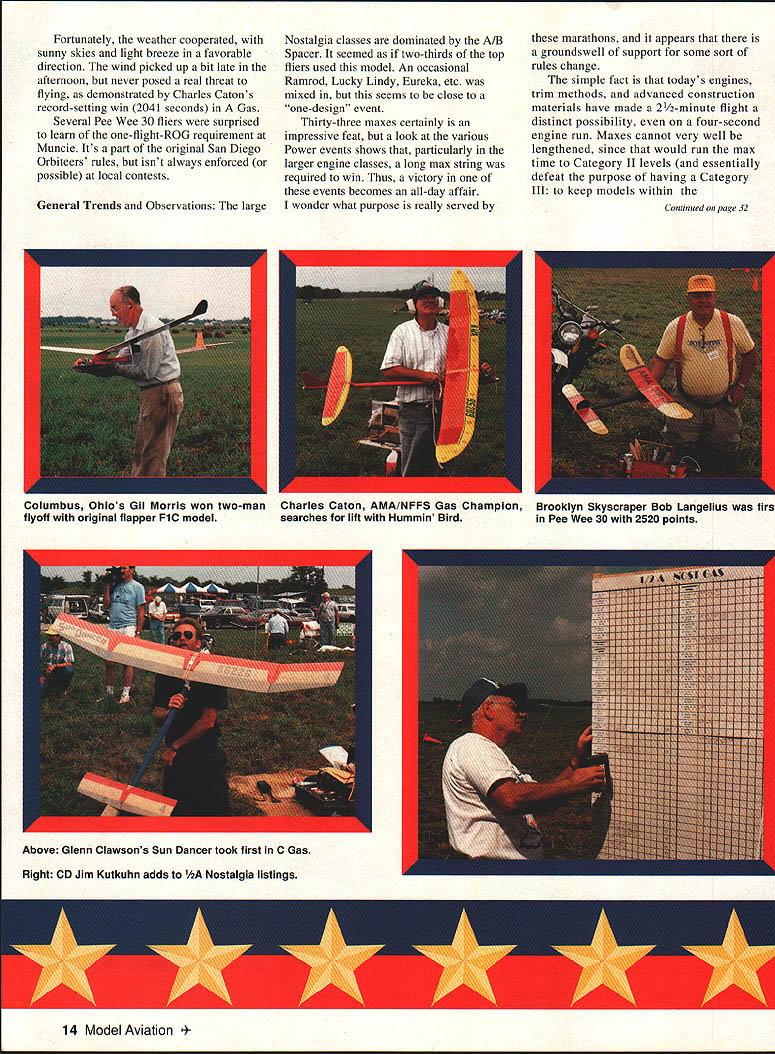
Contest Director Jim Kutkuhn had his hands full orchestrating 25 AMA and 11 NFFS events. Add the Society of Antique Modelers (SAM) events and a dose of Flying Aces Club (FAC) scale events held as separate contests downwind, and there was more than enough activity for everyone. The caliber of competition was evident from the contest's start — it took more than 1,000 seconds (Category III rules) to place in the top 10 in B Gas. Familiar names such as Gil Morris (second place) and Charles Caton (fifth) were prominent throughout the results.
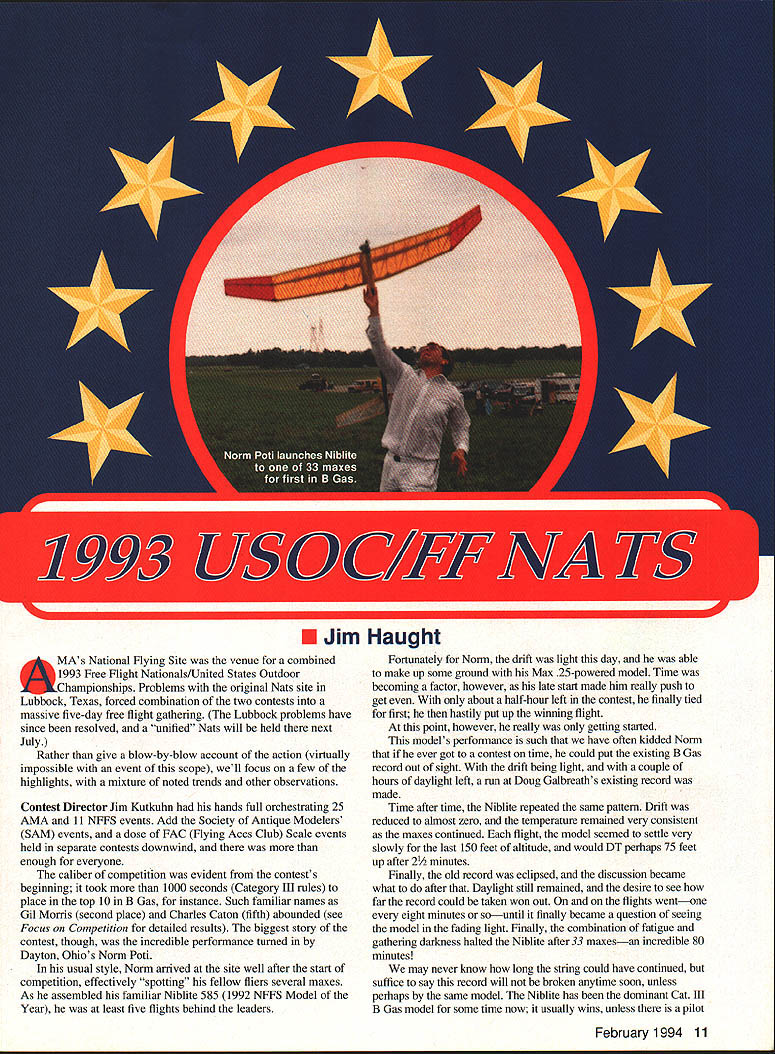
The biggest story of the contest was the incredible performance turned in by Dayton, Ohio's Norm Poti. In his usual style, Norm arrived at the site well after the start of competition, effectively "spotting" his fellow fliers several maxes. As he assembled his familiar Niblite 585 — the 1992 NFFS Model of the Year — he was at least five flights behind the leaders. Fortunately, drift was light that day and he was able to make up some ground with his Max .25-powered model.
Time was becoming a factor; the late start made him push. With about a half-hour left in the contest he finally tied for first and then hastily put up the winning flight. At that point he was only getting started. The Niblite's performance has long prompted jokes that if Norm ever got to a contest on time, he could put the existing B Gas record out of sight. With light drift and a couple of hours of daylight left, he made a run at Doug Galbreath's record.
Time after time the Niblite repeated the same pattern: drift reduced to almost zero, temperature remained very consistent, and maxes continued. The model seemed to settle very slowly; in the last 150 feet of altitude it would DT perhaps 75 feet up after two minutes. Finally the old record was eclipsed and the question became how far the record could be taken. Flights continued — roughly one every eight minutes — until it became a matter of seeing the model in the fading light. Fatigue and darkness finally halted the Niblite after 33 maxes — an incredible 80 minutes. We may never know how long the string could have continued, but suffice to say this record will not be broken anytime soon, unless perhaps by the same model. The Niblite has been the dominant Cat. III B Gas model for some time; it usually wins unless there is pilot error or a late start.
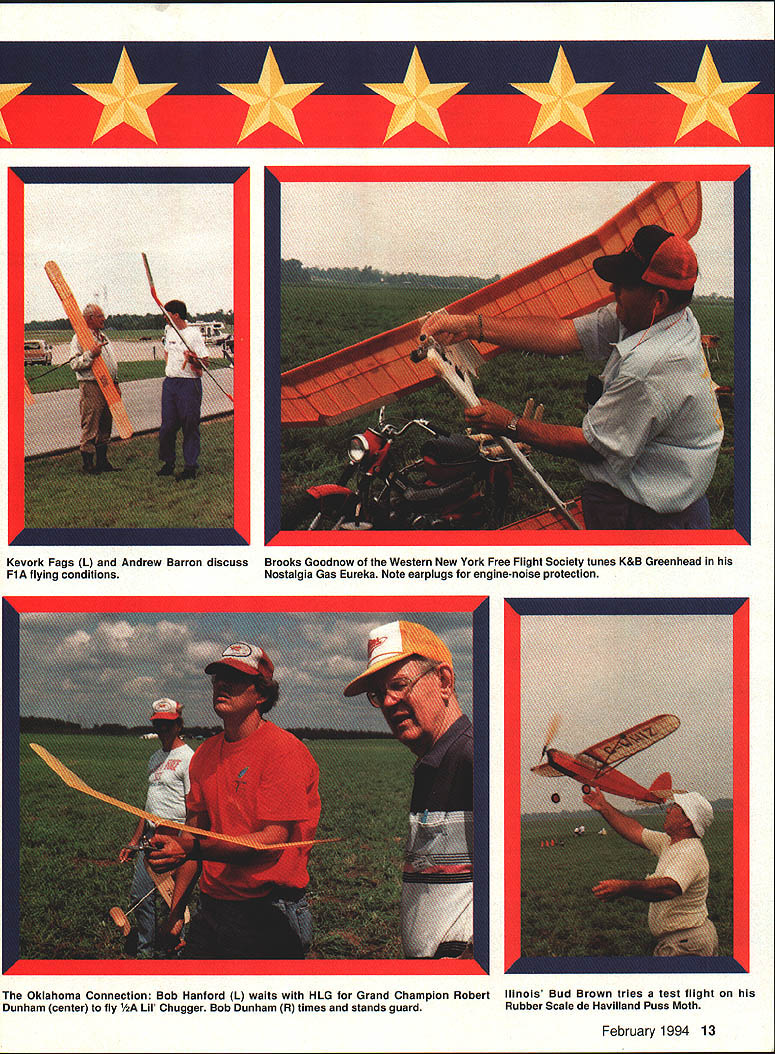
It was somewhat surprising there was no flyoff in F1A. F1A was won by former team member Chuck Markos by a bit more than a minute over Andrew Barron. Overcast skies and moderate temperatures made thermals spotty at towline height.
After some years' absence, the old Tulsa Glue Dobbers Towline trophy was relocated and brought to Muncie by club member Bob Dunham. Chuck's name will be inscribed on the trophy, which will reside in Muncie along with its sister trophy for first place in HLG.
Another record performance from Day One was William Reitdorf's 1,440 in Electric B, which easily surpassed Don Hughes' 596. Bob Bienenstein's Bandit (MA, November 1993) made it two wins in a row, and Bob Hatschek's BABU again finished second.
Weather and Controversies
Unsettled weather conditions played havoc over the next two days and resulted in some unusual and controversial situations:
- On-again, off-again rain and wind led to postponement of the F1C flyoff between Norm Poti and Gil Morris. By mutual agreement they waited out the weather to avoid unnecessary risk to their models.
- Wind and rain on Friday afternoon prompted CD Jim Kutkuhn to make the unusual decision to suspend (not cancel) flying in mid-afternoon. Flying resumed for Friday's events on Saturday morning, which upset several fliers whose strategies were based on Friday's conditions.
- Ironically, a couple of hours after the suspension, conditions improved enough that the F1C flyoff was held in near-calm conditions. Gil Morris' flapper easily defeated Norm Poti's conventional model, with a full-length flight to settle the issue. The very light drift kept the models well within the perimeter of the field.
- Saturday morning dawned bright and sunny, and several Friday events' results changed as fliers hastily ran max strings in the improved conditions. Glenn Clawson benefited from the early-morning weather to take C Gas, edging Texas' Marvin Mace.
- There was also a serious off-field incident: a couple of thoughtless fliers rode their bikes through a downwind neighbor's garden, owned by an elderly woman, leaving her in tears. AMA Public Relations, led by Jay Mealy, helped defuse the situation. A collection was taken up by other fliers to pay for the damage, but the damage had already been done.
This type of behavior has no place in free flight. The mentality of someone who thinks his model is more important than someone's livelihood (crops, gardens, etc.) threatens flying fields and must be firmly discouraged.
Saturday evening featured the NFFS Symposium and banquet. NFFS Hall of Fame awards were presented to Harry Murphy and Hardy Broderson; rubber flier Jim O'Reilly gave an informative talk on his Symposium paper; Bruce Kimball presented the Ten Models of the Year; and various NFFS officers addressed the current state of the organization and free flight in general.
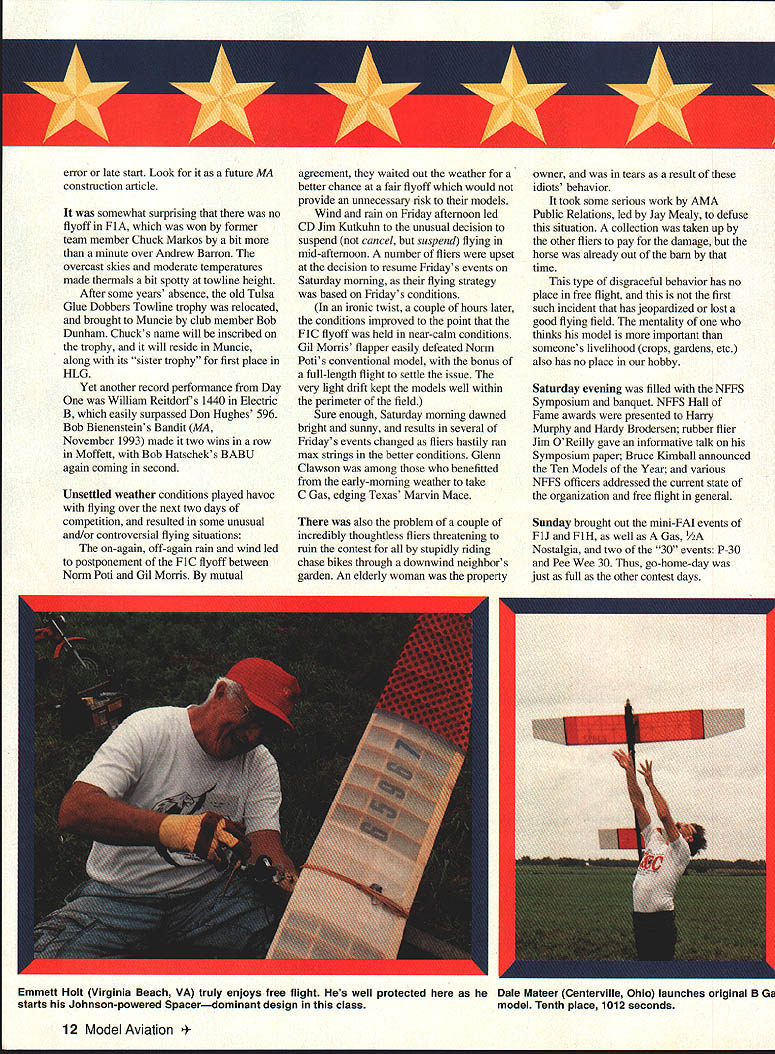
Sunday brought out the mini-FAI events of F1J and F1H, as well as A Gas, 1/2A Nostalgia, and two of the "30" events: P-30 and Pee Wee 30. Go-home day was just as full as the other contest days. Several Pee Wee 30 fliers were surprised to learn of the one-flight ROG requirement at Muncie — part of the original San Diego Orbiteers rules that isn't always enforced at local contests.
General Trends and Observations
- Large Nostalgia classes are dominated by the A/B Spacer — roughly two-thirds of the top fliers used this model. Occasional Ramrod, Lucky Lindy, Eureka, etc., appear, but Nostalgia seems close to a "one-design" event.
- Thirty-three maxes is an impressive feat, but in the larger engine classes a long max string is increasingly required to win. A victory in one of these events can become an all-day affair.
- There is a groundswell of support for rules changes to address marathon flyoffs. Today's engines, trim methods, and advanced materials make 2-1/2-minute flights possible even on very short engine runs. Max times cannot reasonably be lengthened because that would push Category III flights toward Category II levels and defeat the purpose of keeping models within the field's boundaries.
- The only realistic alternatives discussed are:
- Further reduction in engine run for flyoffs — three seconds was a popular choice among fliers.
- Eliminating the initial three flights and starting with flyoff rounds — this may reduce total flights but doesn't fully address the performance issue.
- New-generation engines are coming to the forefront in F1J. While AD .06s were not abundant, several Stels and Shurikens were used. These engines allow larger models to be flown (for example Bill Lynch's Hurry Up/Pegasus series). Expect broader adoption of the new engines in F1J and AMA 1/2A.
- Charles Caton (Alabama) continues to stand out for his remarkably consistent flying. His bunt pattern for AMA Power models — whether 1/2A or Class D — is always vertical and perfectly timed, with no stalls or over-burnt situations. There are no secrets to his method; he freely explains his setups and trim methods to others. He earns every one of his many victories and records.
Next Year
The 1994 USOC was expected to be a stand-alone contest, with the Nationals on their own in Texas in July. Preliminary planning discussed a possible late-June date at the Muncie site, possibly with fewer events to ease retrieval and enable a long-weekend contest format. More information was to follow as planning progressed.
Acknowledgments
Special thanks to Jim Kutkuhn and assistants Dave Thomason, Ed Sullivan, Dan Kane, Bob Waterman, Bob Marsh, and all who gave their flying time to organize and run the contests. Public recognition is also due the AMA site maintenance personnel, led by Greg Chartrand, who prepared the site very well — including an additional mowing of the primary launch/retrieval area, which made setup and retrieval much easier.
The Muncie site has come a long way during the past year, and with additional planned improvements should be able to hold USOC-type events for years to come. See you next season! JH
Transcribed from original scans by AI. Minor OCR errors may remain.

